 Add to Chrome
 Add to Firefox
 Add to Edge
Spectral-Aware Analytic Class-Incremental Learning for Long-Tailed Distributions
Jul 24, 2026
Analytic Continual Learning (ACL) offers a computationally efficient alternative to gradient-based approaches. Recent ACL methods are based on Recursive Least Squares (RLS) and have achieved the state-of-the-art results compared to other alternatives. However, they falter significantly in Class-Incremental Learning scenarios characterized by Long-Tailed distributions. While the ill-conditioning of the autocorrelation (Gram) matrix is a known limitation of RLS, we demonstrate that class imbalance exacerbates this issue into a distinct spectral pathology: "tail" classes suffer from severe spectral collapse, rendering their subspaces numerically indistinguishable from noise. Standard Ridge Regression ($L_2$) fails to address this effectively as it applies isotropic regularization - a uniform penalty that is insufficient to stabilize the tail without over-shrinking the head. To address this, we propose Geometry-Spectral Rectification (GSR), a theoretically grounded framework that treats long-tailed learning as a spectral regularization problem. Unlike standard isotropic regularization (Ridge) which uniformly penalizes all eigenvalues, GSR acts as an anisotropic spectral filter, selectively inflating the collapsed eigenvalues of tail classes. We construct a structured, data-dependent spectral perturbation matrix $Δ$ that selectively inflates collapsed tail eigen-directions of the Gram matrix. Theoretical analysis proves that GSR guarantees an improved stable rank for the Gram matrix, ensuring numerical stability. Extensive experiments show that GSR establishes a new state-of-the-art for analytic CIL, offering a superior trade-off between computational efficiency and robust generalization in long-tailed settings.

Cross-Space Distillation: Teaching One-Step Students with Modern Diffusion Teachers
Jun 30, 2026Modern one-step diffusion models achieve impressive quality through distribution-based timestep distillation. Yet, they rely on a critical assumption: Teacher and Student must inhabit the same latent space. This Shared-Space constraint prevents knowledge transfer from modern high-capacity Teachers (e.g., SD 3.5 and Flux) into compact, deployment-friendly Students such as SD 1.5, whose latent resolution and VAE parameterization differ from the Teacher. We formalize this overlooked regime as Cross-Space Distillation, where Teacher and Student differ in both latent resolution and VAE space. To enable distillation under this mismatch, we introduce the Bridge, a lightweight latent interface that maps Student latents into the Teacher space without modifying the Student backbone. Bridge combines a frozen Student VAE decoder as a spatial prior with a compact learnable projector, and is trained with latent reconstruction and attention fidelity objectives for stable Teacher-space alignment. Across diverse modern Teachers, Bridge enables substantial gains for compact one-step Students; for example, it improves SD 1.5 from 5.4 to 9.4 HPSv3 while preserving one-step inference, low latency, and broad ecosystem compatibility. These results show that heterogeneous large Teachers can be distilled into efficient, deployable backbones through a lightweight latent-space interface.
MPDiT: Multi-Patch Global-to-Local Transformer Architecture For Efficient Flow Matching and Diffusion Model
Mar 27, 2026Transformer architectures, particularly Diffusion Transformers (DiTs), have become widely used in diffusion and flow-matching models due to their strong performance compared to convolutional UNets. However, the isotropic design of DiTs processes the same number of patchified tokens in every block, leading to relatively heavy computation during training process. In this work, we introduce a multi-patch transformer design in which early blocks operate on larger patches to capture coarse global context, while later blocks use smaller patches to refine local details. This hierarchical design could reduces computational cost by up to 50\% in GFLOPs while achieving good generative performance. In addition, we also propose improved designs for time and class embeddings that accelerate training convergence. Extensive experiments on the ImageNet dataset demonstrate the effectiveness of our architectural choices. Code is released at \url{https://github.com/quandao10/MPDiT}
AutoEdit: Automatic Hyperparameter Tuning for Image Editing
Sep 18, 2025Recent advances in diffusion models have revolutionized text-guided image editing, yet existing editing methods face critical challenges in hyperparameter identification. To get the reasonable editing performance, these methods often require the user to brute-force tune multiple interdependent hyperparameters, such as inversion timesteps and attention modification, \textit{etc.} This process incurs high computational costs due to the huge hyperparameter search space. We consider searching optimal editing's hyperparameters as a sequential decision-making task within the diffusion denoising process. Specifically, we propose a reinforcement learning framework, which establishes a Markov Decision Process that dynamically adjusts hyperparameters across denoising steps, integrating editing objectives into a reward function. The method achieves time efficiency through proximal policy optimization while maintaining optimal hyperparameter configurations. Experiments demonstrate significant reduction in search time and computational overhead compared to existing brute-force approaches, advancing the practical deployment of a diffusion-based image editing framework in the real world.
Improved Training Technique for Latent Consistency Models
Feb 03, 2025


Consistency models are a new family of generative models capable of producing high-quality samples in either a single step or multiple steps. Recently, consistency models have demonstrated impressive performance, achieving results on par with diffusion models in the pixel space. However, the success of scaling consistency training to large-scale datasets, particularly for text-to-image and video generation tasks, is determined by performance in the latent space. In this work, we analyze the statistical differences between pixel and latent spaces, discovering that latent data often contains highly impulsive outliers, which significantly degrade the performance of iCT in the latent space. To address this, we replace Pseudo-Huber losses with Cauchy losses, effectively mitigating the impact of outliers. Additionally, we introduce a diffusion loss at early timesteps and employ optimal transport (OT) coupling to further enhance performance. Lastly, we introduce the adaptive scaling-$c$ scheduler to manage the robust training process and adopt Non-scaling LayerNorm in the architecture to better capture the statistics of the features and reduce outlier impact. With these strategies, we successfully train latent consistency models capable of high-quality sampling with one or two steps, significantly narrowing the performance gap between latent consistency and diffusion models. The implementation is released here: https://github.com/quandao10/sLCT/
Self-Corrected Flow Distillation for Consistent One-Step and Few-Step Text-to-Image Generation
Dec 22, 2024


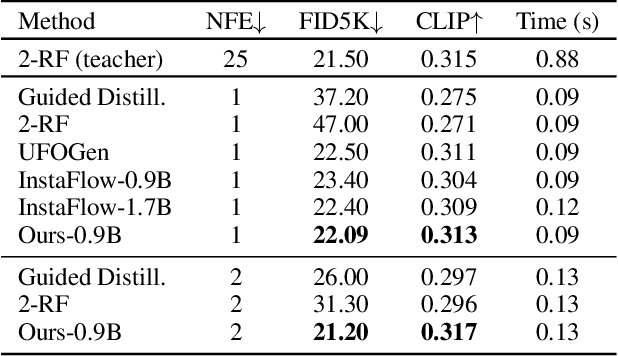
Flow matching has emerged as a promising framework for training generative models, demonstrating impressive empirical performance while offering relative ease of training compared to diffusion-based models. However, this method still requires numerous function evaluations in the sampling process. To address these limitations, we introduce a self-corrected flow distillation method that effectively integrates consistency models and adversarial training within the flow-matching framework. This work is a pioneer in achieving consistent generation quality in both few-step and one-step sampling. Our extensive experiments validate the effectiveness of our method, yielding superior results both quantitatively and qualitatively on CelebA-HQ and zero-shot benchmarks on the COCO dataset. Our implementation is released at https://github.com/VinAIResearch/SCFlow
DiMSUM: Diffusion Mamba -- A Scalable and Unified Spatial-Frequency Method for Image Generation
Nov 06, 2024

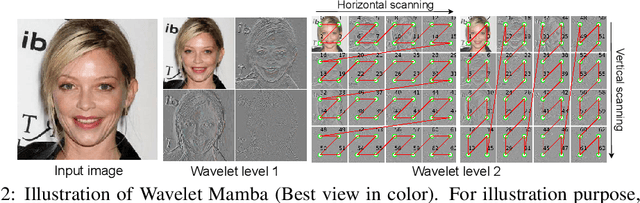

We introduce a novel state-space architecture for diffusion models, effectively harnessing spatial and frequency information to enhance the inductive bias towards local features in input images for image generation tasks. While state-space networks, including Mamba, a revolutionary advancement in recurrent neural networks, typically scan input sequences from left to right, they face difficulties in designing effective scanning strategies, especially in the processing of image data. Our method demonstrates that integrating wavelet transformation into Mamba enhances the local structure awareness of visual inputs and better captures long-range relations of frequencies by disentangling them into wavelet subbands, representing both low- and high-frequency components. These wavelet-based outputs are then processed and seamlessly fused with the original Mamba outputs through a cross-attention fusion layer, combining both spatial and frequency information to optimize the order awareness of state-space models which is essential for the details and overall quality of image generation. Besides, we introduce a globally-shared transformer to supercharge the performance of Mamba, harnessing its exceptional power to capture global relationships. Through extensive experiments on standard benchmarks, our method demonstrates superior results compared to DiT and DIFFUSSM, achieving faster training convergence and delivering high-quality outputs. The codes and pretrained models are released at https://github.com/VinAIResearch/DiMSUM.git.
DICE: Discrete Inversion Enabling Controllable Editing for Multinomial Diffusion and Masked Generative Models
Oct 10, 2024Discrete diffusion models have achieved success in tasks like image generation and masked language modeling but face limitations in controlled content editing. We introduce DICE (Discrete Inversion for Controllable Editing), the first approach to enable precise inversion for discrete diffusion models, including multinomial diffusion and masked generative models. By recording noise sequences and masking patterns during the reverse diffusion process, DICE enables accurate reconstruction and flexible editing of discrete data without the need for predefined masks or attention manipulation. We demonstrate the effectiveness of DICE across both image and text domains, evaluating it on models such as VQ-Diffusion, Paella, and RoBERTa. Our results show that DICE preserves high data fidelity while enhancing editing capabilities, offering new opportunities for fine-grained content manipulation in discrete spaces. For project webpage, see https://hexiaoxiao-cs.github.io/DICE/.
Robust Diffusion GAN using Semi-Unbalanced Optimal Transport
Nov 28, 2023Diffusion models, a type of generative model, have demonstrated great potential for synthesizing highly detailed images. By integrating with GAN, advanced diffusion models like DDGAN \citep{xiao2022DDGAN} could approach real-time performance for expansive practical applications. While DDGAN has effectively addressed the challenges of generative modeling, namely producing high-quality samples, covering different data modes, and achieving faster sampling, it remains susceptible to performance drops caused by datasets that are corrupted with outlier samples. This work introduces a robust training technique based on semi-unbalanced optimal transport to mitigate the impact of outliers effectively. Through comprehensive evaluations, we demonstrate that our robust diffusion GAN (RDGAN) outperforms vanilla DDGAN in terms of the aforementioned generative modeling criteria, i.e., image quality, mode coverage of distribution, and inference speed, and exhibits improved robustness when dealing with both clean and corrupted datasets.
Flow Matching in Latent Space
Jul 17, 2023Flow matching is a recent framework to train generative models that exhibits impressive empirical performance while being relatively easier to train compared with diffusion-based models. Despite its advantageous properties, prior methods still face the challenges of expensive computing and a large number of function evaluations of off-the-shelf solvers in the pixel space. Furthermore, although latent-based generative methods have shown great success in recent years, this particular model type remains underexplored in this area. In this work, we propose to apply flow matching in the latent spaces of pretrained autoencoders, which offers improved computational efficiency and scalability for high-resolution image synthesis. This enables flow-matching training on constrained computational resources while maintaining their quality and flexibility. Additionally, our work stands as a pioneering contribution in the integration of various conditions into flow matching for conditional generation tasks, including label-conditioned image generation, image inpainting, and semantic-to-image generation. Through extensive experiments, our approach demonstrates its effectiveness in both quantitative and qualitative results on various datasets, such as CelebA-HQ, FFHQ, LSUN Church & Bedroom, and ImageNet. We also provide a theoretical control of the Wasserstein-2 distance between the reconstructed latent flow distribution and true data distribution, showing it is upper-bounded by the latent flow matching objective. Our code will be available at https://github.com/VinAIResearch/LFM.git.