 Add to Chrome
 Add to Firefox
 Add to Edge
Gemini 1.5: Unlocking multimodal understanding across millions of tokens of context
Mar 08, 2024
In this report, we present the latest model of the Gemini family, Gemini 1.5 Pro, a highly compute-efficient multimodal mixture-of-experts model capable of recalling and reasoning over fine-grained information from millions of tokens of context, including multiple long documents and hours of video and audio. Gemini 1.5 Pro achieves near-perfect recall on long-context retrieval tasks across modalities, improves the state-of-the-art in long-document QA, long-video QA and long-context ASR, and matches or surpasses Gemini 1.0 Ultra's state-of-the-art performance across a broad set of benchmarks. Studying the limits of Gemini 1.5 Pro's long-context ability, we find continued improvement in next-token prediction and near-perfect retrieval (>99%) up to at least 10M tokens, a generational leap over existing models such as Claude 2.1 (200k) and GPT-4 Turbo (128k). Finally, we highlight surprising new capabilities of large language models at the frontier; when given a grammar manual for Kalamang, a language with fewer than 200 speakers worldwide, the model learns to translate English to Kalamang at a similar level to a person who learned from the same content.

COMMIT: Certifying Robustness of Multi-Sensor Fusion Systems against Semantic Attacks
Mar 04, 2024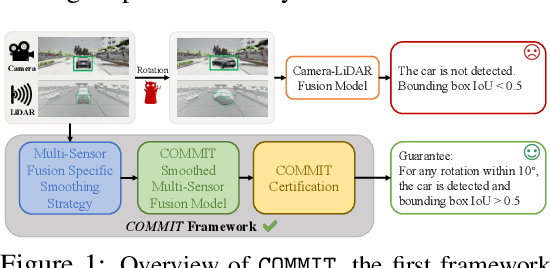
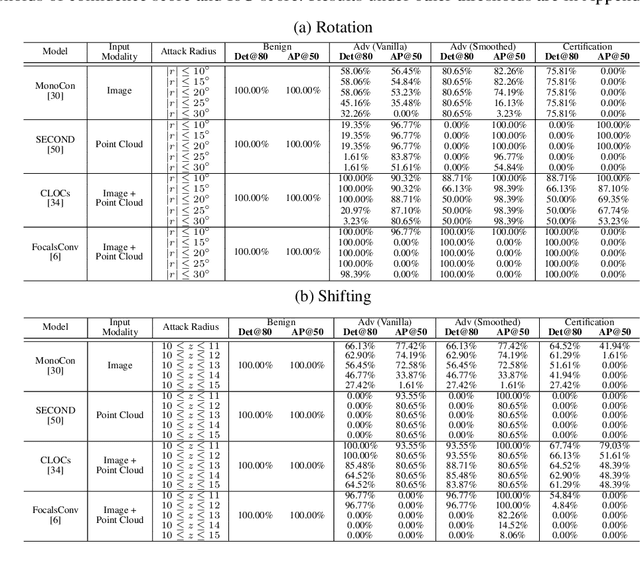
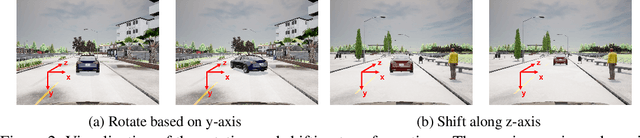
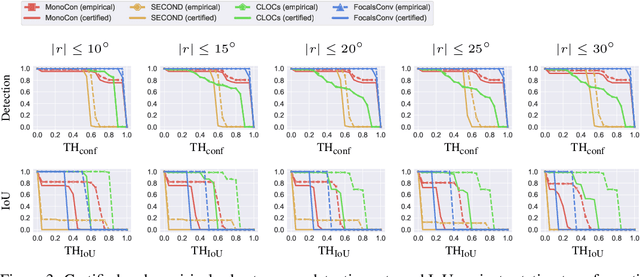
Multi-sensor fusion systems (MSFs) play a vital role as the perception module in modern autonomous vehicles (AVs). Therefore, ensuring their robustness against common and realistic adversarial semantic transformations, such as rotation and shifting in the physical world, is crucial for the safety of AVs. While empirical evidence suggests that MSFs exhibit improved robustness compared to single-modal models, they are still vulnerable to adversarial semantic transformations. Despite the proposal of empirical defenses, several works show that these defenses can be attacked again by new adaptive attacks. So far, there is no certified defense proposed for MSFs. In this work, we propose the first robustness certification framework COMMIT certify robustness of multi-sensor fusion systems against semantic attacks. In particular, we propose a practical anisotropic noise mechanism that leverages randomized smoothing with multi-modal data and performs a grid-based splitting method to characterize complex semantic transformations. We also propose efficient algorithms to compute the certification in terms of object detection accuracy and IoU for large-scale MSF models. Empirically, we evaluate the efficacy of COMMIT in different settings and provide a comprehensive benchmark of certified robustness for different MSF models using the CARLA simulation platform. We show that the certification for MSF models is at most 48.39% higher than that of single-modal models, which validates the advantages of MSF models. We believe our certification framework and benchmark will contribute an important step towards certifiably robust AVs in practice.
KeNet:Knowledge-enhanced Doc-Label Attention Network for Multi-label text classification
Mar 04, 2024Multi-Label Text Classification (MLTC) is a fundamental task in the field of Natural Language Processing (NLP) that involves the assignment of multiple labels to a given text. MLTC has gained significant importance and has been widely applied in various domains such as topic recognition, recommendation systems, sentiment analysis, and information retrieval. However, traditional machine learning and Deep neural network have not yet addressed certain issues, such as the fact that some documents are brief but have a large number of labels and how to establish relationships between the labels. It is imperative to additionally acknowledge that the significance of knowledge is substantiated in the realm of MLTC. To address this issue, we provide a novel approach known as Knowledge-enhanced Doc-Label Attention Network (KeNet). Specifically, we design an Attention Network that incorporates external knowledge, label embedding, and a comprehensive attention mechanism. In contrast to conventional methods, we use comprehensive representation of documents, knowledge and labels to predict all labels for each single text. Our approach has been validated by comprehensive research conducted on three multi-label datasets. Experimental results demonstrate that our method outperforms state-of-the-art MLTC method. Additionally, a case study is undertaken to illustrate the practical implementation of KeNet.
Improving Adversarial Energy-Based Model via Diffusion Process
Mar 04, 2024Generative models have shown strong generation ability while efficient likelihood estimation is less explored. Energy-based models~(EBMs) define a flexible energy function to parameterize unnormalized densities efficiently but are notorious for being difficult to train. Adversarial EBMs introduce a generator to form a minimax training game to avoid expensive MCMC sampling used in traditional EBMs, but a noticeable gap between adversarial EBMs and other strong generative models still exists. Inspired by diffusion-based models, we embedded EBMs into each denoising step to split a long-generated process into several smaller steps. Besides, we employ a symmetric Jeffrey divergence and introduce a variational posterior distribution for the generator's training to address the main challenges that exist in adversarial EBMs. Our experiments show significant improvement in generation compared to existing adversarial EBMs, while also providing a useful energy function for efficient density estimation.
Differentially Private Synthetic Data via Foundation Model APIs 2: Text
Mar 04, 2024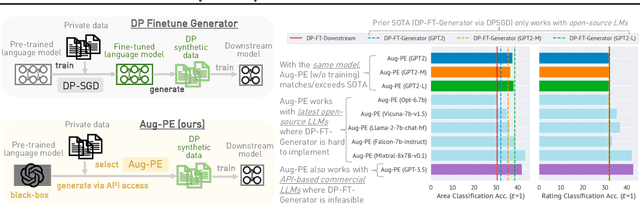

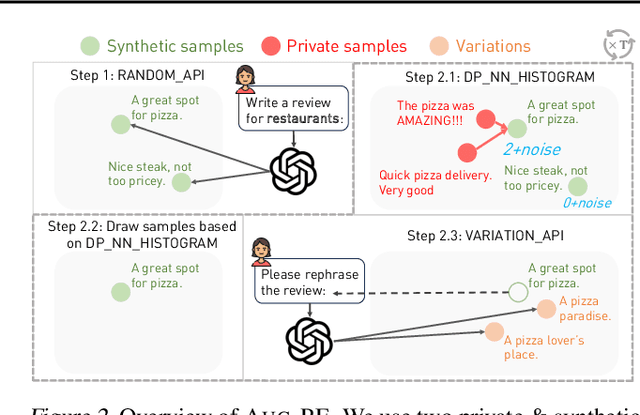
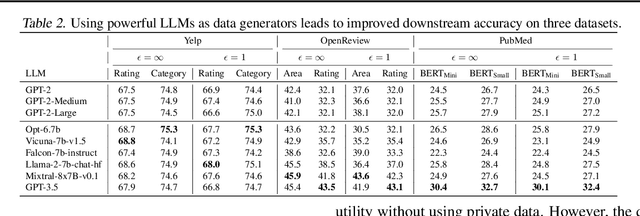
Text data has become extremely valuable due to the emergence of machine learning algorithms that learn from it. A lot of high-quality text data generated in the real world is private and therefore cannot be shared or used freely due to privacy concerns. Generating synthetic replicas of private text data with a formal privacy guarantee, i.e., differential privacy (DP), offers a promising and scalable solution. However, existing methods necessitate DP finetuning of large language models (LLMs) on private data to generate DP synthetic data. This approach is not viable for proprietary LLMs (e.g., GPT-3.5) and also demands considerable computational resources for open-source LLMs. Lin et al. (2024) recently introduced the Private Evolution (PE) algorithm to generate DP synthetic images with only API access to diffusion models. In this work, we propose an augmented PE algorithm, named Aug-PE, that applies to the complex setting of text. We use API access to an LLM and generate DP synthetic text without any model training. We conduct comprehensive experiments on three benchmark datasets. Our results demonstrate that Aug-PE produces DP synthetic text that yields competitive utility with the SOTA DP finetuning baselines. This underscores the feasibility of relying solely on API access of LLMs to produce high-quality DP synthetic texts, thereby facilitating more accessible routes to privacy-preserving LLM applications. Our code and data are available at https://github.com/AI-secure/aug-pe.
Perceptive self-supervised learning network for noisy image watermark removal
Mar 04, 2024Popular methods usually use a degradation model in a supervised way to learn a watermark removal model. However, it is true that reference images are difficult to obtain in the real world, as well as collected images by cameras suffer from noise. To overcome these drawbacks, we propose a perceptive self-supervised learning network for noisy image watermark removal (PSLNet) in this paper. PSLNet depends on a parallel network to remove noise and watermarks. The upper network uses task decomposition ideas to remove noise and watermarks in sequence. The lower network utilizes the degradation model idea to simultaneously remove noise and watermarks. Specifically, mentioned paired watermark images are obtained in a self supervised way, and paired noisy images (i.e., noisy and reference images) are obtained in a supervised way. To enhance the clarity of obtained images, interacting two sub-networks and fusing obtained clean images are used to improve the effects of image watermark removal in terms of structural information and pixel enhancement. Taking into texture information account, a mixed loss uses obtained images and features to achieve a robust model of noisy image watermark removal. Comprehensive experiments show that our proposed method is very effective in comparison with popular convolutional neural networks (CNNs) for noisy image watermark removal. Codes can be obtained at https://github.com/hellloxiaotian/PSLNet.
ROME: Memorization Insights from Text, Probability and Hidden State in Large Language Models
Mar 04, 2024Probing the memorization of large language models holds significant importance. Previous works have established metrics for quantifying memorization, explored various influencing factors, such as data duplication, model size, and prompt length, and evaluated memorization by comparing model outputs with training corpora. However, the training corpora are of enormous scale and its pre-processing is time-consuming. To explore memorization without accessing training data, we propose a novel approach, named ROME, wherein memorization is explored by comparing disparities across memorized and non-memorized. Specifically, models firstly categorize the selected samples into memorized and non-memorized groups, and then comparing the demonstrations in the two groups from the insights of text, probability, and hidden state. Experimental findings show the disparities in factors including word length, part-of-speech, word frequency, mean and variance, just to name a few.
Boosting Box-supervised Instance Segmentation with Pseudo Depth
Mar 02, 2024The realm of Weakly Supervised Instance Segmentation (WSIS) under box supervision has garnered substantial attention, showcasing remarkable advancements in recent years. However, the limitations of box supervision become apparent in its inability to furnish effective information for distinguishing foreground from background within the specified target box. This research addresses this challenge by introducing pseudo-depth maps into the training process of the instance segmentation network, thereby boosting its performance by capturing depth differences between instances. These pseudo-depth maps are generated using a readily available depth predictor and are not necessary during the inference stage. To enable the network to discern depth features when predicting masks, we integrate a depth prediction layer into the mask prediction head. This innovative approach empowers the network to simultaneously predict masks and depth, enhancing its ability to capture nuanced depth-related information during the instance segmentation process. We further utilize the mask generated in the training process as supervision to distinguish the foreground from the background. When selecting the best mask for each box through the Hungarian algorithm, we use depth consistency as one calculation cost item. The proposed method achieves significant improvements on Cityscapes and COCO dataset.
Tree-Regularized Tabular Embeddings
Mar 01, 2024Tabular neural network (NN) has attracted remarkable attentions and its recent advances have gradually narrowed the performance gap with respect to tree-based models on many public datasets. While the mainstreams focus on calibrating NN to fit tabular data, we emphasize the importance of homogeneous embeddings and alternately concentrate on regularizing tabular inputs through supervised pretraining. Specifically, we extend a recent work (DeepTLF) and utilize the structure of pretrained tree ensembles to transform raw variables into a single vector (T2V), or an array of tokens (T2T). Without loss of space efficiency, these binarized embeddings can be consumed by canonical tabular NN with fully-connected or attention-based building blocks. Through quantitative experiments on 88 OpenML datasets with binary classification task, we validated that the proposed tree-regularized representation not only tapers the difference with respect to tree-based models, but also achieves on-par and better performance when compared with advanced NN models. Most importantly, it possesses better robustness and can be easily scaled and generalized as standalone encoder for tabular modality. Codes: https://github.com/milanlx/tree-regularized-embedding.
HALC: Object Hallucination Reduction via Adaptive Focal-Contrast Decoding
Mar 01, 2024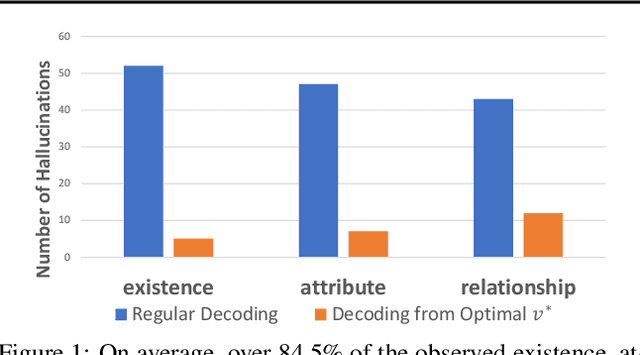

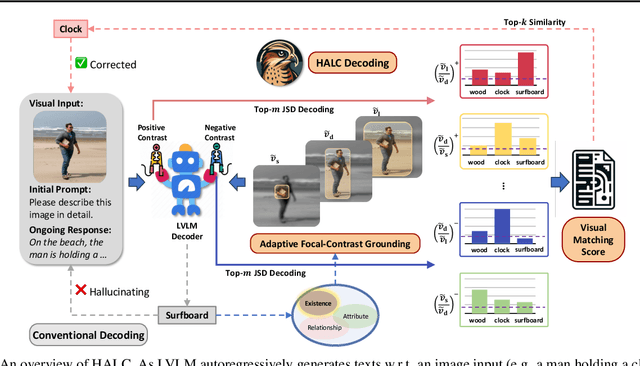

While large vision-language models (LVLMs) have demonstrated impressive capabilities in interpreting multi-modal contexts, they invariably suffer from object hallucinations (OH). We introduce HALC, a novel decoding algorithm designed to mitigate OH in LVLMs. HALC leverages distinct fine-grained optimal visual information in vision-language tasks and operates on both local and global contexts simultaneously. Specifically, HALC integrates a robust auto-focal grounding mechanism (locally) to correct hallucinated tokens on the fly, and a specialized beam search algorithm (globally) to significantly reduce OH while preserving text generation quality. Additionally, HALC can be integrated into any LVLMs as a plug-and-play module without extra training. Extensive experimental studies demonstrate the effectiveness of HALC in reducing OH, outperforming state-of-the-arts across four benchmarks.