 Add to Chrome
 Add to Firefox
 Add to Edge
Wavelet-based Unsupervised Label-to-Image Translation
May 16, 2023
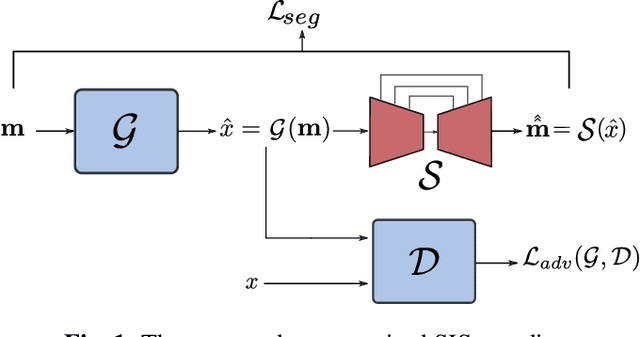
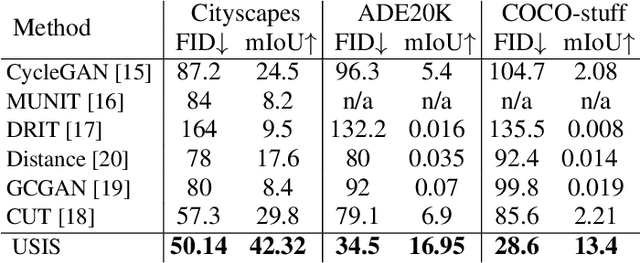
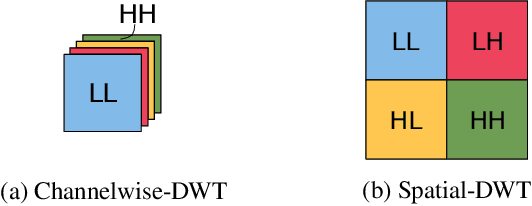
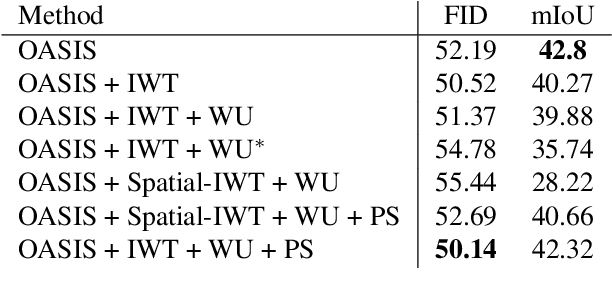
Semantic Image Synthesis (SIS) is a subclass of image-to-image translation where a semantic layout is used to generate a photorealistic image. State-of-the-art conditional Generative Adversarial Networks (GANs) need a huge amount of paired data to accomplish this task while generic unpaired image-to-image translation frameworks underperform in comparison, because they color-code semantic layouts and learn correspondences in appearance instead of semantic content. Starting from the assumption that a high quality generated image should be segmented back to its semantic layout, we propose a new Unsupervised paradigm for SIS (USIS) that makes use of a self-supervised segmentation loss and whole image wavelet based discrimination. Furthermore, in order to match the high-frequency distribution of real images, a novel generator architecture in the wavelet domain is proposed. We test our methodology on 3 challenging datasets and demonstrate its ability to bridge the performance gap between paired and unpaired models.

Urban-StyleGAN: Learning to Generate and Manipulate Images of Urban Scenes
May 16, 2023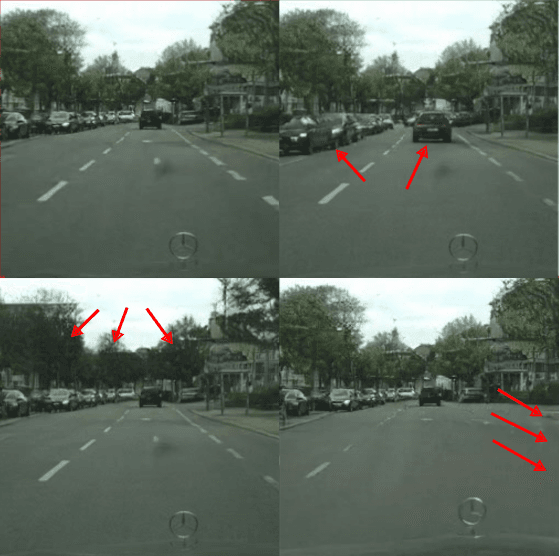
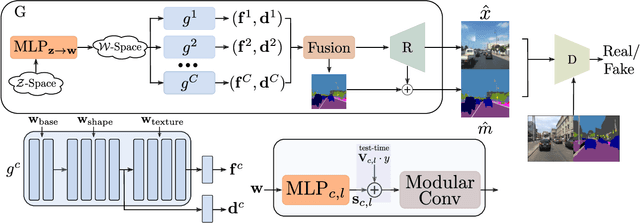
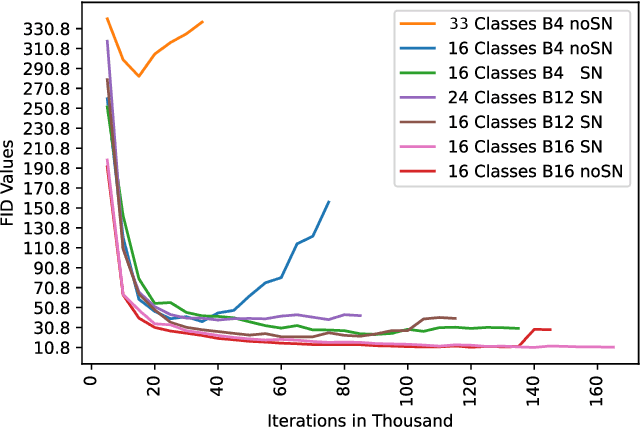
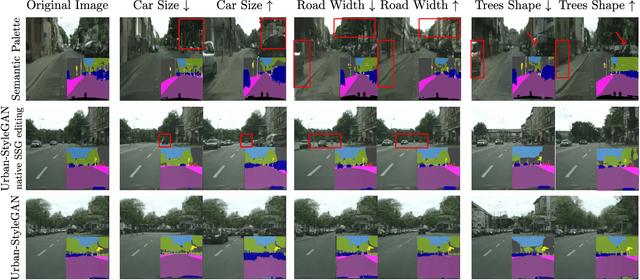
A promise of Generative Adversarial Networks (GANs) is to provide cheap photorealistic data for training and validating AI models in autonomous driving. Despite their huge success, their performance on complex images featuring multiple objects is understudied. While some frameworks produce high-quality street scenes with little to no control over the image content, others offer more control at the expense of high-quality generation. A common limitation of both approaches is the use of global latent codes for the whole image, which hinders the learning of independent object distributions. Motivated by SemanticStyleGAN (SSG), a recent work on latent space disentanglement in human face generation, we propose a novel framework, Urban-StyleGAN, for urban scene generation and manipulation. We find that a straightforward application of SSG leads to poor results because urban scenes are more complex than human faces. To provide a more compact yet disentangled latent representation, we develop a class grouping strategy wherein individual classes are grouped into super-classes. Moreover, we employ an unsupervised latent exploration algorithm in the $\mathcal{S}$-space of the generator and show that it is more efficient than the conventional $\mathcal{W}^{+}$-space in controlling the image content. Results on the Cityscapes and Mapillary datasets show the proposed approach achieves significantly more controllability and improved image quality than previous approaches on urban scenes and is on par with general-purpose non-controllable generative models (like StyleGAN2) in terms of quality.
Towards Pragmatic Semantic Image Synthesis for Urban Scenes
May 16, 2023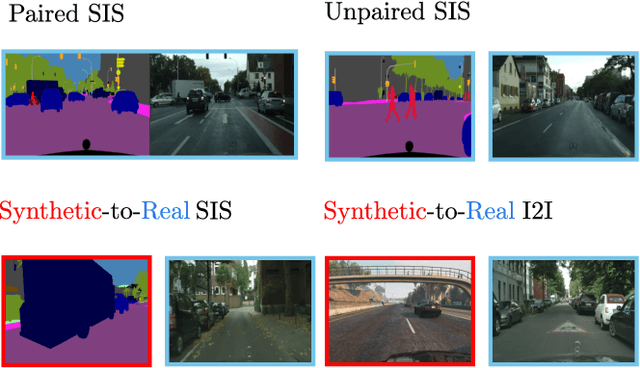
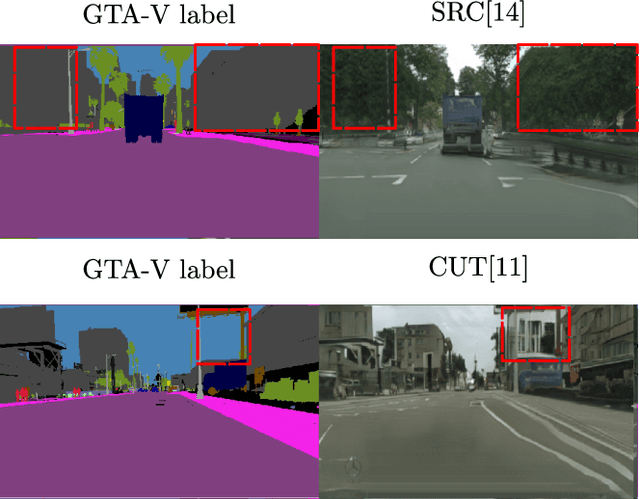
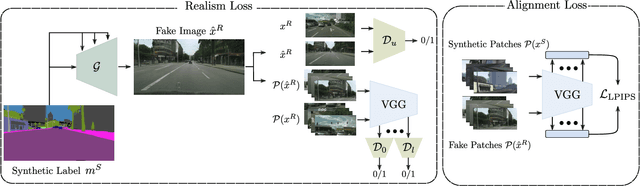
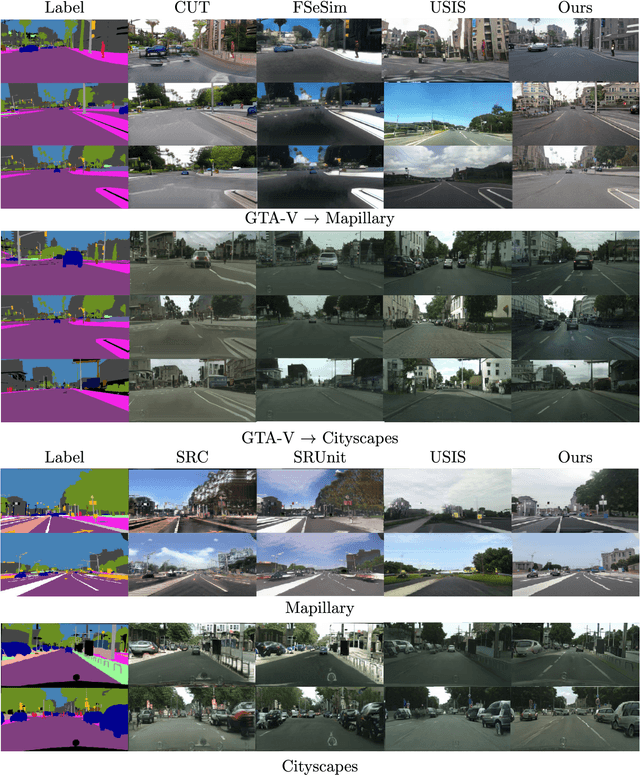
The need for large amounts of training and validation data is a huge concern in scaling AI algorithms for autonomous driving. Semantic Image Synthesis (SIS), or label-to-image translation, promises to address this issue by translating semantic layouts to images, providing a controllable generation of photorealistic data. However, they require a large amount of paired data, incurring extra costs. In this work, we present a new task: given a dataset with synthetic images and labels and a dataset with unlabeled real images, our goal is to learn a model that can generate images with the content of the input mask and the appearance of real images. This new task reframes the well-known unsupervised SIS task in a more practical setting, where we leverage cheaply available synthetic data from a driving simulator to learn how to generate photorealistic images of urban scenes. This stands in contrast to previous works, which assume that labels and images come from the same domain but are unpaired during training. We find that previous unsupervised works underperform on this task, as they do not handle distribution shifts between two different domains. To bypass these problems, we propose a novel framework with two main contributions. First, we leverage the synthetic image as a guide to the content of the generated image by penalizing the difference between their high-level features on a patch level. Second, in contrast to previous works which employ one discriminator that overfits the target domain semantic distribution, we employ a discriminator for the whole image and multiscale discriminators on the image patches. Extensive comparisons on the benchmarks GTA-V $\rightarrow$ Cityscapes and GTA-V $\rightarrow$ Mapillary show the superior performance of the proposed model against state-of-the-art on this task.
NIFF: Alleviating Forgetting in Generalized Few-Shot Object Detection via Neural Instance Feature Forging
Mar 09, 2023Privacy and memory are two recurring themes in a broad conversation about the societal impact of AI. These concerns arise from the need for huge amounts of data to train deep neural networks. A promise of Generalized Few-shot Object Detection (G-FSOD), a learning paradigm in AI, is to alleviate the need for collecting abundant training samples of novel classes we wish to detect by leveraging prior knowledge from old classes (i.e., base classes). G-FSOD strives to learn these novel classes while alleviating catastrophic forgetting of the base classes. However, existing approaches assume that the base images are accessible, an assumption that does not hold when sharing and storing data is problematic. In this work, we propose the first data-free knowledge distillation (DFKD) approach for G-FSOD that leverages the statistics of the region of interest (RoI) features from the base model to forge instance-level features without accessing the base images. Our contribution is three-fold: (1) we design a standalone lightweight generator with (2) class-wise heads (3) to generate and replay diverse instance-level base features to the RoI head while finetuning on the novel data. This stands in contrast to standard DFKD approaches in image classification, which invert the entire network to generate base images. Moreover, we make careful design choices in the novel finetuning pipeline to regularize the model. We show that our approach can dramatically reduce the base memory requirements, all while setting a new standard for G-FSOD on the challenging MS-COCO and PASCAL-VOC benchmarks.
LightTS: Lightweight Time Series Classification with Adaptive Ensemble Distillation -- Extended Version
Feb 24, 2023Due to the sweeping digitalization of processes, increasingly vast amounts of time series data are being produced. Accurate classification of such time series facilitates decision making in multiple domains. State-of-the-art classification accuracy is often achieved by ensemble learning where results are synthesized from multiple base models. This characteristic implies that ensemble learning needs substantial computing resources, preventing their use in resource-limited environments, such as in edge devices. To extend the applicability of ensemble learning, we propose the LightTS framework that compresses large ensembles into lightweight models while ensuring competitive accuracy. First, we propose adaptive ensemble distillation that assigns adaptive weights to different base models such that their varying classification capabilities contribute purposefully to the training of the lightweight model. Second, we propose means of identifying Pareto optimal settings w.r.t. model accuracy and model size, thus enabling users with a space budget to select the most accurate lightweight model. We report on experiments using 128 real-world time series sets and different types of base models that justify key decisions in the design of LightTS and provide evidence that LightTS is able to outperform competitors.
Reinforcing User Retention in a Billion Scale Short Video Recommender System
Feb 12, 2023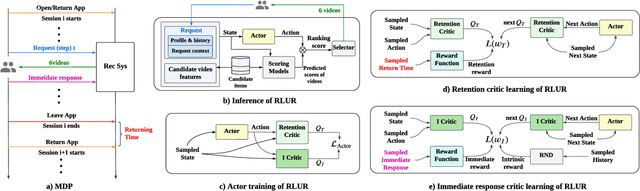
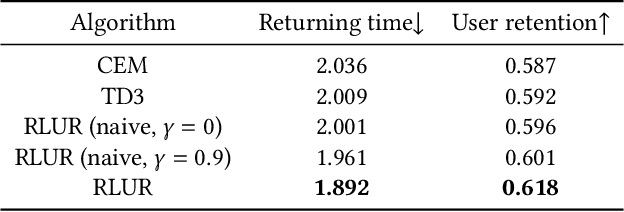
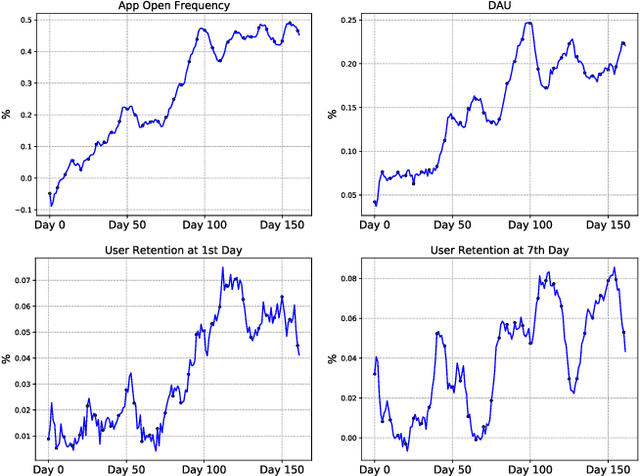
Recently, short video platforms have achieved rapid user growth by recommending interesting content to users. The objective of the recommendation is to optimize user retention, thereby driving the growth of DAU (Daily Active Users). Retention is a long-term feedback after multiple interactions of users and the system, and it is hard to decompose retention reward to each item or a list of items. Thus traditional point-wise and list-wise models are not able to optimize retention. In this paper, we choose reinforcement learning methods to optimize the retention as they are designed to maximize the long-term performance. We formulate the problem as an infinite-horizon request-based Markov Decision Process, and our objective is to minimize the accumulated time interval of multiple sessions, which is equal to improving the app open frequency and user retention. However, current reinforcement learning algorithms can not be directly applied in this setting due to uncertainty, bias, and long delay time incurred by the properties of user retention. We propose a novel method, dubbed RLUR, to address the aforementioned challenges. Both offline and live experiments show that RLUR can significantly improve user retention. RLUR has been fully launched in Kuaishou app for a long time, and achieves consistent performance improvement on user retention and DAU.
LSDM: Long-Short Diffeomorphic Motion for Weakly-Supervised Ultrasound Landmark Tracking
Jan 11, 2023Accurate tracking of an anatomical landmark over time has been of high interests for disease assessment such as minimally invasive surgery and tumor radiation therapy. Ultrasound imaging is a promising modality benefiting from low-cost and real-time acquisition. However, generating a precise landmark tracklet is very challenging, as attempts can be easily distorted by different interference such as landmark deformation, visual ambiguity and partial observation. In this paper, we propose a long-short diffeomorphic motion network, which is a multi-task framework with a learnable deformation prior to search for the plausible deformation of landmark. Specifically, we design a novel diffeomorphism representation in both long and short temporal domains for delineating motion margins and reducing long-term cumulative tracking errors. To further mitigate local anatomical ambiguity, we propose an expectation maximisation motion alignment module to iteratively optimize both long and short deformation, aligning to the same directional and spatial representation. The proposed multi-task system can be trained in a weakly-supervised manner, which only requires few landmark annotations for tracking and zero annotation for long-short deformation learning. We conduct extensive experiments on two ultrasound landmark tracking datasets. Experimental results show that our proposed method can achieve better or competitive landmark tracking performance compared with other state-of-the-art tracking methods, with a strong generalization capability across different scanner types and different ultrasound modalities.
A Pattern Discovery Approach to Multivariate Time Series Forecasting
Dec 20, 2022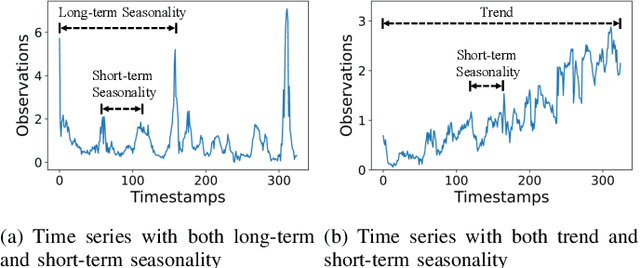
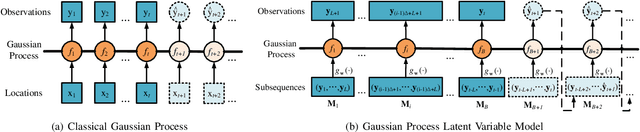
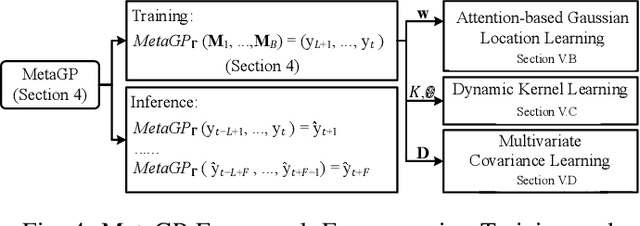
Multivariate time series forecasting constitutes important functionality in cyber-physical systems, whose prediction accuracy can be improved significantly by capturing temporal and multivariate correlations among multiple time series. State-of-the-art deep learning methods fail to construct models for full time series because model complexity grows exponentially with time series length. Rather, these methods construct local temporal and multivariate correlations within subsequences, but fail to capture correlations among subsequences, which significantly affect their forecasting accuracy. To capture the temporal and multivariate correlations among subsequences, we design a pattern discovery model, that constructs correlations via diverse pattern functions. While the traditional pattern discovery method uses shared and fixed pattern functions that ignore the diversity across time series. We propose a novel pattern discovery method that can automatically capture diverse and complex time series patterns. We also propose a learnable correlation matrix, that enables the model to capture distinct correlations among multiple time series. Extensive experiments show that our model achieves state-of-the-art prediction accuracy.
FLAG3D: A 3D Fitness Activity Dataset with Language Instruction
Dec 09, 2022With the continuously thriving popularity around the world, fitness activity analytic has become an emerging research topic in computer vision. While a variety of new tasks and algorithms have been proposed recently, there are growing hunger for data resources involved in high-quality data, fine-grained labels, and diverse environments. In this paper, we present FLAG3D, a large-scale 3D fitness activity dataset with language instruction containing 180K sequences of 60 categories. FLAG3D features the following three aspects: 1) accurate and dense 3D human pose captured from advanced MoCap system to handle the complex activity and large movement, 2) detailed and professional language instruction to describe how to perform a specific activity, 3) versatile video resources from a high-tech MoCap system, rendering software, and cost-effective smartphones in natural environments. Extensive experiments and in-depth analysis show that FLAG3D contributes great research value for various challenges, such as cross-domain human action recognition, dynamic human mesh recovery, and language-guided human action generation. Our dataset and source code will be publicly available at https://andytang15.github.io/FLAG3D.
AutoPINN: When AutoML Meets Physics-Informed Neural Networks
Dec 08, 2022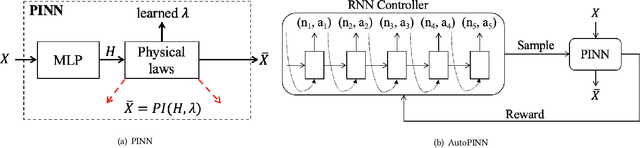

Physics-Informed Neural Networks (PINNs) have recently been proposed to solve scientific and engineering problems, where physical laws are introduced into neural networks as prior knowledge. With the embedded physical laws, PINNs enable the estimation of critical parameters, which are unobservable via physical tools, through observable variables. For example, Power Electronic Converters (PECs) are essential building blocks for the green energy transition. PINNs have been applied to estimate the capacitance, which is unobservable during PEC operations, using current and voltage, which can be observed easily during operations. The estimated capacitance facilitates self-diagnostics of PECs. Existing PINNs are often manually designed, which is time-consuming and may lead to suboptimal performance due to a large number of design choices for neural network architectures and hyperparameters. In addition, PINNs are often deployed on different physical devices, e.g., PECs, with limited and varying resources. Therefore, it requires designing different PINN models under different resource constraints, making it an even more challenging task for manual design. To contend with the challenges, we propose Automated Physics-Informed Neural Networks (AutoPINN), a framework that enables the automated design of PINNs by combining AutoML and PINNs. Specifically, we first tailor a search space that allows finding high-accuracy PINNs for PEC internal parameter estimation. We then propose a resource-aware search strategy to explore the search space to find the best PINN model under different resource constraints. We experimentally demonstrate that AutoPINN is able to find more accurate PINN models than human-designed, state-of-the-art PINN models using fewer resources.