 Add to Chrome
 Add to Firefox
 Add to Edge
Point Cloud Registration
Papers and Code
Bridge 2D-3D: Uncertainty-aware Hierarchical Registration Network with Domain Alignment
Apr 02, 2025
The method for image-to-point cloud registration typically determines the rigid transformation using a coarse-to-fine pipeline. However, directly and uniformly matching image patches with point cloud patches may lead to focusing on incorrect noise patches during matching while ignoring key ones. Moreover, due to the significant differences between image and point cloud modalities, it may be challenging to bridge the domain gap without specific improvements in design. To address the above issues, we innovatively propose the Uncertainty-aware Hierarchical Matching Module (UHMM) and the Adversarial Modal Alignment Module (AMAM). Within the UHMM, we model the uncertainty of critical information in image patches and facilitate multi-level fusion interactions between image and point cloud features. In the AMAM, we design an adversarial approach to reduce the domain gap between image and point cloud. Extensive experiments and ablation studies on RGB-D Scene V2 and 7-Scenes benchmarks demonstrate the superiority of our method, making it a state-of-the-art approach for image-to-point cloud registration tasks.

Unlocking Generalization Power in LiDAR Point Cloud Registration
Mar 13, 2025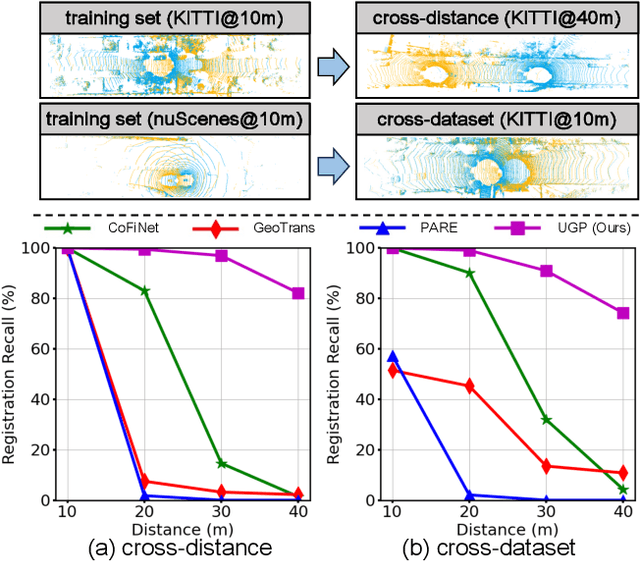
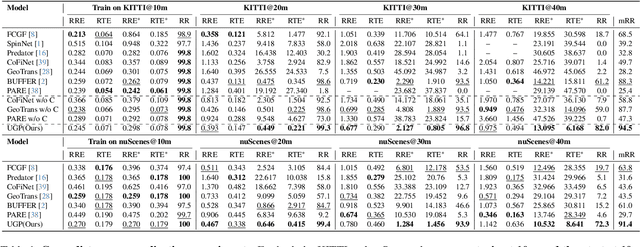
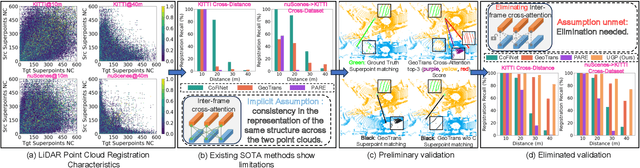

In real-world environments, a LiDAR point cloud registration method with robust generalization capabilities (across varying distances and datasets) is crucial for ensuring safety in autonomous driving and other LiDAR-based applications. However, current methods fall short in achieving this level of generalization. To address these limitations, we propose UGP, a pruned framework designed to enhance generalization power for LiDAR point cloud registration. The core insight in UGP is the elimination of cross-attention mechanisms to improve generalization, allowing the network to concentrate on intra-frame feature extraction. Additionally, we introduce a progressive self-attention module to reduce ambiguity in large-scale scenes and integrate Bird's Eye View (BEV) features to incorporate semantic information about scene elements. Together, these enhancements significantly boost the network's generalization performance. We validated our approach through various generalization experiments in multiple outdoor scenes. In cross-distance generalization experiments on KITTI and nuScenes, UGP achieved state-of-the-art mean Registration Recall rates of 94.5% and 91.4%, respectively. In cross-dataset generalization from nuScenes to KITTI, UGP achieved a state-of-the-art mean Registration Recall of 90.9%. Code will be available at https://github.com/peakpang/UGP.
When and Where Localization Fails: An Analysis of the Iterative Closest Point in Evolving Environment
Jul 23, 2025Robust relocalization in dynamic outdoor environments remains a key challenge for autonomous systems relying on 3D lidar. While long-term localization has been widely studied, short-term environmental changes, occurring over days or weeks, remain underexplored despite their practical significance. To address this gap, we present a highresolution, short-term multi-temporal dataset collected weekly from February to April 2025 across natural and semi-urban settings. Each session includes high-density point cloud maps, 360 deg panoramic images, and trajectory data. Projected lidar scans, derived from the point cloud maps and modeled with sensor-accurate occlusions, are used to evaluate alignment accuracy against the ground truth using two Iterative Closest Point (ICP) variants: Point-to-Point and Point-to-Plane. Results show that Point-to-Plane offers significantly more stable and accurate registration, particularly in areas with sparse features or dense vegetation. This study provides a structured dataset for evaluating short-term localization robustness, a reproducible framework for analyzing scan-to-map alignment under noise, and a comparative evaluation of ICP performance in evolving outdoor environments. Our analysis underscores how local geometry and environmental variability affect localization success, offering insights for designing more resilient robotic systems.
A Pointcloud Registration Framework for Relocalization in Subterranean Environments
Apr 09, 2025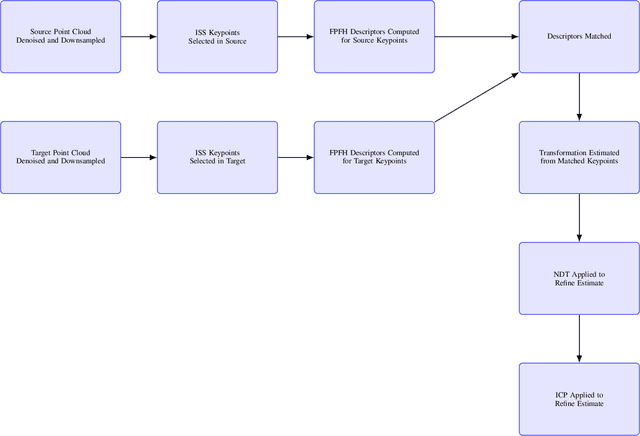
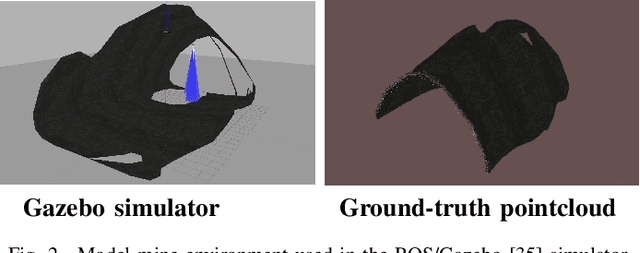
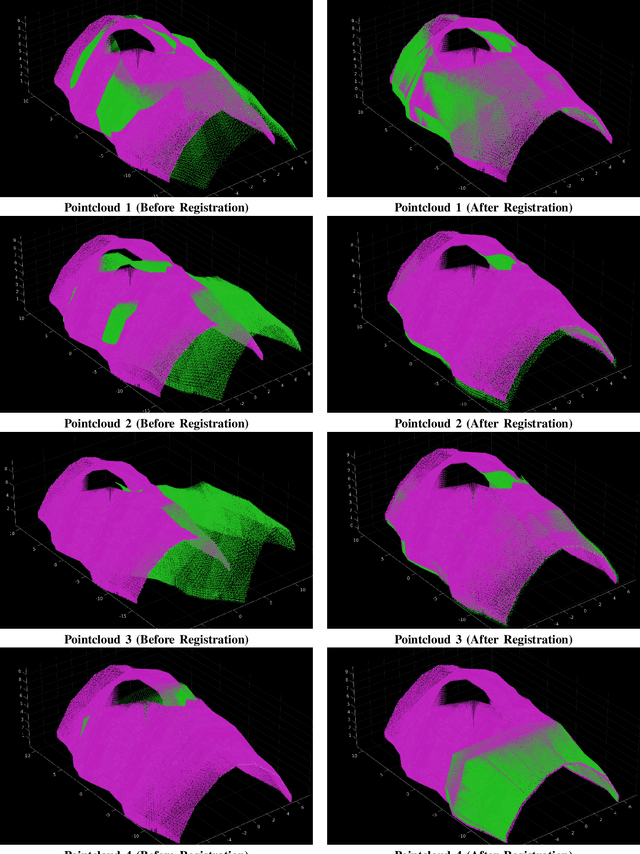
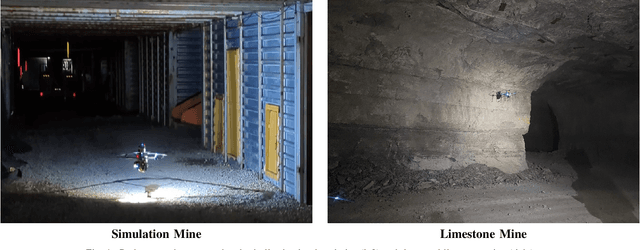
Relocalization, the process of re-establishing a robot's position within an environment, is crucial for ensuring accurate navigation and task execution when external positioning information, such as GPS, is unavailable or has been lost. Subterranean environments present significant challenges for relocalization due to limited external positioning information, poor lighting that affects camera localization, irregular and often non-distinct surfaces, and dust, which can introduce noise and occlusion in sensor data. In this work, we propose a robust, computationally friendly framework for relocalization through point cloud registration utilizing a prior point cloud map. The framework employs Intrinsic Shape Signatures (ISS) to select feature points in both the target and prior point clouds. The Fast Point Feature Histogram (FPFH) algorithm is utilized to create descriptors for these feature points, and matching these descriptors yields correspondences between the point clouds. A 3D transformation is estimated using the matched points, which initializes a Normal Distribution Transform (NDT) registration. The transformation result from NDT is further refined using the Iterative Closest Point (ICP) registration algorithm. This framework enhances registration accuracy even in challenging conditions, such as dust interference and significant initial transformations between the target and source, making it suitable for autonomous robots operating in underground mines and tunnels. This framework was validated with experiments in simulated and real-world mine datasets, demonstrating its potential for improving relocalization.
BUFFER-X: Towards Zero-Shot Point Cloud Registration in Diverse Scenes
Mar 11, 2025Recent advances in deep learning-based point cloud registration have improved generalization, yet most methods still require retraining or manual parameter tuning for each new environment. In this paper, we identify three key factors limiting generalization: (a) reliance on environment-specific voxel size and search radius, (b) poor out-of-domain robustness of learning-based keypoint detectors, and (c) raw coordinate usage, which exacerbates scale discrepancies. To address these issues, we present a zero-shot registration pipeline called BUFFER-X by (a) adaptively determining voxel size/search radii, (b) using farthest point sampling to bypass learned detectors, and (c) leveraging patch-wise scale normalization for consistent coordinate bounds. In particular, we present a multi-scale patch-based descriptor generation and a hierarchical inlier search across scales to improve robustness in diverse scenes. We also propose a novel generalizability benchmark using 11 datasets that cover various indoor/outdoor scenarios and sensor modalities, demonstrating that BUFFER-X achieves substantial generalization without prior information or manual parameter tuning for the test datasets. Our code is available at https://github.com/MIT-SPARK/BUFFER-X.
Implementation of a Zed 2i Stereo Camera for High-Frequency Shoreline Change and Coastal Elevation Monitoring
Apr 08, 2025The increasing population, thus financial interests, in coastal areas have increased the need to monitor coastal elevation and shoreline change. Though several resources exist to obtain this information, they often lack the required temporal resolution for short-term monitoring (e.g., every hour). To address this issue, this study implements a low-cost ZED 2i stereo camera system and close-range photogrammetry to collect images for generating 3D point clouds, digital surface models (DSMs) of beach elevation, and georectified imagery at a localized scale and high temporal resolution. The main contributions of this study are (i) intrinsic camera calibration, (ii) georectification and registration of acquired imagery and point cloud, (iii) generation of the DSM of the beach elevation, and (iv) a comparison of derived products against those from uncrewed aircraft system structure-from-motion photogrammetry. Preliminary results show that despite its limitations, the ZED 2i can provide the desired mapping products at localized and high temporal scales. The system achieved a mean reprojection error of 0.20 px, a point cloud registration of 27 cm, a vertical error of 37.56 cm relative to ground truth, and georectification root mean square errors of 2.67 cm and 2.81 cm for x and y.
* Published in IGARSS 2023 - 2023 IEEE International Geoscience and Remote Sensing Symposium
Fully-Geometric Cross-Attention for Point Cloud Registration
Feb 12, 2025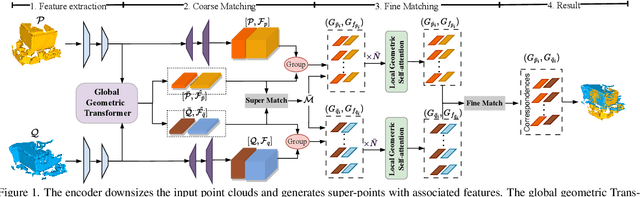
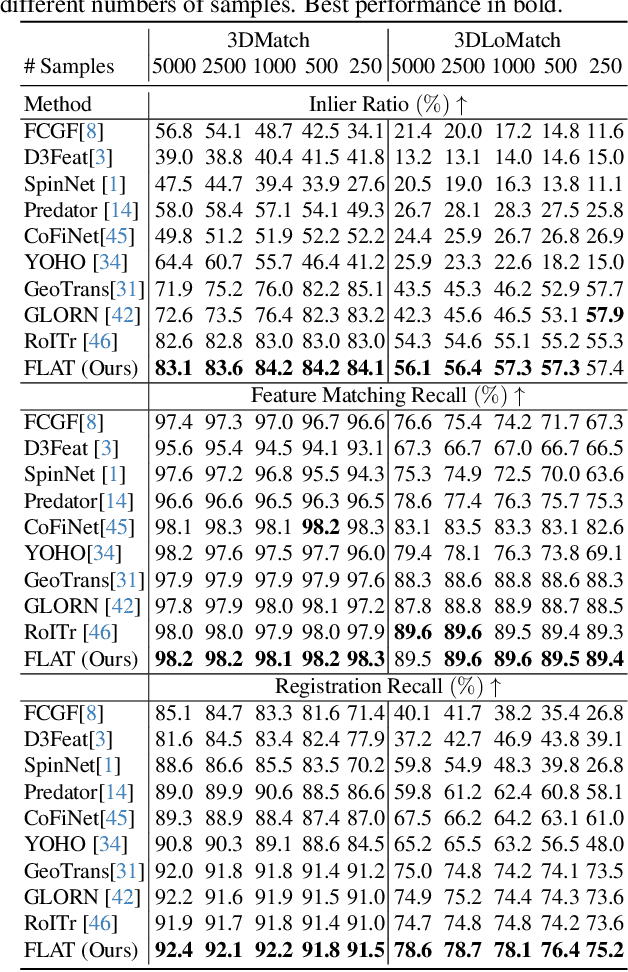
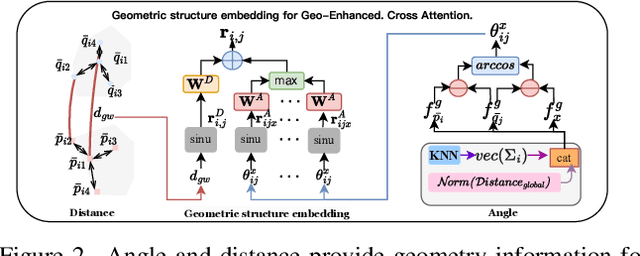
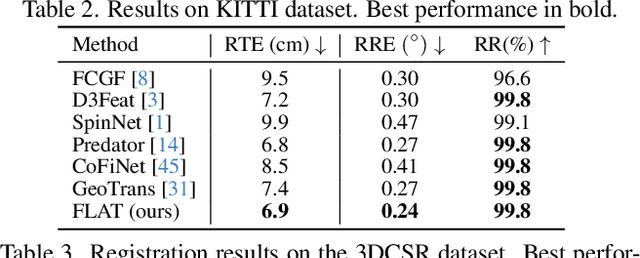
Point cloud registration approaches often fail when the overlap between point clouds is low due to noisy point correspondences. This work introduces a novel cross-attention mechanism tailored for Transformer-based architectures that tackles this problem, by fusing information from coordinates and features at the super-point level between point clouds. This formulation has remained unexplored primarily because it must guarantee rotation and translation invariance since point clouds reside in different and independent reference frames. We integrate the Gromov-Wasserstein distance into the cross-attention formulation to jointly compute distances between points across different point clouds and account for their geometric structure. By doing so, points from two distinct point clouds can attend to each other under arbitrary rigid transformations. At the point level, we also devise a self-attention mechanism that aggregates the local geometric structure information into point features for fine matching. Our formulation boosts the number of inlier correspondences, thereby yielding more precise registration results compared to state-of-the-art approaches. We have conducted an extensive evaluation on 3DMatch, 3DLoMatch, KITTI, and 3DCSR datasets.
Tightly Coupled Range Inertial Odometry and Mapping with Exact Point Cloud Downsampling
May 02, 2025In this work, to facilitate the real-time processing of multi-scan registration error minimization on factor graphs, we devise a point cloud downsampling algorithm based on coreset extraction. This algorithm extracts a subset of the residuals of input points such that the subset yields exactly the same quadratic error function as that of the original set for a given pose. This enables a significant reduction in the number of residuals to be evaluated without approximation errors at the sampling point. Using this algorithm, we devise a complete SLAM framework that consists of odometry estimation based on sliding window optimization and global trajectory optimization based on registration error minimization over the entire map, both of which can run in real time on a standard CPU. The experimental results demonstrate that the proposed framework outperforms state-of-the-art CPU-based SLAM frameworks without the use of GPU acceleration.
Investigating Vision-Language Model for Point Cloud-based Vehicle Classification
Apr 10, 2025Heavy-duty trucks pose significant safety challenges due to their large size and limited maneuverability compared to passenger vehicles. A deeper understanding of truck characteristics is essential for enhancing the safety perspective of cooperative autonomous driving. Traditional LiDAR-based truck classification methods rely on extensive manual annotations, which makes them labor-intensive and costly. The rapid advancement of large language models (LLMs) trained on massive datasets presents an opportunity to leverage their few-shot learning capabilities for truck classification. However, existing vision-language models (VLMs) are primarily trained on image datasets, which makes it challenging to directly process point cloud data. This study introduces a novel framework that integrates roadside LiDAR point cloud data with VLMs to facilitate efficient and accurate truck classification, which supports cooperative and safe driving environments. This study introduces three key innovations: (1) leveraging real-world LiDAR datasets for model development, (2) designing a preprocessing pipeline to adapt point cloud data for VLM input, including point cloud registration for dense 3D rendering and mathematical morphological techniques to enhance feature representation, and (3) utilizing in-context learning with few-shot prompting to enable vehicle classification with minimally labeled training data. Experimental results demonstrate encouraging performance of this method and present its potential to reduce annotation efforts while improving classification accuracy.
Diff-Reg v2: Diffusion-Based Matching Matrix Estimation for Image Matching and 3D Registration
Mar 07, 2025
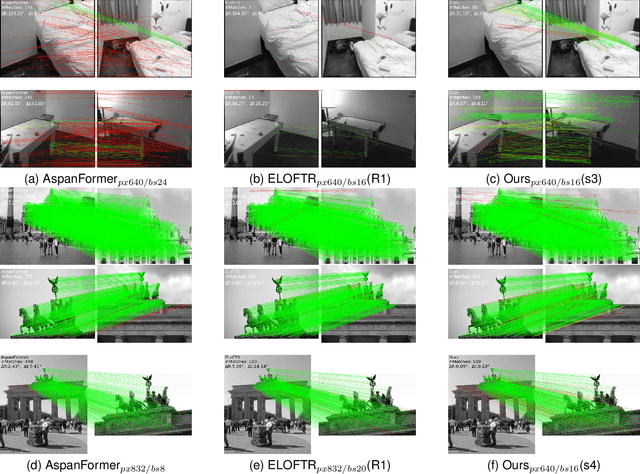


Establishing reliable correspondences is crucial for all registration tasks, including 2D image registration, 3D point cloud registration, and 2D-3D image-to-point cloud registration. However, these tasks are often complicated by challenges such as scale inconsistencies, symmetry, and large deformations, which can lead to ambiguous matches. Previous feature-based and correspondence-based methods typically rely on geometric or semantic features to generate or polish initial potential correspondences. Some methods typically leverage specific geometric priors, such as topological preservation, to devise diverse and innovative strategies tailored to a given enhancement goal, which cannot be exhaustively enumerated. Additionally, many previous approaches rely on a single-step prediction head, which can struggle with local minima in complex matching scenarios. To address these challenges, we introduce an innovative paradigm that leverages a diffusion model in matrix space for robust matching matrix estimation. Our model treats correspondence estimation as a denoising diffusion process in the matching matrix space, gradually refining the intermediate matching matrix to the optimal one. Specifically, we apply the diffusion model in the doubly stochastic matrix space for 3D-3D and 2D-3D registration tasks. In the 2D image registration task, we deploy the diffusion model in a matrix subspace where dual-softmax projection regularization is applied. For all three registration tasks, we provide adaptive matching matrix embedding implementations tailored to the specific characteristics of each task while maintaining a consistent "match-to-warp" encoding pattern. Furthermore, we adopt a lightweight design for the denoising module. In inference, once points or image features are extracted and fixed, this module performs multi-step denoising predictions through reverse sampling.