 Add to Chrome
 Add to Firefox
 Add to Edge
Zero Shot Long Video Question Answering
Papers and Code
Universal Video Temporal Grounding with Generative Multi-modal Large Language Models
Jun 23, 2025
This paper presents a computational model for universal video temporal grounding, which accurately localizes temporal moments in videos based on natural language queries (e.g., questions or descriptions). Unlike existing methods that are often limited to specific video domains or durations, we propose UniTime, a robust and universal video grounding model leveraging the strong vision-language understanding capabilities of generative Multi-modal Large Language Models (MLLMs). Our model effectively handles videos of diverse views, genres, and lengths while comprehending complex language queries. The key contributions include: (i) We consider steering strong MLLMs for temporal grounding in videos. To enable precise timestamp outputs, we incorporate temporal information by interleaving timestamp tokens with video tokens. (ii) By training the model to handle videos with different input granularities through adaptive frame scaling, our approach achieves robust temporal grounding for both short and long videos. (iii) Comprehensive experiments show that UniTime outperforms state-of-the-art approaches in both zero-shot and dataset-specific finetuned settings across five public temporal grounding benchmarks. (iv) When employed as a preliminary moment retriever for long-form video question-answering (VideoQA), UniTime significantly improves VideoQA accuracy, highlighting its value for complex video understanding tasks.

Advancing Egocentric Video Question Answering with Multimodal Large Language Models
Apr 06, 2025Egocentric Video Question Answering (QA) requires models to handle long-horizon temporal reasoning, first-person perspectives, and specialized challenges like frequent camera movement. This paper systematically evaluates both proprietary and open-source Multimodal Large Language Models (MLLMs) on QaEgo4Dv2 - a refined dataset of egocentric videos derived from QaEgo4D. Four popular MLLMs (GPT-4o, Gemini-1.5-Pro, Video-LLaVa-7B and Qwen2-VL-7B-Instruct) are assessed using zero-shot and fine-tuned approaches for both OpenQA and CloseQA settings. We introduce QaEgo4Dv2 to mitigate annotation noise in QaEgo4D, enabling more reliable comparison. Our results show that fine-tuned Video-LLaVa-7B and Qwen2-VL-7B-Instruct achieve new state-of-the-art performance, surpassing previous benchmarks by up to +2.6% ROUGE/METEOR (for OpenQA) and +13% accuracy (for CloseQA). We also present a thorough error analysis, indicating the model's difficulty in spatial reasoning and fine-grained object recognition - key areas for future improvement.
Zero-shot Action Localization via the Confidence of Large Vision-Language Models
Oct 18, 2024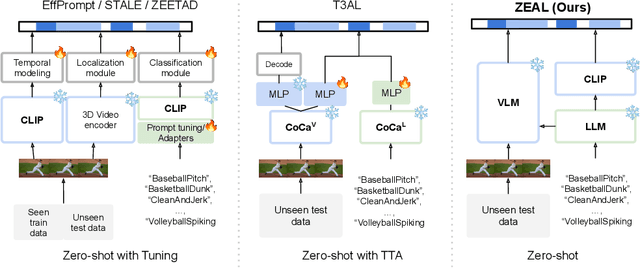
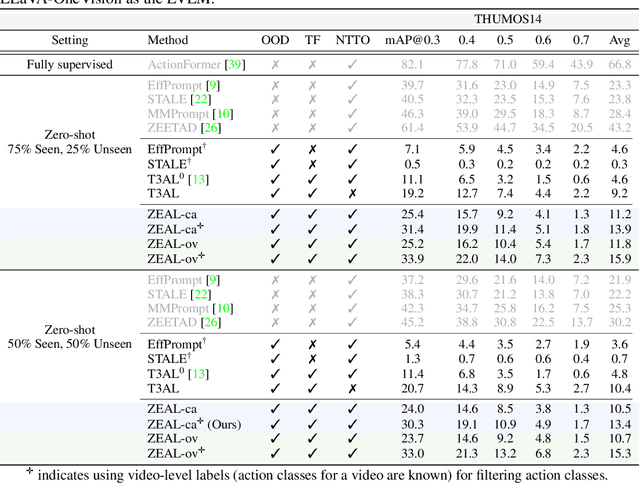
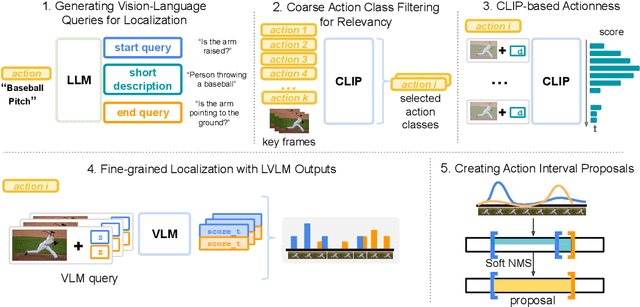
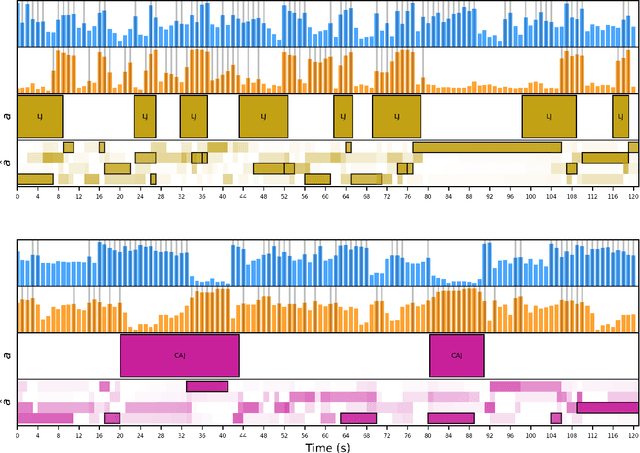
Precise action localization in untrimmed video is vital for fields such as professional sports and minimally invasive surgery, where the delineation of particular motions in recordings can dramatically enhance analysis. But in many cases, large scale datasets with video-label pairs for localization are unavailable, limiting the opportunity to fine-tune video-understanding models. Recent developments in large vision-language models (LVLM) address this need with impressive zero-shot capabilities in a variety of video understanding tasks. However, the adaptation of image-based LVLMs, with their powerful visual question answering capabilities, to action localization in long-form video is still relatively unexplored. To this end, we introduce a true ZEro-shot Action Localization method (ZEAL). Specifically, we leverage the built-in action knowledge of a large language model (LLM) to inflate actions into highly-detailed descriptions of the archetypal start and end of the action. These descriptions serve as queries to LVLM for generating frame-level confidence scores which can be aggregated to produce localization outputs. The simplicity and flexibility of our method lends it amenable to more capable LVLMs as they are developed, and we demonstrate remarkable results in zero-shot action localization on a challenging benchmark, without any training.
Zero-Shot Long-Form Video Understanding through Screenplay
Jun 25, 2024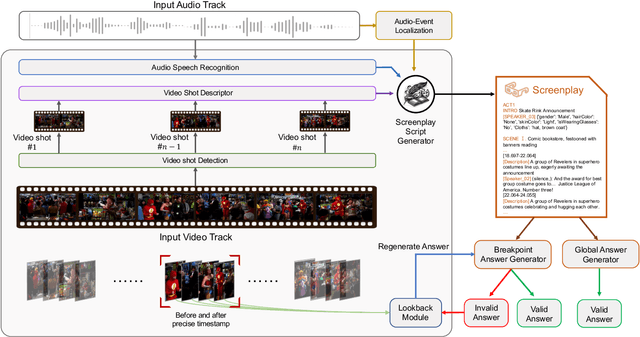
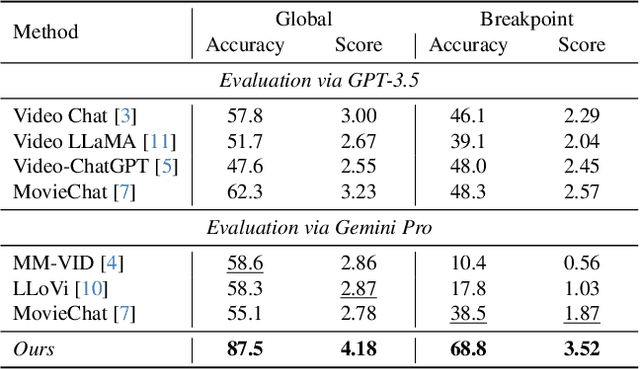
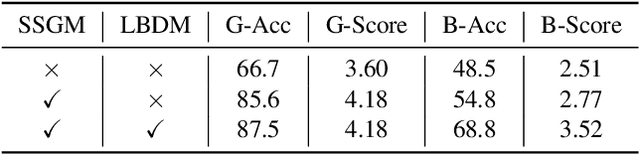

The Long-form Video Question-Answering task requires the comprehension and analysis of extended video content to respond accurately to questions by utilizing both temporal and contextual information. In this paper, we present MM-Screenplayer, an advanced video understanding system with multi-modal perception capabilities that can convert any video into textual screenplay representations. Unlike previous storytelling methods, we organize video content into scenes as the basic unit, rather than just visually continuous shots. Additionally, we developed a ``Look Back'' strategy to reassess and validate uncertain information, particularly targeting breakpoint mode. MM-Screenplayer achieved highest score in the CVPR'2024 LOng-form VidEo Understanding (LOVEU) Track 1 Challenge, with a global accuracy of 87.5% and a breakpoint accuracy of 68.8%.
VideoINSTA: Zero-shot Long Video Understanding via Informative Spatial-Temporal Reasoning with LLMs
Sep 30, 2024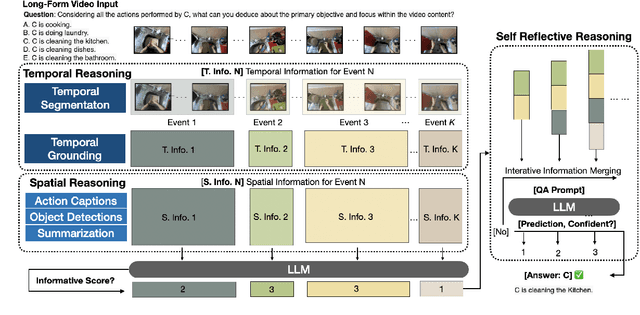

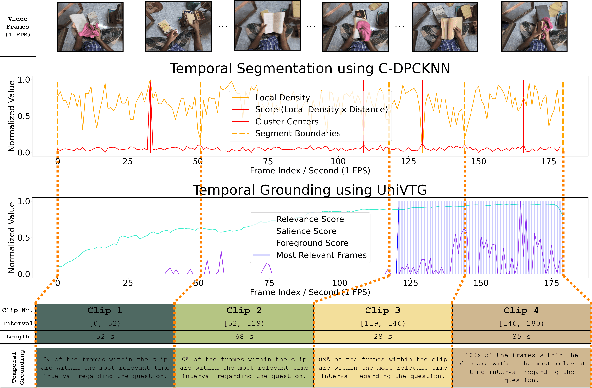

In the video-language domain, recent works in leveraging zero-shot Large Language Model-based reasoning for video understanding have become competitive challengers to previous end-to-end models. However, long video understanding presents unique challenges due to the complexity of reasoning over extended timespans, even for zero-shot LLM-based approaches. The challenge of information redundancy in long videos prompts the question of what specific information is essential for large language models (LLMs) and how to leverage them for complex spatial-temporal reasoning in long-form video analysis. We propose a framework VideoINSTA, i.e. INformative Spatial-TemporAl Reasoning for zero-shot long-form video understanding. VideoINSTA contributes (1) a zero-shot framework for long video understanding using LLMs; (2) an event-based temporal reasoning and content-based spatial reasoning approach for LLMs to reason over spatial-temporal information in videos; (3) a self-reflective information reasoning scheme balancing temporal factors based on information sufficiency and prediction confidence. Our model significantly improves the state-of-the-art on three long video question-answering benchmarks: EgoSchema, NextQA, and IntentQA, and the open question answering dataset ActivityNetQA. The code is released here: https://github.com/mayhugotong/VideoINSTA.
LongVLM: Efficient Long Video Understanding via Large Language Models
Apr 10, 2024
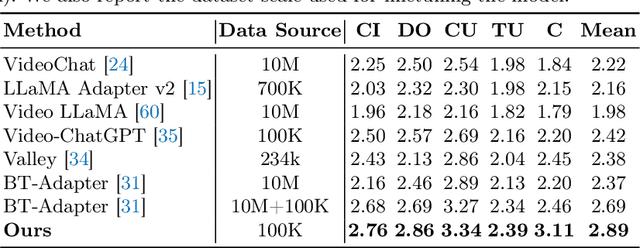
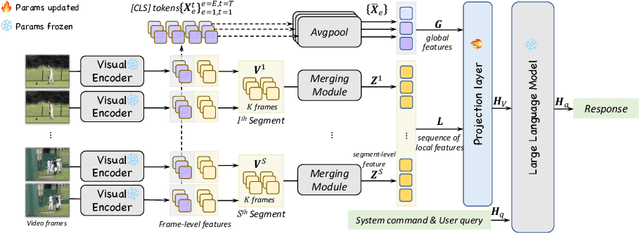
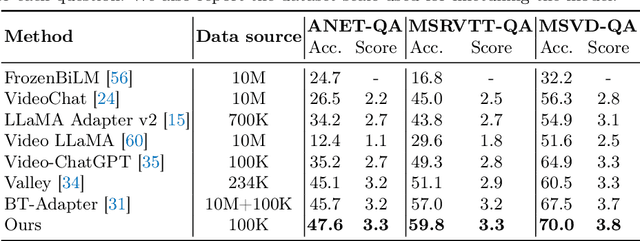
Empowered by Large Language Models (LLMs), recent advancements in VideoLLMs have driven progress in various video understanding tasks. These models encode video representations through pooling or query aggregation over a vast number of visual tokens, making computational and memory costs affordable. Despite successfully providing an overall comprehension of video content, existing VideoLLMs still face challenges in achieving detailed understanding in videos due to overlooking local information in long-term videos. To tackle this challenge, we introduce LongVLM, a straightforward yet powerful VideoLLM for long video understanding, building upon the observation that long videos often consist of sequential key events, complex actions, and camera movements. Our approach proposes to decompose long videos into multiple short-term segments and encode local features for each local segment via a hierarchical token merging module. These features are concatenated in temporal order to maintain the storyline across sequential short-term segments. Additionally, we propose to integrate global semantics into each local feature to enhance context understanding. In this way, we encode video representations that incorporate both local and global information, enabling the LLM to generate comprehensive responses for long-term videos. Experimental results on the VideoChatGPT benchmark and zero-shot video question-answering datasets demonstrate the superior capabilities of our model over the previous state-of-the-art methods. Qualitative examples demonstrate that our model produces more precise responses for long videos understanding. Code will be available at https://github.com/ziplab/LongVLM.
VideoAgent: Long-form Video Understanding with Large Language Model as Agent
Mar 15, 2024Long-form video understanding represents a significant challenge within computer vision, demanding a model capable of reasoning over long multi-modal sequences. Motivated by the human cognitive process for long-form video understanding, we emphasize interactive reasoning and planning over the ability to process lengthy visual inputs. We introduce a novel agent-based system, VideoAgent, that employs a large language model as a central agent to iteratively identify and compile crucial information to answer a question, with vision-language foundation models serving as tools to translate and retrieve visual information. Evaluated on the challenging EgoSchema and NExT-QA benchmarks, VideoAgent achieves 54.1% and 71.3% zero-shot accuracy with only 8.4 and 8.2 frames used on average. These results demonstrate superior effectiveness and efficiency of our method over the current state-of-the-art methods, highlighting the potential of agent-based approaches in advancing long-form video understanding.
Language Repository for Long Video Understanding
Mar 21, 2024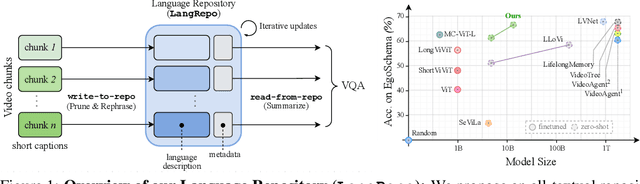

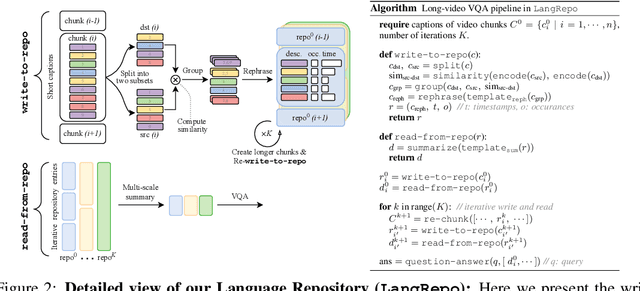

Language has become a prominent modality in computer vision with the rise of multi-modal LLMs. Despite supporting long context-lengths, their effectiveness in handling long-term information gradually declines with input length. This becomes critical, especially in applications such as long-form video understanding. In this paper, we introduce a Language Repository (LangRepo) for LLMs, that maintains concise and structured information as an interpretable (i.e., all-textual) representation. Our repository is updated iteratively based on multi-scale video chunks. We introduce write and read operations that focus on pruning redundancies in text, and extracting information at various temporal scales. The proposed framework is evaluated on zero-shot visual question-answering benchmarks including EgoSchema, NExT-QA, IntentQA and NExT-GQA, showing state-of-the-art performance at its scale. Our code is available at https://github.com/kkahatapitiya/LangRepo.
Koala: Key frame-conditioned long video-LLM
Apr 05, 2024


Long video question answering is a challenging task that involves recognizing short-term activities and reasoning about their fine-grained relationships. State-of-the-art video Large Language Models (vLLMs) hold promise as a viable solution due to their demonstrated emergent capabilities on new tasks. However, despite being trained on millions of short seconds-long videos, vLLMs are unable to understand minutes-long videos and accurately answer questions about them. To address this limitation, we propose a lightweight and self-supervised approach, Key frame-conditioned long video-LLM (Koala), that introduces learnable spatiotemporal queries to adapt pretrained vLLMs for generalizing to longer videos. Our approach introduces two new tokenizers that condition on visual tokens computed from sparse video key frames for understanding short and long video moments. We train our proposed approach on HowTo100M and demonstrate its effectiveness on zero-shot long video understanding benchmarks, where it outperforms state-of-the-art large models by 3 - 6% in absolute accuracy across all tasks. Surprisingly, we also empirically show that our approach not only helps a pretrained vLLM to understand long videos but also improves its accuracy on short-term action recognition.
MovieChat+: Question-aware Sparse Memory for Long Video Question Answering
Apr 26, 2024Recently, integrating video foundation models and large language models to build a video understanding system can overcome the limitations of specific pre-defined vision tasks. Yet, existing methods either employ complex spatial-temporal modules or rely heavily on additional perception models to extract temporal features for video understanding, and they only perform well on short videos. For long videos, the computational complexity and memory costs associated with long-term temporal connections are significantly increased, posing additional challenges.Taking advantage of the Atkinson-Shiffrin memory model, with tokens in Transformers being employed as the carriers of memory in combination with our specially designed memory mechanism, we propose MovieChat to overcome these challenges. We lift pre-trained multi-modal large language models for understanding long videos without incorporating additional trainable temporal modules, employing a zero-shot approach. MovieChat achieves state-of-the-art performance in long video understanding, along with the released MovieChat-1K benchmark with 1K long video, 2K temporal grounding labels, and 14K manual annotations for validation of the effectiveness of our method. The code along with the dataset can be accessed via the following https://github.com/rese1f/MovieChat.