 Add to Chrome
 Add to Firefox
 Add to Edge
Adaptive Dense Evidence Refinement for Video Relational Reasoning for VRR-QA Challenge
May 31, 2026
VRR-QA evaluates whether video-language systems can infer spatial, temporal, viewpoint, depth, and visibility relations that are not always resolved by a single frame. We present an inference-only system built around adaptive test-time computation. The system first answers each question with a direct video-language model pass, then uses multiple lightweight views to find unstable questions. Only these difficult questions are routed to a high-budget dense evidence module that constructs timestamped frame observations, relation-specific probes, candidate verification, and conservative temporal aggregation. This design separates two problems that are often confused in video question answering: finding plausible alternative answers and deciding when a current answer should actually be changed. On the test split, the final system obtains 90.07 average accuracy and 87.81 macro average accuracy. The report focuses on the final test system and the implementation settings required to reproduce the adaptive dense verifier.

Temporal Evidence Routing with Structured Visual Evidence for TimeLogicQA
May 31, 2026TimeLogicQA evaluates whether video question answering systems can reason over temporal relations such as event existence, ordering, persistence, boundary conditions, and overlap. We address this task with a visual evidence routing pipeline that separates perception from symbolic temporal reasoning. The system first parses each question into event targets, answer mode, candidate options, and temporal operators. It then routes videos according to duration and operator difficulty, using ordered full-frame evidence for short clips and event-focused candidate windows for long videos. A multimodal large language model produces structured visual evidence for the relevant events, while programmatic verifiers recover dense action intervals and a deterministic reducer applies operator-specific temporal rules to produce the final answer. Conservative fusion accepts an answer only when the visual evidence, temporal program, and confidence checks agree, reducing noisy answer flips. On the official test evaluation, our final system achieves an AvgAcc of 81.8.
Dual-Route Top-K Retrieval with 1v1 VLM Reranking for the CoVR-R
May 31, 2026We describe \emph{Dual-Route Top-K Retrieval with 1v1 VLM Reranking} for the CoVR-R challenge. The method treats composed video retrieval as two coupled problems: finding a sufficiently complete top-k candidate set, and then safely deciding whether any candidate should replace a strong current top-1. We first improve the reasoning/text seed with a VLM slot selector over existing candidates, without introducing DFN visual retrieval. We then add a visual route from contact-sheet embeddings using DFN-H/DFN-L. The routes are merged into a top-10 candidate set, after which a VLM final reranker performs conservative 1v1 comparisons between the current top-1 and each challenger. On the hidden test split, the final system reaches 95.28 R@1, 97.47 R@5, 98.48 R@10, and 99.66 R@50. The main lesson is that CoVR-R benefits more from recall-selection decoupling than from broad text reranking or direct multi-candidate VLM classification.
BFLA: Block-Filtered Long-Context Attention Mechanism
May 12, 2026This paper proposes Block-Filtered Long-Context Attention (BFLA), a training-free sparse prefill attention mechanism for long-context inference. BFLA adopts a two-stage design. In Stage 1, query and key sequences are compressed into coarse blocks, and lightweight block-level softmax mass estimation is performed to construct an input-dependent block importance mask. In Stage 2, the coarse mask is expanded to the Triton attention-tile grid. Several tile-level rescue strategies are applied to reduce information loss, where a fused sparse prefill kernel skips unimportant KV tiles while preserving exact token-level attention inside every retained tile. BFLA requires no retraining, calibration, preprocessing, or model modification and can be plugged into existing vLLM-style paged-attention workloads. Experiments on Gemma 4, Llama 3.1, Qwen 3.5, and Qwen 3.6 series models show that BFLA substantially accelerates long-context prefilling with minimal accuracy degradation compared to dense Triton FlashAttention. Project website: https://github.com/Alicewithrabbit/BFLA.
Adapting Point Cloud Analysis via Multimodal Bayesian Distribution Learning
Mar 23, 2026Multimodal 3D vision-language models show strong generalization across diverse 3D tasks, but their performance still degrades notably under domain shifts. This has motivated recent studies on test-time adaptation (TTA), which enables models to adapt online using test-time data. Among existing TTA methods, cache-based mechanisms are widely adopted for leveraging previously observed samples in online prediction refinement. However, they store only limited historical information, leading to progressive information loss as the test stream evolves. In addition, their prediction logits are fused heuristically, making adaptation unstable. To address these limitations, we propose BayesMM, a Multimodal Bayesian Distribution Learning framework for test-time point cloud analysis. BayesMM models textual priors and streaming visual features of each class as Gaussian distributions: textual parameters are derived from semantic prompts, while visual parameters are updated online with arriving samples. The two modalities are fused via Bayesian model averaging, which automatically adjusts their contributions based on posterior evidence, yielding a unified prediction that adapts continually to evolving test-time data without training. Extensive experiments on multiple point cloud benchmarks demonstrate that BayesMM maintains robustness under distributional shifts, yielding over 4% average improvement.
SoccerNet 2025 Challenges Results
Aug 26, 2025The SoccerNet 2025 Challenges mark the fifth annual edition of the SoccerNet open benchmarking effort, dedicated to advancing computer vision research in football video understanding. This year's challenges span four vision-based tasks: (1) Team Ball Action Spotting, focused on detecting ball-related actions in football broadcasts and assigning actions to teams; (2) Monocular Depth Estimation, targeting the recovery of scene geometry from single-camera broadcast clips through relative depth estimation for each pixel; (3) Multi-View Foul Recognition, requiring the analysis of multiple synchronized camera views to classify fouls and their severity; and (4) Game State Reconstruction, aimed at localizing and identifying all players from a broadcast video to reconstruct the game state on a 2D top-view of the field. Across all tasks, participants were provided with large-scale annotated datasets, unified evaluation protocols, and strong baselines as starting points. This report presents the results of each challenge, highlights the top-performing solutions, and provides insights into the progress made by the community. The SoccerNet Challenges continue to serve as a driving force for reproducible, open research at the intersection of computer vision, artificial intelligence, and sports. Detailed information about the tasks, challenges, and leaderboards can be found at https://www.soccer-net.org, with baselines and development kits available at https://github.com/SoccerNet.
On the Generalization of SFT: A Reinforcement Learning Perspective with Reward Rectification
Aug 07, 2025We present a simple yet theoretically motivated improvement to Supervised Fine-Tuning (SFT) for the Large Language Model (LLM), addressing its limited generalization compared to reinforcement learning (RL). Through mathematical analysis, we reveal that standard SFT gradients implicitly encode a problematic reward structure that may severely restrict the generalization capabilities of model. To rectify this, we propose Dynamic Fine-Tuning (DFT), stabilizing gradient updates for each token by dynamically rescaling the objective function with the probability of this token. Remarkably, this single-line code change significantly outperforms standard SFT across multiple challenging benchmarks and base models, demonstrating greatly improved generalization. Additionally, our approach shows competitive results in offline RL settings, offering an effective yet simpler alternative. This work bridges theoretical insight and practical solutions, substantially advancing SFT performance. The code will be available at https://github.com/yongliang-wu/DFT.
KRIS-Bench: Benchmarking Next-Level Intelligent Image Editing Models
May 22, 2025Recent advances in multi-modal generative models have enabled significant progress in instruction-based image editing. However, while these models produce visually plausible outputs, their capacity for knowledge-based reasoning editing tasks remains under-explored. In this paper, we introduce KRIS-Bench (Knowledge-based Reasoning in Image-editing Systems Benchmark), a diagnostic benchmark designed to assess models through a cognitively informed lens. Drawing from educational theory, KRIS-Bench categorizes editing tasks across three foundational knowledge types: Factual, Conceptual, and Procedural. Based on this taxonomy, we design 22 representative tasks spanning 7 reasoning dimensions and release 1,267 high-quality annotated editing instances. To support fine-grained evaluation, we propose a comprehensive protocol that incorporates a novel Knowledge Plausibility metric, enhanced by knowledge hints and calibrated through human studies. Empirical results on 10 state-of-the-art models reveal significant gaps in reasoning performance, highlighting the need for knowledge-centric benchmarks to advance the development of intelligent image editing systems.
VEU-Bench: Towards Comprehensive Understanding of Video Editing
Apr 24, 2025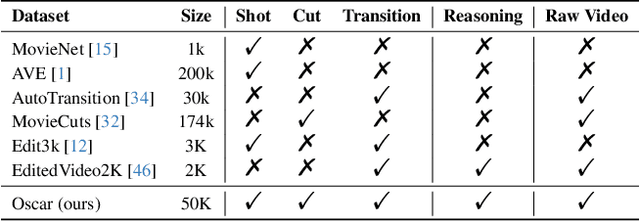
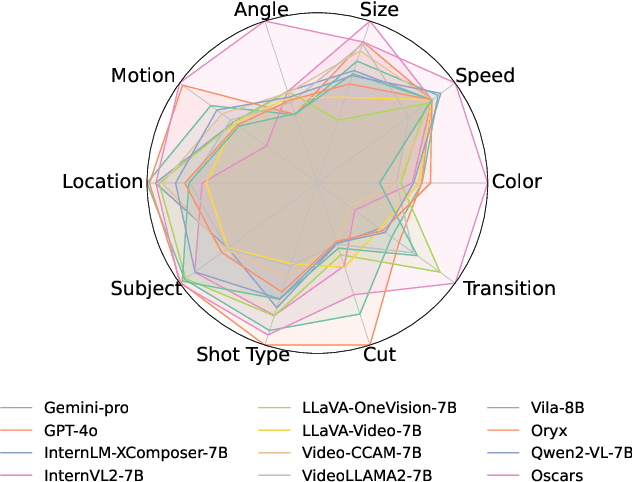
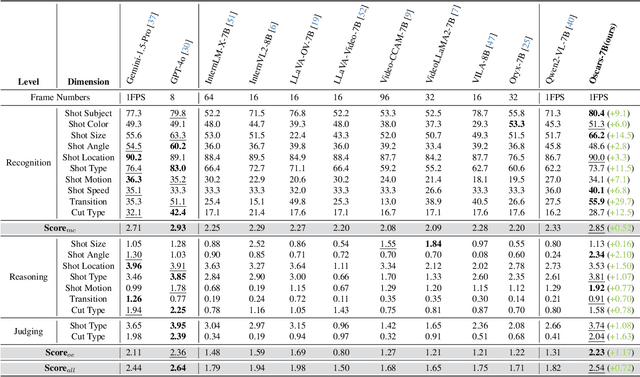
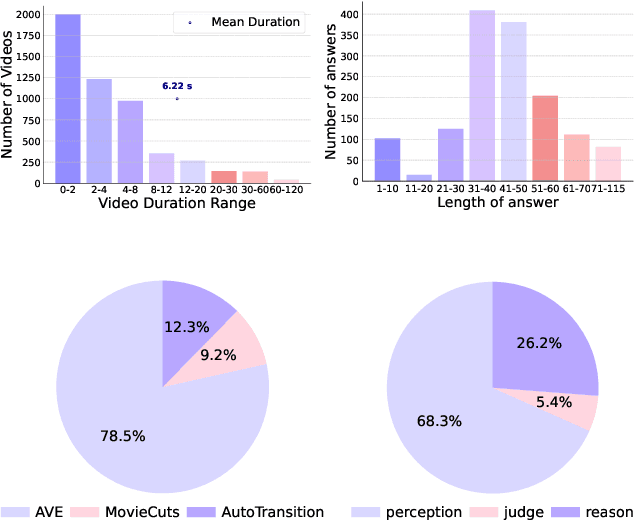
Widely shared videos on the internet are often edited. Recently, although Video Large Language Models (Vid-LLMs) have made great progress in general video understanding tasks, their capabilities in video editing understanding (VEU) tasks remain unexplored. To address this gap, in this paper, we introduce VEU-Bench (Video Editing Understanding Benchmark), a comprehensive benchmark that categorizes video editing components across various dimensions, from intra-frame features like shot size to inter-shot attributes such as cut types and transitions. Unlike previous video editing understanding benchmarks that focus mainly on editing element classification, VEU-Bench encompasses 19 fine-grained tasks across three stages: recognition, reasoning, and judging. To enhance the annotation of VEU automatically, we built an annotation pipeline integrated with an ontology-based knowledge base. Through extensive experiments with 11 state-of-the-art Vid-LLMs, our findings reveal that current Vid-LLMs face significant challenges in VEU tasks, with some performing worse than random choice. To alleviate this issue, we develop Oscars, a VEU expert model fine-tuned on the curated VEU-Bench dataset. It outperforms existing open-source Vid-LLMs on VEU-Bench by over 28.3% in accuracy and achieves performance comparable to commercial models like GPT-4o. We also demonstrate that incorporating VEU data significantly enhances the performance of Vid-LLMs on general video understanding benchmarks, with an average improvement of 8.3% across nine reasoning tasks.
Automatically Planning Optimal Parallel Strategy for Large Language Models
Dec 31, 2024
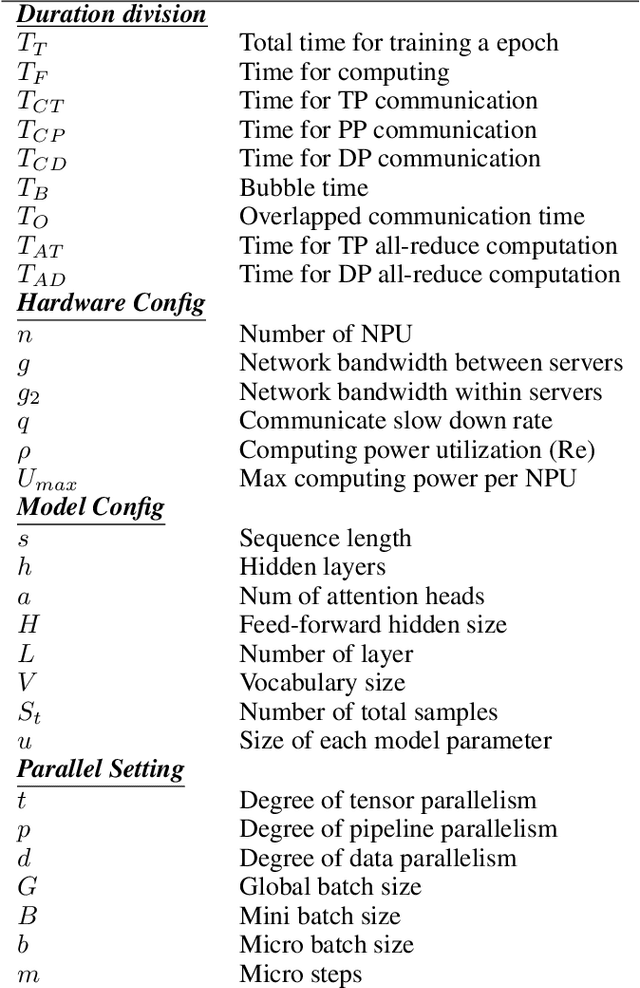
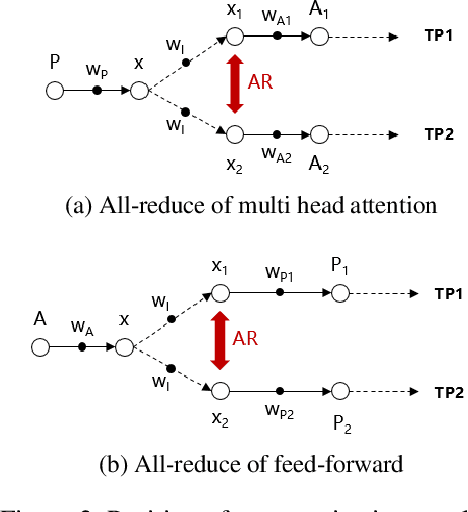

The number of parameters in large-scale language models based on transformers is gradually increasing, and the scale of computing clusters is also growing. The technology of quickly mobilizing large amounts of computing resources for parallel computing is becoming increasingly important. In this paper, we propose an automatic parallel algorithm that automatically plans the parallel strategy with maximum throughput based on model and hardware information. By decoupling the training time into computation, communication, and overlap, we established a training duration simulation model. Based on this simulation model, we prune the parallel solution space to shorten the search time required. The multi-node experiment results show that the algorithm can estimate the parallel training duration in real time with an average accuracy of 96%. In our test, the recommendation strategy provided by the algorithm is always globally optimal.