 Add to Chrome
 Add to Firefox
 Add to Edge
Ovis
Papers and Code
Autoregressive Universal Video Segmentation Model
Aug 26, 2025
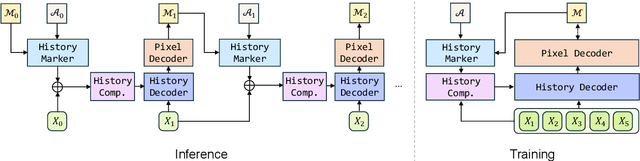
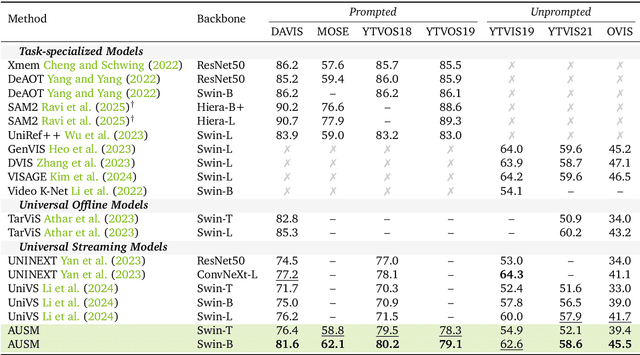
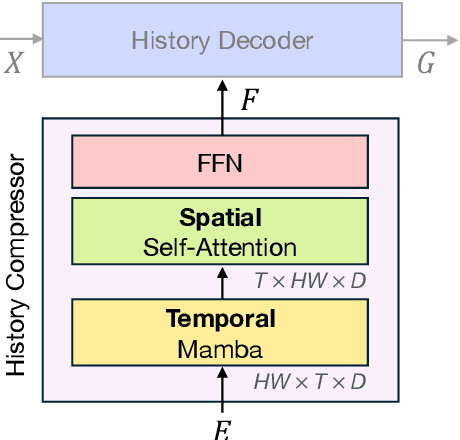
Recent video foundation models such as SAM2 excel at prompted video segmentation by treating masks as a general-purpose primitive. However, many real-world settings require unprompted segmentation that aims to detect and track all objects in a video without external cues, leaving today's landscape fragmented across task-specific models and pipelines. We recast streaming video segmentation as sequential mask prediction, analogous to language modeling, and introduce the Autoregressive Universal Segmentation Model (AUSM), a single architecture that unifies both prompted and unprompted video segmentation. Built on recent state-space models, AUSM maintains a fixed-size spatial state and scales to video streams of arbitrary length. Furthermore, all components of AUSM are designed for parallel training across frames, yielding substantial speedups over iterative training. On standard benchmarks (DAVIS17, YouTube-VOS 2018 & 2019, MOSE, YouTube-VIS 2019 & 2021, and OVIS) AUSM outperforms prior universal streaming video segmentation methods and achieves up to 2.5x faster training on 16-frame sequences.

Local2Global query Alignment for Video Instance Segmentation
Jul 27, 2025Online video segmentation methods excel at handling long sequences and capturing gradual changes, making them ideal for real-world applications. However, achieving temporally consistent predictions remains a challenge, especially with gradual accumulation of noise or drift in on-line propagation, abrupt occlusions and scene transitions. This paper introduces Local2Global, an online framework, for video instance segmentation, exhibiting state-of-the-art performance with simple baseline and training purely in online fashion. Leveraging the DETR-based query propagation framework, we introduce two novel sets of queries:(1) local queries that capture initial object-specific spatial features from each frame and (2) global queries containing past spatio-temporal representations. We propose the L2G-aligner, a novel lightweight transformer decoder, to facilitate an early alignment between local and global queries. This alignment allows our model to effectively utilize current frame information while maintaining temporal consistency, producing a smooth transition between frames. Furthermore, L2G-aligner is integrated within the segmentation model, without relying on additional complex heuristics, or memory mechanisms. Extensive experiments across various challenging VIS and VPS datasets showcase the superiority of our method with simple online training, surpassing current benchmarks without bells and rings. For instance, we achieve 54.3 and 49.4 AP on Youtube-VIS-19/-21 datasets and 37.0 AP on OVIS dataset respectively withthe ResNet-50 backbone.
SyncVIS: Synchronized Video Instance Segmentation
Dec 01, 2024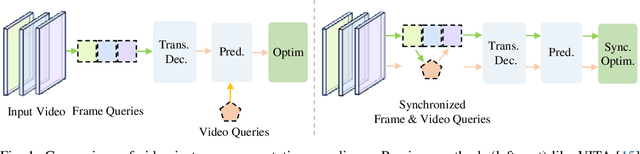
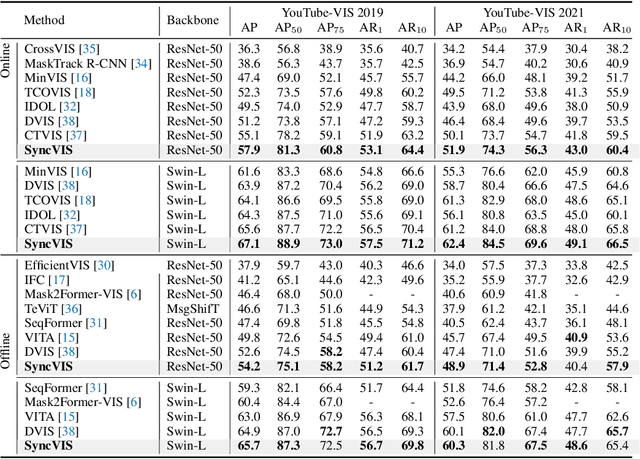

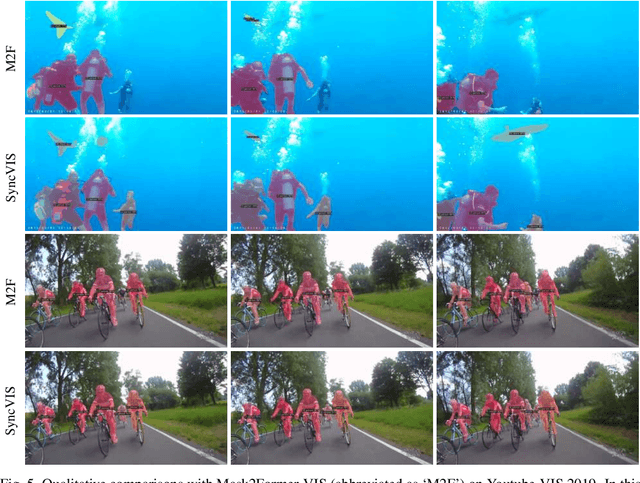
Recent DETR-based methods have advanced the development of Video Instance Segmentation (VIS) through transformers' efficiency and capability in modeling spatial and temporal information. Despite harvesting remarkable progress, existing works follow asynchronous designs, which model video sequences via either video-level queries only or adopting query-sensitive cascade structures, resulting in difficulties when handling complex and challenging video scenarios. In this work, we analyze the cause of this phenomenon and the limitations of the current solutions, and propose to conduct synchronized modeling via a new framework named SyncVIS. Specifically, SyncVIS explicitly introduces video-level query embeddings and designs two key modules to synchronize video-level query with frame-level query embeddings: a synchronized video-frame modeling paradigm and a synchronized embedding optimization strategy. The former attempts to promote the mutual learning of frame- and video-level embeddings with each other and the latter divides large video sequences into small clips for easier optimization. Extensive experimental evaluations are conducted on the challenging YouTube-VIS 2019 & 2021 & 2022, and OVIS benchmarks and SyncVIS achieves state-of-the-art results, which demonstrates the effectiveness and generality of the proposed approach. The code is available at https://github.com/rkzheng99/SyncVIS.
On Occlusions in Video Action Detection: Benchmark Datasets And Training Recipes
Oct 25, 2024


This paper explores the impact of occlusions in video action detection. We facilitate this study by introducing five new benchmark datasets namely O-UCF and O-JHMDB consisting of synthetically controlled static/dynamic occlusions, OVIS-UCF and OVIS-JHMDB consisting of occlusions with realistic motions and Real-OUCF for occlusions in realistic-world scenarios. We formally confirm an intuitive expectation: existing models suffer a lot as occlusion severity is increased and exhibit different behaviours when occluders are static vs when they are moving. We discover several intriguing phenomenon emerging in neural nets: 1) transformers can naturally outperform CNN models which might have even used occlusion as a form of data augmentation during training 2) incorporating symbolic-components like capsules to such backbones allows them to bind to occluders never even seen during training and 3) Islands of agreement can emerge in realistic images/videos without instance-level supervision, distillation or contrastive-based objectives2(eg. video-textual training). Such emergent properties allow us to derive simple yet effective training recipes which lead to robust occlusion models inductively satisfying the first two stages of the binding mechanism (grouping/segregation). Models leveraging these recipes outperform existing video action-detectors under occlusion by 32.3% on O-UCF, 32.7% on O-JHMDB & 2.6% on Real-OUCF in terms of the vMAP metric. The code for this work has been released at https://github.com/rajatmodi62/OccludedActionBenchmark.
Are Deep Learning Models Robust to Partial Object Occlusion in Visual Recognition Tasks?
Sep 16, 2024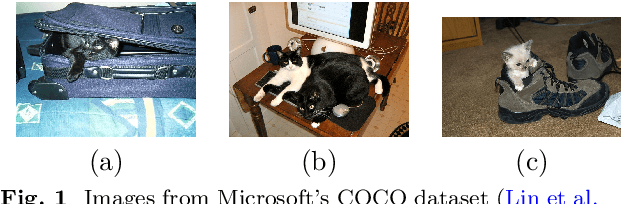

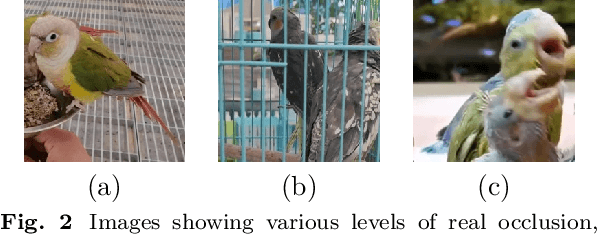
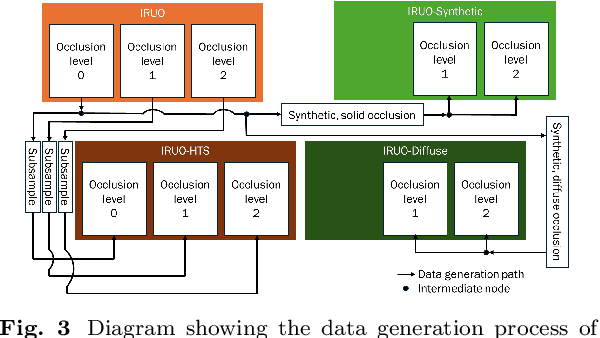
Image classification models, including convolutional neural networks (CNNs), perform well on a variety of classification tasks but struggle under conditions of partial occlusion, i.e., conditions in which objects are partially covered from the view of a camera. Methods to improve performance under occlusion, including data augmentation, part-based clustering, and more inherently robust architectures, including Vision Transformer (ViT) models, have, to some extent, been evaluated on their ability to classify objects under partial occlusion. However, evaluations of these methods have largely relied on images containing artificial occlusion, which are typically computer-generated and therefore inexpensive to label. Additionally, methods are rarely compared against each other, and many methods are compared against early, now outdated, deep learning models. We contribute the Image Recognition Under Occlusion (IRUO) dataset, based on the recently developed Occluded Video Instance Segmentation (OVIS) dataset (arXiv:2102.01558). IRUO utilizes real-world and artificially occluded images to test and benchmark leading methods' robustness to partial occlusion in visual recognition tasks. In addition, we contribute the design and results of a human study using images from IRUO that evaluates human classification performance at multiple levels and types of occlusion. We find that modern CNN-based models show improved recognition accuracy on occluded images compared to earlier CNN-based models, and ViT-based models are more accurate than CNN-based models on occluded images, performing only modestly worse than human accuracy. We also find that certain types of occlusion, including diffuse occlusion, where relevant objects are seen through "holes" in occluders such as fences and leaves, can greatly reduce the accuracy of deep recognition models as compared to humans, especially those with CNN backbones.
Eigen-Cluster VIS: Improving Weakly-supervised Video Instance Segmentation by Leveraging Spatio-temporal Consistency
Aug 29, 2024

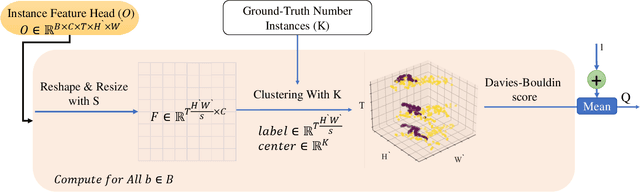

The performance of Video Instance Segmentation (VIS) methods has improved significantly with the advent of transformer networks. However, these networks often face challenges in training due to the high annotation cost. To address this, unsupervised and weakly-supervised methods have been developed to reduce the dependency on annotations. This work introduces a novel weakly-supervised method called Eigen-cluster VIS that, without requiring any mask annotations, achieves competitive accuracy compared to other VIS approaches. This method is based on two key innovations: a Temporal Eigenvalue Loss (TEL) and a clip-level Quality Cluster Coefficient (QCC). The TEL ensures temporal coherence by leveraging the eigenvalues of the Laplacian matrix derived from graph adjacency matrices. By minimizing the mean absolute error (MAE) between the eigenvalues of adjacent frames, this loss function promotes smooth transitions and stable segmentation boundaries over time, reducing temporal discontinuities and improving overall segmentation quality. The QCC employs the K-means method to ensure the quality of spatio-temporal clusters without relying on ground truth masks. Using the Davies-Bouldin score, the QCC provides an unsupervised measure of feature discrimination, allowing the model to self-evaluate and adapt to varying object distributions, enhancing robustness during the testing phase. These enhancements are computationally efficient and straightforward, offering significant performance gains without additional annotated data. The proposed Eigen-Cluster VIS method is evaluated on the YouTube-VIS 2019/2021 and OVIS datasets, demonstrating that it effectively narrows the performance gap between the fully-supervised and weakly-supervised VIS approaches. The code is available on: https://github.com/farnooshar/EigenClusterVIS
Unified Embedding Alignment for Open-Vocabulary Video Instance Segmentation
Jul 10, 2024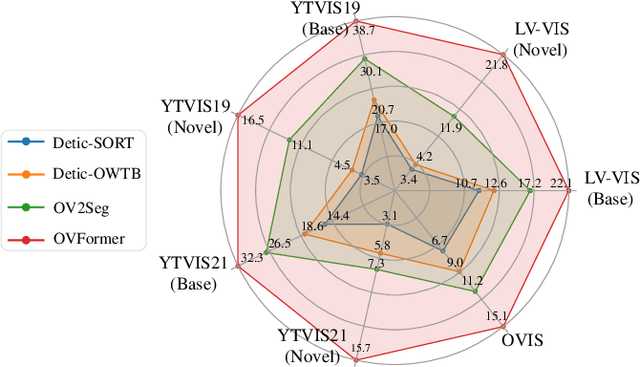
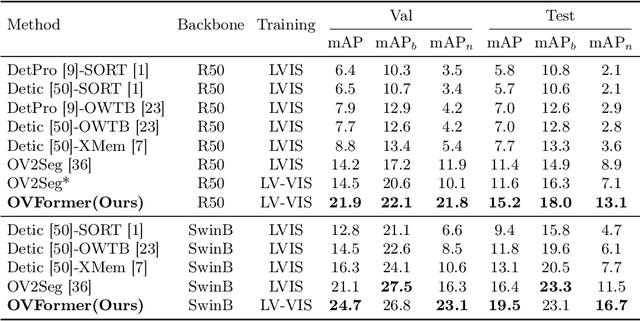
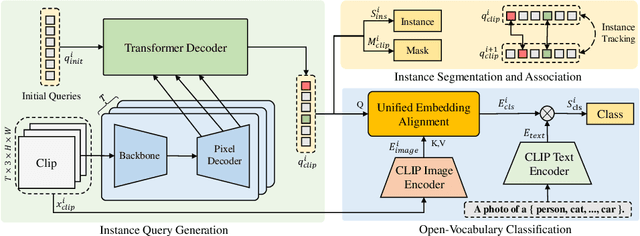
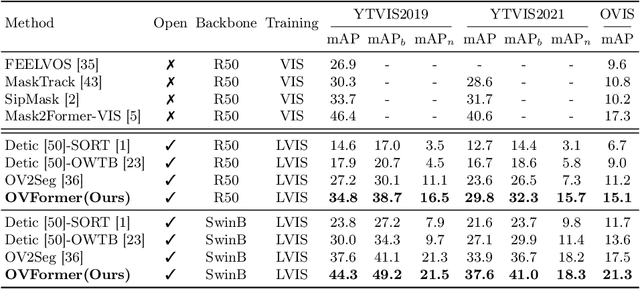
Open-Vocabulary Video Instance Segmentation (VIS) is attracting increasing attention due to its ability to segment and track arbitrary objects. However, the recent Open-Vocabulary VIS attempts obtained unsatisfactory results, especially in terms of generalization ability of novel categories. We discover that the domain gap between the VLM features (e.g., CLIP) and the instance queries and the underutilization of temporal consistency are two central causes. To mitigate these issues, we design and train a novel Open-Vocabulary VIS baseline called OVFormer. OVFormer utilizes a lightweight module for unified embedding alignment between query embeddings and CLIP image embeddings to remedy the domain gap. Unlike previous image-based training methods, we conduct video-based model training and deploy a semi-online inference scheme to fully mine the temporal consistency in the video. Without bells and whistles, OVFormer achieves 21.9 mAP with a ResNet-50 backbone on LV-VIS, exceeding the previous state-of-the-art performance by 7.7. Extensive experiments on some Close-Vocabulary VIS datasets also demonstrate the strong zero-shot generalization ability of OVFormer (+ 7.6 mAP on YouTube-VIS 2019, + 3.9 mAP on OVIS). Code is available at https://github.com/fanghaook/OVFormer.
Context-Aware Video Instance Segmentation
Jul 03, 2024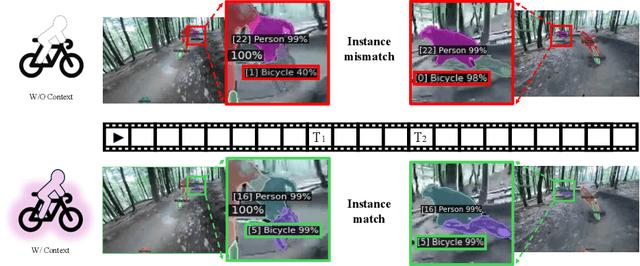
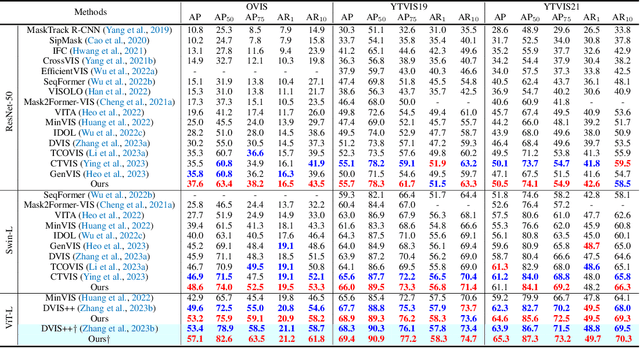
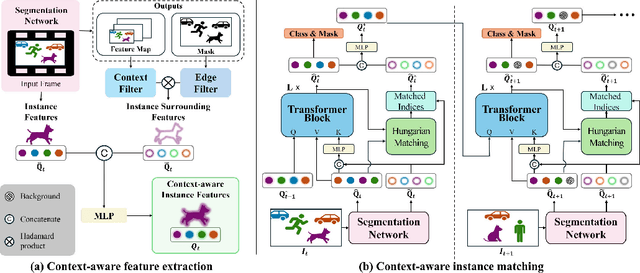
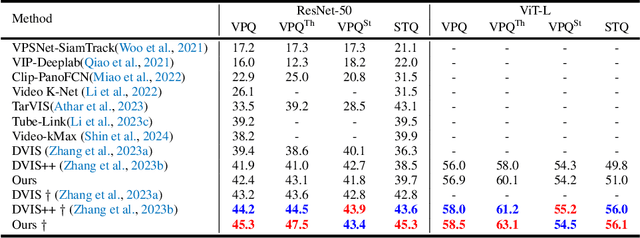
In this paper, we introduce the Context-Aware Video Instance Segmentation (CAVIS), a novel framework designed to enhance instance association by integrating contextual information adjacent to each object. To efficiently extract and leverage this information, we propose the Context-Aware Instance Tracker (CAIT), which merges contextual data surrounding the instances with the core instance features to improve tracking accuracy. Additionally, we introduce the Prototypical Cross-frame Contrastive (PCC) loss, which ensures consistency in object-level features across frames, thereby significantly enhancing instance matching accuracy. CAVIS demonstrates superior performance over state-of-the-art methods on all benchmark datasets in video instance segmentation (VIS) and video panoptic segmentation (VPS). Notably, our method excels on the OVIS dataset, which is known for its particularly challenging videos.
Ovis: Structural Embedding Alignment for Multimodal Large Language Model
May 31, 2024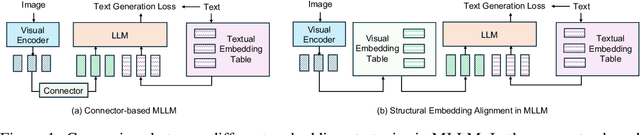
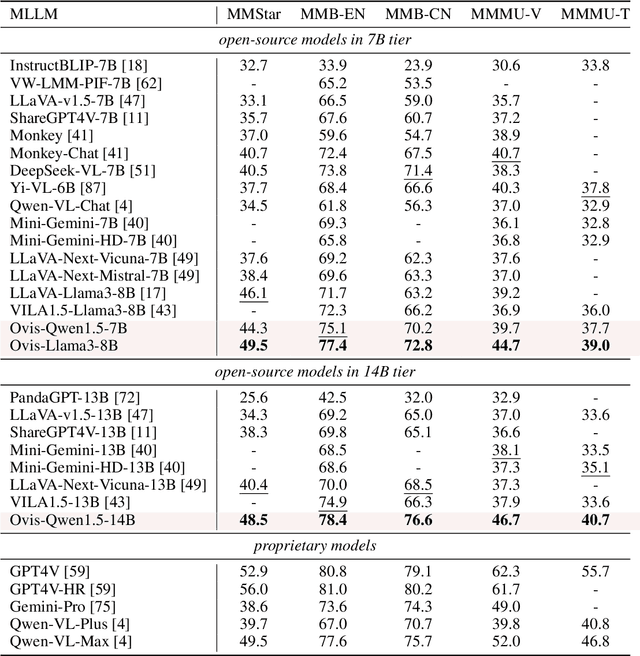
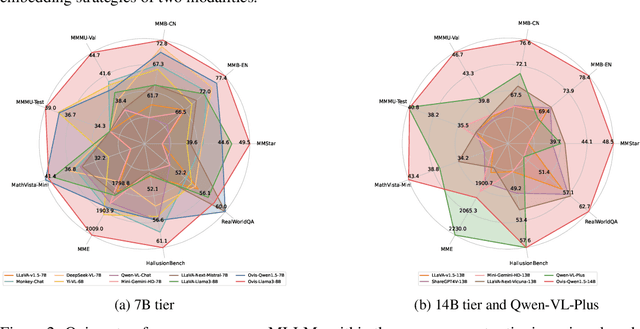
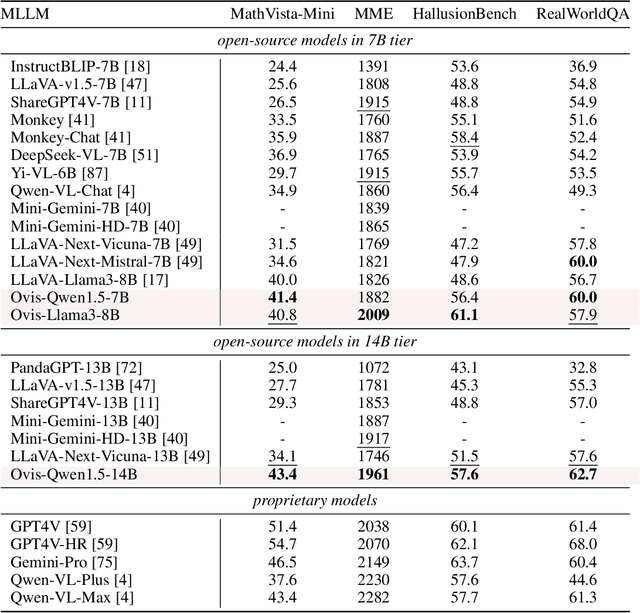
Current Multimodal Large Language Models (MLLMs) typically integrate a pre-trained LLM with another pre-trained vision transformer through a connector, such as an MLP, endowing the LLM with visual capabilities. However, the misalignment between two embedding strategies in MLLMs -- the structural textual embeddings based on an embedding look-up table and the continuous embeddings generated directly by the vision encoder -- makes challenges for a more seamless fusion of visual and textual information. We propose Ovis, a novel MLLM architecture designed to structurally align visual and textual embeddings. Ovis integrates an additional learnable visual embedding table into the visual encoder's process. To capture rich visual semantics, each image patch indexes the visual embedding table multiple times, resulting in a final visual embedding that is a probabilistic combination of the indexed embeddings. This structural approach mirrors the method used for generating textual embeddings. Empirical evaluations on various multimodal benchmarks demonstrate that Ovis outperforms open-source MLLMs of similar parameter scales and even surpasses the proprietary model Qwen-VL-Plus overall. These results highlight the potential of Ovis' structured visual representation for advancing MLLM architectural design and promoting more effective multimodal learning. Both the source code and the training dataset of Ovis will be made publicly available.
PM-VIS: High-Performance Box-Supervised Video Instance Segmentation
Apr 22, 2024
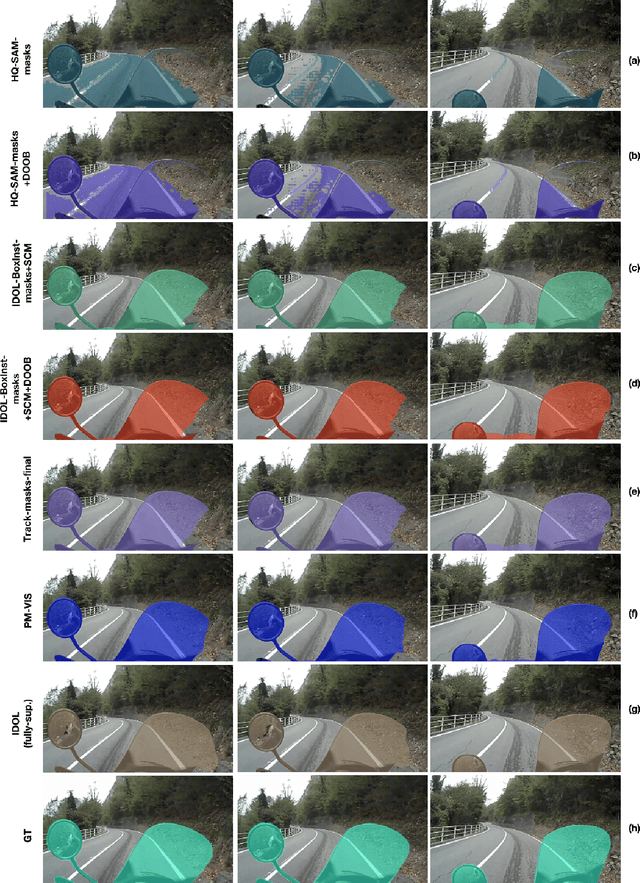
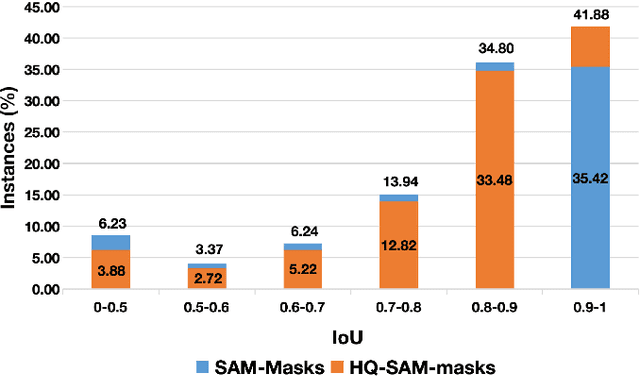
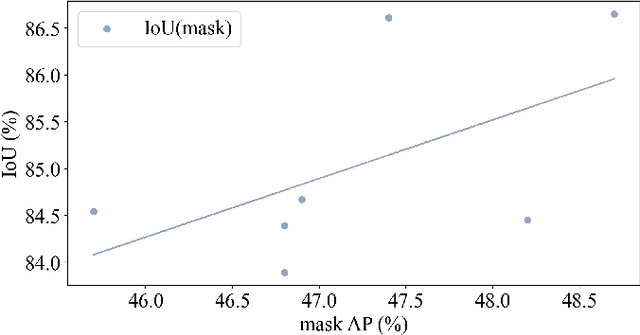
Labeling pixel-wise object masks in videos is a resource-intensive and laborious process. Box-supervised Video Instance Segmentation (VIS) methods have emerged as a viable solution to mitigate the labor-intensive annotation process. . In practical applications, the two-step approach is not only more flexible but also exhibits a higher recognition accuracy. Inspired by the recent success of Segment Anything Model (SAM), we introduce a novel approach that aims at harnessing instance box annotations from multiple perspectives to generate high-quality instance pseudo masks, thus enriching the information contained in instance annotations. We leverage ground-truth boxes to create three types of pseudo masks using the HQ-SAM model, the box-supervised VIS model (IDOL-BoxInst), and the VOS model (DeAOT) separately, along with three corresponding optimization mechanisms. Additionally, we introduce two ground-truth data filtering methods, assisted by high-quality pseudo masks, to further enhance the training dataset quality and improve the performance of fully supervised VIS methods. To fully capitalize on the obtained high-quality Pseudo Masks, we introduce a novel algorithm, PM-VIS, to integrate mask losses into IDOL-BoxInst. Our PM-VIS model, trained with high-quality pseudo mask annotations, demonstrates strong ability in instance mask prediction, achieving state-of-the-art performance on the YouTube-VIS 2019, YouTube-VIS 2021, and OVIS validation sets, notably narrowing the gap between box-supervised and fully supervised VIS methods.