 Add to Chrome
 Add to Firefox
 Add to Edge
Raven: High-Recall Sequence Modeling with Sparse Memory Routing
Jul 28, 2026
Long-context recall in linear-time sequence models highlights a tradeoff in how they write to memory. State-based linear models, such as state-space models (SSMs) and linear Transformers, write densely, updating the entire state for each newly arrived token, which leads to interference and makes specific past tokens hard to recover. Sliding-window attention (SWA) exhibits the opposite behavior: it writes sparsely by storing explicit token representations, but only within a fixed window, so recall drops once the relevant token is evicted. Interpolating between these models, we introduce Raven, a linear-time sequence model that maintains a fixed set of memory slots and, at each step, decays and updates only a selected subset via learned, input-dependent routing. This lets Raven mitigate SWA's position-based overwriting and hard eviction while reducing interference from dense state updates in SSMs, thereby preserving long-range content much more effectively. Across recall-intensive benchmarks, Raven is competitive with or outperforms prior linear-time baselines, achieving strong long-context recall where both SWA and SSMs sharply degrade. It remains effective when extrapolating to context lengths as large as 16x its training length, with similar gains in hybrid architectures.

Mamba-3: Improved Sequence Modeling using State Space Principles
Mar 16, 2026Scaling inference-time compute has emerged as an important driver of LLM performance, making inference efficiency a central focus of model design alongside model quality. While the current Transformer-based models deliver strong model quality, their quadratic compute and linear memory make inference expensive. This has spurred the development of sub-quadratic models with reduced linear compute and constant memory requirements. However, many recent linear models trade off model quality and capability for algorithmic efficiency, failing on tasks such as state tracking. Moreover, their theoretically linear inference remains hardware-inefficient in practice. Guided by an inference-first perspective, we introduce three core methodological improvements inspired by the state space model (SSM) viewpoint of linear models. We combine: (1) a more expressive recurrence derived from SSM discretization, (2) a complex-valued state update rule that enables richer state tracking, and (3) a multi-input, multi-output (MIMO) formulation for better model performance without increasing decode latency. Together with architectural refinements, our Mamba-3 model achieves significant gains across retrieval, state-tracking, and downstream language modeling tasks. At the 1.5B scale, Mamba-3 improves average downstream accuracy by 0.6 percentage points compared to the next best model (Gated DeltaNet), with Mamba-3's MIMO variant further improving accuracy by another 1.2 points for a total 1.8 point gain. Across state-size experiments, Mamba-3 achieves comparable perplexity to Mamba-2 despite using half of its predecessor's state size. Our evaluations demonstrate Mamba-3's ability to advance the performance-efficiency Pareto frontier.
dnaHNet: A Scalable and Hierarchical Foundation Model for Genomic Sequence Learning
Feb 14, 2026Genomic foundation models have the potential to decode DNA syntax, yet face a fundamental tradeoff in their input representation. Standard fixed-vocabulary tokenizers fragment biologically meaningful motifs such as codons and regulatory elements, while nucleotide-level models preserve biological coherence but incur prohibitive computational costs for long contexts. We introduce dnaHNet, a state-of-the-art tokenizer-free autoregressive model that segments and models genomic sequences end-to-end. Using a differentiable dynamic chunking mechanism, dnaHNet compresses raw nucleotides into latent tokens adaptively, balancing compression with predictive accuracy. Pretrained on prokaryotic genomes, dnaHNet outperforms leading architectures including StripedHyena2 in scaling and efficiency. This recursive chunking yields quadratic FLOP reductions, enabling $>3 \times$ inference speedup over Transformers. On zero-shot tasks, dnaHNet achieves superior performance in predicting protein variant fitness and gene essentiality, while automatically discovering hierarchical biological structures without supervision. These results establish dnaHNet as a scalable, interpretable framework for next-generation genomic modeling.
Retrieval-Aware Distillation for Transformer-SSM Hybrids
Feb 11, 2026State-space models (SSMs) offer efficient sequence modeling but lag behind Transformers on benchmarks that require in-context retrieval. Prior work links this gap to a small set of attention heads, termed Gather-and-Aggregate (G&A), which SSMs struggle to reproduce. We propose *retrieval-aware distillation*, which converts a pretrained Transformer into a hybrid student by preserving only these retrieval-critical heads and distilling the rest into recurrent heads. We identify the essential heads via ablation on a synthetic retrieval task, producing a hybrid with sparse, non-uniform attention placement. We show that preserving **just 2% of attention heads recovers over 95% of teacher performance on retrieval-heavy tasks** (10 heads in a 1B model), requiring far fewer heads than hybrids that retain at least 25%. We further find that large recurrent states often compensate for missing retrieval: once retrieval is handled by these heads, the SSM backbone can be simplified with limited loss, even with an $8\times$ reduction in state dimension. By reducing both the attention cache and the SSM state, the resulting hybrid is $5$--$6\times$ more memory-efficient than comparable hybrids, closing the Transformer--SSM gap at a fraction of the memory cost.
Autoregressive Universal Video Segmentation Model
Aug 26, 2025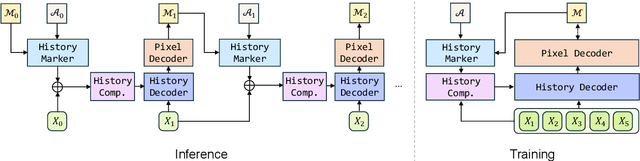
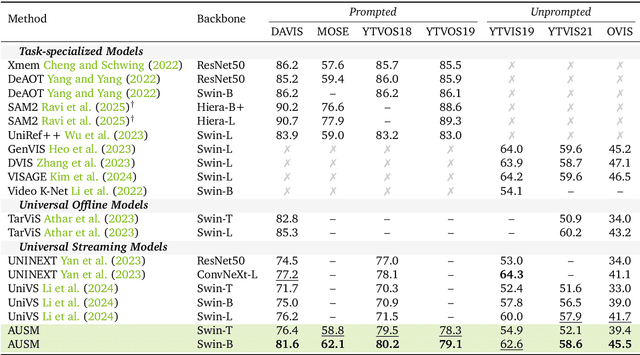
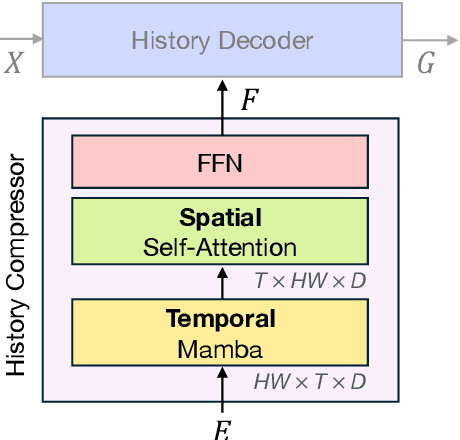
Recent video foundation models such as SAM2 excel at prompted video segmentation by treating masks as a general-purpose primitive. However, many real-world settings require unprompted segmentation that aims to detect and track all objects in a video without external cues, leaving today's landscape fragmented across task-specific models and pipelines. We recast streaming video segmentation as sequential mask prediction, analogous to language modeling, and introduce the Autoregressive Universal Segmentation Model (AUSM), a single architecture that unifies both prompted and unprompted video segmentation. Built on recent state-space models, AUSM maintains a fixed-size spatial state and scales to video streams of arbitrary length. Furthermore, all components of AUSM are designed for parallel training across frames, yielding substantial speedups over iterative training. On standard benchmarks (DAVIS17, YouTube-VOS 2018 & 2019, MOSE, YouTube-VIS 2019 & 2021, and OVIS) AUSM outperforms prior universal streaming video segmentation methods and achieves up to 2.5x faster training on 16-frame sequences.
Dynamic Chunking for End-to-End Hierarchical Sequence Modeling
Jul 10, 2025Despite incredible progress in language models (LMs) in recent years, largely resulting from moving away from specialized models designed for specific tasks to general models based on powerful architectures (e.g. the Transformer) that learn everything from raw data, pre-processing steps such as tokenization remain a barrier to true end-to-end foundation models. We introduce a collection of new techniques that enable a dynamic chunking mechanism which automatically learns content -- and context -- dependent segmentation strategies learned jointly with the rest of the model. Incorporating this into an explicit hierarchical network (H-Net) allows replacing the (implicitly hierarchical) tokenization-LM-detokenization pipeline with a single model learned fully end-to-end. When compute- and data- matched, an H-Net with one stage of hierarchy operating at the byte level outperforms a strong Transformer language model operating over BPE tokens. Iterating the hierarchy to multiple stages further increases its performance by modeling multiple levels of abstraction, demonstrating significantly better scaling with data and matching a token-based Transformer of twice its size. H-Nets pretrained on English show significantly increased character-level robustness, and qualitatively learn meaningful data-dependent chunking strategies without any heuristics or explicit supervision. Finally, the H-Net's improvement over tokenized pipelines is further increased in languages and modalities with weaker tokenization heuristics, such as Chinese and code, or DNA sequences (nearly 4x improvement in data efficiency over baselines), showing the potential of true end-to-end models that learn and scale better from unprocessed data.
Understanding and Improving Length Generalization in Recurrent Models
Jul 03, 2025Recently, recurrent models such as state space models and linear attention have become popular due to their linear complexity in the sequence length. Thanks to their recurrent nature, in principle they can process arbitrarily long sequences, but their performance sometimes drops considerably beyond their training context lengths-i.e. they fail to length generalize. In this work, we provide comprehensive empirical and theoretical analysis to support the unexplored states hypothesis, which posits that models fail to length generalize when during training they are only exposed to a limited subset of the distribution of all attainable states (i.e. states that would be attained if the recurrence was applied to long sequences). Furthermore, we investigate simple training interventions that aim to increase the coverage of the states that the model is trained on, e.g. by initializing the state with Gaussian noise or with the final state of a different input sequence. With only 500 post-training steps ($\sim 0.1\%$ of the pre-training budget), these interventions enable length generalization for sequences that are orders of magnitude longer than the training context (e.g. $2k\longrightarrow 128k$) and show improved performance in long context tasks, thus presenting a simple and efficient way to enable robust length generalization in general recurrent models.
Understanding the Skill Gap in Recurrent Language Models: The Role of the Gather-and-Aggregate Mechanism
Apr 22, 2025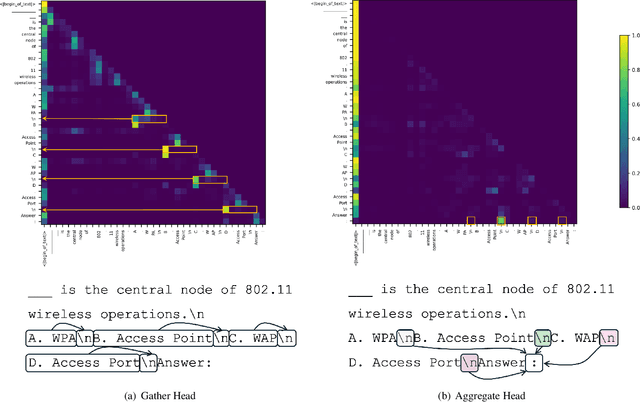
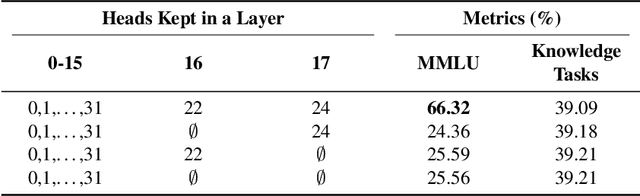
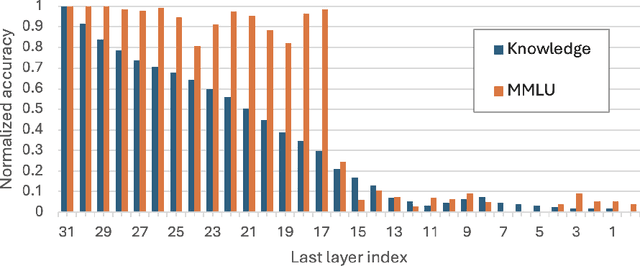
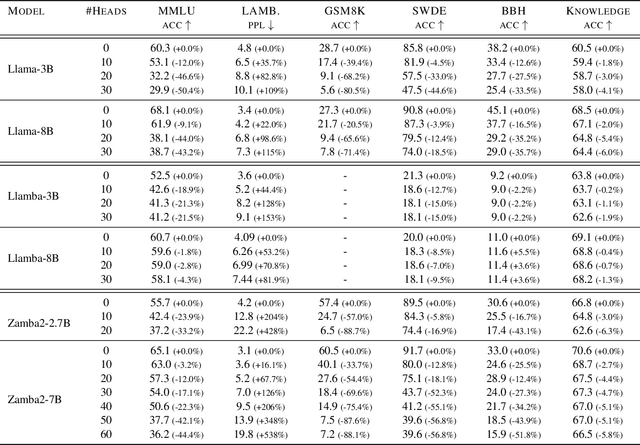
SSMs offer efficient processing of long sequences with fixed state sizes, but struggle with algorithmic tasks like retrieving past context. In this work, we examine how such in-context retrieval operates within Transformer- and SSM-based language models. We find that both architectures develop the same fundamental Gather-and-Aggregate (G&A) mechanism. A Gather Head first identifies and extracts relevant information from the context, which an Aggregate Head then integrates into a final representation. Across both model types, G&A concentrates in just a few heads, making them critical bottlenecks even for benchmarks that require a basic form of retrieval. For example, disabling a single Gather or Aggregate Head of a pruned Llama-3.1-8B degrades its ability to retrieve the correct answer letter in MMLU, reducing accuracy from 66% to 25%. This finding suggests that in-context retrieval can obscure the limited knowledge demands of certain tasks. Despite strong MMLU performance with retrieval intact, the pruned model fails on other knowledge tests. Similar G&A dependencies exist in GSM8K, BBH, and dialogue tasks. Given the significance of G&A in performance, we show that retrieval challenges in SSMs manifest in how they implement G&A, leading to smoother attention patterns rather than the sharp token transitions that effective G&A relies on. Thus, while a gap exists between Transformers and SSMs in implementing in-context retrieval, it is confined to a few heads, not the entire model. This insight suggests a unified explanation for performance differences between Transformers and SSMs while also highlighting ways to combine their strengths. For example, in pretrained hybrid models, attention components naturally take on the role of Aggregate Heads. Similarly, in a pretrained pure SSM, replacing a single G&A head with an attention-based variant significantly improves retrieval.
Lyra: An Efficient and Expressive Subquadratic Architecture for Modeling Biological Sequences
Mar 20, 2025Deep learning architectures such as convolutional neural networks and Transformers have revolutionized biological sequence modeling, with recent advances driven by scaling up foundation and task-specific models. The computational resources and large datasets required, however, limit their applicability in biological contexts. We introduce Lyra, a subquadratic architecture for sequence modeling, grounded in the biological framework of epistasis for understanding sequence-to-function relationships. Mathematically, we demonstrate that state space models efficiently capture global epistatic interactions and combine them with projected gated convolutions for modeling local relationships. We demonstrate that Lyra is performant across over 100 wide-ranging biological tasks, achieving state-of-the-art (SOTA) performance in many key areas, including protein fitness landscape prediction, biophysical property prediction (e.g. disordered protein region functions) peptide engineering applications (e.g. antibody binding, cell-penetrating peptide prediction), RNA structure analysis, RNA function prediction, and CRISPR guide design. It achieves this with orders-of-magnitude improvements in inference speed and reduction in parameters (up to 120,000-fold in our tests) compared to recent biology foundation models. Using Lyra, we were able to train and run every task in this study on two or fewer GPUs in under two hours, democratizing access to biological sequence modeling at SOTA performance, with potential applications to many fields.
Thinking Slow, Fast: Scaling Inference Compute with Distilled Reasoners
Feb 27, 2025Recent advancements have demonstrated that the performance of large language models (LLMs) can be significantly enhanced by scaling computational resources at test time. A common strategy involves generating multiple Chain-of-Thought (CoT) trajectories and aggregating their outputs through various selection mechanisms. This raises a fundamental question: can models with lower complexity leverage their superior generation throughput to outperform similarly sized Transformers for a fixed computational budget? To address this question and overcome the lack of strong subquadratic reasoners, we distill pure and hybrid Mamba models from pretrained Transformers. Trained on only 8 billion tokens, our distilled models show strong performance and scaling on mathematical reasoning datasets while being much faster at inference for large batches and long sequences. Despite the zero-shot performance hit due to distillation, both pure and hybrid Mamba models can scale their coverage and accuracy performance past their Transformer teacher models under fixed time budgets, opening a new direction for scaling inference compute.