 Add to Chrome
 Add to Firefox
 Add to Edge
CRAFT: Constrained Reward via Attention Fine-Tuning for Subject Personalization without Composed Targets
Aug 14, 2026
Subject-driven image personalization---generating new images that preserve the identity of one or several reference subjects in novel scenes---is a foundational capability for modern visual content creation. It is currently dominated by generalized methods that fine-tune a pretrained multimodal diffusion transformer (MMDiT) on hundreds of thousands to millions of paired \emph{(reference, composed-target)} examples, where each composed target is a synthesized image of the subject in a novel scene. Producing such targets demands a costly multi-stage curation pipeline---LLM-based prompt generation, T2I-based composed-target synthesis, reference-subject extraction, VLM-based quality filtering, and correspondence labeling---and tightly couples each method to a particular target synthesizer and curation choice. We introduce \emph{CRAFT} (Constrained Reward via Attention Fine-Tuning), a single-step ReFL framework that fine-tunes a pre-trained \emph{reference-aware} MMDiT via LoRA adapters using a compact reference-only data construction---$10$K reference images and subject masks, with no composed-target supervision. CRAFT realizes a \emph{Where to look} principle: attention-level rewards align noise- and phrase-token attention with the correct reference subject, and the resulting per-subject attention masks gate a pixel-level identity reward to keep image-space supervision consistent with the learned attention routing. Applied to FLUX.2-klein-9B, CRAFT achieves state-of-the-art performance on XVerseBench \rev{while using no composed-target supervision---only $10$K reference-only samples, whereas prior generalized methods require $150$K to over $2$M composed-target pairs}. The same recipe transfers to other reference-aware backbones, consistently improving performance. Project page: https://jihun999.github.io/projects/CRAFT/.

CascadeOcc: Rethinking 3D Occupancy World Models with Cascaded VQ Representations
Jun 26, 2026This letter proposes CascadeOcc, a novel occupancy world model that prioritizes intrinsic structural hierarchy over extrinsic auxiliary modalities for autonomous driving. Occupancy world models -- forecasting the future driving environment and planning the driving trajectory -- effectively bridge perception and planning, but current approaches often heavily rely on external modalities or large language models, failing to fully exploit the inherent structural potential of occupancy representations themselves. To enhance representational capacity for complex 3D scenes, we integrate a cascaded Vector Quantized (VQ) mechanism into an autoregressive framework. Following a coarse-to-fine principle, CascadeOcc progressively refines fine-grained details from global structures through a multi-scale architecture. Additionally, we incorporate a TimeMixer to capture multi-scale temporal dependencies, establishing a dual-hierarchy mechanism in both space and time. Experimental results on 4D occupancy forecasting and motion planning benchmarks demonstrate that CascadeOcc achieves superior performance among vision-centric approaches, validating that optimizing inherent representations is a powerful alternative to relying on external foundation models.
RobOralScan: Learning Active Intraoral Scanning for Robotic Dental Reconstruction
Jun 25, 2026Intraoral scanning is widely used for digital optical impressions in prosthodontic, implant, and orthodontic treatment, but full-arch and long-span scanning remain labor-intensive tasks with limited automation. In the confined oral cavity, operators must continuously adjust scanner motion while accumulating narrow field-of-view observations, making reconstruction quality sensitive to missing tooth surfaces and operator workload. We propose RobOralScan, which, to the best of our knowledge, is the first reinforcement learning (RL)-based pipeline for robotic automatic intraoral scanning. RobOralScan introduces a geometric memory-based observation space that accumulates partial scan observations into a tri-state geometric representation, allowing the policy to reason over scan history and insufficiently observed regions. It further introduces tooth-wise coverage learning, combining coverage-aware reward signals and a progressive training scheme to improve global reconstruction coverage while reducing uneven coverage across individual teeth. The learned policy selects relative scanner motions from accumulated geometric memory and robot proprioception for closed-loop scan control within the oral workspace. RobOralScan achieves a Chamfer Distance of 0.00838, an average coverage of 92.58%, a lower-tail per-tooth coverage of 88.45%, and a normalized AUC of 0.6674, completing the scan criterion in 8 of 10 evaluation episodes. Furthermore, zero-shot sim-to-real experiments demonstrate its practical feasibility on a physical robot-scanner setup.
Linear Recurrent Unit with Semantic Modulation for Image Super-Resolution
Jun 18, 2026Linear recurrent unit (LRU), designed with a principled formulation for stable linear recurrence, has demonstrated promising accuracy and robustness on long-range dependency tasks. However, its static parameterization and single-scan method limits its applicability to 2D vision tasks. In this study, we propose a LRU-based restoration network with a semantic modulating unit (SMU) to achieve a harmonious balance between performance and efficiency in single-image super-resolution. The SMU plays three key roles: LRU modulation, spatial categorization, and feature enhancement through learned prototype. Extensive experiments demonstrate that our method quantitatively and qualitatively surpasses recent state-of-the-art methods. Notably, our approach achieves superior performance with computational complexity on par with existing methods. The source code and models are available at https://github.com/MingyuChoi-run/LSM
CVA: Context-aware Video-text Alignment for Video Temporal Grounding
Mar 26, 2026We propose Context-aware Video-text Alignment (CVA), a novel framework to address a significant challenge in video temporal grounding: achieving temporally sensitive video-text alignment that remains robust to irrelevant background context. Our framework is built on three key components. First, we propose Query-aware Context Diversification (QCD), a new data augmentation strategy that ensures only semantically unrelated content is mixed in. It builds a video-text similarity-based pool of replacement clips to simulate diverse contexts while preventing the ``false negative" caused by query-agnostic mixing. Second, we introduce the Context-invariant Boundary Discrimination (CBD) loss, a contrastive loss that enforces semantic consistency at challenging temporal boundaries, making their representations robust to contextual shifts and hard negatives. Third, we introduce the Context-enhanced Transformer Encoder (CTE), a hierarchical architecture that combines windowed self-attention and bidirectional cross-attention with learnable queries to capture multi-scale temporal context. Through the synergy of these data-centric and architectural enhancements, CVA achieves state-of-the-art performance on major VTG benchmarks, including QVHighlights and Charades-STA. Notably, our method achieves a significant improvement of approximately 5 points in Recall@1 (R1) scores over state-of-the-art methods, highlighting its effectiveness in mitigating false negatives.
Scale-invariant and View-relational Representation Learning for Full Surround Monocular Depth
Dec 09, 2025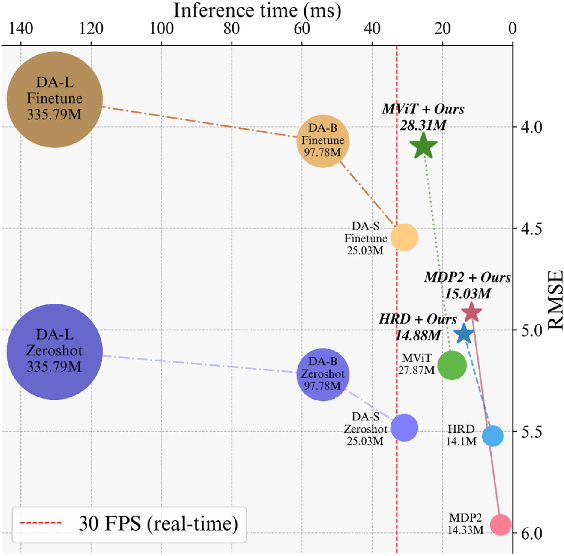
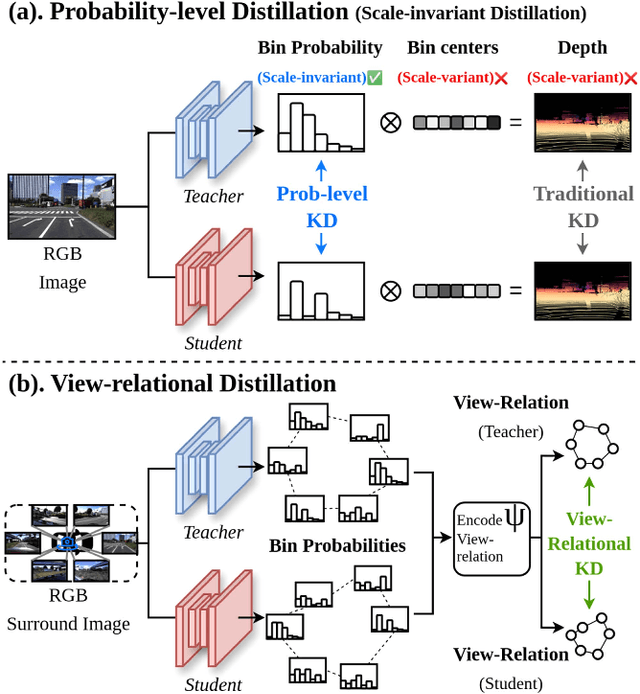
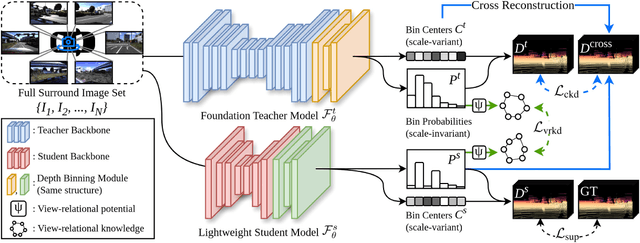
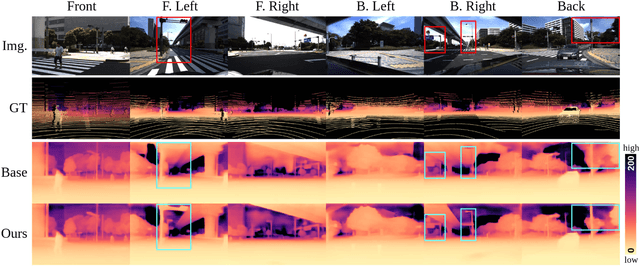
Recent foundation models demonstrate strong generalization capabilities in monocular depth estimation. However, directly applying these models to Full Surround Monocular Depth Estimation (FSMDE) presents two major challenges: (1) high computational cost, which limits real-time performance, and (2) difficulty in estimating metric-scale depth, as these models are typically trained to predict only relative depth. To address these limitations, we propose a novel knowledge distillation strategy that transfers robust depth knowledge from a foundation model to a lightweight FSMDE network. Our approach leverages a hybrid regression framework combining the knowledge distillation scheme--traditionally used in classification--with a depth binning module to enhance scale consistency. Specifically, we introduce a cross-interaction knowledge distillation scheme that distills the scale-invariant depth bin probabilities of a foundation model into the student network while guiding it to infer metric-scale depth bin centers from ground-truth depth. Furthermore, we propose view-relational knowledge distillation, which encodes structural relationships among adjacent camera views and transfers them to enhance cross-view depth consistency. Experiments on DDAD and nuScenes demonstrate the effectiveness of our method compared to conventional supervised methods and existing knowledge distillation approaches. Moreover, our method achieves a favorable trade-off between performance and efficiency, meeting real-time requirements.
Infinite-Story: A Training-Free Consistent Text-to-Image Generation
Nov 17, 2025We present Infinite-Story, a training-free framework for consistent text-to-image (T2I) generation tailored for multi-prompt storytelling scenarios. Built upon a scale-wise autoregressive model, our method addresses two key challenges in consistent T2I generation: identity inconsistency and style inconsistency. To overcome these issues, we introduce three complementary techniques: Identity Prompt Replacement, which mitigates context bias in text encoders to align identity attributes across prompts; and a unified attention guidance mechanism comprising Adaptive Style Injection and Synchronized Guidance Adaptation, which jointly enforce global style and identity appearance consistency while preserving prompt fidelity. Unlike prior diffusion-based approaches that require fine-tuning or suffer from slow inference, Infinite-Story operates entirely at test time, delivering high identity and style consistency across diverse prompts. Extensive experiments demonstrate that our method achieves state-of-the-art generation performance, while offering over 6X faster inference (1.72 seconds per image) than the existing fastest consistent T2I models, highlighting its effectiveness and practicality for real-world visual storytelling.
Bridging Geometric and Semantic Foundation Models for Generalized Monocular Depth Estimation
May 29, 2025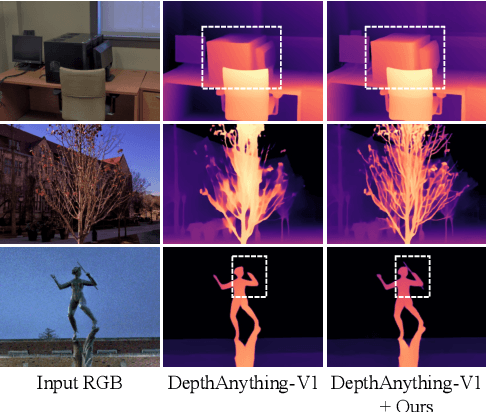
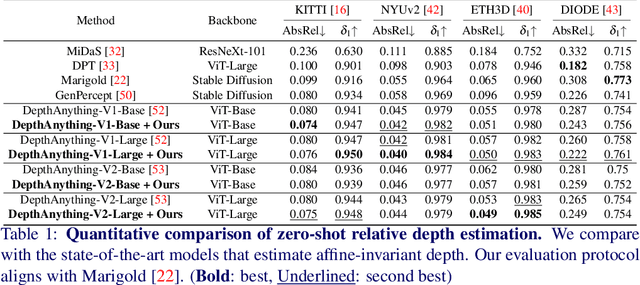
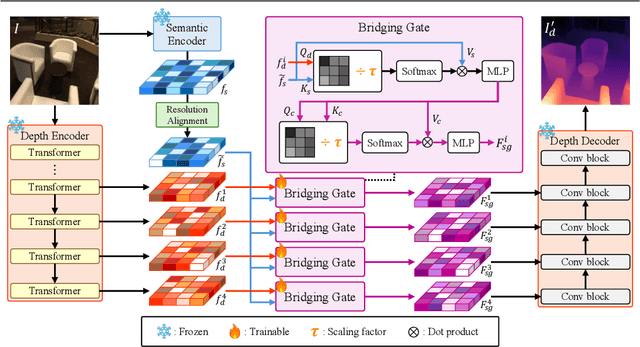

We present Bridging Geometric and Semantic (BriGeS), an effective method that fuses geometric and semantic information within foundation models to enhance Monocular Depth Estimation (MDE). Central to BriGeS is the Bridging Gate, which integrates the complementary strengths of depth and segmentation foundation models. This integration is further refined by our Attention Temperature Scaling technique. It finely adjusts the focus of the attention mechanisms to prevent over-concentration on specific features, thus ensuring balanced performance across diverse inputs. BriGeS capitalizes on pre-trained foundation models and adopts a strategy that focuses on training only the Bridging Gate. This method significantly reduces resource demands and training time while maintaining the model's ability to generalize effectively. Extensive experiments across multiple challenging datasets demonstrate that BriGeS outperforms state-of-the-art methods in MDE for complex scenes, effectively handling intricate structures and overlapping objects.
A Training-Free Style-aligned Image Generation with Scale-wise Autoregressive Model
Apr 08, 2025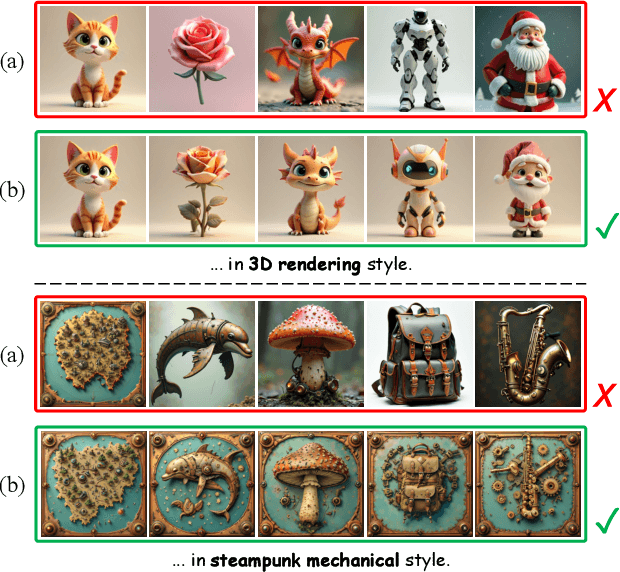

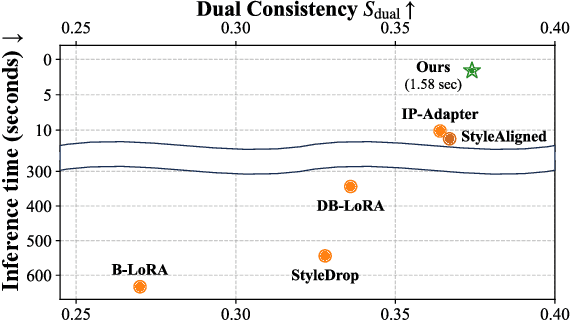
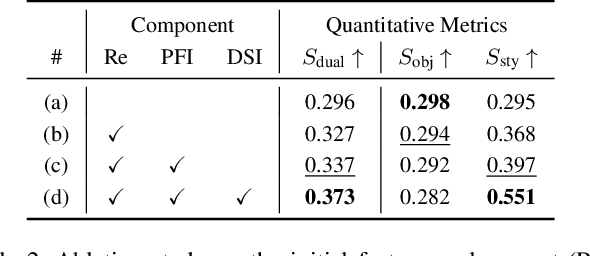
We present a training-free style-aligned image generation method that leverages a scale-wise autoregressive model. While large-scale text-to-image (T2I) models, particularly diffusion-based methods, have demonstrated impressive generation quality, they often suffer from style misalignment across generated image sets and slow inference speeds, limiting their practical usability. To address these issues, we propose three key components: initial feature replacement to ensure consistent background appearance, pivotal feature interpolation to align object placement, and dynamic style injection, which reinforces style consistency using a schedule function. Unlike previous methods requiring fine-tuning or additional training, our approach maintains fast inference while preserving individual content details. Extensive experiments show that our method achieves generation quality comparable to competing approaches, significantly improves style alignment, and delivers inference speeds over six times faster than the fastest model.
Intrinsic Image Decomposition for Robust Self-supervised Monocular Depth Estimation on Reflective Surfaces
Mar 28, 2025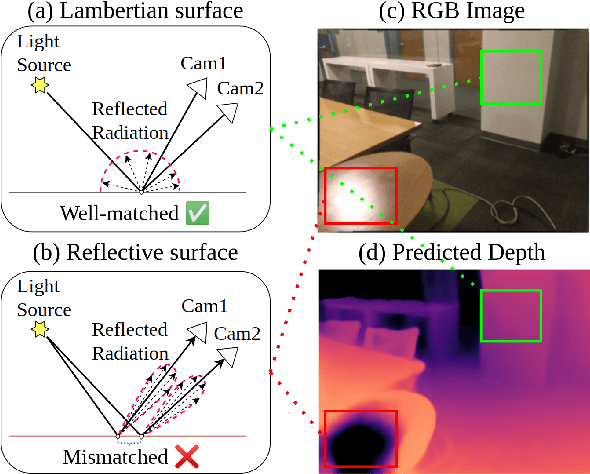
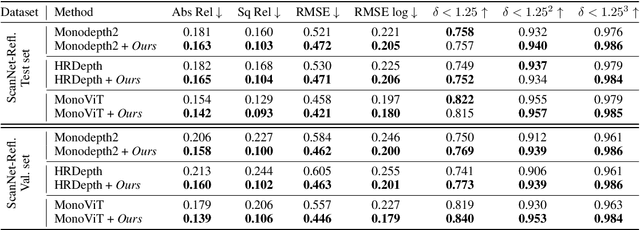
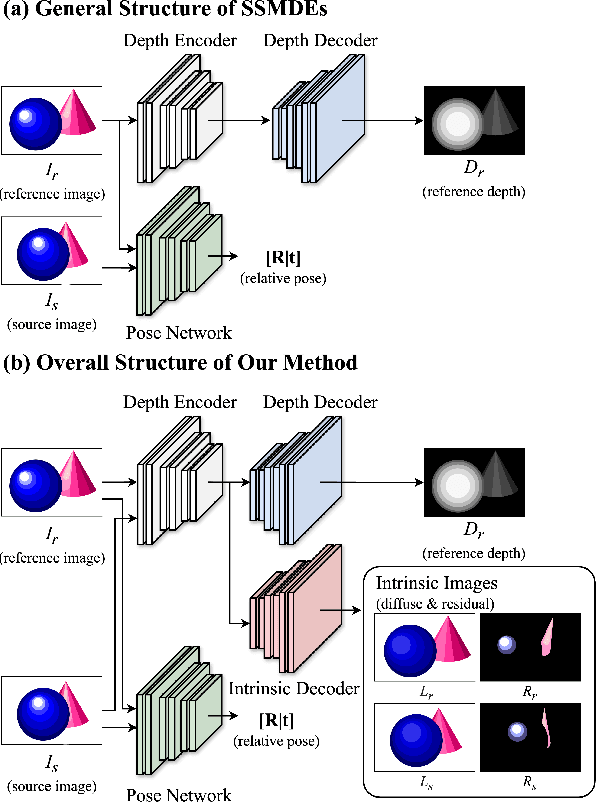
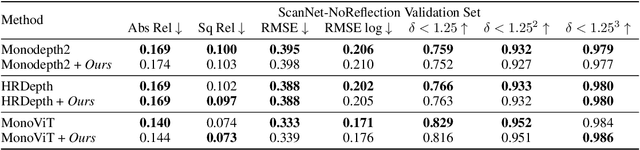
Self-supervised monocular depth estimation (SSMDE) has gained attention in the field of deep learning as it estimates depth without requiring ground truth depth maps. This approach typically uses a photometric consistency loss between a synthesized image, generated from the estimated depth, and the original image, thereby reducing the need for extensive dataset acquisition. However, the conventional photometric consistency loss relies on the Lambertian assumption, which often leads to significant errors when dealing with reflective surfaces that deviate from this model. To address this limitation, we propose a novel framework that incorporates intrinsic image decomposition into SSMDE. Our method synergistically trains for both monocular depth estimation and intrinsic image decomposition. The accurate depth estimation facilitates multi-image consistency for intrinsic image decomposition by aligning different view coordinate systems, while the decomposition process identifies reflective areas and excludes corrupted gradients from the depth training process. Furthermore, our framework introduces a pseudo-depth generation and knowledge distillation technique to further enhance the performance of the student model across both reflective and non-reflective surfaces. Comprehensive evaluations on multiple datasets show that our approach significantly outperforms existing SSMDE baselines in depth prediction, especially on reflective surfaces.