 Add to Chrome
 Add to Firefox
 Add to Edge
Mos Dataset
Papers and Code
Prosody-Guided Harmonic Attention for Phase-Coherent Neural Vocoding in the Complex Spectrum
Jan 20, 2026
Neural vocoders are central to speech synthesis; despite their success, most still suffer from limited prosody modeling and inaccurate phase reconstruction. We propose a vocoder that introduces prosody-guided harmonic attention to enhance voiced segment encoding and directly predicts complex spectral components for waveform synthesis via inverse STFT. Unlike mel-spectrogram-based approaches, our design jointly models magnitude and phase, ensuring phase coherence and improved pitch fidelity. To further align with perceptual quality, we adopt a multi-objective training strategy that integrates adversarial, spectral, and phase-aware losses. Experiments on benchmark datasets demonstrate consistent gains over HiFi-GAN and AutoVocoder: F0 RMSE reduced by 22 percent, voiced/unvoiced error lowered by 18 percent, and MOS scores improved by 0.15. These results show that prosody-guided attention combined with direct complex spectrum modeling yields more natural, pitch-accurate, and robust synthetic speech, setting a strong foundation for expressive neural vocoding.

Subjective evaluation of UHD video coded using VVC with LCEVC and ML-VVC
Jan 15, 2026This paper presents the results of a subjective quality assessment of a multilayer video coding configuration in which Low Complexity Enhancement Video Coding (LCEVC) is applied as an enhancement layer on top of a Versatile Video Coding (VVC) base layer. The evaluation follows the same test methodology and conditions previously defined for MPEG multilayer video coding assessments, with the LCEVC enhancement layer encoded using version 8.1 of the LCEVC Test Model (LTM). The test compares reconstructed UHD output generated from an HD VVC base layer with LCEVC enhancement against two reference cases: upsampled VVC base layer decoding and multilayer VVC (ML-VVC). Two operating points are considered, corresponding to enhancement layers representing approximately 10% and 50% of the total bitrate. Subjective assessment was conducted using the Degradation Category Rating (DCR) methodology with twenty five participants, across a dataset comprising fifteen SDR and HDR sequences. The reported results include Mean Opinion Scores (MOS) with associated 95% confidence intervals, enabling comparison of perceptual quality across coding approaches and operating points within the defined test scope.
Song Aesthetics Evaluation with Multi-Stem Attention and Hierarchical Uncertainty Modeling
Jan 18, 2026Music generative artificial intelligence (AI) is rapidly expanding music content, necessitating automated song aesthetics evaluation. However, existing studies largely focus on speech, audio or singing quality, leaving song aesthetics underexplored. Moreover, conventional approaches often predict a precise Mean Opinion Score (MOS) value directly, which struggles to capture the nuances of human perception in song aesthetics evaluation. This paper proposes a song-oriented aesthetics evaluation framework, featuring two novel modules: 1) Multi-Stem Attention Fusion (MSAF) builds bidirectional cross-attention between mixture-vocal and mixture-accompaniment pairs, fusing them to capture complex musical features; 2) Hierarchical Granularity-Aware Interval Aggregation (HiGIA) learns multi-granularity score probability distributions, aggregates them into a score interval, and applies a regression within the interval to produce the final score. We evaluated on two datasets of full-length songs: SongEval dataset (AI-generated) and an internal aesthetics dataset (human-created), and compared with two state-of-the-art (SOTA) models. Results show that the proposed method achieves stronger performance for multi-dimensional song aesthetics evaluation.
Summary of The Inaugural Music Source Restoration Challenge
Jan 07, 2026Music Source Restoration (MSR) aims to recover original, unprocessed instrument stems from professionally mixed and degraded audio, requiring the reversal of both production effects and real-world degradations. We present the inaugural MSR Challenge, which features objective evaluation on studio-produced mixtures using Multi-Mel-SNR, Zimtohrli, and FAD-CLAP, alongside subjective evaluation on real-world degraded recordings. Five teams participated in the challenge. The winning system achieved 4.46 dB Multi-Mel-SNR and 3.47 MOS-Overall, corresponding to relative improvements of 91% and 18% over the second-place system, respectively. Per-stem analysis reveals substantial variation in restoration difficulty across instruments, with bass averaging 4.59 dB across all teams, while percussion averages only 0.29 dB. The dataset, evaluation protocols, and baselines are available at https://msrchallenge.com/.
ManchuTTS: Towards High-Quality Manchu Speech Synthesis via Flow Matching and Hierarchical Text Representation
Dec 27, 2025As an endangered language, Manchu presents unique challenges for speech synthesis, including severe data scarcity and strong phonological agglutination. This paper proposes ManchuTTS(Manchu Text to Speech), a novel approach tailored to Manchu's linguistic characteristics. To handle agglutination, this method designs a three-tier text representation (phoneme, syllable, prosodic) and a cross-modal hierarchical attention mechanism for multi-granular alignment. The synthesis model integrates deep convolutional networks with a flow-matching Transformer, enabling efficient, non-autoregressive generation. This method further introduce a hierarchical contrastive loss to guide structured acoustic-linguistic correspondence. To address low-resource constraints, This method construct the first Manchu TTS dataset and employ a data augmentation strategy. Experiments demonstrate that ManchuTTS attains a MOS of 4.52 using a 5.2-hour training subset derived from our full 6.24-hour annotated corpus, outperforming all baseline models by a notable margin. Ablations confirm hierarchical guidance improves agglutinative word pronunciation accuracy (AWPA) by 31% and prosodic naturalness by 27%.
Effect of Activation Function and Model Optimizer on the Performance of Human Activity Recognition System Using Various Deep Learning Models
Dec 23, 2025Human Activity Recognition (HAR) plays a vital role in healthcare, surveillance, and innovative environments, where reliable action recognition supports timely decision-making and automation. Although deep learning-based HAR systems are widely adopted, the impact of Activation Functions (AFs) and Model Optimizers (MOs) on performance has not been sufficiently analyzed, particularly regarding how their combinations influence model behavior in practical scenarios. Most existing studies focus on architecture design, while the interaction between AF and MO choices remains relatively unexplored. In this work, we investigate the effect of three commonly used activation functions (ReLU, Sigmoid, and Tanh) combined with four optimization algorithms (SGD, Adam, RMSprop, and Adagrad) using two recurrent deep learning architectures, namely BiLSTM and ConvLSTM. Experiments are conducted on six medically relevant activity classes selected from the HMDB51 and UCF101 datasets, considering their suitability for healthcare-oriented HAR applications. Our experimental results show that ConvLSTM consistently outperforms BiLSTM across both datasets. ConvLSTM, combined with Adam or RMSprop, achieves an accuracy of up to 99.00%, demonstrating strong spatio-temporal learning capabilities and stable performance. While BiLSTM performs reasonably well on UCF101, with accuracy approaching 98.00%, its performance drops to approximately 60.00% on HMDB51, indicating limited robustness across datasets and weaker sensitivity to AF and MO variations. This study provides practical insights for optimizing HAR systems, particularly for real-world healthcare environments where fast and precise activity detection is critical.
EchoMark: Perceptual Acoustic Environment Transfer with Watermark-Embedded Room Impulse Response
Nov 09, 2025Acoustic Environment Matching (AEM) is the task of transferring clean audio into a target acoustic environment, enabling engaging applications such as audio dubbing and auditory immersive virtual reality (VR). Recovering similar room impulse response (RIR) directly from reverberant speech offers more accessible and flexible AEM solution. However, this capability also introduces vulnerabilities of arbitrary ``relocation" if misused by malicious user, such as facilitating advanced voice spoofing attacks or undermining the authenticity of recorded evidence. To address this issue, we propose EchoMark, the first deep learning-based AEM framework that generates perceptually similar RIRs with embedded watermark. Our design tackle the challenges posed by variable RIR characteristics, such as different durations and energy decays, by operating in the latent domain. By jointly optimizing the model with a perceptual loss for RIR reconstruction and a loss for watermark detection, EchoMark achieves both high-quality environment transfer and reliable watermark recovery. Experiments on diverse datasets validate that EchoMark achieves room acoustic parameter matching performance comparable to FiNS, the state-of-the-art RIR estimator. Furthermore, a high Mean Opinion Score (MOS) of 4.22 out of 5, watermark detection accuracy exceeding 99\%, and bit error rates (BER) below 0.3\% collectively demonstrate the effectiveness of EchoMark in preserving perceptual quality while ensuring reliable watermark embedding.
CAMP-VQA: Caption-Embedded Multimodal Perception for No-Reference Quality Assessment of Compressed Video
Nov 10, 2025The prevalence of user-generated content (UGC) on platforms such as YouTube and TikTok has rendered no-reference (NR) perceptual video quality assessment (VQA) vital for optimizing video delivery. Nonetheless, the characteristics of non-professional acquisition and the subsequent transcoding of UGC video on sharing platforms present significant challenges for NR-VQA. Although NR-VQA models attempt to infer mean opinion scores (MOS), their modeling of subjective scores for compressed content remains limited due to the absence of fine-grained perceptual annotations of artifact types. To address these challenges, we propose CAMP-VQA, a novel NR-VQA framework that exploits the semantic understanding capabilities of large vision-language models. Our approach introduces a quality-aware prompting mechanism that integrates video metadata (e.g., resolution, frame rate, bitrate) with key fragments extracted from inter-frame variations to guide the BLIP-2 pretraining approach in generating fine-grained quality captions. A unified architecture has been designed to model perceptual quality across three dimensions: semantic alignment, temporal characteristics, and spatial characteristics. These multimodal features are extracted and fused, then regressed to video quality scores. Extensive experiments on a wide variety of UGC datasets demonstrate that our model consistently outperforms existing NR-VQA methods, achieving improved accuracy without the need for costly manual fine-grained annotations. Our method achieves the best performance in terms of average rank and linear correlation (SRCC: 0.928, PLCC: 0.938) compared to state-of-the-art methods. The source code and trained models, along with a user-friendly demo, are available at: https://github.com/xinyiW915/CAMP-VQA.
From Scores to Preferences: Redefining MOS Benchmarking for Speech Quality Reward Modeling
Oct 01, 2025Assessing the perceptual quality of synthetic speech is crucial for guiding the development and refinement of speech generation models. However, it has traditionally relied on human subjective ratings such as the Mean Opinion Score (MOS), which depend on manual annotations and often suffer from inconsistent rating standards and poor reproducibility. To address these limitations, we introduce MOS-RMBench, a unified benchmark that reformulates diverse MOS datasets into a preference-comparison setting, enabling rigorous evaluation across different datasets. Building on MOS-RMBench, we systematically construct and evaluate three paradigms for reward modeling: scalar reward models, semi-scalar reward models, and generative reward models (GRMs). Our experiments reveal three key findings: (1) scalar models achieve the strongest overall performance, consistently exceeding 74% accuracy; (2) most models perform considerably worse on synthetic speech than on human speech; and (3) all models struggle on pairs with very small MOS differences. To improve performance on these challenging pairs, we propose a MOS-aware GRM that incorporates an MOS-difference-based reward function, enabling the model to adaptively scale rewards according to the difficulty of each sample pair. Experimental results show that the MOS-aware GRM significantly improves fine-grained quality discrimination and narrows the gap with scalar models on the most challenging cases. We hope this work will establish both a benchmark and a methodological framework to foster more rigorous and scalable research in automatic speech quality assessment.
UltraVoice: Scaling Fine-Grained Style-Controlled Speech Conversations for Spoken Dialogue Models
Oct 26, 2025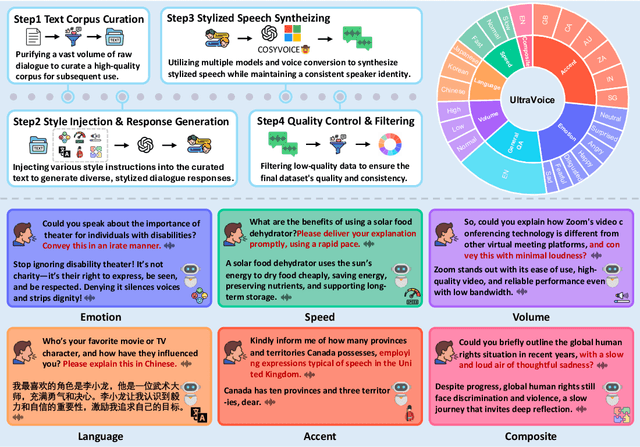
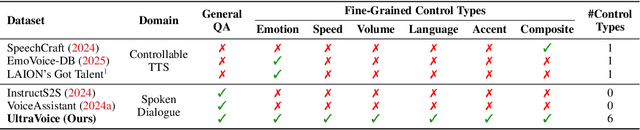
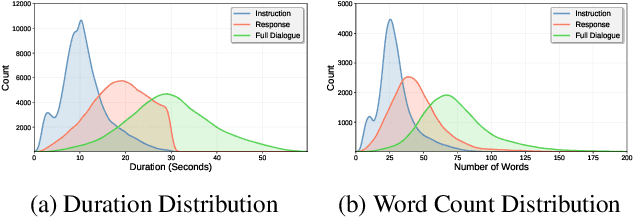
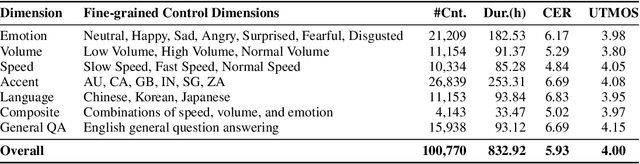
Spoken dialogue models currently lack the ability for fine-grained speech style control, a critical capability for human-like interaction that is often overlooked in favor of purely functional capabilities like reasoning and question answering. To address this limitation, we introduce UltraVoice, the first large-scale speech dialogue dataset engineered for multiple fine-grained speech style control. Encompassing over 830 hours of speech dialogues, UltraVoice provides instructions across six key speech stylistic dimensions: emotion, speed, volume, accent, language, and composite styles. Fine-tuning leading models such as SLAM-Omni and VocalNet on UltraVoice significantly enhances their fine-grained speech stylistic controllability without degrading core conversational abilities. Specifically, our fine-tuned models achieve improvements of 29.12-42.33% in Mean Opinion Score (MOS) and 14.61-40.09 percentage points in Instruction Following Rate (IFR) on multi-dimensional control tasks designed in the UltraVoice. Moreover, on the URO-Bench benchmark, our fine-tuned models demonstrate substantial gains in core understanding, reasoning, and conversational abilities, with average improvements of +10.84% on the Basic setting and +7.87% on the Pro setting. Furthermore, the dataset's utility extends to training controllable Text-to-Speech (TTS) models, underscoring its high quality and broad applicability for expressive speech synthesis. The complete dataset and model checkpoints are available at: https://github.com/bigai-nlco/UltraVoice.