 Add to Chrome
 Add to Firefox
 Add to Edge
Summary of DCASE 2026 Task 5: Audio-Dependent Question Answering
Jul 21, 2026
DCASE~2026 Task~5 introduces Audio-Dependent Question Answering (ADQA), which tests whether large audio-language models answer from the audio rather than from textual priors. An Audio-Dependency Filtering (ADF) pipeline combines silent-audio probing, per-option perplexity, a large language model (LLM) commonsense check, and human review to remove items solvable from text alone. The 3000 items that pass form the ADQA-Bench evaluation set, spanning music, speech, and environmental audio. The inaugural edition draws 14 teams and 36 submissions across two tracks defined by total parameter count (up to 100B and under 10B). A Chung-Ang University ensemble of MOSS-Audio-8B-Thinking and Qwen3-Omni-30B reaches the top overall accuracy at \pct{58.33}, and a MOSS-only configuration from the same team leads the sub-10B track at \pct{57.30}. Across the 30 submissions with a comparable development score, evaluation accuracy falls by 11.91 percentage points (pp) on average (median 10.91\,pp) on the hidden evaluation split, which is designed to be harder than the development split. The most common building blocks are: the MOSS-Audio-8B-Thinking backbone (13 of 36 submissions), Low-Rank Adaptation (LoRA) fine-tuning on AudioMCQ-StrongAC, and preference or reinforcement-learning objectives -- Group Relative Policy Optimization (GRPO) in five teams, Group reward-Decoupled Normalization Policy Optimization (GDPO) in two. At test time, prompt engineering is near-universal, and majority or choice-permutation voting is common. Every system misses the same set of 233 evaluation items.

Efficient Text-to-Audio Generation via Pruning
Jul 14, 2026Diffusion-based text-to-audio generative models such as AudioLDM achieve high perceptual quality and strong semantic consistency; however, their practical deployment is hindered by the substantial computational cost of the U-Net denoising backbone. In this work, we apply model pruning to improve the computational efficiency of AudioLDM, a U-Net-based text-conditioned audio latent diffusion model. We analyse parameter redundancy across U-Net convolutional blocks and evaluate a filter-pruning strategy. Pruning is guided by norm-based criteria and followed by lightweight finetuning to recover performance losses. Experimental results demonstrate that up to 83% of the parameters and 39% of the multiply-accumulate operations of U-Net have been reduced while maintaining, and in some cases improving, generation quality compared to the baseline unpruned network. We find that pruning affects AudioLDM's ability to generate certain sound events including safety-critical sounds such as gunshots, sirens, and explosions, as well as mechanical sounds such as drills and sewing machines, and other sounds such as sprays and tick-tocks, which are mostly recovered by lightweight finetuning of the pruned model.
Teaching Speech Enhancement Models to Sing: Domain Adaptation from Speech Enhancement to Singing Voice Separation
Jul 13, 2026State-of-the-art speech enhancement models benefit from large-scale labeled datasets, whereas singing voice separation models suffer from limited available training data. To address this limitation, we formulate singing voice separation as domain adaptation from speech enhancement to singing voice separation. We investigate two fine-tuning strategies: full fine-tuning and parameter-efficient fine-tuning using Low-Rank Adaptation (LoRA) on a discriminative and a generative model. Models with either adaptation strategy outperform the same architectures trained from scratch by 0.29-1.8 dB in Signal-to-Distortion-Ratio. Full fine-tuning yields the highest singing voice separation performance, but catastrophic forgetting degrades speech enhancement performance. LoRA fine-tuning achieves competitive singing voice separation performance while preserving the original speech enhancement capability with only 6-12% additional parameters compared to the base speech enhancement model. Furthermore, the generative model shows improved generalization to an unseen test set. The results demonstrate that adapting pretrained speech enhancement models is an effective strategy for training singing voice separation models in data-scarce scenarios.
Explainable AI in Speaker Recognition -- Attention Map Visualisation and Evaluation
Jun 22, 2026Explaining and understanding the decision-making process of artificial intelligence (AI) systems, particularly those implemented by neural networks, falls within the field of explainable AI (XAI). Analogous to the human attention mechanism, neural networks are assumed to possess their own attention mechanisms that selectively process information during decision-making. This work proposes to study one XAI topic: analysing and visualising the attention mechanisms of neural networks. Our experiments are performed on speaker recognition neural networks that are trained to identify speaker identity from a given utterance. Previous studies have widely used class activation map (CAM)-based methods to analyse and visualise the attention mechanisms of neural networks. Each of these methods produces an attention map for each network input, highlighting which input regions are selectively processed when the speaker recognition network makes decisions. However, the evaluation of attention maps produced by these methods remains largely underexplored. This work systematically reviews an existing attention map evaluation algorithm, establishing key concepts and identifying its shortcomings. On the basis of this existing evaluation algorithm, a new version is then proposed to address the identified shortcomings, called the Modified Randomised Input Sampling for Explanation - Evaluation algorithm (Modified RISE-eval). Using Modified RISE-eval, we evaluate the attention maps produced by two representative CAM-based methods, GradCAM and LayerCAM, applied to a certain speaker recognition network. The evaluation results demonstrate that GradCAM and LayerCAM each exhibit distinct advantages when applied under different experimental conditions in the speaker recognition task.
Explainable AI in Speaker Recognition -- Making Latent Representations Understandable
Apr 25, 2026Neural networks can be trained to learn task-relevant representations from data. Understanding how these networks make decisions falls within the Explainable AI (XAI) domain. This paper proposes to study an XAI topic: uncovering unknown organisational patterns in network representations, particularly those representations learned by the speaker recognition network that recognises the speaker identity of utterances. Past studies employed algorithms (e.g. t-distributed Stochastic Neighbour Embedding and K-means) to analyse and visualise how network representations form independent clusters, indicating the presence of flat clustering phenomena within the space defined by these representations. In contrast, this work applies two algorithms -- Single-Linkage Clustering (SLINK) and Hierarchical Density-Based Spatial Clustering of Applications with Noise (HDBSCAN) -- to analyse how representations form clusters with hierarchical relationships rather than being independent, thereby demonstrating the existence of hierarchical clustering phenomena within the network representation space. To semantically understand the above hierarchical clustering phenomena, a new algorithm, termed Hierarchical Cluster-Class Matching (HCCM), is designed to perform one-to-one matching between predefined semantic classes and hierarchical representation clusters (i.e. those produced by SLINK or HDBSCAN). Some hierarchical clusters are successfully matched to individual semantic classes (e.g. male, UK), while others to conjunctions of semantic classes (e.g. male and UK, female and Ireland). A new metric, Liebig's score, is proposed to quantify the performance of each matching behaviour, allowing us to diagnose the factor that most strongly limits matching performance.
BioDCASE 2026 Challenge Baseline for Cross-Domain Mosquito Species Classification
Mar 20, 2026Mosquito-borne diseases affect more than one billion people each year and cause close to one million deaths. Traditional surveillance methods rely on traps and manual identification that are slow, labor-intensive, and difficult to scale. Audio-based mosquito monitoring offers a non-destructive, lower-cost, and more scalable complement to trap-based surveillance, but reliable species classification remains difficult under real-world recording conditions. Mosquito flight tones are narrow-band, often low in signal-to-noise ratio, and easily masked by background noise, and recordings for several epidemiologically relevant species remain limited, creating pronounced class imbalance. Variation across devices, environments, and collection protocols further increases the difficulty of robust classification. Such variation can cause models to rely on domain-specific recording artefacts rather than species-relevant acoustic cues, which makes transfer to new acquisition settings difficult. The BioDCASE 2026 Cross-Domain Mosquito Species Classification (CD-MSC) challenge is designed around this deployment problem by evaluating performance on both seen and unseen domains. This paper presents the official baseline system and evaluation pipeline as a simple, fully reproducible reference for the CD-MSC challenge task. The baseline uses log-mel features and a multitemporal resolution convolutional neural network (MTRCNN) with species and auxiliary domain outputs, together with complete training and test scripts. The baseline system performs strongly on seen domains but degrades markedly on unseen domains, showing that cross-domain generalisation, rather than within-domain recognition, is the central challenge for practical mosquito species classification from multi-source bioacoustic recordings.
Summary of The Inaugural Music Source Restoration Challenge
Jan 07, 2026Music Source Restoration (MSR) aims to recover original, unprocessed instrument stems from professionally mixed and degraded audio, requiring the reversal of both production effects and real-world degradations. We present the inaugural MSR Challenge, which features objective evaluation on studio-produced mixtures using Multi-Mel-SNR, Zimtohrli, and FAD-CLAP, alongside subjective evaluation on real-world degraded recordings. Five teams participated in the challenge. The winning system achieved 4.46 dB Multi-Mel-SNR and 3.47 MOS-Overall, corresponding to relative improvements of 91% and 18% over the second-place system, respectively. Per-stem analysis reveals substantial variation in restoration difficulty across instruments, with bass averaging 4.59 dB across all teams, while percussion averages only 0.29 dB. The dataset, evaluation protocols, and baselines are available at https://msrchallenge.com/.
Region-Specific Audio Tagging for Spatial Sound
Sep 11, 2025Audio tagging aims to label sound events appearing in an audio recording. In this paper, we propose region-specific audio tagging, a new task which labels sound events in a given region for spatial audio recorded by a microphone array. The region can be specified as an angular space or a distance from the microphone. We first study the performance of different combinations of spectral, spatial, and position features. Then we extend state-of-the-art audio tagging systems such as pre-trained audio neural networks (PANNs) and audio spectrogram transformer (AST) to the proposed region-specific audio tagging task. Experimental results on both the simulated and the real datasets show the feasibility of the proposed task and the effectiveness of the proposed method. Further experiments show that incorporating the directional features is beneficial for omnidirectional tagging.
Towards Reliable Objective Evaluation Metrics for Generative Singing Voice Separation Models
Jul 15, 2025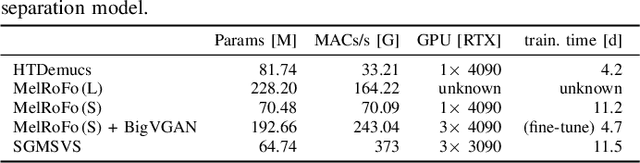
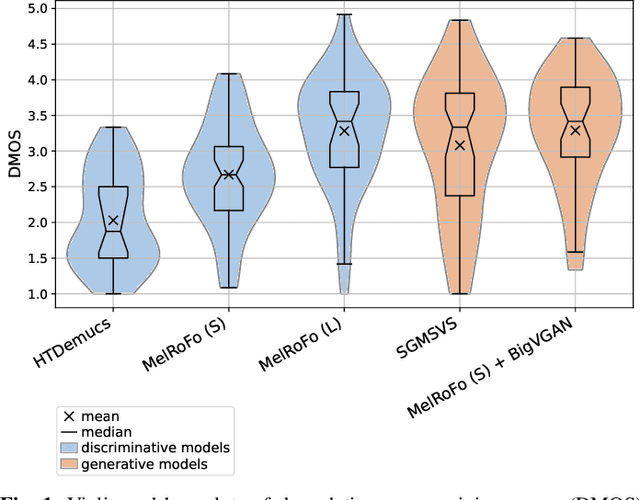
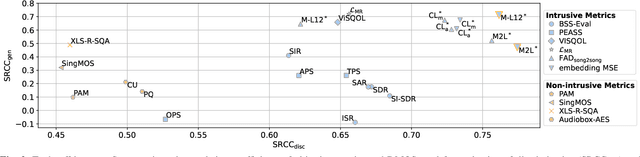
Traditional Blind Source Separation Evaluation (BSS-Eval) metrics were originally designed to evaluate linear audio source separation models based on methods such as time-frequency masking. However, recent generative models may introduce nonlinear relationships between the separated and reference signals, limiting the reliability of these metrics for objective evaluation. To address this issue, we conduct a Degradation Category Rating listening test and analyze correlations between the obtained degradation mean opinion scores (DMOS) and a set of objective audio quality metrics for the task of singing voice separation. We evaluate three state-of-the-art discriminative models and two new competitive generative models. For both discriminative and generative models, intrusive embedding-based metrics show higher correlations with DMOS than conventional intrusive metrics such as BSS-Eval. For discriminative models, the highest correlation is achieved by the MSE computed on Music2Latent embeddings. When it comes to the evaluation of generative models, the strongest correlations are evident for the multi-resolution STFT loss and the MSE calculated on MERT-L12 embeddings, with the latter also providing the most balanced correlation across both model types. Our results highlight the limitations of BSS-Eval metrics for evaluating generative singing voice separation models and emphasize the need for careful selection and validation of alternative evaluation metrics for the task of singing voice separation.
Music Source Restoration
May 27, 2025We introduce Music Source Restoration (MSR), a novel task addressing the gap between idealized source separation and real-world music production. Current Music Source Separation (MSS) approaches assume mixtures are simple sums of sources, ignoring signal degradations employed during music production like equalization, compression, and reverb. MSR models mixtures as degraded sums of individually degraded sources, with the goal of recovering original, undegraded signals. Due to the lack of data for MSR, we present RawStems, a dataset annotation of 578 songs with unprocessed source signals organized into 8 primary and 17 secondary instrument groups, totaling 354.13 hours. To the best of our knowledge, RawStems is the first dataset that contains unprocessed music stems with hierarchical categories. We consider spectral filtering, dynamic range compression, harmonic distortion, reverb and lossy codec as possible degradations, and establish U-Former as a baseline method, demonstrating the feasibility of MSR on our dataset. We release the RawStems dataset annotations, degradation simulation pipeline, training code and pre-trained models to be publicly available.