 Add to Chrome
 Add to Firefox
 Add to Edge
3D Object Classification
Papers and Code
FlowCalib: LiDAR-to-Vehicle Miscalibration Detection using Scene Flows
Jan 30, 2026
Accurate sensor-to-vehicle calibration is essential for safe autonomous driving. Angular misalignments of LiDAR sensors can lead to safety-critical issues during autonomous operation. However, current methods primarily focus on correcting sensor-to-sensor errors without considering the miscalibration of individual sensors that cause these errors in the first place. We introduce FlowCalib, the first framework that detects LiDAR-to-vehicle miscalibration using motion cues from the scene flow of static objects. Our approach leverages the systematic bias induced by rotational misalignment in the flow field generated from sequential 3D point clouds, eliminating the need for additional sensors. The architecture integrates a neural scene flow prior for flow estimation and incorporates a dual-branch detection network that fuses learned global flow features with handcrafted geometric descriptors. These combined representations allow the system to perform two complementary binary classification tasks: a global binary decision indicating whether misalignment is present and separate, axis-specific binary decisions indicating whether each rotational axis is misaligned. Experiments on the nuScenes dataset demonstrate FlowCalib's ability to robustly detect miscalibration, establishing a benchmark for sensor-to-vehicle miscalibration detection.

PatchAlign3D: Local Feature Alignment for Dense 3D Shape understanding
Jan 05, 2026Current foundation models for 3D shapes excel at global tasks (retrieval, classification) but transfer poorly to local part-level reasoning. Recent approaches leverage vision and language foundation models to directly solve dense tasks through multi-view renderings and text queries. While promising, these pipelines require expensive inference over multiple renderings, depend heavily on large language-model (LLM) prompt engineering for captions, and fail to exploit the inherent 3D geometry of shapes. We address this gap by introducing an encoder-only 3D model that produces language-aligned patch-level features directly from point clouds. Our pre-training approach builds on existing data engines that generate part-annotated 3D shapes by pairing multi-view SAM regions with VLM captioning. Using this data, we train a point cloud transformer encoder in two stages: (1) distillation of dense 2D features from visual encoders such as DINOv2 into 3D patches, and (2) alignment of these patch embeddings with part-level text embeddings through a multi-positive contrastive objective. Our 3D encoder achieves zero-shot 3D part segmentation with fast single-pass inference without any test-time multi-view rendering, while significantly outperforming previous rendering-based and feed-forward approaches across several 3D part segmentation benchmarks. Project website: https://souhail-hadgi.github.io/patchalign3dsite/
BrepLLM: Native Boundary Representation Understanding with Large Language Models
Dec 18, 2025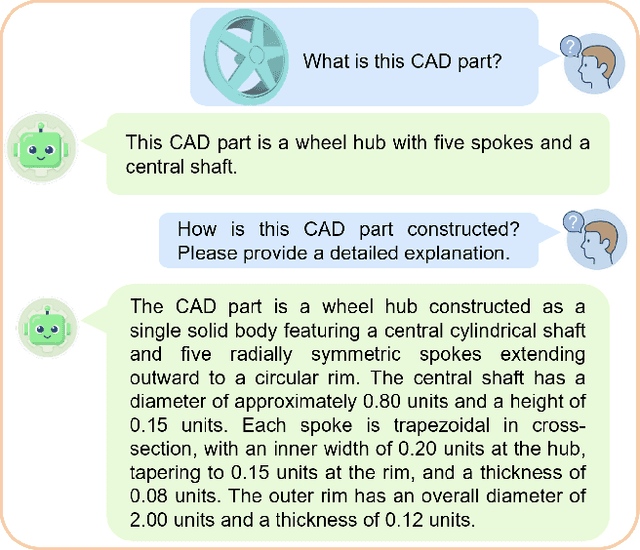


Current token-sequence-based Large Language Models (LLMs) are not well-suited for directly processing 3D Boundary Representation (Brep) models that contain complex geometric and topological information. We propose BrepLLM, the first framework that enables LLMs to parse and reason over raw Brep data, bridging the modality gap between structured 3D geometry and natural language. BrepLLM employs a two-stage training pipeline: Cross-modal Alignment Pre-training and Multi-stage LLM Fine-tuning. In the first stage, an adaptive UV sampling strategy converts Breps into graphs representation with geometric and topological information. We then design a hierarchical BrepEncoder to extract features from geometry (i.e., faces and edges) and topology, producing both a single global token and a sequence of node tokens. Then we align the global token with text embeddings from a frozen CLIP text encoder (ViT-L/14) via contrastive learning. In the second stage, we integrate the pretrained BrepEncoder into an LLM. We then align its sequence of node tokens using a three-stage progressive training strategy: (1) training an MLP-based semantic mapping from Brep representation to 2D with 2D-LLM priors. (2) performing fine-tuning of the LLM. (3) designing a Mixture-of-Query Experts (MQE) to enhance geometric diversity modeling. We also construct Brep2Text, a dataset comprising 269,444 Brep-text question-answer pairs. Experiments show that BrepLLM achieves state-of-the-art (SOTA) results on 3D object classification and captioning tasks.
Retrieving Objects from 3D Scenes with Box-Guided Open-Vocabulary Instance Segmentation
Dec 22, 2025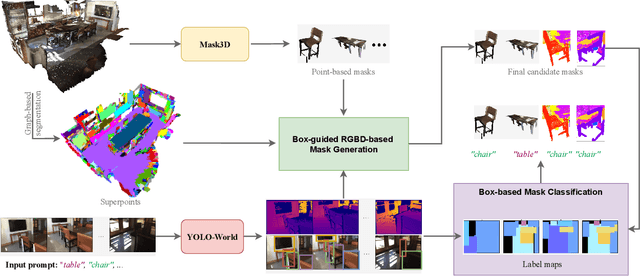

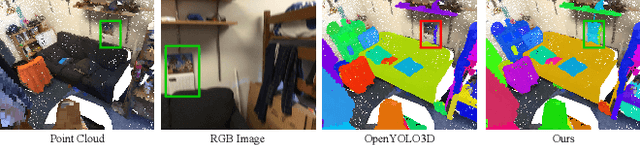
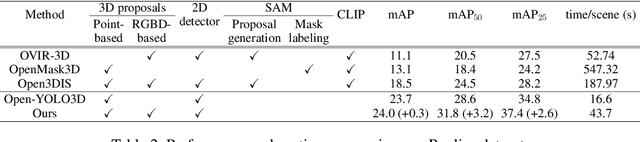
Locating and retrieving objects from scene-level point clouds is a challenging problem with broad applications in robotics and augmented reality. This task is commonly formulated as open-vocabulary 3D instance segmentation. Although recent methods demonstrate strong performance, they depend heavily on SAM and CLIP to generate and classify 3D instance masks from images accompanying the point cloud, leading to substantial computational overhead and slow processing that limit their deployment in real-world settings. Open-YOLO 3D alleviates this issue by using a real-time 2D detector to classify class-agnostic masks produced directly from the point cloud by a pretrained 3D segmenter, eliminating the need for SAM and CLIP and significantly reducing inference time. However, Open-YOLO 3D often fails to generalize to object categories that appear infrequently in the 3D training data. In this paper, we propose a method that generates 3D instance masks for novel objects from RGB images guided by a 2D open-vocabulary detector. Our approach inherits the 2D detector's ability to recognize novel objects while maintaining efficient classification, enabling fast and accurate retrieval of rare instances from open-ended text queries. Our code will be made available at https://github.com/ndkhanh360/BoxOVIS.
Bhargava Cube--Inspired Quadratic Regularization for Structured Neural Embeddings
Dec 12, 2025We present a novel approach to neural representation learning that incorporates algebraic constraints inspired by Bhargava cubes from number theory. Traditional deep learning methods learn representations in unstructured latent spaces lacking interpretability and mathematical consistency. Our framework maps input data to constrained 3-dimensional latent spaces where embeddings are regularized to satisfy learned quadratic relationships derived from Bhargava's combinatorial structures. The architecture employs a differentiable auxiliary loss function operating independently of classification objectives, guiding models toward mathematically structured representations. We evaluate on MNIST, achieving 99.46% accuracy while producing interpretable 3D embeddings that naturally cluster by digit class and satisfy learned quadratic constraints. Unlike existing manifold learning approaches requiring explicit geometric supervision, our method imposes weak algebraic priors through differentiable constraints, ensuring compatibility with standard optimization. This represents the first application of number-theoretic constructs to neural representation learning, establishing a foundation for incorporating structured mathematical priors in neural networks.
MTMed3D: A Multi-Task Transformer-Based Model for 3D Medical Imaging
Nov 15, 2025In the field of medical imaging, AI-assisted techniques such as object detection, segmentation, and classification are widely employed to alleviate the workload of physicians and doctors. However, single-task models are predominantly used, overlooking the shared information across tasks. This oversight leads to inefficiencies in real-life applications. In this work, we propose MTMed3D, a novel end-to-end Multi-task Transformer-based model to address the limitations of single-task models by jointly performing 3D detection, segmentation, and classification in medical imaging. Our model uses a Transformer as the shared encoder to generate multi-scale features, followed by CNN-based task-specific decoders. The proposed framework was evaluated on the BraTS 2018 and 2019 datasets, achieving promising results across all three tasks, especially in detection, where our method achieves better results than prior works. Additionally, we compare our multi-task model with equivalent single-task variants trained separately. Our multi-task model significantly reduces computational costs and achieves faster inference speed while maintaining comparable performance to the single-task models, highlighting its efficiency advantage. To the best of our knowledge, this is the first work to leverage Transformers for multi-task learning that simultaneously covers detection, segmentation, and classification tasks in 3D medical imaging, presenting its potential to enhance diagnostic processes. The code is available at https://github.com/fanlimua/MTMed3D.git.
3D-TDA -- Topological feature extraction from 3D images for Alzheimer's disease classification
Nov 11, 2025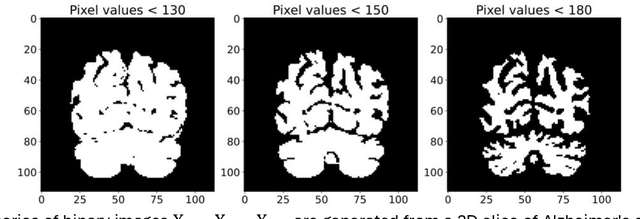
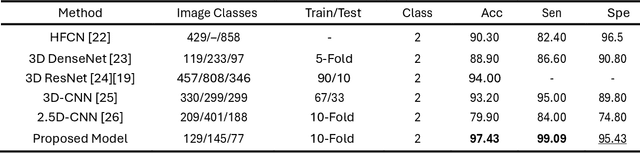
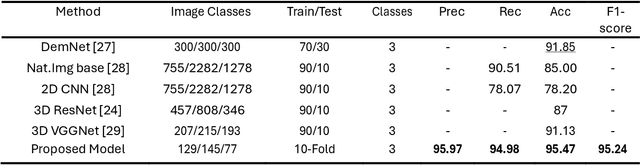
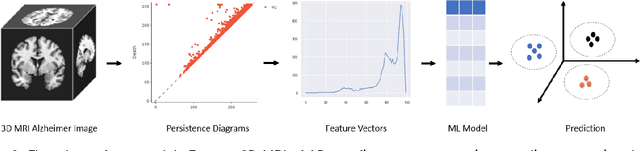
Now that disease-modifying therapies for Alzheimer disease have been approved by regulatory agencies, the early, objective, and accurate clinical diagnosis of AD based on the lowest-cost measurement modalities possible has become an increasingly urgent need. In this study, we propose a novel feature extraction method using persistent homology to analyze structural MRI of the brain. This approach converts topological features into powerful feature vectors through Betti functions. By integrating these feature vectors with a simple machine learning model like XGBoost, we achieve a computationally efficient machine learning model. Our model outperforms state-of-the-art deep learning models in both binary and three-class classification tasks for ADNI 3D MRI disease diagnosis. Using 10-fold cross-validation, our model achieved an average accuracy of 97.43 percent and sensitivity of 99.09 percent for binary classification. For three-class classification, it achieved an average accuracy of 95.47 percent and sensitivity of 94.98 percent. Unlike many deep learning models, our approach does not require data augmentation or extensive preprocessing, making it particularly suitable for smaller datasets. Topological features differ significantly from those commonly extracted using convolutional filters and other deep learning machinery. Because it provides an entirely different type of information from machine learning models, it has the potential to combine topological features with other models later on.
TransactionGPT
Nov 12, 2025We present TransactionGPT (TGPT), a foundation model for consumer transaction data within one of world's largest payment networks. TGPT is designed to understand and generate transaction trajectories while simultaneously supporting a variety of downstream prediction and classification tasks. We introduce a novel 3D-Transformer architecture specifically tailored for capturing the complex dynamics in payment transaction data. This architecture incorporates design innovations that enhance modality fusion and computational efficiency, while seamlessly enabling joint optimization with downstream objectives. Trained on billion-scale real-world transactions, TGPT significantly improves downstream classification performance against a competitive production model and exhibits advantages over baselines in generating future transactions. We conduct extensive empirical evaluations utilizing a diverse collection of company transaction datasets spanning multiple downstream tasks, thereby enabling a thorough assessment of TGPT's effectiveness and efficiency in comparison to established methodologies. Furthermore, we examine the incorporation of LLM-derived embeddings within TGPT and benchmark its performance against fine-tuned LLMs, demonstrating that TGPT achieves superior predictive accuracy as well as faster training and inference. We anticipate that the architectural innovations and practical guidelines from this work will advance foundation models for transaction-like data and catalyze future research in this emerging field.
3D-ANC: Adaptive Neural Collapse for Robust 3D Point Cloud Recognition
Nov 10, 2025Deep neural networks have recently achieved notable progress in 3D point cloud recognition, yet their vulnerability to adversarial perturbations poses critical security challenges in practical deployments. Conventional defense mechanisms struggle to address the evolving landscape of multifaceted attack patterns. Through systematic analysis of existing defenses, we identify that their unsatisfactory performance primarily originates from an entangled feature space, where adversarial attacks can be performed easily. To this end, we present 3D-ANC, a novel approach that capitalizes on the Neural Collapse (NC) mechanism to orchestrate discriminative feature learning. In particular, NC depicts where last-layer features and classifier weights jointly evolve into a simplex equiangular tight frame (ETF) arrangement, establishing maximally separable class prototypes. However, leveraging this advantage in 3D recognition confronts two substantial challenges: (1) prevalent class imbalance in point cloud datasets, and (2) complex geometric similarities between object categories. To tackle these obstacles, our solution combines an ETF-aligned classification module with an adaptive training framework consisting of representation-balanced learning (RBL) and dynamic feature direction loss (FDL). 3D-ANC seamlessly empowers existing models to develop disentangled feature spaces despite the complexity in 3D data distribution. Comprehensive evaluations state that 3D-ANC significantly improves the robustness of models with various structures on two datasets. For instance, DGCNN's classification accuracy is elevated from 27.2% to 80.9% on ModelNet40 -- a 53.7% absolute gain that surpasses leading baselines by 34.0%.
DiLO: Disentangled Latent Optimization for Learning Shape and Deformation in Grouped Deforming 3D Objects
Nov 08, 2025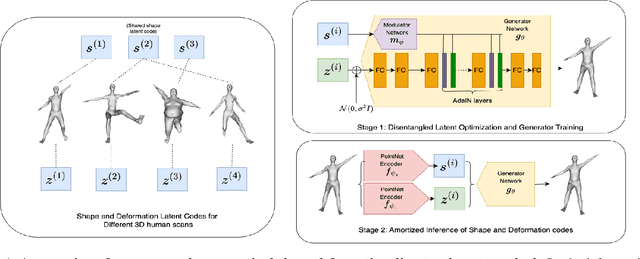
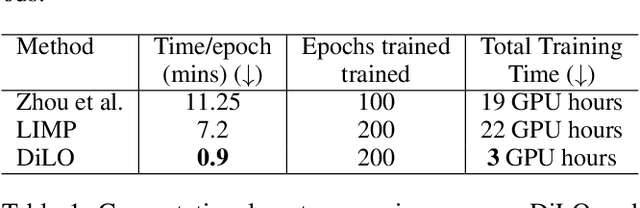
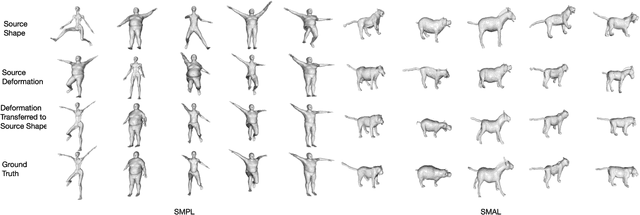
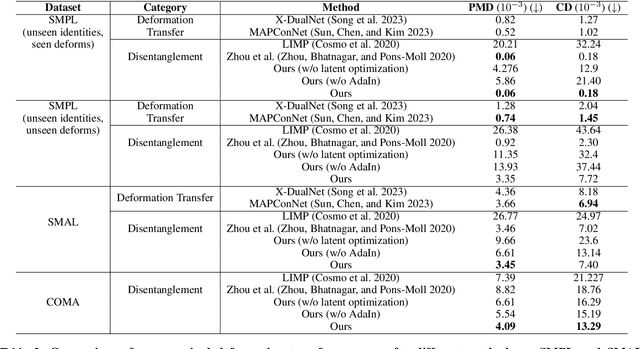
In this work, we propose a disentangled latent optimization-based method for parameterizing grouped deforming 3D objects into shape and deformation factors in an unsupervised manner. Our approach involves the joint optimization of a generator network along with the shape and deformation factors, supported by specific regularization techniques. For efficient amortized inference of disentangled shape and deformation codes, we train two order-invariant PoinNet-based encoder networks in the second stage of our method. We demonstrate several significant downstream applications of our method, including unsupervised deformation transfer, deformation classification, and explainability analysis. Extensive experiments conducted on 3D human, animal, and facial expression datasets demonstrate that our simple approach is highly effective in these downstream tasks, comparable or superior to existing methods with much higher complexity.