 Add to Chrome
 Add to Firefox
 Add to Edge
HalluTracer: Hallucination Detection via Depth-Averaging Truth Signals
Aug 17, 2026
Even well-aligned large language models confidently generate factually incorrect text, making hallucination a persistent reliability risk in high-stakes deployments. These models nonetheless carry linearly separable truthfulness signals in their internal representations. Existing white-box detectors, however, collapse this evidence to isolated components or a single depth, discarding discriminative information distributed across the full forward pass. We introduce HalluTracer, a detection framework that reads and aggregates truthfulness evidence across every layer of the forward pass before the model emits any answer token. A geometric analysis reveals that the per-layer signals are weakly correlated, so that simple depth averaging suppresses layer-specific noise and captures nearly all linearly accessible information. Across six open-source language models and five hallucination benchmarks, HalluTracer consistently outperforms matched white-box baselines, with gains ranging from one to fourteen points. Collectively, our work recasts hallucination detection from a layer-selection problem into a depth-aggregation problem governed by the geometric sparsity of the truthfulness signal.

Causal Discovery with Inverted Self-attention for Multivariate Time Series
Jul 30, 2026Causal discovery in multivariate time series data is challenging due to complex interactions, high dimensionality, and nonlinear dependencies among variables. Existing methods often struggle to capture these complexities, resulting in inaccurate causal structures. To address this issue, we propose a novel framework that leverages self-attention mechanisms within the transformer architecture for causal discovery. Our approach introduces a novel inverted causal self-attention mechanism (CSAM) that emphasizes latent and indirect causal relationships by inverting tokens and inducing sparsity in attention scores, focusing on significant causal interactions and reducing spurious correlations. Additionally, we develop a global causal algorithm to identify global causal links, providing a holistic metric for causal influence, along with a causal verification module to ensure robustness in the identified causal relationships, enhancing the reliability of our framework. Experiments on both linear and nonlinear datasets, along with ablation studies and sensitivity analyses, show that our framework outperforms existing methods, demonstrating its potential for causal discovery in complex multivariate time series.
Dual Inversion for Text-to-Image Diffusion Models: From Both Prompt and Noise Perspectives
Jul 29, 2026Prompt inversion, as a typical reverse engineering technique, enables text-to-image (T2I) diffusion models to generate the desired target images without extensive prompt engineering. However, existing prompt inversion methods suffer from significant limitations: (1) gradient-based methods are unstable and uninterpretable, often resulting in generated images with severe artifacts; (2) gradient-free methods yield human-readable prompts but still fail to preserve visual fidelity due to the lack of fine-grained detail alignment. We contend that the limitations stem from treating prompt inversion as a sufficient condition for reverse engineering, ignoring the critical role of the latent noise that encodes structural information. Consequently, we propose Dualin (Dual inversion), a two-stage method that jointly recovers both the semantic prompt and latent noise of the target image. In the first stage, we integrate vision-language model, CLIP and large language model to invert a faithful, human-interpretable hard prompt. In the second stage, unconditional DDIM inversion reconstructs the exact latent noise of the target image, guaranteeing the consistency at the structural information level. Theoretically, we prove that the inverted noise enables flexible image editing without re-optimization. Extensive experiments on diverse datasets demonstrate that Dualin simultaneously generates high-quality inverted prompts and achieves state-of-the-art image fidelity. Additionally, Dualin can establish a robust foundation for the precise and controllable image editing.
Auditing Machine Unlearning: A Systematic Research on Whether Models Truly Forget
Jun 15, 2026Machine unlearning has been extensively studied in response to growing privacy concerns and regulatory requirements. However, auditing whether unlearning algorithms have truly erased the influence of specific data remains an open challenge. The lack of reliable and practical auditing mechanisms can lead to critical privacy risks, such as residual information leakage. This paper initiates a systematic investigation into whether existing unlearning algorithms can truly forget the designated data. We propose the first practical and general-purpose auditing framework for machine unlearning, inspired by the concept of proof of ignorance. Our framework addresses the key practicality limitations of existing methods by eliminating the need for retraining-from-scratch baselines, avoiding the training of large numbers of shadow models, and requiring no intrusive intervention in the original training process. To evaluate the effectiveness of our framework, we first conduct validation experiments to verify its soundness and completeness. We then perform comprehensive experiments across six datasets and ten representative unlearning methods. The results demonstrate that our framework reliably distinguishes between successful and failed unlearning. In particular, we observe that retraining-based and fine-tuning-based methods can achieve effective unlearning, even when the target data remain in the original dataset. In contrast, de-optimization-based methods fail to achieve true unlearning and instead degrade the model's performance. Fisher/Hessian-based methods also fail to unlearn requested data, even formal certification is provided. Moreover, we show that our framework is robust against fake unlearning attempts and generalizes well to large language models.
A Comprehensive Survey of Knowledge-Based Vision Question Answering Systems: The Lifecycle of Knowledge in Visual Reasoning Task
Apr 24, 2025Knowledge-based Vision Question Answering (KB-VQA) extends general Vision Question Answering (VQA) by not only requiring the understanding of visual and textual inputs but also extensive range of knowledge, enabling significant advancements across various real-world applications. KB-VQA introduces unique challenges, including the alignment of heterogeneous information from diverse modalities and sources, the retrieval of relevant knowledge from noisy or large-scale repositories, and the execution of complex reasoning to infer answers from the combined context. With the advancement of Large Language Models (LLMs), KB-VQA systems have also undergone a notable transformation, where LLMs serve as powerful knowledge repositories, retrieval-augmented generators and strong reasoners. Despite substantial progress, no comprehensive survey currently exists that systematically organizes and reviews the existing KB-VQA methods. This survey aims to fill this gap by establishing a structured taxonomy of KB-VQA approaches, and categorizing the systems into main stages: knowledge representation, knowledge retrieval, and knowledge reasoning. By exploring various knowledge integration techniques and identifying persistent challenges, this work also outlines promising future research directions, providing a foundation for advancing KB-VQA models and their applications.
UniRVQA: A Unified Framework for Retrieval-Augmented Vision Question Answering via Self-Reflective Joint Training
Apr 05, 2025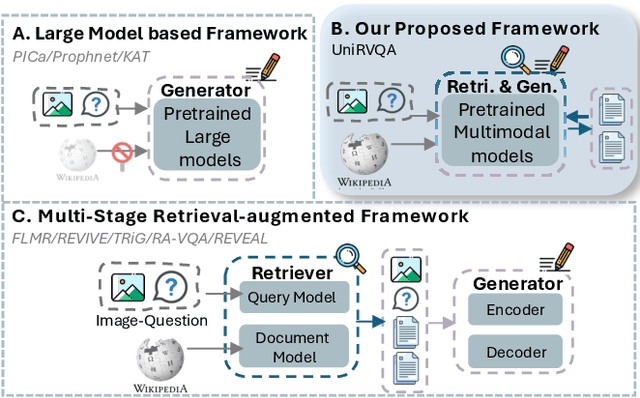
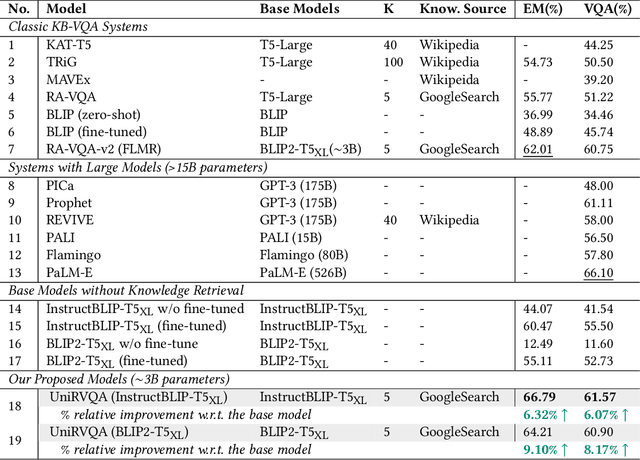
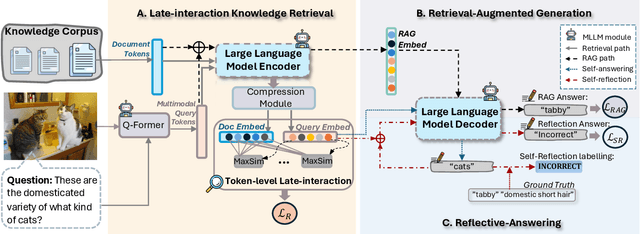
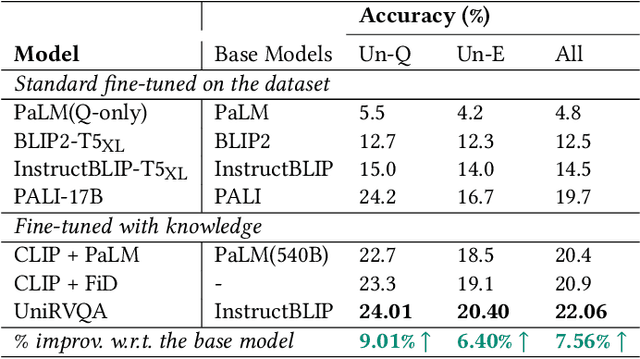
Knowledge-based Vision Question Answering (KB-VQA) systems address complex visual-grounded questions requiring external knowledge, such as web-sourced encyclopedia articles. Existing methods often use sequential and separate frameworks for the retriever and the generator with limited parametric knowledge sharing. However, since both retrieval and generation tasks require accurate understanding of contextual and external information, such separation can potentially lead to suboptimal system performance. Another key challenge is the integration of multimodal information. General-purpose multimodal pre-trained models, while adept at multimodal representation learning, struggle with fine-grained retrieval required for knowledge-intensive visual questions. Recent specialized pre-trained models mitigate the issue, but are computationally expensive. To bridge the gap, we propose a Unified Retrieval-Augmented VQA framework (UniRVQA). UniRVQA adapts general multimodal pre-trained models for fine-grained knowledge-intensive tasks within a unified framework, enabling cross-task parametric knowledge sharing and the extension of existing multimodal representation learning capability. We further introduce a reflective-answering mechanism that allows the model to explicitly evaluate and refine its knowledge boundary. Additionally, we integrate late interaction into the retrieval-augmented generation joint training process to enhance fine-grained understanding of queries and documents. Our approach achieves competitive performance against state-of-the-art models, delivering a significant 4.7% improvement in answering accuracy, and brings an average 7.5% boost in base MLLMs' VQA performance.
Vertical Federated Unlearning via Backdoor Certification
Dec 16, 2024Vertical Federated Learning (VFL) offers a novel paradigm in machine learning, enabling distinct entities to train models cooperatively while maintaining data privacy. This method is particularly pertinent when entities possess datasets with identical sample identifiers but diverse attributes. Recent privacy regulations emphasize an individual's \emph{right to be forgotten}, which necessitates the ability for models to unlearn specific training data. The primary challenge is to develop a mechanism to eliminate the influence of a specific client from a model without erasing all relevant data from other clients. Our research investigates the removal of a single client's contribution within the VFL framework. We introduce an innovative modification to traditional VFL by employing a mechanism that inverts the typical learning trajectory with the objective of extracting specific data contributions. This approach seeks to optimize model performance using gradient ascent, guided by a pre-defined constrained model. We also introduce a backdoor mechanism to verify the effectiveness of the unlearning procedure. Our method avoids fully accessing the initial training data and avoids storing parameter updates. Empirical evidence shows that the results align closely with those achieved by retraining from scratch. Utilizing gradient ascent, our unlearning approach addresses key challenges in VFL, laying the groundwork for future advancements in this domain. All the code and implementations related to this paper are publicly available at https://github.com/mengde-han/VFL-unlearn.
Predicting Financial Literacy via Semi-supervised Learning
Dec 18, 2023Financial literacy (FL) represents a person's ability to turn assets into income, and understanding digital currencies has been added to the modern definition. FL can be predicted by exploiting unlabelled recorded data in financial networks via semi-supervised learning (SSL). Measuring and predicting FL has not been widely studied, resulting in limited understanding of customer financial engagement consequences. Previous studies have shown that low FL increases the risk of social harm. Therefore, it is important to accurately estimate FL to allocate specific intervention programs to less financially literate groups. This will not only increase company profitability, but will also reduce government spending. Some studies considered predicting FL in classification tasks, whereas others developed FL definitions and impacts. The current paper investigated mechanisms to learn customer FL level from their financial data using sampling by synthetic minority over-sampling techniques for regression with Gaussian noise (SMOGN). We propose the SMOGN-COREG model for semi-supervised regression, applying SMOGN to deal with unbalanced datasets and a nonparametric multi-learner co-regression (COREG) algorithm for labeling. We compared the SMOGN-COREG model with six well-known regressors on five datasets to evaluate the proposed models effectiveness on unbalanced and unlabelled financial data. Experimental results confirmed that the proposed method outperformed the comparator models for unbalanced and unlabelled financial data. Therefore, SMOGN-COREG is a step towards using unlabelled data to estimate FL level.
* 12 pages
Leveraged Mel spectrograms using Harmonic and Percussive Components in Speech Emotion Recognition
Dec 18, 2023Speech Emotion Recognition (SER) affective technology enables the intelligent embedded devices to interact with sensitivity. Similarly, call centre employees recognise customers' emotions from their pitch, energy, and tone of voice so as to modify their speech for a high-quality interaction with customers. This work explores, for the first time, the effects of the harmonic and percussive components of Mel spectrograms in SER. We attempt to leverage the Mel spectrogram by decomposing distinguishable acoustic features for exploitation in our proposed architecture, which includes a novel feature map generator algorithm, a CNN-based network feature extractor and a multi-layer perceptron (MLP) classifier. This study specifically focuses on effective data augmentation techniques for building an enriched hybrid-based feature map. This process results in a function that outputs a 2D image so that it can be used as input data for a pre-trained CNN-VGG16 feature extractor. Furthermore, we also investigate other acoustic features such as MFCCs, chromagram, spectral contrast, and the tonnetz to assess our proposed framework. A test accuracy of 92.79% on the Berlin EMO-DB database is achieved. Our result is higher than previous works using CNN-VGG16.
* 12 pages
An Extended Variational Mode Decomposition Algorithm Developed Speech Emotion Recognition Performance
Dec 18, 2023Emotion recognition (ER) from speech signals is a robust approach since it cannot be imitated like facial expression or text based sentiment analysis. Valuable information underlying the emotions are significant for human-computer interactions enabling intelligent machines to interact with sensitivity in the real world. Previous ER studies through speech signal processing have focused exclusively on associations between different signal mode decomposition methods and hidden informative features. However, improper decomposition parameter selections lead to informative signal component losses due to mode duplicating and mixing. In contrast, the current study proposes VGG-optiVMD, an empowered variational mode decomposition algorithm, to distinguish meaningful speech features and automatically select the number of decomposed modes and optimum balancing parameter for the data fidelity constraint by assessing their effects on the VGG16 flattening output layer. Various feature vectors were employed to train the VGG16 network on different databases and assess VGG-optiVMD reproducibility and reliability. One, two, and three-dimensional feature vectors were constructed by concatenating Mel-frequency cepstral coefficients, Chromagram, Mel spectrograms, Tonnetz diagrams, and spectral centroids. Results confirmed a synergistic relationship between the fine-tuning of the signal sample rate and decomposition parameters with classification accuracy, achieving state-of-the-art 96.09% accuracy in predicting seven emotions on the Berlin EMO-DB database.
* 12 pages