 Add to Chrome
 Add to Firefox
 Add to Edge
MAG: MAnifold Guided Semi-Supervised Multi-modal In-Context Learning
Aug 13, 2026
Few-shot in-context learning (ICL) with multi-modal large language models (MLLMs) enables task adaptation without parameter updates, but its performance is highly sensitive to the quality and coverage of the selected demonstrations. While unlabeled multi-modal data is abundant, it remains elusive how to exploit them for ICL. We propose MAG (MAnifold-Guided semi-supervised in-context demonstra- tion selection), an efficient framework that leverages unlabeled data to improve multi-modal ICL. MAG formulates demonstration selection as a semi-supervised propagation problem on a multi-modal graph and adopts a two-stage strategy: (i) relevance score propagation identifies a compact set of high-impact unlabeled samples for pseudo-labeling, reducing MLLM inference cost; (ii) multi-modal relevance is used to select the final demonstrations. We show that textual represen- tations are more effective for relevance propagation, while both visual and textual modalities are crucial for high-quality demonstration selection. Experiments on eight multi-modal benchmarks demonstrate that MAG consistently outperforms strong baselines in label-scarce regimes, achieving significant gains with a limited pseudo-labeling budget.

Using Cognitive Models to Improve Language Model Simulation of Human Persuasion Games
Jun 16, 2026People make decisions differently in strategic interactions. Some update beliefs like a Bayesian; others exhibit biases like motivated reasoning. Although creators of large language models use simulated humans for safety evaluations and training, they often fail to cover this breadth of human behavior. We argue that cognitive science and economics provide a convenient tool for doing so, making use of mathematical models of human decision-making. We propose an approach that we call Equation-to-Behavior Prompting for guiding large language models to match cognitive models, and evaluate this approach on persuasion games based on legal decision-making. We find that large models can approximate equation-based specifications -- Bayesian updating, affine distortion, motivated updating, and Grether's $α$-$β$ model -- using prompting, but small models fail to do so. However, training small models with reinforcement learning to adhere to mathematical rules, Equation-to-Behavior RL, reduces belief error by 26.5% in out-of-distribution parameterizations. We show that these simulations can help create diverse training environments; training small models to consider different kinds of decision-makers improves average belief change by 2.5%--12% over Bayesian-only training, even when persuading GPT-5-mini. Our work could improve human simulations for training and evaluation in increasingly realistic settings, and could also enable novel research into more complicated mathematical models of human decision-making.
Must Read: A Systematic Survey of Computational Persuasion
May 12, 2025Persuasion is a fundamental aspect of communication, influencing decision-making across diverse contexts, from everyday conversations to high-stakes scenarios such as politics, marketing, and law. The rise of conversational AI systems has significantly expanded the scope of persuasion, introducing both opportunities and risks. AI-driven persuasion can be leveraged for beneficial applications, but also poses threats through manipulation and unethical influence. Moreover, AI systems are not only persuaders, but also susceptible to persuasion, making them vulnerable to adversarial attacks and bias reinforcement. Despite rapid advancements in AI-generated persuasive content, our understanding of what makes persuasion effective remains limited due to its inherently subjective and context-dependent nature. In this survey, we provide a comprehensive overview of computational persuasion, structured around three key perspectives: (1) AI as a Persuader, which explores AI-generated persuasive content and its applications; (2) AI as a Persuadee, which examines AI's susceptibility to influence and manipulation; and (3) AI as a Persuasion Judge, which analyzes AI's role in evaluating persuasive strategies, detecting manipulation, and ensuring ethical persuasion. We introduce a taxonomy for computational persuasion research and discuss key challenges, including evaluating persuasiveness, mitigating manipulative persuasion, and developing responsible AI-driven persuasive systems. Our survey outlines future research directions to enhance the safety, fairness, and effectiveness of AI-powered persuasion while addressing the risks posed by increasingly capable language models.
ResearchTown: Simulator of Human Research Community
Dec 23, 2024Large Language Models (LLMs) have demonstrated remarkable potential in scientific domains, yet a fundamental question remains unanswered: Can we simulate human research communities with LLMs? Addressing this question can deepen our understanding of the processes behind idea brainstorming and inspire the automatic discovery of novel scientific insights. In this work, we propose ResearchTown, a multi-agent framework for research community simulation. Within this framework, the human research community is simplified and modeled as an agent-data graph, where researchers and papers are represented as agent-type and data-type nodes, respectively, and connected based on their collaboration relationships. We also introduce TextGNN, a text-based inference framework that models various research activities (e.g., paper reading, paper writing, and review writing) as special forms of a unified message-passing process on the agent-data graph. To evaluate the quality of the research simulation, we present ResearchBench, a benchmark that uses a node-masking prediction task for scalable and objective assessment based on similarity. Our experiments reveal three key findings: (1) ResearchTown can provide a realistic simulation of collaborative research activities, including paper writing and review writing; (2) ResearchTown can maintain robust simulation with multiple researchers and diverse papers; (3) ResearchTown can generate interdisciplinary research ideas that potentially inspire novel research directions.
How Far Are We From AGI
May 16, 2024
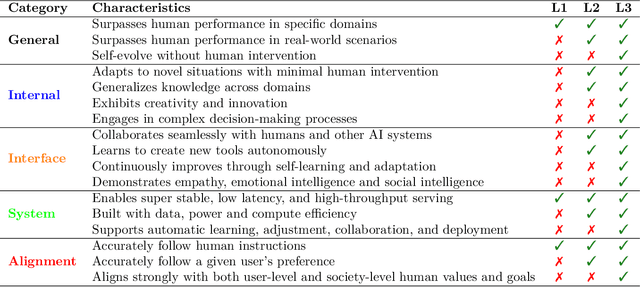
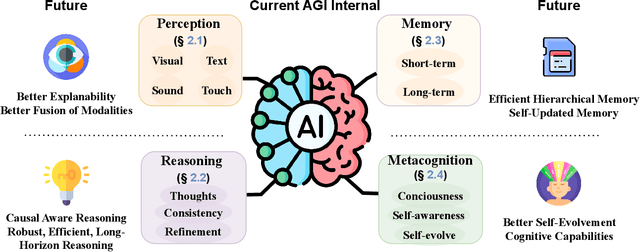

The evolution of artificial intelligence (AI) has profoundly impacted human society, driving significant advancements in multiple sectors. Yet, the escalating demands on AI have highlighted the limitations of AI's current offerings, catalyzing a movement towards Artificial General Intelligence (AGI). AGI, distinguished by its ability to execute diverse real-world tasks with efficiency and effectiveness comparable to human intelligence, reflects a paramount milestone in AI evolution. While existing works have summarized specific recent advancements of AI, they lack a comprehensive discussion of AGI's definitions, goals, and developmental trajectories. Different from existing survey papers, this paper delves into the pivotal questions of our proximity to AGI and the strategies necessary for its realization through extensive surveys, discussions, and original perspectives. We start by articulating the requisite capability frameworks for AGI, integrating the internal, interface, and system dimensions. As the realization of AGI requires more advanced capabilities and adherence to stringent constraints, we further discuss necessary AGI alignment technologies to harmonize these factors. Notably, we emphasize the importance of approaching AGI responsibly by first defining the key levels of AGI progression, followed by the evaluation framework that situates the status-quo, and finally giving our roadmap of how to reach the pinnacle of AGI. Moreover, to give tangible insights into the ubiquitous impact of the integration of AI, we outline existing challenges and potential pathways toward AGI in multiple domains. In sum, serving as a pioneering exploration into the current state and future trajectory of AGI, this paper aims to foster a collective comprehension and catalyze broader public discussions among researchers and practitioners on AGI.
Wikibench: Community-Driven Data Curation for AI Evaluation on Wikipedia
Feb 21, 2024AI tools are increasingly deployed in community contexts. However, datasets used to evaluate AI are typically created by developers and annotators outside a given community, which can yield misleading conclusions about AI performance. How might we empower communities to drive the intentional design and curation of evaluation datasets for AI that impacts them? We investigate this question on Wikipedia, an online community with multiple AI-based content moderation tools deployed. We introduce Wikibench, a system that enables communities to collaboratively curate AI evaluation datasets, while navigating ambiguities and differences in perspective through discussion. A field study on Wikipedia shows that datasets curated using Wikibench can effectively capture community consensus, disagreement, and uncertainty. Furthermore, study participants used Wikibench to shape the overall data curation process, including refining label definitions, determining data inclusion criteria, and authoring data statements. Based on our findings, we propose future directions for systems that support community-driven data curation.
TeacherLM: Teaching to Fish Rather Than Giving the Fish, Language Modeling Likewise
Oct 31, 2023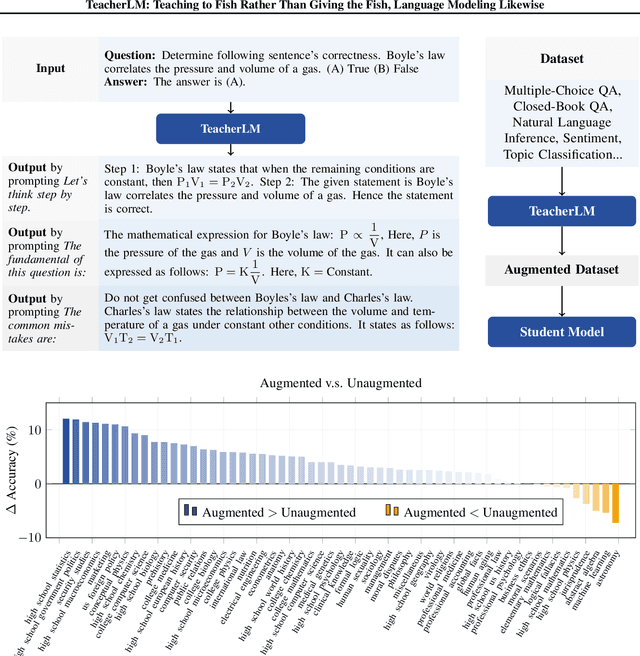
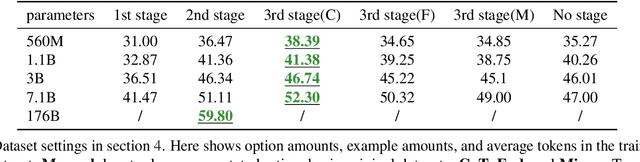
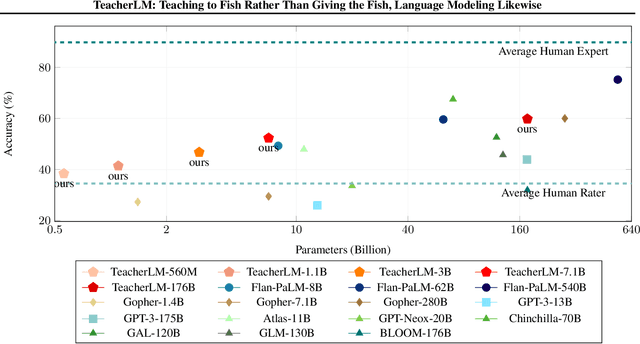

Large Language Models (LLMs) exhibit impressive reasoning and data augmentation capabilities in various NLP tasks. However, what about small models? In this work, we propose TeacherLM-7.1B, capable of annotating relevant fundamentals, chain of thought, and common mistakes for most NLP samples, which makes annotation more than just an answer, thus allowing other models to learn "why" instead of just "what". The TeacherLM-7.1B model achieved a zero-shot score of 52.3 on MMLU, surpassing most models with over 100B parameters. Even more remarkable is its data augmentation ability. Based on TeacherLM-7.1B, we augmented 58 NLP datasets and taught various student models with different parameters from OPT and BLOOM series in a multi-task setting. The experimental results indicate that the data augmentation provided by TeacherLM has brought significant benefits. We will release the TeacherLM series of models and augmented datasets as open-source.
Modeling the Trade-off of Privacy Preservation and Activity Recognition on Low-Resolution Images
Mar 18, 2023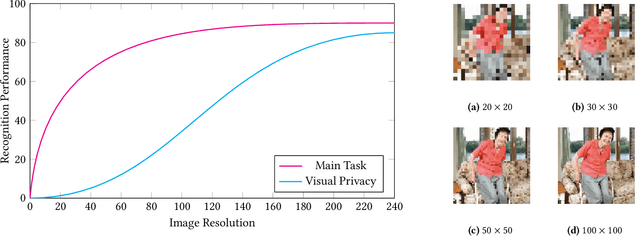
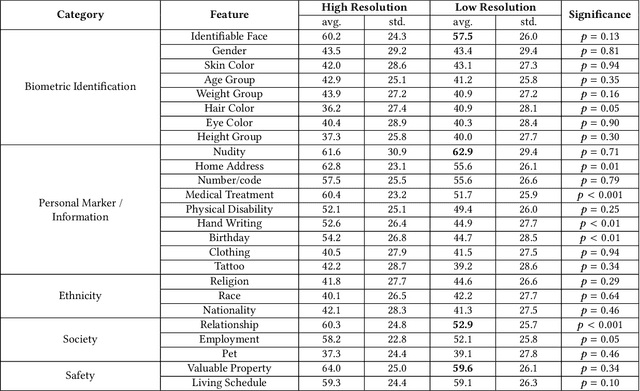
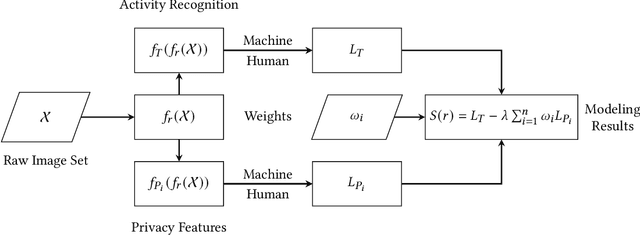
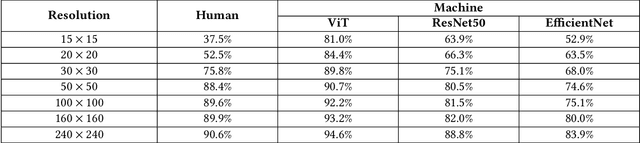
A computer vision system using low-resolution image sensors can provide intelligent services (e.g., activity recognition) but preserve unnecessary visual privacy information from the hardware level. However, preserving visual privacy and enabling accurate machine recognition have adversarial needs on image resolution. Modeling the trade-off of privacy preservation and machine recognition performance can guide future privacy-preserving computer vision systems using low-resolution image sensors. In this paper, using the at-home activity of daily livings (ADLs) as the scenario, we first obtained the most important visual privacy features through a user survey. Then we quantified and analyzed the effects of image resolution on human and machine recognition performance in activity recognition and privacy awareness tasks. We also investigated how modern image super-resolution techniques influence these effects. Based on the results, we proposed a method for modeling the trade-off of privacy preservation and activity recognition on low-resolution images.