 Add to Chrome
 Add to Firefox
 Add to Edge
Test-time Scaling over Perception: Resolving the Grounding Paradox in Thinking with Images
Apr 13, 2026
Recent multimodal large language models (MLLMs) have begun to support Thinking with Images by invoking visual tools such as zooming and cropping during inference. Yet these systems remain brittle in fine-grained visual reasoning because they must decide where to look before they have access to the evidence needed to make that decision correctly. We identify this circular dependency as the Grounding Paradox. To address it, we propose Test-Time Scaling over Perception (TTSP), a framework that treats perception itself as a scalable inference process. TTSP generates multiple exploratory perception traces, filters unreliable traces using entropy-based confidence estimation, distills validated observations into structured knowledge, and iteratively refines subsequent exploration toward unresolved uncertainty. Extensive experiments on high-resolution and general multimodal reasoning benchmarks show that TTSP consistently outperforms strong baselines across backbone sizes, while also exhibiting favorable scalability and token efficiency. Our results suggest that scaling perception at test time is a promising direction for robust multimodal reasoning under perceptual uncertainty.

SubFLOT: Submodel Extraction for Efficient and Personalized Federated Learning via Optimal Transport
Apr 08, 2026Federated Learning (FL) enables collaborative model training while preserving data privacy, but its practical deployment is hampered by system and statistical heterogeneity. While federated network pruning offers a path to mitigate these issues, existing methods face a critical dilemma: server-side pruning lacks personalization, whereas client-side pruning is computationally prohibitive for resource-constrained devices. Furthermore, the pruning process itself induces significant parametric divergence among heterogeneous submodels, destabilizing training and hindering global convergence. To address these challenges, we propose SubFLOT, a novel framework for server-side personalized federated pruning. SubFLOT introduces an Optimal Transport-enhanced Pruning (OTP) module that treats historical client models as proxies for local data distributions, formulating the pruning task as a Wasserstein distance minimization problem to generate customized submodels without accessing raw data. Concurrently, to counteract parametric divergence, our Scaling-based Adaptive Regularization (SAR) module adaptively penalizes a submodel's deviation from the global model, with the penalty's strength scaled by the client's pruning rate. Comprehensive experiments demonstrate that SubFLOT consistently and substantially outperforms state-of-the-art methods, underscoring its potential for deploying efficient and personalized models on resource-constrained edge devices.
SoftDedup: an Efficient Data Reweighting Method for Speeding Up Language Model Pre-training
Jul 09, 2024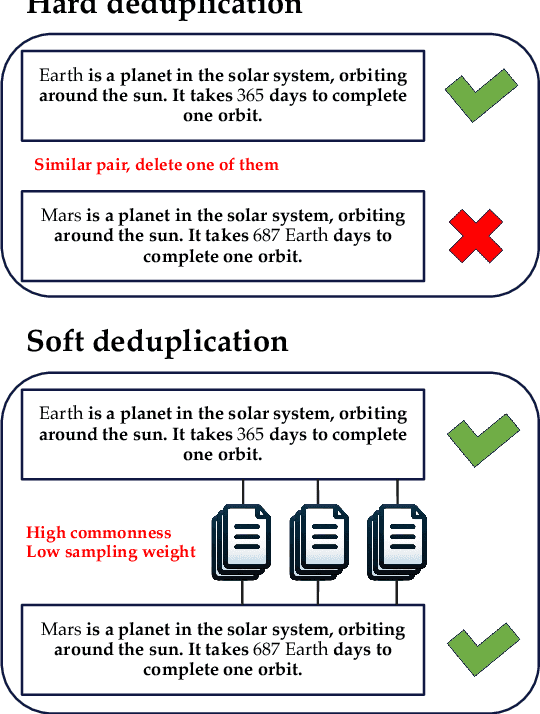
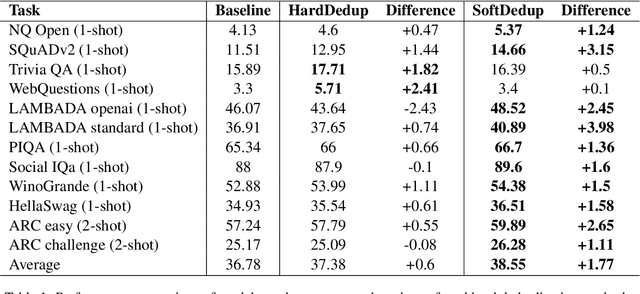
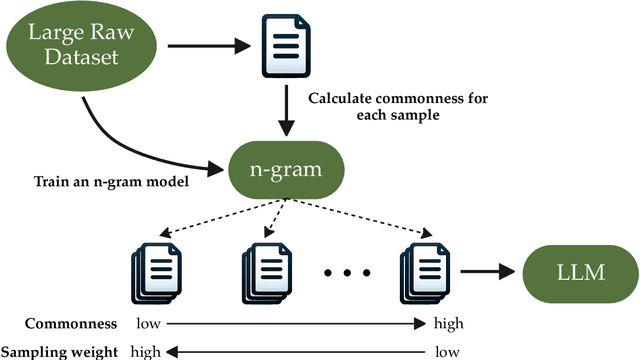
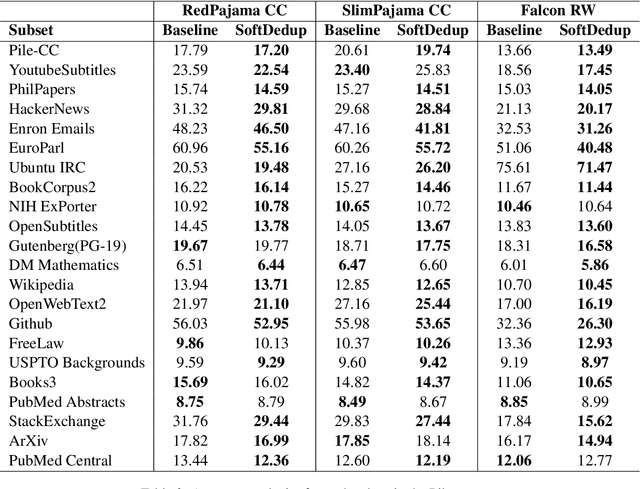
The effectiveness of large language models (LLMs) is often hindered by duplicated data in their extensive pre-training datasets. Current approaches primarily focus on detecting and removing duplicates, which risks the loss of valuable information and neglects the varying degrees of duplication. To address this, we propose a soft deduplication method that maintains dataset integrity while selectively reducing the sampling weight of data with high commonness. Central to our approach is the concept of "data commonness", a metric we introduce to quantify the degree of duplication by measuring the occurrence probabilities of samples using an n-gram model. Empirical analysis shows that this method significantly improves training efficiency, achieving comparable perplexity scores with at least a 26% reduction in required training steps. Additionally, it enhances average few-shot downstream accuracy by 1.77% when trained for an equivalent duration. Importantly, this approach consistently improves performance, even on rigorously deduplicated datasets, indicating its potential to complement existing methods and become a standard pre-training process for LLMs.
TeacherLM: Teaching to Fish Rather Than Giving the Fish, Language Modeling Likewise
Oct 31, 2023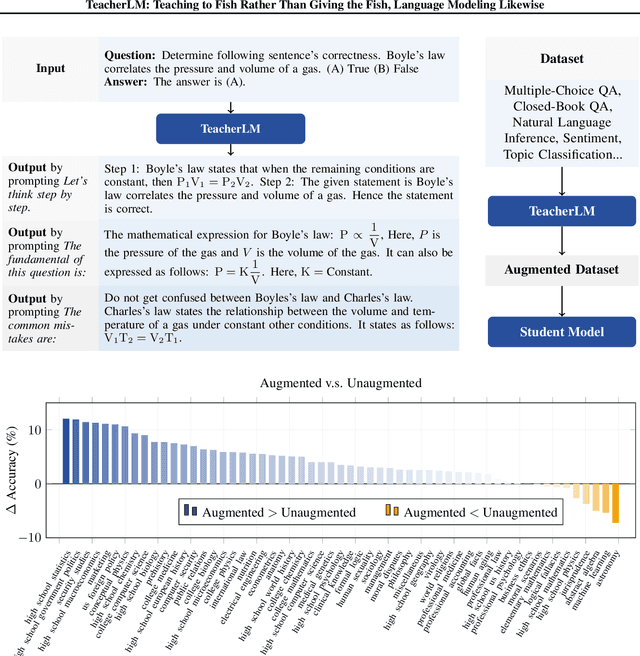
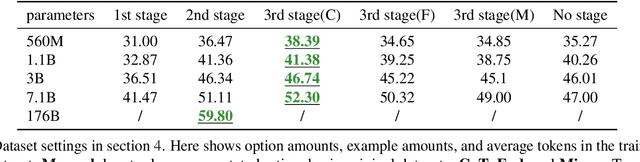
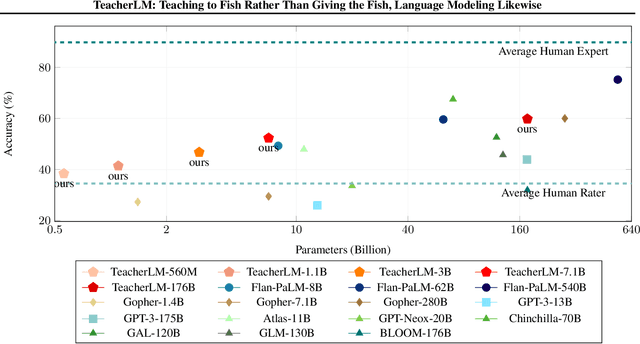

Large Language Models (LLMs) exhibit impressive reasoning and data augmentation capabilities in various NLP tasks. However, what about small models? In this work, we propose TeacherLM-7.1B, capable of annotating relevant fundamentals, chain of thought, and common mistakes for most NLP samples, which makes annotation more than just an answer, thus allowing other models to learn "why" instead of just "what". The TeacherLM-7.1B model achieved a zero-shot score of 52.3 on MMLU, surpassing most models with over 100B parameters. Even more remarkable is its data augmentation ability. Based on TeacherLM-7.1B, we augmented 58 NLP datasets and taught various student models with different parameters from OPT and BLOOM series in a multi-task setting. The experimental results indicate that the data augmentation provided by TeacherLM has brought significant benefits. We will release the TeacherLM series of models and augmented datasets as open-source.