 Add to Chrome
 Add to Firefox
 Add to Edge
Kimi K3: Open Frontier Intelligence
Jul 27, 2026
We introduce Kimi K3, a 2.8T parameter Mixture-of-Experts model with 104 billion activated parameters, native vision capabilities, and a 1-million-token context window. Kimi K3 is built on Kimi Delta Attention and Attention Residuals, which improve information flow across sequence length and model depth. Together with Stable LatentMoE, which effectively activates 16 of 896 routed experts per token, and refined training and data recipes, these advances yield an approximately 2.5x improvement in overall scaling efficiency over Kimi K2. Post-training highlights reinforcement learning across general, agentic, and coding domains and multiple reasoning-effort levels, enabling compositional generalization and robust long-horizon execution. At 2.8T scale, Kimi K3 is supported by infrastructure advances in multiple areas: algorithm-system co-design for KDA, perfectly balanced expert-parallel training with efficient memory management, million-token agentic RL with persistent rollout and sandbox states, and deployment innovations. Extensive evaluations show that Kimi K3 achieves frontier-level performance across long-horizon coding, agentic, knowledge, reasoning, and vision tasks. While its overall performance still trails the most powerful proprietary models, namely Claude Fable 5 and GPT-5.6 Sol, Kimi K3 consistently outperforms other open and proprietary models evaluated in our suite. We release the full Kimi K3 model weights to facilitate future research and accelerate the broader deployment and adoption of frontier intelligence.

Self-supervised Automatic Matting
Jul 11, 2026High-quality alpha mattes are notoriously expensive to annotate, creating a fundamental data bottleneck for deep image matting. While prior work attempts to reduce annotation cost using coarser labels like trimaps or masks, they remain reliant on costly per-pixel supervision, limiting scalability and generalization. In this work, we push the boundary further and ask: can we train an automatic matting model using only RGB images, with no manual annotation at all? We answer this by presenting SSMatte, a self-supervised framework that for the first time achieves performance on par with fully-supervised automatic matting. Our key insight is to decompose the problem into semantic anchoring and detail matting. SSMatte first generates a semantic matting prompt from frozen self-supervised ViT features by propagating class-token seeds via a novel, training-efficient semantic anchoring loss based on a generalized Rayleigh quotient. This prompt then anchors a detail matting network, which is optimized via a fixed-point-based loss that enforces alpha-RGB consistency. Extensive experiments show SSMatte outperforms prior weakly-supervised methods, matches the performance of fully-supervised models on portrait benchmarks, and demonstrates favorable scaling and generalization behaviors with additional data. Our work pushes automatic matting to an fresh, fully annotation-free paradigm. Code will be available.
Trajectory-Anchor Optimization for Overconfident Thermal Visual Place Recognition: Zero-Leakage OOD Auditing and Kidnapped-Robot Recovery
Jul 06, 2026Modern thermal visual place recognition (TIR-VPR) frontends based on foundation models achieve remarkable closed-set retrieval but suffer from an overconfident forced-matching failure mode. Under out-of-distribution (OOD) or unmapped conditions, they generate highly plausible yet false loop candidates without a drop in similarity scores. While classical multi-hypothesis tracking (MHT) backends can mitigate these ambiguities by maintaining divergent trajectory beliefs, their exponential computational overhead violates real-time robotic constraints. To bridge this gap, we present Trajectory-Anchor Optimization (TAO). To counter the combinatorial challenge of evaluating parallel hypotheses (e.g., K=100), TAO compresses multi-view temporal verification into a batched SE(2) Procrustes alignment problem. By leveraging tensor-level vectorization and single-invocation batched SVD, this formulation bypasses the dynamic tree expansion of MHT, guaranteeing a strictly bounded per-frame execution loop of O(KN). Under a strict zero-leakage evaluation protocol, we show that while a passive geometric backend cannot mathematically separate metric localization errors from coherent hallucinations at a micro-scale (<5m) due to local visual ambiguities, TAO serves as an efficient fail-safe filter at a macro-scale. Within a 5m radius, hallucinations often possess a locally consistent geometry that deceives rigid alignment. However, beyond this threshold, the K=100 disparate hypotheses disperse spatially across the global map. This dispersion breaks the rigid temporal co-visibility constraint within the sliding window (N=20), causing the joint optimization residual to escalate sharply. Consequently, TAO establishes a distinct macroscopic convergence basin (10m) where multi-view geometric consistency reliably isolates catastrophic topological breaks and suppresses critical false acceptances.
Kimi K2.5: Visual Agentic Intelligence
Feb 02, 2026We introduce Kimi K2.5, an open-source multimodal agentic model designed to advance general agentic intelligence. K2.5 emphasizes the joint optimization of text and vision so that two modalities enhance each other. This includes a series of techniques such as joint text-vision pre-training, zero-vision SFT, and joint text-vision reinforcement learning. Building on this multimodal foundation, K2.5 introduces Agent Swarm, a self-directed parallel agent orchestration framework that dynamically decomposes complex tasks into heterogeneous sub-problems and executes them concurrently. Extensive evaluations show that Kimi K2.5 achieves state-of-the-art results across various domains including coding, vision, reasoning, and agentic tasks. Agent Swarm also reduces latency by up to $4.5\times$ over single-agent baselines. We release the post-trained Kimi K2.5 model checkpoint to facilitate future research and real-world applications of agentic intelligence.
CorpusQA: A 10 Million Token Benchmark for Corpus-Level Analysis and Reasoning
Jan 21, 2026While large language models now handle million-token contexts, their capacity for reasoning across entire document repositories remains largely untested. Existing benchmarks are inadequate, as they are mostly limited to single long texts or rely on a "sparse retrieval" assumption-that answers can be derived from a few relevant chunks. This assumption fails for true corpus-level analysis, where evidence is highly dispersed across hundreds of documents and answers require global integration, comparison, and statistical aggregation. To address this critical gap, we introduce CorpusQA, a new benchmark scaling up to 10 million tokens, generated via a novel data synthesis framework. By decoupling reasoning from textual representation, this framework creates complex, computation-intensive queries with programmatically guaranteed ground-truth answers, challenging systems to perform holistic reasoning over vast, unstructured text without relying on fallible human annotation. We further demonstrate the utility of our framework beyond evaluation, showing that fine-tuning on our synthesized data effectively enhances an LLM's general long-context reasoning capabilities. Extensive experiments reveal that even state-of-the-art long-context LLMs struggle as input length increases, and standard retrieval-augmented generation systems collapse entirely. Our findings indicate that memory-augmented agentic architectures offer a more robust alternative, suggesting a critical shift is needed from simply extending context windows to developing advanced architectures for global information synthesis.
QwenLong-L1.5: Post-Training Recipe for Long-Context Reasoning and Memory Management
Dec 15, 2025We introduce QwenLong-L1.5, a model that achieves superior long-context reasoning capabilities through systematic post-training innovations. The key technical breakthroughs of QwenLong-L1.5 are as follows: (1) Long-Context Data Synthesis Pipeline: We develop a systematic synthesis framework that generates challenging reasoning tasks requiring multi-hop grounding over globally distributed evidence. By deconstructing documents into atomic facts and their underlying relationships, and then programmatically composing verifiable reasoning questions, our approach creates high-quality training data at scale, moving substantially beyond simple retrieval tasks to enable genuine long-range reasoning capabilities. (2) Stabilized Reinforcement Learning for Long-Context Training: To overcome the critical instability in long-context RL, we introduce task-balanced sampling with task-specific advantage estimation to mitigate reward bias, and propose Adaptive Entropy-Controlled Policy Optimization (AEPO) that dynamically regulates exploration-exploitation trade-offs. (3) Memory-Augmented Architecture for Ultra-Long Contexts: Recognizing that even extended context windows cannot accommodate arbitrarily long sequences, we develop a memory management framework with multi-stage fusion RL training that seamlessly integrates single-pass reasoning with iterative memory-based processing for tasks exceeding 4M tokens. Based on Qwen3-30B-A3B-Thinking, QwenLong-L1.5 achieves performance comparable to GPT-5 and Gemini-2.5-Pro on long-context reasoning benchmarks, surpassing its baseline by 9.90 points on average. On ultra-long tasks (1M~4M tokens), QwenLong-L1.5's memory-agent framework yields a 9.48-point gain over the agent baseline. Additionally, the acquired long-context reasoning ability translates to enhanced performance in general domains like scientific reasoning, memory tool using, and extended dialogue.
Addressing Information Loss and Interaction Collapse: A Dual Enhanced Attention Framework for Feature Interaction
Mar 14, 2025The Transformer has proven to be a significant approach in feature interaction for CTR prediction, achieving considerable success in previous works. However, it also presents potential challenges in handling feature interactions. Firstly, Transformers may encounter information loss when capturing feature interactions. By relying on inner products to represent pairwise relationships, they compress raw interaction information, which can result in a degradation of fidelity. Secondly, due to the long-tail features distribution, feature fields with low information-abundance embeddings constrain the information abundance of other fields, leading to collapsed embedding matrices. To tackle these issues, we propose a Dual Attention Framework for Enhanced Feature Interaction, known as Dual Enhanced Attention. This framework integrates two attention mechanisms: the Combo-ID attention mechanism and the collapse-avoiding attention mechanism. The Combo-ID attention mechanism directly retains feature interaction pairs to mitigate information loss, while the collapse-avoiding attention mechanism adaptively filters out low information-abundance interaction pairs to prevent interaction collapse. Extensive experiments conducted on industrial datasets have shown the effectiveness of Dual Enhanced Attention.
Efficient Portrait Matte Creation With Layer Diffusion and Connectivity Priors
Jan 27, 2025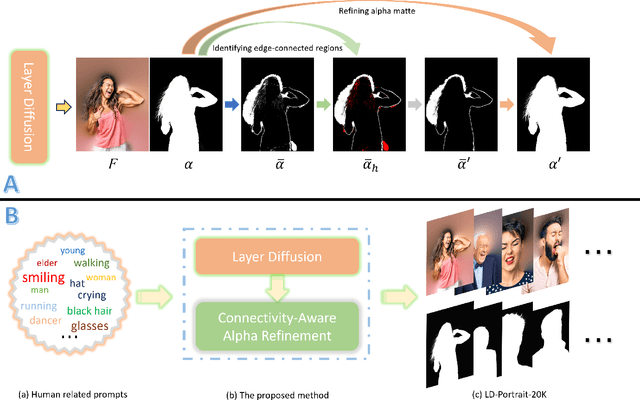
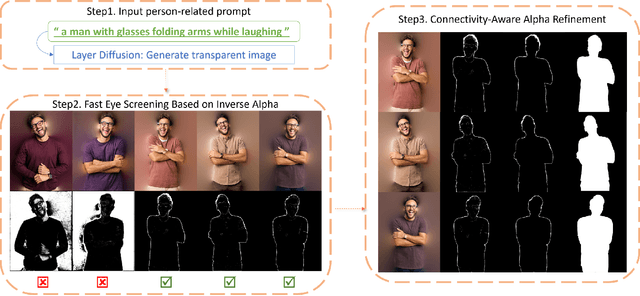

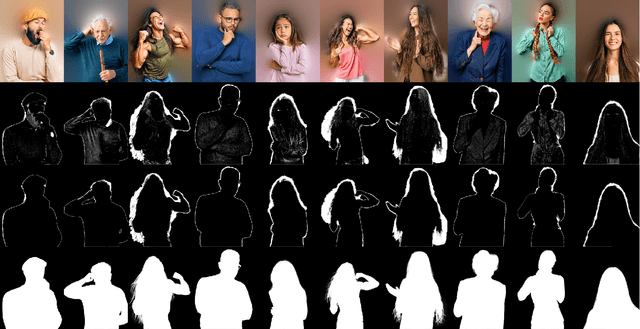
Learning effective deep portrait matting models requires training data of both high quality and large quantity. Neither quality nor quantity can be easily met for portrait matting, however. Since the most accurate ground-truth portrait mattes are acquired in front of the green screen, it is almost impossible to harvest a large-scale portrait matting dataset in reality. This work shows that one can leverage text prompts and the recent Layer Diffusion model to generate high-quality portrait foregrounds and extract latent portrait mattes. However, the portrait mattes cannot be readily in use due to significant generation artifacts. Inspired by the connectivity priors observed in portrait images, that is, the border of portrait foregrounds always appears connected, a connectivity-aware approach is introduced to refine portrait mattes. Building on this, a large-scale portrait matting dataset is created, termed LD-Portrait-20K, with $20,051$ portrait foregrounds and high-quality alpha mattes. Extensive experiments demonstrated the value of the LD-Portrait-20K dataset, with models trained on it significantly outperforming those trained on other datasets. In addition, comparisons with the chroma keying algorithm and an ablation study on dataset capacity further confirmed the effectiveness of the proposed matte creation approach. Further, the dataset also contributes to state-of-the-art video portrait matting, implemented by simple video segmentation and a trimap-based image matting model trained on this dataset.
DropEdge not Foolproof: Effective Augmentation Method for Signed Graph Neural Networks
Sep 29, 2024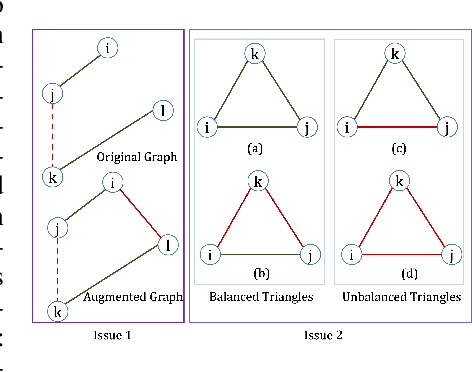


The paper discusses signed graphs, which model friendly or antagonistic relationships using edges marked with positive or negative signs, focusing on the task of link sign prediction. While Signed Graph Neural Networks (SGNNs) have advanced, they face challenges like graph sparsity and unbalanced triangles. The authors propose using data augmentation (DA) techniques to address these issues, although many existing methods are not suitable for signed graphs due to a lack of side information. They highlight that the random DropEdge method, a rare DA approach applicable to signed graphs, does not enhance link sign prediction performance. In response, they introduce the Signed Graph Augmentation (SGA) framework, which includes a structure augmentation module to identify candidate edges and a strategy for selecting beneficial candidates, ultimately improving SGNN training. Experimental results show that SGA significantly boosts the performance of SGNN models, with a notable 32.3% improvement in F1-micro for SGCN on the Slashdot dataset.
Angle-Aware Coverage with Camera Rotational Motion Control
Apr 22, 2024This paper presents a novel control strategy for drone networks to improve the quality of 3D structures reconstructed from aerial images by drones. Unlike the existing coverage control strategies for this purpose, our proposed approach simultaneously controls both the camera orientation and drone translational motion, enabling more comprehensive perspectives and enhancing the map's overall quality. Subsequently, we present a novel problem formulation, including a new performance function to evaluate the drone positions and camera orientations. We then design a QP-based controller with a control barrier-like function for a constraint on the decay rate of the objective function. The present problem formulation poses a new challenge, requiring significantly greater computational efforts than the case involving only translational motion control. We approach this issue technologically, namely by introducing JAX, utilizing just-in-time (JIT) compilation and Graphical Processing Unit (GPU) acceleration. We finally conduct extensive verifications through simulation in ROS (Robot Operating System) and show the real-time feasibility of the controller and the superiority of the present controller to the conventional method.