 Add to Chrome
 Add to Firefox
 Add to Edge
Beyond Time Series: Spatial Reasoning for Epidemic Forecasting via Multimodal Learning
Jun 20, 2026
Epidemic forecasting models typically rely on surveillance data reported over administrative regions, treating them as atomic units, thereby obscuring sub-regional spatial structure that shapes disease dynamics. We introduce a spatially structured multimodal epidemic forecasting setting that integrates region-level temporal surveillance data with spatially localized auxiliary signals that are misaligned in resolution and structure, reflecting realistic public health reporting constraints. Building on this formulation, we propose M-SPICE (Multimodal SPatIal Context for Epidemic Forecasting), a structure-aware spatiotemporal forecasting framework that performs joint reasoning over temporal disease dynamics and spatial context via attention-based multimodal fusion, allowing spatial signals to selectively condition temporal representations across forecast horizons. We evaluate our approach on real-world COVID-19, influenza, and influenza-like illness (ILI) forecasting tasks under realistic real-time evaluation protocols. Across all forecasting settings, our method consistently outperforms state-of-the-art multivariate time-series, multimodal, and epidemiological forecasting baselines while maintaining strong probabilistic forecasting performance. Finally, interpretability analyses reveal when, where, and how spatial signals are leveraged, highlighting settings in which purely temporal, region-aggregated models are most likely to fail.

Adapting SAM to Nuclei Instance Segmentation and Classification via Cooperative Fine-Grained Refinement
Mar 30, 2026Nuclei instance segmentation is critical in computational pathology for cancer diagnosis and prognosis. Recently, the Segment Anything Model has demonstrated exceptional performance in various segmentation tasks, leveraging its rich priors and powerful global context modeling capabilities derived from large-scale pre-training on natural images. However, directly applying SAM to the medical imaging domain faces significant limitations: it lacks sufficient perception of the local structural features that are crucial for nuclei segmentation, and full fine-tuning for downstream tasks requires substantial computational costs. To efficiently transfer SAM's robust prior knowledge to nuclei instance segmentation while supplementing its task-aware local perception, we propose a parameter-efficient fine-tuning framework, named Cooperative Fine-Grained Refinement of SAM, consisting of three core components: 1) a Multi-scale Adaptive Local-aware Adapter, which enables effective capability transfer by augmenting the frozen SAM backbone with minimal parameters and instilling a powerful perception of local structures through dynamically generated, multi-scale convolutional kernels; 2) a Hierarchical Modulated Fusion Module, which dynamically aggregates multi-level encoder features to preserve fine-grained spatial details; and 3) a Boundary-Guided Mask Refinement, which integrates multi-context boundary cues with semantic features through explicit supervision, producing a boundary-focused signal to refine initial mask predictions for sharper delineation. These three components work cooperatively to enhance local perception, preserve spatial details, and refine boundaries, enabling SAM to perform accurate nuclei instance segmentation directly.
DropEdge not Foolproof: Effective Augmentation Method for Signed Graph Neural Networks
Sep 29, 2024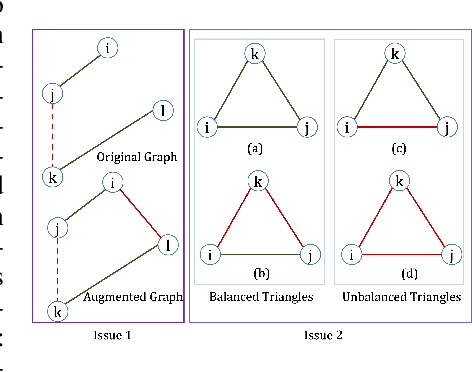


The paper discusses signed graphs, which model friendly or antagonistic relationships using edges marked with positive or negative signs, focusing on the task of link sign prediction. While Signed Graph Neural Networks (SGNNs) have advanced, they face challenges like graph sparsity and unbalanced triangles. The authors propose using data augmentation (DA) techniques to address these issues, although many existing methods are not suitable for signed graphs due to a lack of side information. They highlight that the random DropEdge method, a rare DA approach applicable to signed graphs, does not enhance link sign prediction performance. In response, they introduce the Signed Graph Augmentation (SGA) framework, which includes a structure augmentation module to identify candidate edges and a strategy for selecting beneficial candidates, ultimately improving SGNN training. Experimental results show that SGA significantly boosts the performance of SGNN models, with a notable 32.3% improvement in F1-micro for SGCN on the Slashdot dataset.
Assessing Phrase Break of ESL Speech with Pre-trained Language Models and Large Language Models
Jun 08, 2023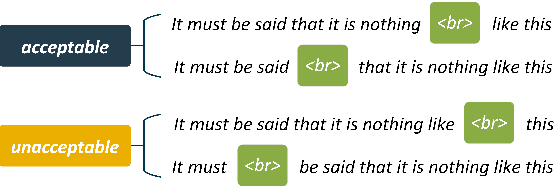
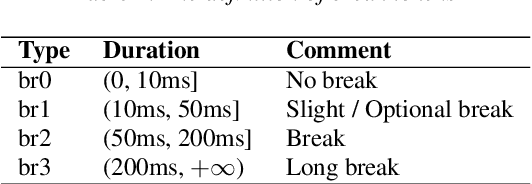
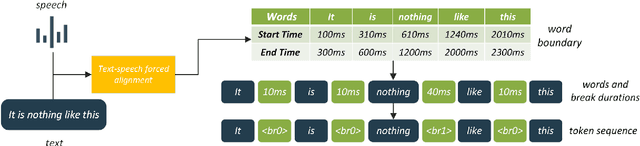
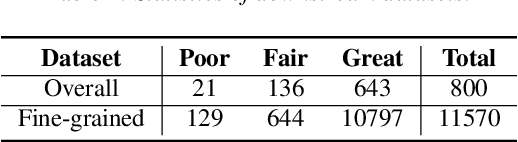
This work introduces approaches to assessing phrase breaks in ESL learners' speech using pre-trained language models (PLMs) and large language models (LLMs). There are two tasks: overall assessment of phrase break for a speech clip and fine-grained assessment of every possible phrase break position. To leverage NLP models, speech input is first force-aligned with texts, and then pre-processed into a token sequence, including words and phrase break information. To utilize PLMs, we propose a pre-training and fine-tuning pipeline with the processed tokens. This process includes pre-training with a replaced break token detection module and fine-tuning with text classification and sequence labeling. To employ LLMs, we design prompts for ChatGPT. The experiments show that with the PLMs, the dependence on labeled training data has been greatly reduced, and the performance has improved. Meanwhile, we verify that ChatGPT, a renowned LLM, has potential for further advancement in this area.
Assessing Phrase Break of ESL speech with Pre-trained Language Models
Oct 28, 2022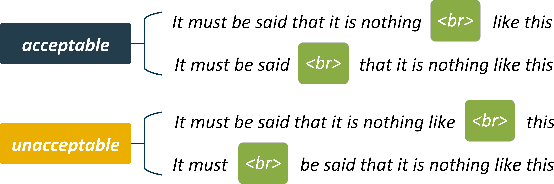
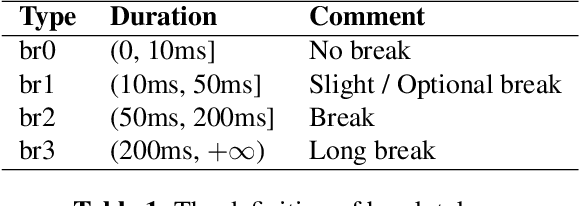
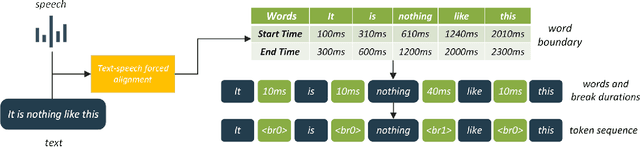
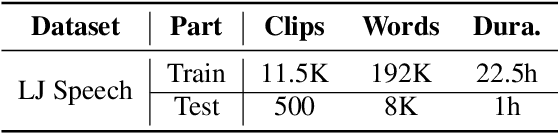
This work introduces an approach to assessing phrase break in ESL learners' speech with pre-trained language models (PLMs). Different with traditional methods, this proposal converts speech to token sequences, and then leverages the power of PLMs. There are two sub-tasks: overall assessment of phrase break for a speech clip; fine-grained assessment of every possible phrase break position. Speech input is first force-aligned with texts, then pre-processed to a token sequence, including words and associated phrase break information. The token sequence is then fed into the pre-training and fine-tuning pipeline. In pre-training, a replaced break token detection module is trained with token data where each token has a certain percentage chance to be randomly replaced. In fine-tuning, overall and fine-grained scoring are optimized with text classification and sequence labeling pipeline, respectively. With the introduction of PLMs, the dependence on labeled training data has been greatly reduced, and performance has improved.
A free lunch from ViT:Adaptive Attention Multi-scale Fusion Transformer for Fine-grained Visual Recognition
Oct 11, 2021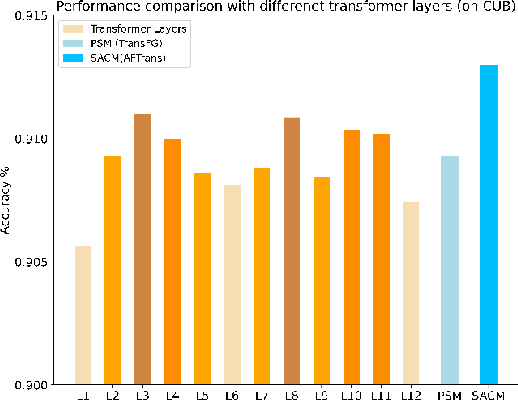
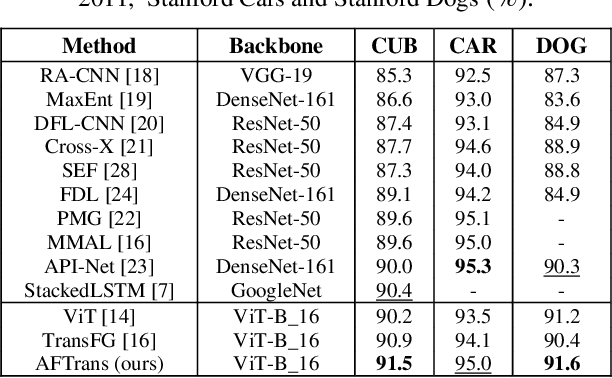
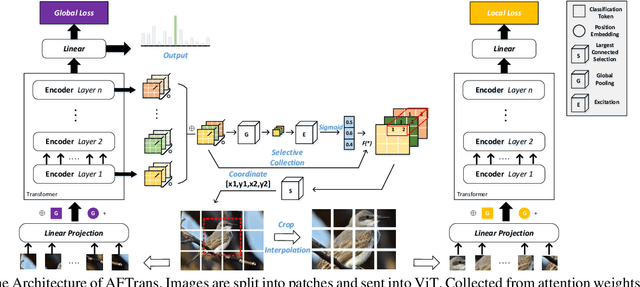
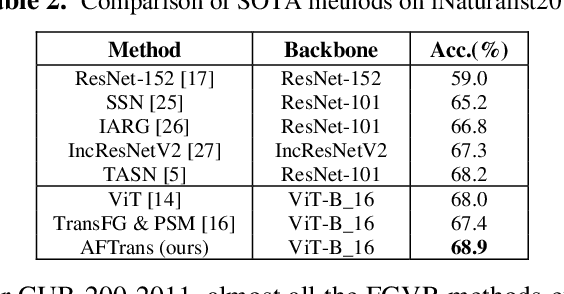
Learning subtle representation about object parts plays a vital role in fine-grained visual recognition (FGVR) field. The vision transformer (ViT) achieves promising results on computer vision due to its attention mechanism. Nonetheless, with the fixed size of patches in ViT, the class token in deep layer focuses on the global receptive field and cannot generate multi-granularity features for FGVR. To capture region attention without box annotations and compensate for ViT shortcomings in FGVR, we propose a novel method named Adaptive attention multi-scale Fusion Transformer (AFTrans). The Selective Attention Collection Module (SACM) in our approach leverages attention weights in ViT and filters them adaptively to correspond with the relative importance of input patches. The multiple scales (global and local) pipeline is supervised by our weights sharing encoder and can be easily trained end-to-end. Comprehensive experiments demonstrate that AFTrans can achieve SOTA performance on three published fine-grained benchmarks: CUB-200-2011, Stanford Dogs and iNat2017.