 Add to Chrome
 Add to Firefox
 Add to Edge
QwenLong-L1.5: Post-Training Recipe for Long-Context Reasoning and Memory Management
Dec 15, 2025
We introduce QwenLong-L1.5, a model that achieves superior long-context reasoning capabilities through systematic post-training innovations. The key technical breakthroughs of QwenLong-L1.5 are as follows: (1) Long-Context Data Synthesis Pipeline: We develop a systematic synthesis framework that generates challenging reasoning tasks requiring multi-hop grounding over globally distributed evidence. By deconstructing documents into atomic facts and their underlying relationships, and then programmatically composing verifiable reasoning questions, our approach creates high-quality training data at scale, moving substantially beyond simple retrieval tasks to enable genuine long-range reasoning capabilities. (2) Stabilized Reinforcement Learning for Long-Context Training: To overcome the critical instability in long-context RL, we introduce task-balanced sampling with task-specific advantage estimation to mitigate reward bias, and propose Adaptive Entropy-Controlled Policy Optimization (AEPO) that dynamically regulates exploration-exploitation trade-offs. (3) Memory-Augmented Architecture for Ultra-Long Contexts: Recognizing that even extended context windows cannot accommodate arbitrarily long sequences, we develop a memory management framework with multi-stage fusion RL training that seamlessly integrates single-pass reasoning with iterative memory-based processing for tasks exceeding 4M tokens. Based on Qwen3-30B-A3B-Thinking, QwenLong-L1.5 achieves performance comparable to GPT-5 and Gemini-2.5-Pro on long-context reasoning benchmarks, surpassing its baseline by 9.90 points on average. On ultra-long tasks (1M~4M tokens), QwenLong-L1.5's memory-agent framework yields a 9.48-point gain over the agent baseline. Additionally, the acquired long-context reasoning ability translates to enhanced performance in general domains like scientific reasoning, memory tool using, and extended dialogue.

Entropy-Guided Reasoning Compression
Nov 18, 2025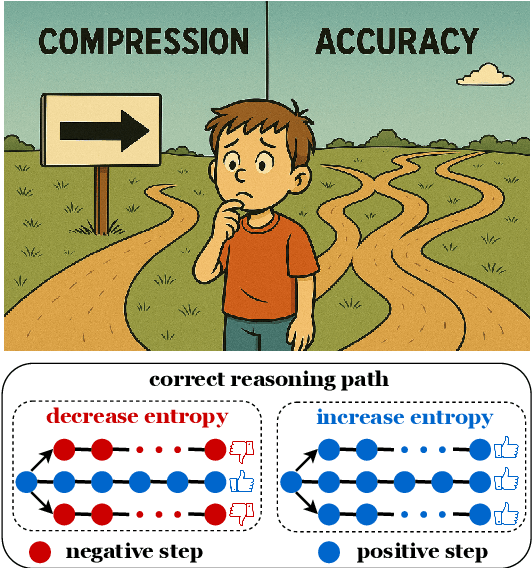
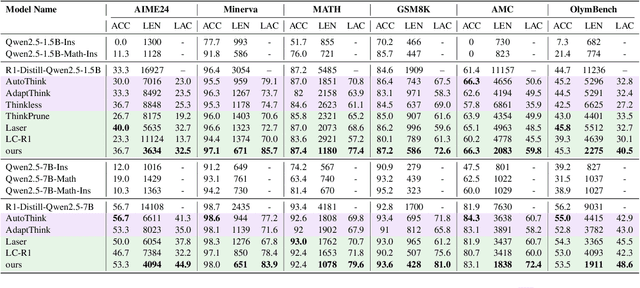
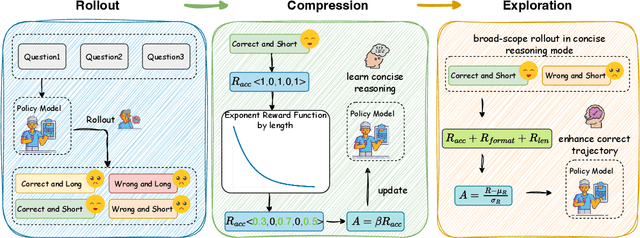
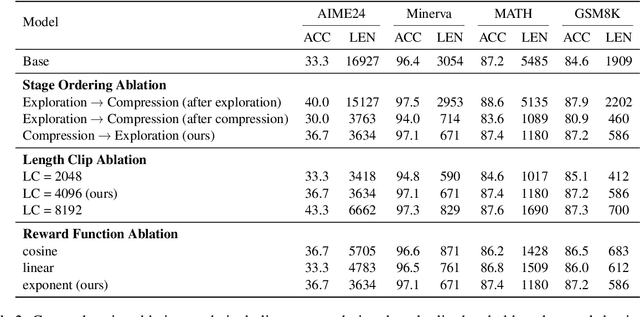
Large reasoning models have demonstrated remarkable performance on complex reasoning tasks, yet the excessive length of their chain-of-thought outputs remains a major practical bottleneck due to high computation cost and poor deployability. Existing compression methods have achieved partial success but overlook a crucial phenomenon in the training process -- the entropy conflict. During compression training, entropy decreases, leading to shorter reasoning but limited exploration, while accuracy-oriented objectives increase entropy, lengthening reasoning chains. This can cause the model to get stuck in a local dilemma. Our analysis further reveals the origin of the entropy conflict: many high-entropy tokens are logical connectors that receive larger gradients and are encouraged under the performance objective, while the compression objective simultaneously penalizes these potentially redundant connectors. This opposing pressure creates a direct source of entropy conflict. To address these issues, we adopt an entropy-guided training framework. As entropy descends, the model is guided toward efficient reasoning by encouraging concise thought steps; as entropy rises, exploration is reinforced under the compact reasoning mode to improve robustness. Experiments on six mathematical benchmarks show that our method compresses reasoning length to 20% of the original while maintaining or even surpassing baseline accuracy. Code and models will be released publicly.
EduBench: A Comprehensive Benchmarking Dataset for Evaluating Large Language Models in Diverse Educational Scenarios
May 22, 2025As large language models continue to advance, their application in educational contexts remains underexplored and under-optimized. In this paper, we address this gap by introducing the first diverse benchmark tailored for educational scenarios, incorporating synthetic data containing 9 major scenarios and over 4,000 distinct educational contexts. To enable comprehensive assessment, we propose a set of multi-dimensional evaluation metrics that cover 12 critical aspects relevant to both teachers and students. We further apply human annotation to ensure the effectiveness of the model-generated evaluation responses. Additionally, we succeed to train a relatively small-scale model on our constructed dataset and demonstrate that it can achieve performance comparable to state-of-the-art large models (e.g., Deepseek V3, Qwen Max) on the test set. Overall, this work provides a practical foundation for the development and evaluation of education-oriented language models. Code and data are released at https://github.com/ybai-nlp/EduBench.
SoLoPO: Unlocking Long-Context Capabilities in LLMs via Short-to-Long Preference Optimization
May 16, 2025Despite advances in pretraining with extended context lengths, large language models (LLMs) still face challenges in effectively utilizing real-world long-context information, primarily due to insufficient long-context alignment caused by data quality issues, training inefficiencies, and the lack of well-designed optimization objectives. To address these limitations, we propose a framework named $\textbf{S}$h$\textbf{o}$rt-to-$\textbf{Lo}$ng $\textbf{P}$reference $\textbf{O}$ptimization ($\textbf{SoLoPO}$), decoupling long-context preference optimization (PO) into two components: short-context PO and short-to-long reward alignment (SoLo-RA), supported by both theoretical and empirical evidence. Specifically, short-context PO leverages preference pairs sampled from short contexts to enhance the model's contextual knowledge utilization ability. Meanwhile, SoLo-RA explicitly encourages reward score consistency utilization for the responses when conditioned on both short and long contexts that contain identical task-relevant information. This facilitates transferring the model's ability to handle short contexts into long-context scenarios. SoLoPO is compatible with mainstream preference optimization algorithms, while substantially improving the efficiency of data construction and training processes. Experimental results show that SoLoPO enhances all these algorithms with respect to stronger length and domain generalization abilities across various long-context benchmarks, while achieving notable improvements in both computational and memory efficiency.
Reviving Dormant Memories: Investigating Catastrophic Forgetting in Language Models through Rationale-Guidance Difficulty
Nov 18, 2024Although substantial efforts have been made to mitigate catastrophic forgetting in continual learning, the intrinsic mechanisms are not well understood. In this paper, we discover that when a forgetting model passively receives an externally provided partial appropriate rationale, its performance on the forgotten task can be restored. Furthermore, by simply adding a task-agnostic prefix to the original instruction, the forgetting model can actively generate an appropriate rationale to reach the correct answer. These findings suggest that the model does not actually ``forget'' the task knowledge; instead, the degraded performance can be attributed to the failure of the original instructions in guiding the model to generate the appropriate rationales. Based on this insight, we propose the Rationale-Guidance Difficulty metric to evaluate how effectively a given instruction guides the model in generating appropriate rationales. We apply this metric to optimize the allocation of replay data in replay-based continual learning algorithm. Experimental results demonstrate that our data allocation method effectively mitigates catastrophic forgetting and maintains better model plasticity simultaneously across models.
How Far Can In-Context Alignment Go? Exploring the State of In-Context Alignment
Jun 17, 2024Recent studies have demonstrated that In-Context Learning (ICL), through the use of specific demonstrations, can align Large Language Models (LLMs) with human preferences known as In-Context Alignment (ICA), indicating that models can comprehend human instructions without requiring parameter adjustments. However, the exploration of the mechanism and applicability of ICA remains limited. In this paper, we begin by dividing the context text used in ICA into three categories: format, system prompt, and example. Through ablation experiments, we investigate the effectiveness of each part in enabling ICA to function effectively. We then examine how variants in these parts impact the model's alignment performance. Our findings indicate that the example part is crucial for enhancing the model's alignment capabilities, with changes in examples significantly affecting alignment performance. We also conduct a comprehensive evaluation of ICA's zero-shot capabilities in various alignment tasks. The results indicate that compared to parameter fine-tuning methods, ICA demonstrates superior performance in knowledge-based tasks and tool-use tasks. However, it still exhibits certain limitations in areas such as multi-turn dialogues and instruction following.
TSST: A Benchmark and Evaluation Models for Text Speech-Style Transfer
Nov 14, 2023


Text style is highly abstract, as it encompasses various aspects of a speaker's characteristics, habits, logical thinking, and the content they express. However, previous text-style transfer tasks have primarily focused on data-driven approaches, lacking in-depth analysis and research from the perspectives of linguistics and cognitive science. In this paper, we introduce a novel task called Text Speech-Style Transfer (TSST). The main objective is to further explore topics related to human cognition, such as personality and emotion, based on the capabilities of existing LLMs. Considering the objective of our task and the distinctive characteristics of oral speech in real-life scenarios, we trained multi-dimension (i.e. filler words, vividness, interactivity, emotionality) evaluation models for the TSST and validated their correlation with human assessments. We thoroughly analyze the performance of several large language models (LLMs) and identify areas where further improvement is needed. Moreover, driven by our evaluation models, we have released a new corpus that improves the capabilities of LLMs in generating text with speech-style characteristics. In summary, we present the TSST task, a new benchmark for style transfer and emphasizing human-oriented evaluation, exploring and advancing the performance of current LLMs.
MindLLM: Pre-training Lightweight Large Language Model from Scratch, Evaluations and Domain Applications
Oct 29, 2023



Large Language Models (LLMs) have demonstrated remarkable performance across various natural language tasks, marking significant strides towards general artificial intelligence. While general artificial intelligence is leveraged by developing increasingly large-scale models, there could be another branch to develop lightweight custom models that better serve certain domains, taking into account the high cost of training and deploying LLMs and the scarcity of resources. In this paper, we present MindLLM, a novel series of bilingual lightweight large language models, trained from scratch, alleviating such burdens by offering models with 1.3 billion and 3 billion parameters. A thorough account of experiences accrued during large model development is given, covering every step of the process, including data construction, model architecture, evaluation, and applications. Such insights are hopefully valuable for fellow academics and developers. MindLLM consistently matches or surpasses the performance of other open-source larger models on some public benchmarks. We also introduce an innovative instruction tuning framework tailored for smaller models to enhance their capabilities efficiently. Moreover, we explore the application of MindLLM in specific vertical domains such as law and finance, underscoring the agility and adaptability of our lightweight models.
Multiscale Motion-Aware and Spatial-Temporal-Channel Contextual Coding Network for Learned Video Compression
Oct 19, 2023Recently, learned video compression has achieved exciting performance. Following the traditional hybrid prediction coding framework, most learned methods generally adopt the motion estimation motion compensation (MEMC) method to remove inter-frame redundancy. However, inaccurate motion vector (MV) usually lead to the distortion of reconstructed frame. In addition, most approaches ignore the spatial and channel redundancy. To solve above problems, we propose a motion-aware and spatial-temporal-channel contextual coding based video compression network (MASTC-VC), which learns the latent representation and uses variational autoencoders (VAEs) to capture the characteristics of intra-frame pixels and inter-frame motion. Specifically, we design a multiscale motion-aware module (MS-MAM) to estimate spatial-temporal-channel consistent motion vector by utilizing the multiscale motion prediction information in a coarse-to-fine way. On the top of it, we further propose a spatial-temporal-channel contextual module (STCCM), which explores the correlation of latent representation to reduce the bit consumption from spatial, temporal and channel aspects respectively. Comprehensive experiments show that our proposed MASTC-VC is surprior to previous state-of-the-art (SOTA) methods on three public benchmark datasets. More specifically, our method brings average 10.15\% BD-rate savings against H.265/HEVC (HM-16.20) in PSNR metric and average 23.93\% BD-rate savings against H.266/VVC (VTM-13.2) in MS-SSIM metric.