 Add to Chrome
 Add to Firefox
 Add to Edge
Pinching Antennas-Aided Integrated Sensing and Multicast Communication Systems
Feb 18, 2026
A pinching antennas (PAs)-aided integrated sensing and multicast communication framework is proposed. In this framework, the communication performance is measured by the multicast rate considering max-min fairness. Moreover, the sensing performance is quantified by the Bayesian Cramér-Rao bound (BCRB), where a Gauss-Hermite quadrature-based approach is proposed to compute the Bayesian Fisher information matrix. Based on these metrics, PA placement is optimized under three criteria: communications-centric (C-C), sensing-centric (S-C), and Pareto-optimal designs. These designs are investigated in two scenarios: the single-PA case and the multi-PA case. 1) For the single-PA case, a closed-form solution is derived for the location of the C-C transmit PA, while the S-C design yields optimal transmit and receive PA placements that are symmetric about the target location. Leveraging this geometric insight, the Pareto-optimal design is solved by enforcing this PA placement symmetry, thereby reducing the joint transmit and receive PA placement to the transmit PA optimization. 2) For the general multi-PA case, the PA placements constitute a highly non-convex optimization problem. To solve this, an element-wise alternating optimization-based method is proposed to sequentially optimize all PA placements for the S-C design, and is further incorporated into an augmented Lagrangian (AL) framework and a rate-profile formulation to solve the C-C and Pareto-optimal design problems, respectively. Numerical results show that: i) PASS substantially outperforms fixed-antenna baselines in both multicast rate and sensing accuracy; ii) the multicasting gain becomes more pronounced as the user density increases; and iii) the sensing accuracy improves with the number of deployed PAs.

AI-Native 6G Physical Layer with Cross-Module Optimization and Cooperative Control Agents
Jan 07, 2026In this article, a framework of AI-native cross-module optimized physical layer with cooperative control agents is proposed, which involves optimization across global AI/ML modules of the physical layer with innovative design of multiple enhancement mechanisms and control strategies. Specifically, it achieves simultaneous optimization across global modules of uplink AI/ML-based joint source-channel coding with modulation, and downlink AI/ML-based modulation with precoding and corresponding data detection, reducing traditional inter-module information barriers to facilitate end-to-end optimization toward global objectives. Moreover, multiple enhancement mechanisms are also proposed, including i) an AI/ML-based cross-layer modulation approach with theoretical analysis for downlink transmission that breaks the isolation of inter-layer features to expand the solution space for determining improved constellation, ii) a utility-oriented precoder construction method that shifts the role of the AI/ML-based CSI feedback decoder from recovering the original CSI to directly generating precoding matrices aiming to improve end-to-end performance, and iii) incorporating modulation into AI/ML-based CSI feedback to bypass bit-level bottlenecks that introduce quantization errors, non-differentiable gradients, and limitations in constellation solution spaces. Furthermore, AI/ML based control agents for optimized transmission schemes are proposed that leverage AI/ML to perform model switching according to channel state, thereby enabling integrated control for global throughput optimization. Finally, simulation results demonstrate the superiority of the proposed solutions in terms of BLER and throughput. These extensive simulations employ more practical assumptions that are aligned with the requirements of the 3GPP, which hopefully provides valuable insights for future standardization discussions.
DeepGuard: Defending Deep Joint Source-Channel Coding Against Eavesdropping at Physical-Layer
Dec 21, 2025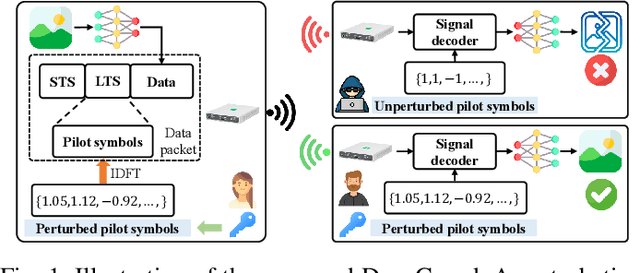
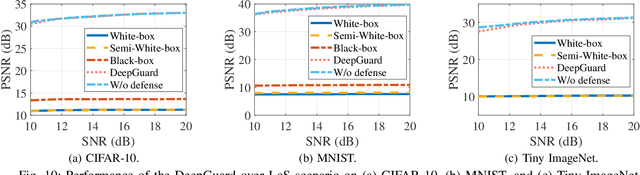
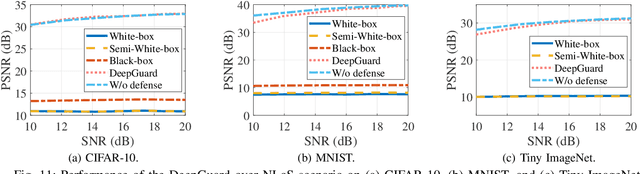
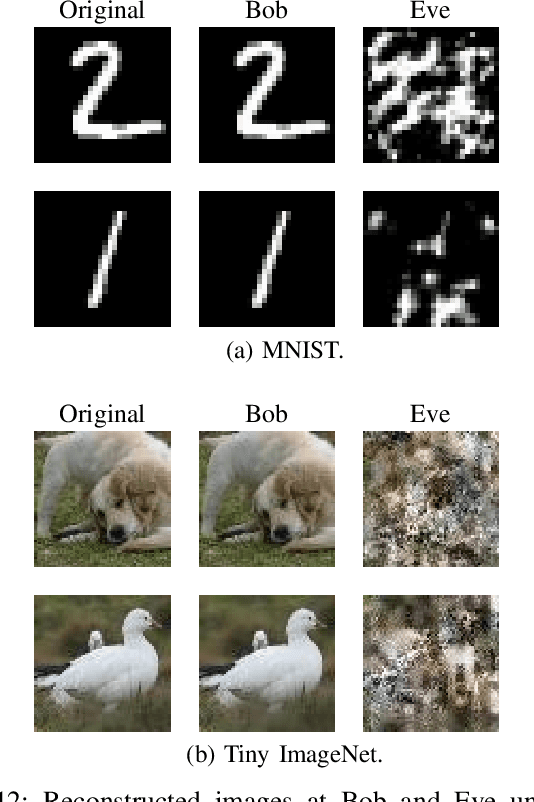
Deep joint source-channel coding (DeepJSCC) has emerged as a promising paradigm for efficient and robust information transmission. However, its intrinsic characteristics also pose new security challenges, notably an increased vulnerability to eavesdropping attacks. Existing studies on defending against eavesdropping attacks in DeepJSCC, while demonstrating certain effectiveness, often incur considerable computational overhead or introduce performance trade-offs that may adversely affect legitimate users. In this paper, we present DeepGuard, to the best of our knowledge, the first physical-layer defense framework for DeepJSCC against eavesdropping attacks, validated through over-the-air experiments using software-defined radios (SDRs). Considering that existing eavesdropping attacks against DeepJSCC are limited to simulation under ideal channels, we take a step further by identifying and implementing four representative types of attacks under various configurations in orthogonal frequency-division multiplexing systems. These attacks are evaluated over-the-air under diverse scenarios, allowing us to comprehensively characterize the real-world threat landscape. To mitigate these threats, DeepGuard introduces a novel preamble perturbation mechanism that modifies the preamble shared only between legitimate transceivers. To realize it, we first conduct a theoretical analysis of the perturbation's impact on the signals intercepted by the eavesdropper. Building upon this, we develop an end-to-end perturbation optimization algorithm that significantly degrades eavesdropping performance while preserving reliable communication for legitimate users. We prototype DeepGuard using SDRs and conduct extensive over-the-air experiments in practical scenarios. Extensive experiments demonstrate that DeepGuard effectively mitigates eavesdropping threats.
Wireless-Powered Mobile Crowdsensing Enhanced by UAV-Mounted RIS: Joint Transmission, Compression, and Trajectory Design
Jul 31, 2024


Mobile crowdsensing (MCS) enables data collection from massive devices to achieve a wide sensing range. Wireless power transfer (WPT) is a promising paradigm for prolonging the operation time of MCS systems by sustainably transferring power to distributed devices. However, the efficiency of WPT significantly deteriorates when the channel conditions are poor. Unmanned aerial vehicles (UAVs) and reconfigurable intelligent surfaces (RISs) can serve as active or passive relays to enhance the efficiency of WPT in unfavourable propagation environments. Therefore, to explore the potential of jointly deploying UAVs and RISs to enhance transmission efficiency, we propose a novel transmission framework for the WPT-assisted MCS systems, which is enhanced by a UAV-mounted RIS. Subsequently, under different compression schemes, two optimization problems are formulated to maximize the weighted sum of the data uploaded by the user equipments (UEs) by jointly designing the WPT and uploading time, the beamforming matrics, the CPU cycles, and the UAV trajectory. A block coordinate descent (BCD) algorithm based on the closed-form beamforming designs and the successive convex approximation (SCA) algorithm is proposed to solve the formulated problems. Furthermore, to highlight the insight of the gains brought by the compression schemes, we analyze the energy efficiencies of compression schemes and confirm that the gains gradually reduce with the increasing power used for compression. Simulation results demonstrate that the amount of collected data can be effectively increased in wireless-powered MCS systems.
Rethinking the Performance of ISAC System: From Efficiency and Utility Perspectives
Aug 18, 2022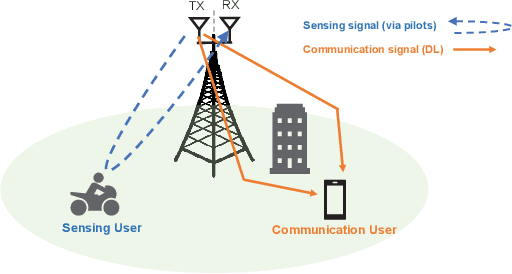
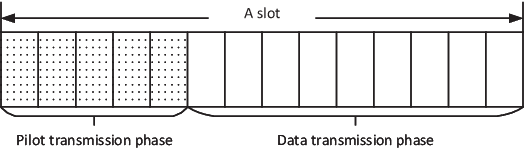
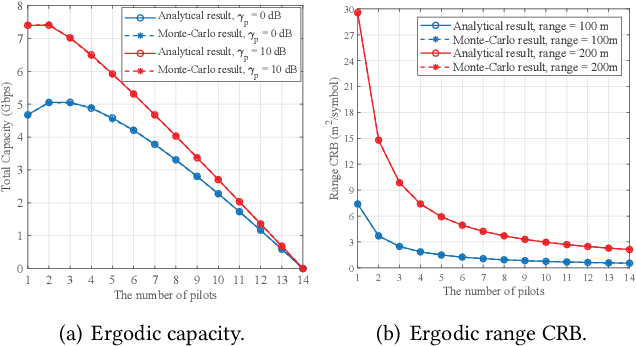
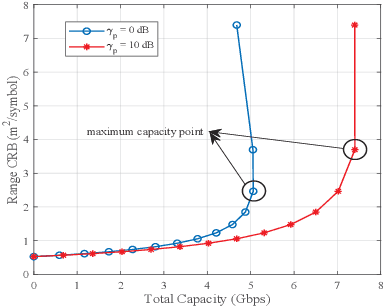
Integrated sensing and communications (ISAC) is an essential technology for the 6G communication system, which enables the conventional wireless communication network capable of sensing targets around. The shared use of pilots is a promising strategy to achieve ISAC. It brings a trade-off between communication and sensing, which is still unclear under the imperfect channel estimation condition. To provide some insights, the trade-off between ergodic capacity with imperfect channel estimation and ergodic Cramer-Rao bound (CRB) of range sensing is investigated. Firstly, the closedform expressions of ergodic capacity and ergodic range CRB are derived, which are associated with the number of pilots. Secondly, two novel metrics named efficiency and utility are firstly proposed to evaluate the joint performance of capacity and range sensing error. Specifically, efficiency is used to evaluate the achievable capacity per unit of the sensing error, and utility is designed to evaluate the utilization degree of ISAC. Moreover, an algorithm of pilot length optimization is designed to achieve the best efficiency. Finally, simulation results are given to verify the accuracy of analytical results, and provide some insights on designing the slot structure.
AI Enlightens Wireless Communication: A Transformer Backbone for CSI Feedback
Jun 16, 2022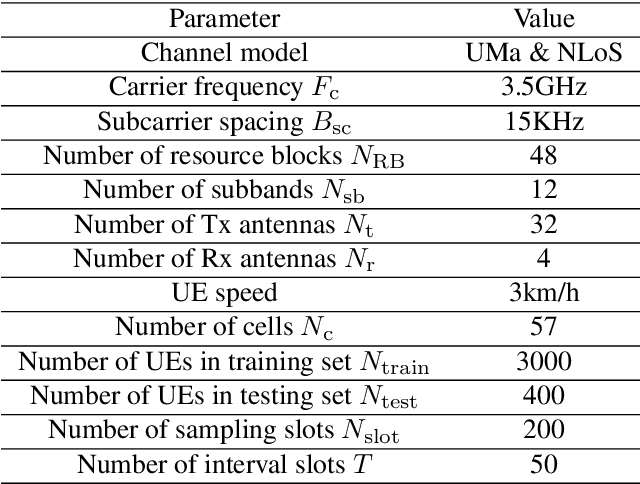
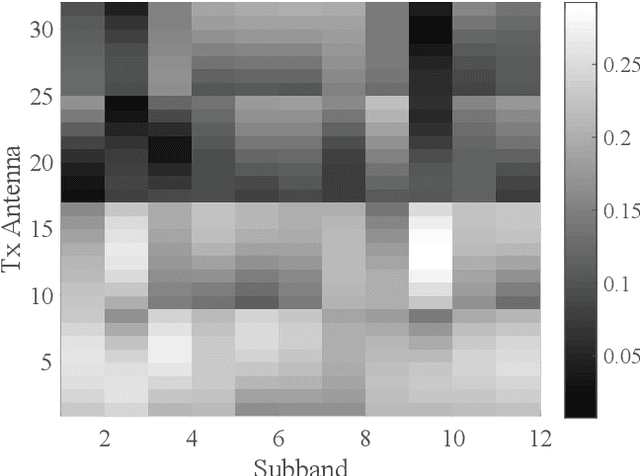
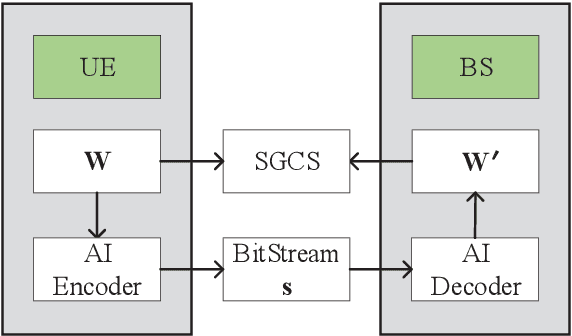
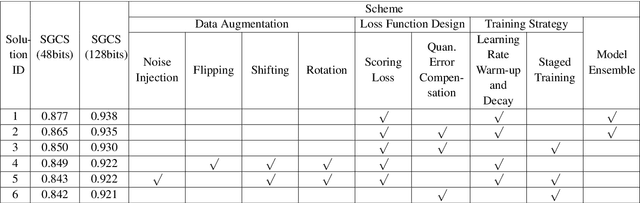
This paper is based on the background of the 2nd Wireless Communication Artificial Intelligence (AI) Competition (WAIC) which is hosted by IMT-2020(5G) Promotion Group 5G+AIWork Group, where the framework of the eigenvector-based channel state information (CSI) feedback problem is firstly provided. Then a basic Transformer backbone for CSI feedback referred to EVCsiNet-T is proposed. Moreover, a series of potential enhancements for deep learning based (DL-based) CSI feedback including i) data augmentation, ii) loss function design, iii) training strategy, and iv) model ensemble are introduced. The experimental results involving the comparison between EVCsiNet-T and traditional codebook methods over different channels are further provided, which show the advanced performance and a promising prospect of Transformer on DL-based CSI feedback problem.
Sensing as A Service in 6G Perceptive Networks: A Unified Framework for ISAC Resource Allocation
Feb 22, 2022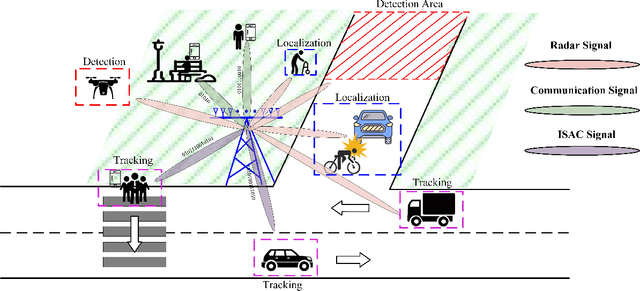
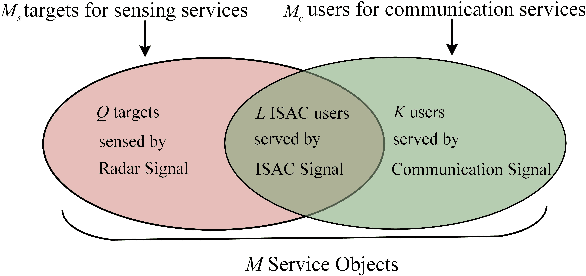
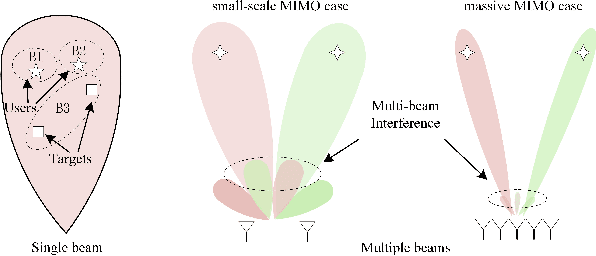
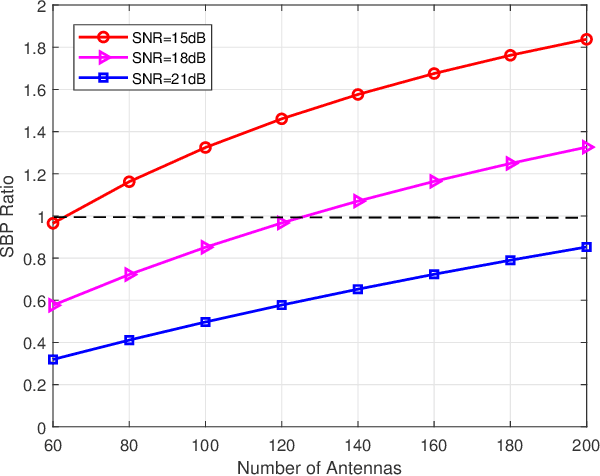
In the upcoming next-generation (5G-Advanced and 6G) wireless networks, sensing as a service will play a more important role than ever before. Recently, the concept of perceptive network is proposed as a paradigm shift that provides sensing and communication (S&C) services simultaneously. This type of technology is typically referred to as Integrated Sensing and Communications (ISAC). In this paper, we propose the concept of sensing quality of service (QoS) in terms of diverse applications. Specifically, the probability of detection, the Cramer-Rao bound (CRB) for parameter estimation and the posterior CRB for moving target indication are employed to measure the sensing QoS for detection, localization, and tracking, respectively. Then, we establish a unified framework for ISAC resource allocation, where the fairness and the comprehensiveness optimization criteria are considered for the aforementioned sensing services. The proposed schemes can flexibly allocate the limited power and bandwidth resources according to both S&C QoSs. Finally, we study the performance trade-off between S&C services in different resource allocation schemes by numerical simulations.
Multiple Residual Dense Networks for Reconfigurable Intelligent Surfaces Cascaded Channel Estimation
Dec 09, 2021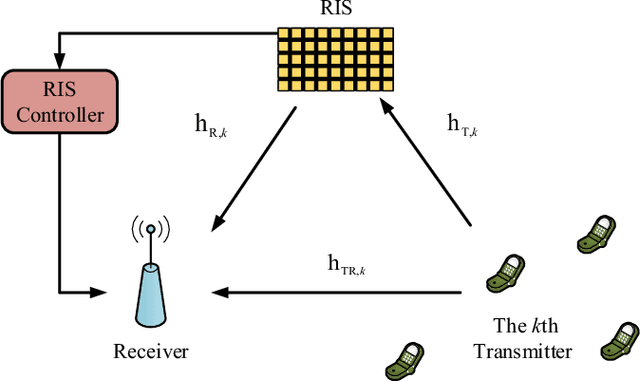
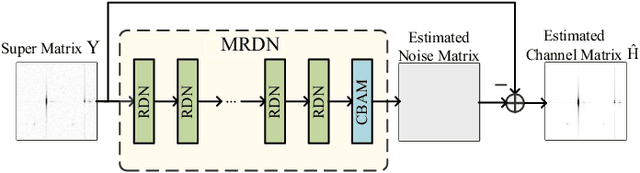
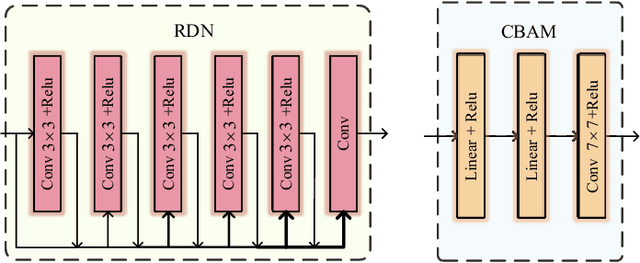
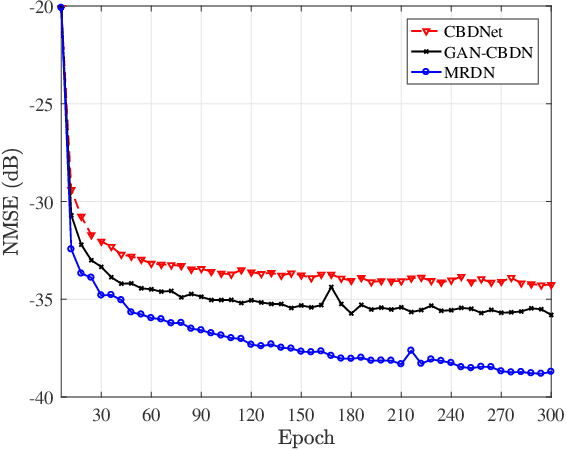
Reconfigurable intelligent surface (RIS) constitutes an essential and promising paradigm that relies programmable wireless environment and provides capability for space-intensive communications, due to the use of low-cost massive reflecting elements over the entire surfaces of man-made structures. However, accurate channel estimation is a fundamental technical prerequisite to achieve the huge performance gains from RIS. By leveraging the low rank structure of RIS channels, three practical residual neural networks, named convolutional blind denoising network, convolutional denoising generative adversarial networks and multiple residual dense network, are proposed to obtain accurate channel state information, which can reflect the impact of different methods on the estimation performance. Simulation results reveal the evolution direction of these three methods and reveal their superior performance compared with existing benchmark schemes.
AI Enlightens Wireless Communication: Analyses, Solutions and Opportunities on CSI Feedback
Jun 15, 2021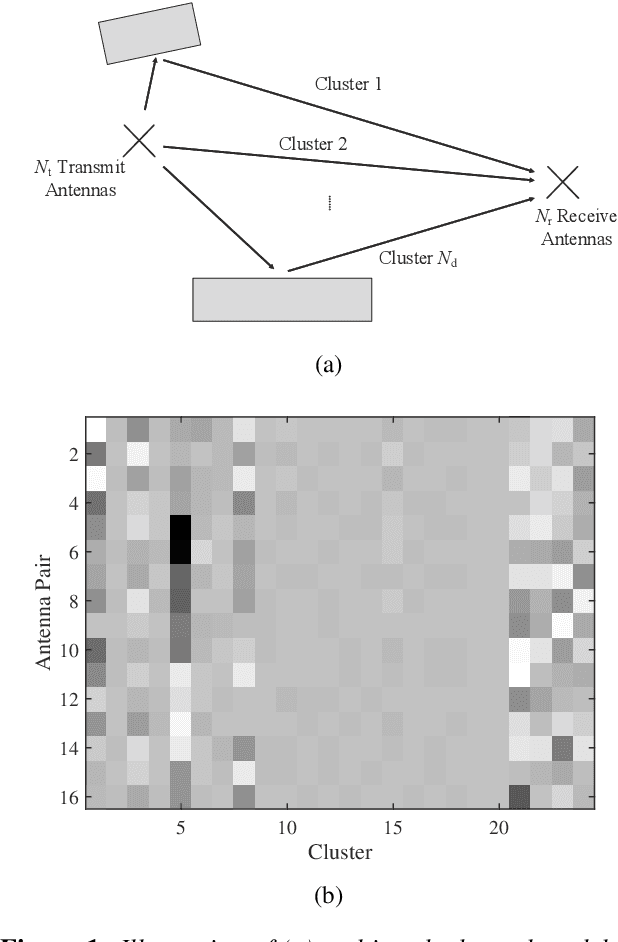
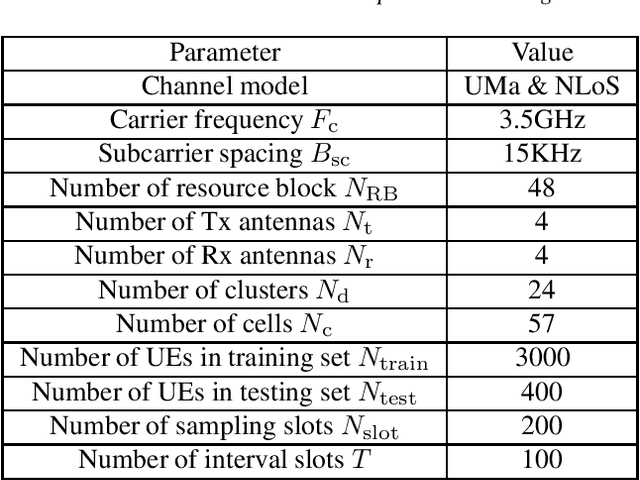
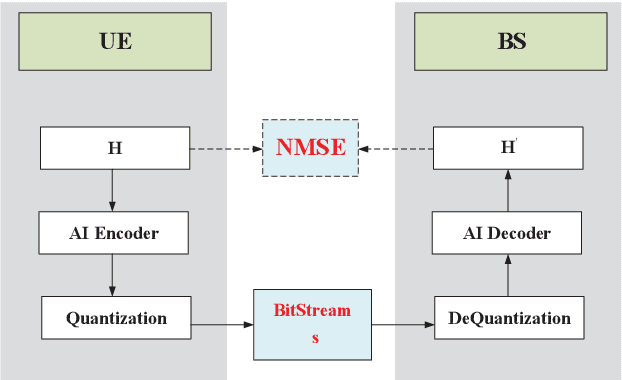
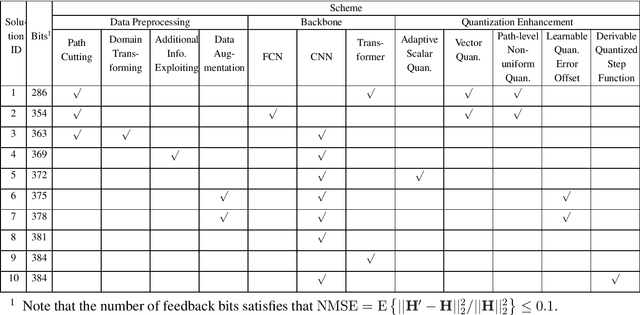
In this paper, we give a systematic description of the 1st Wireless Communication Artificial Intelligence (AI) Competition (WAIC) which is hosted by IMT-2020(5G) Promotion Group 5G+AI Work Group. Firstly, the framework of full channel state information (F-CSI) feedback problem and its corresponding channel dataset are provided. Then the enhancing schemes for DL-based F-CSI feedback including i) channel data analysis and preprocessing, ii) neural network design and iii) quantization enhancement are elaborated. The final competition results composed of different enhancing schemes are presented. Based on the valuable experience of 1st WAIC, we also list some challenges and potential study areas for the design of AI-based wireless communication systems.