 Add to Chrome
 Add to Firefox
 Add to Edge
RFCheck: Synthetic RF Sensing Data Can Fail Measurement Consistency
Aug 10, 2026
Synthetic radio-frequency (RF) sensing data are widely used to augment wireless sensing tasks, yet their measurement consistency with real data is rarely evaluated under matched acquisition conditions. This paper identifies a measurement-consistency failure mode: synthetic samples may pass task-facing checks while deviating from the measurement behavior of real samples collected and processed by the same sensing pipeline, potentially introducing synthetic shortcuts and biasing downstream model selection. We propose RFCheck, a calibrated measurement audit that uses held-out real data from the same acquisition and preprocessing pipeline as the reference. RFCheck calibrates representation-specific tests on real samples and flags synthetic samples whose responses exceed the calibrated real-data range. We use the audit for candidate screening and residual repair. We validate RFCheck primarily on Wi-Fi channel state information (CSI), where the audit examines delay-domain and local frequency-domain structures. Experiments show that aggregate statistics and label-based screening can miss measurement failures detected by RFCheck. Under the same label acceptance rule, low-risk and high-risk synthetic candidates exhibit different downstream behavior. A repair reference reduces the flagged ratio to 10.83% while preserving mean task performance. In a held-out proposal study, correction followed by calibrated selection produces a class-balanced set with no flagged samples under a fixed training budget. We further apply the same calibration principle to frequency-modulated continuous-wave (FMCW) millimeter-wave radar gesture sensing. The results show that synthetic RF sensing data can violate measurement consistency even when conventional task checks are satisfied, motivating measurement-aware diagnosis and mitigation before augmentation.

Toward Intelligent Skies: Signal Processing and AI Foundations of Low-Altitude Wireless Networks
Aug 08, 2026The rapid growth of low-altitude aerial services and applications, driven by uncrewed aerial vehicles (UAVs), calls for a new class of digital infrastructure beyond conventional terrestrial networks. The low-altitude wireless network (LAWN) has been proposed as dynamically reconfigurable three-dimensional architectures that integrate aerial and ground nodes to provide connectivity, sensing, and control in open, safety-critical airspace. This tutorial presents a comprehensive treatment of LAWNs from the joint perspectives of artificial intelligence (AI) and signal processing. We first review the historical evolution and architectural foundations of LAWNs, introducing altitude-based layers and functional planes, and summarizing the regulatory and standardization landscape. Building on this system view, we then discuss signal processing fundamentals for LAWNs, including 3D channel and system models, performance metrics, waveform and receiver design, localization and tracking, and multi-functionality co-design. Next, we survey AI techniques for LAWNs, covering discriminative and generative models for perception, control, resource management, and security, as well as emerging paradigms such as foundation models, large language models, and digital twins for mission planning and closed-loop optimization. To illustrate AI-signal processing integration in practice, we provide a case study of an AI-driven multi-tier LAWN with hybrid satellite, high-altitude, and ground nodes. The tutorial concludes by outlining key research challenges in architecture design, signal processing-AI co-design, safety and security, experimentation, and standardization, and by highlighting opportunities for LAWNs to evolve into dependable, AI-native infrastructure for the intelligent skies.
Radar-Aided Near-Field Beam Prediction via Beam Map Learning for XL-MIMO V2I Communications
Jul 30, 2026Near-field beam training in extremely large-scale multiple-input multiple-output (XL-MIMO) vehicle-to-infrastructure (V2I) systems incurs high overhead due to large range-angle codebooks and rapid channel variation. This paper proposes a passive radar-aided framework for near-field beam prediction based on radar-to-beam map learning. By exploiting the spatial correlation between radar observations and communication signals, the proposed method maps radar Bartlett spectra to communication beam maps using a lightweight encoder-decoder convolutional neural network. Gaussian soft supervision is further introduced to preserve beam-space continuity. Simulations on a synchronized Sionna ray tracing radar-communication dataset show that the proposed method consistently improves Top-k accuracy, distance-based accuracy, beam loss, and spectral efficiency.
Sense Smarter, Think Better: Edge Perception for Next-Generation Networks
May 18, 2026Edge perception has emerged as a foundational capability for future wireless networks, enabling the network edge to proactively sense, interpret, and interact with the physical environment in a task-oriented and resource-aware manner. This survey provides a comprehensive and structured overview of edge perception. We first review representative sensing modalities and edge artificial intelligence (AI) techniques as the fundamental building blocks. We then examine their synergistic interactions. We systematically analyze how edge AI enhances sensing capabilities, encompassing both in-band and out-of-band modalities, as well as multi-modal sensor data fusion. Moreover, we discuss the role of task-driven sensing in facilitating edge AI, including integrated sensing-communication-computation designs, and active perception frameworks that dynamically adapt sensing strategies for downstream applications. Finally, we identify key challenges and open issues. By consolidating fragmented research across sensing, communication, and edge AI, this survey provides forward-looking insights for the design and implementation of edge perception systems for sixth-generation (6G) networks.
SDP: A Unified Protocol and Benchmarking Framework for Reproducible Wireless Sensing
Jan 13, 2026Learning-based wireless sensing has made rapid progress, yet the field still lacks a unified and reproducible experimental foundation. Unlike computer vision, wireless sensing relies on hardware-dependent channel measurements whose representations, preprocessing pipelines, and evaluation protocols vary significantly across devices and datasets, hindering fair comparison and reproducibility. This paper proposes the Sensing Data Protocol (SDP), a protocol-level abstraction and unified benchmark for scalable wireless sensing. SDP acts as a standardization layer that decouples learning tasks from hardware heterogeneity. To this end, SDP enforces deterministic physical-layer sanitization, canonical tensor construction, and standardized training and evaluation procedures, decoupling learning performance from hardware-specific artifacts. Rather than introducing task-specific models, SDP establishes a principled protocol foundation for fair evaluation across diverse sensing tasks and platforms. Extensive experiments demonstrate that SDP achieves competitive accuracy while substantially improving stability, reducing inter-seed performance variance by orders of magnitude on complex activity recognition tasks. A real-world experiment using commercial off-the-shelf Wi-Fi hardware further illustrating the protocol's interoperability across heterogeneous hardware. By providing a unified protocol and benchmark, SDP enables reproducible and comparable wireless sensing research and supports the transition from ad hoc experimentation toward reliable engineering practice.
Integrating Low-Altitude SAR Imaging into UAV Data Backhaul
Dec 26, 2025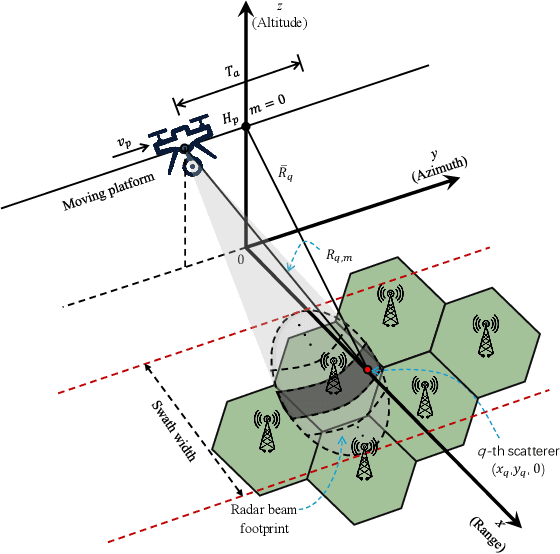
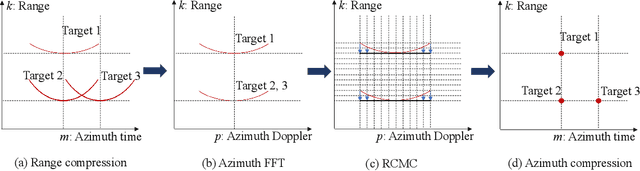
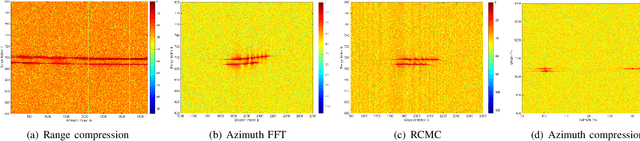
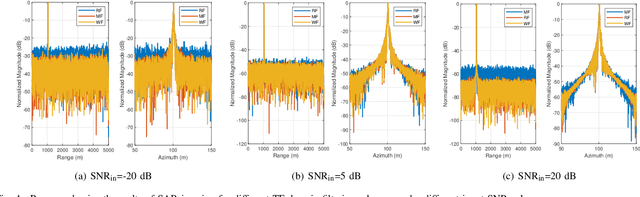
Synthetic aperture radar (SAR) deployed on unmanned aerial vehicles (UAVs) is expected to provide burgeoning imaging services for low-altitude wireless networks (LAWNs), thereby enabling large-scale environmental sensing and timely situational awareness. Conventional SAR systems typically leverages a deterministic radar waveform, while it conflicts with the integrated sensing and communications (ISAC) paradigm by discarding signaling randomness, in whole or in part. In fact, this approach reduces to the uplink pilot sensing in 5G New Radio (NR) with sounding reference signals (SRS), underutilizing data symbols. To explore the potential of data-aided imaging, we develop a low-altitude SAR imaging framework that sufficiently leverages data symbols carried by the native orthogonal frequency division multiplexing (OFDM) communication waveform. The randomness of modulated data in the temporal-frequency (TF) domain, introduced by non-constant modulus constellations such as quadrature amplitude modulation (QAM), may however severely degrade the imaging quality. To mitigate this effect, we incorporate several TF-domain filtering schemes within a rangeDoppler (RD) imaging framework and evaluate their impact. We further propose using the normalized mean square error (NMSE) of a reference point target's profile as an imaging performance metric. Simulation results with 5G NR parameters demonstrate that data-aided imaging substantially outperforms pilot-only counterpart, accordingly validating the effectiveness of the proposed OFDM-SAR imaging approach in LAWNs.
From Optimization to Learning: Dual-Approach Resource Allocation for Over-the-Air Edge Computing Under Execution Uncertainty
Dec 23, 2025The exponential proliferation of mobile devices and data-intensive applications in future wireless networks imposes substantial computational burdens on resource-constrained devices, thereby fostering the emergence of over-the-air computation (AirComp) as a transformative paradigm for edge intelligence.} To enhance the efficiency and scalability of AirComp systems, this paper proposes a comprehensive dual-approach framework that systematically transitions from traditional mathematical optimization to deep reinforcement learning (DRL) for resource allocation under execution uncertainty. Specifically, we establish a rigorous system model capturing execution uncertainty via Gamma-distributed computational workloads, resulting in challenging nonlinear optimization problems involving complex Gamma functions. For single-user scenarios, we design advanced block coordinate descent (BCD) and majorization-maximization (MM) algorithms, which yield semi-closed-form solutions with provable performance guarantees. However, conventional optimization approaches become computationally intractable in dynamic multi-user environments due to inter-user interference and resource contention. To this end, we introduce a Deep Q-Network (DQN)-based DRL framework capable of adaptively learning optimal policies through environment interaction. Our dual methodology effectively bridges analytical tractability with adaptive intelligence, leveraging optimization for foundational insight and learning for real-time adaptability. Extensive numerical results corroborate the performance gains achieved via increased edge server density and validate the superiority of our optimization-to-learning paradigm in next-generation AirComp systems.
A Sensing Dataset Protocol for Benchmarking and Multi-Task Wireless Sensing
Dec 13, 2025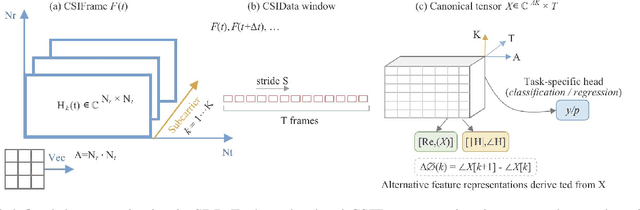
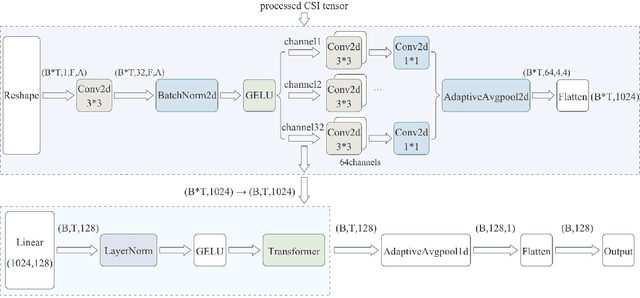
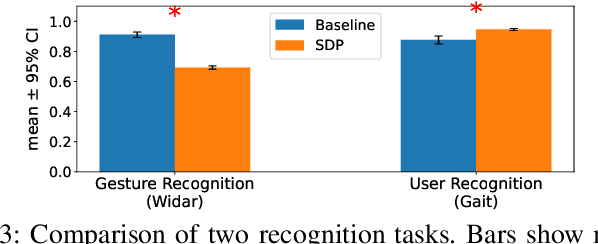
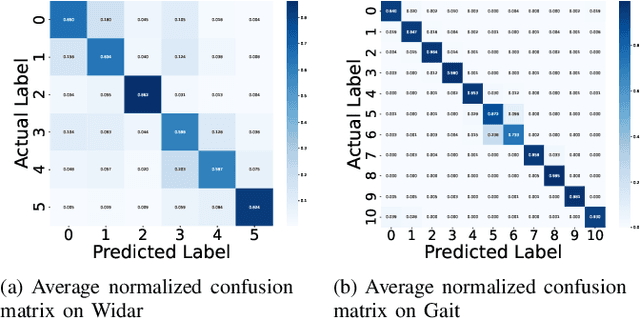
Wireless sensing has become a fundamental enabler for intelligent environments, supporting applications such as human detection, activity recognition, localization, and vital sign monitoring. Despite rapid advances, existing datasets and pipelines remain fragmented across sensing modalities, hindering fair comparison, transfer, and reproducibility. We propose the Sensing Dataset Protocol (SDP), a protocol-level specification and benchmark framework for large-scale wireless sensing. SDP defines how heterogeneous wireless signals are mapped into a unified perception data-block schema through lightweight synchronization, frequency-time alignment, and resampling, while a Canonical Polyadic-Alternating Least Squares (CP-ALS) pooling stage provides a task-agnostic representation that preserves multipath, spectral, and temporal structures. Built upon this protocol, a unified benchmark is established for detection, recognition, and vital-sign estimation with consistent preprocessing, training, and evaluation. Experiments under the cross-user split demonstrate that SDP significantly reduces variance (approximately 88%) across seeds while maintaining competitive accuracy and latency, confirming its value as a reproducible foundation for multi-modal and multitask sensing research.
Integrated Sensing and Communication: Towards Multifunctional Perceptive Network
Oct 16, 2025The capacity-maximization design philosophy has driven the growth of wireless networks for decades. However, with the slowdown in recent data traffic demand, the mobile industry can no longer rely solely on communication services to sustain development. In response, Integrated Sensing and Communications (ISAC) has emerged as a transformative solution, embedding sensing capabilities into communication networks to enable multifunctional wireless systems. This paradigm shift expands the role of networks from sole data transmission to versatile platforms supporting diverse applications. In this review, we provide a bird's-eye view of ISAC for new researchers, highlighting key challenges, opportunities, and application scenarios to guide future exploration in this field.
The Role of ISAC in 6G Networks: Enabling Next-Generation Wireless Systems
Oct 06, 2025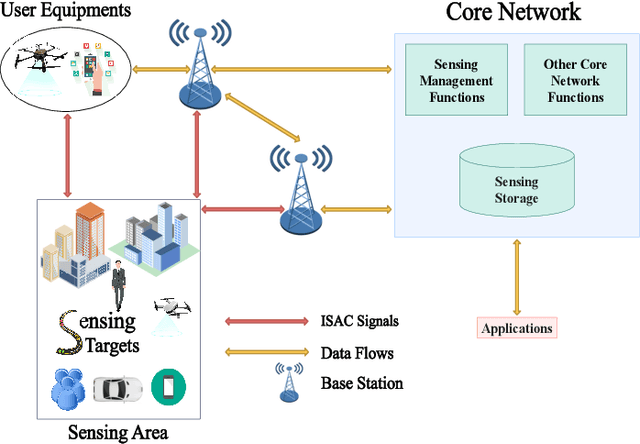
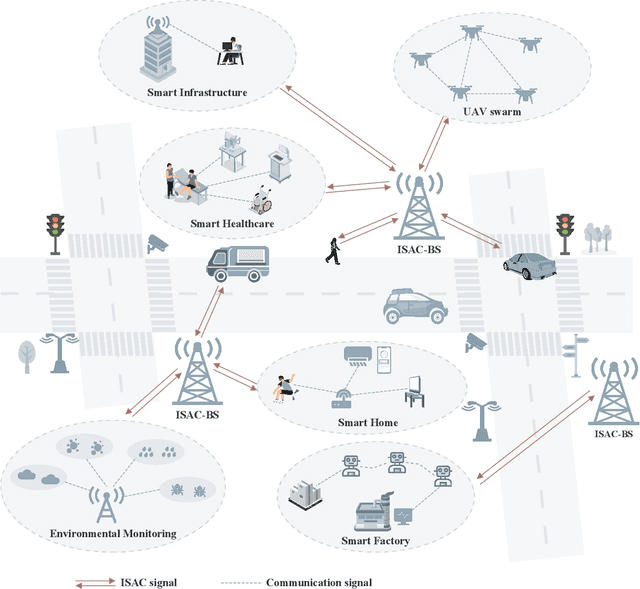
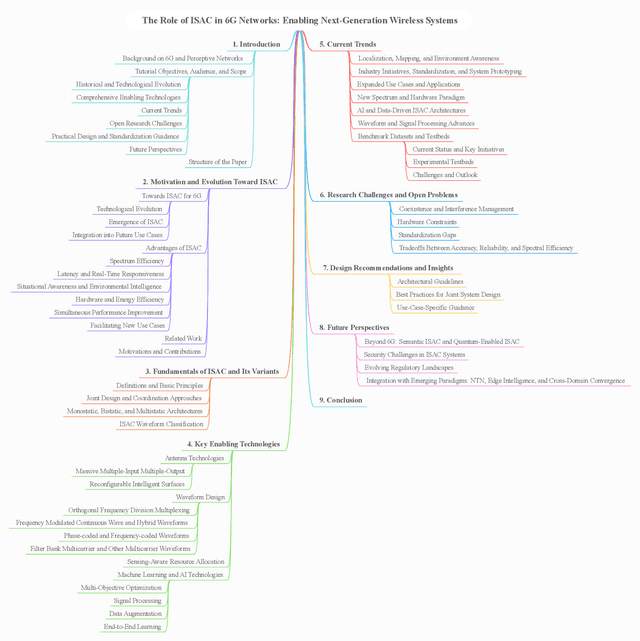
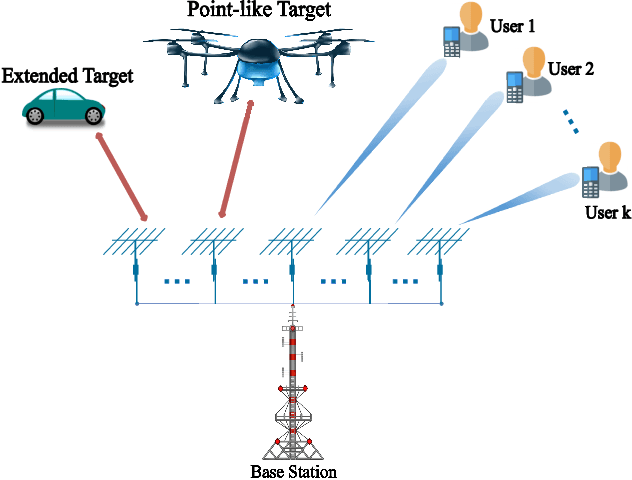
The commencement of the sixth-generation (6G) wireless networks represents a fundamental shift in the integration of communication and sensing technologies to support next-generation applications. Integrated sensing and communication (ISAC) is a key concept in this evolution, enabling end-to-end support for both communication and sensing within a unified framework. It enhances spectrum efficiency, reduces latency, and supports diverse use cases, including smart cities, autonomous systems, and perceptive environments. This tutorial provides a comprehensive overview of ISAC's role in 6G networks, beginning with its evolution since 5G and the technical drivers behind its adoption. Core principles and system variations of ISAC are introduced, followed by an in-depth discussion of the enabling technologies that facilitate its practical deployment. The paper further analyzes current research directions to highlight key challenges, open issues, and emerging trends. Design insights and recommendations are also presented to support future development and implementation. This work ultimately try to address three central questions: Why is ISAC essential for 6G? What innovations does it bring? How will it shape the future of wireless communication?