 Add to Chrome
 Add to Firefox
 Add to Edge
DeepGuard: Defending Deep Joint Source-Channel Coding Against Eavesdropping at Physical-Layer
Dec 21, 2025
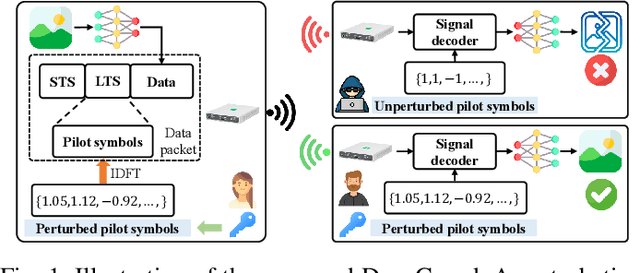
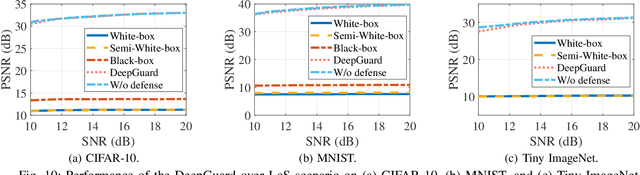
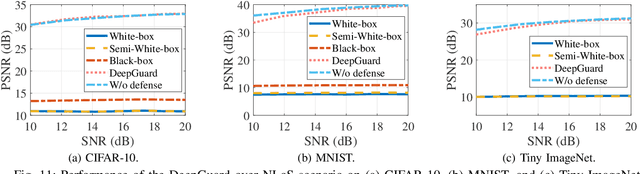
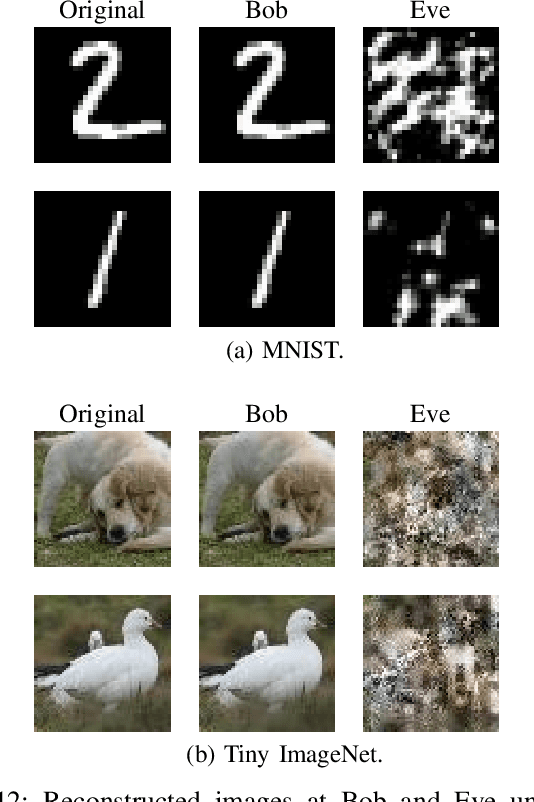
Deep joint source-channel coding (DeepJSCC) has emerged as a promising paradigm for efficient and robust information transmission. However, its intrinsic characteristics also pose new security challenges, notably an increased vulnerability to eavesdropping attacks. Existing studies on defending against eavesdropping attacks in DeepJSCC, while demonstrating certain effectiveness, often incur considerable computational overhead or introduce performance trade-offs that may adversely affect legitimate users. In this paper, we present DeepGuard, to the best of our knowledge, the first physical-layer defense framework for DeepJSCC against eavesdropping attacks, validated through over-the-air experiments using software-defined radios (SDRs). Considering that existing eavesdropping attacks against DeepJSCC are limited to simulation under ideal channels, we take a step further by identifying and implementing four representative types of attacks under various configurations in orthogonal frequency-division multiplexing systems. These attacks are evaluated over-the-air under diverse scenarios, allowing us to comprehensively characterize the real-world threat landscape. To mitigate these threats, DeepGuard introduces a novel preamble perturbation mechanism that modifies the preamble shared only between legitimate transceivers. To realize it, we first conduct a theoretical analysis of the perturbation's impact on the signals intercepted by the eavesdropper. Building upon this, we develop an end-to-end perturbation optimization algorithm that significantly degrades eavesdropping performance while preserving reliable communication for legitimate users. We prototype DeepGuard using SDRs and conduct extensive over-the-air experiments in practical scenarios. Extensive experiments demonstrate that DeepGuard effectively mitigates eavesdropping threats.

Semantic-aware Transmission for Robust Point Cloud Classification
Jun 23, 2023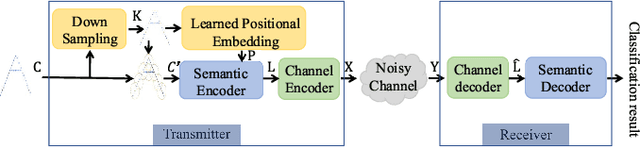

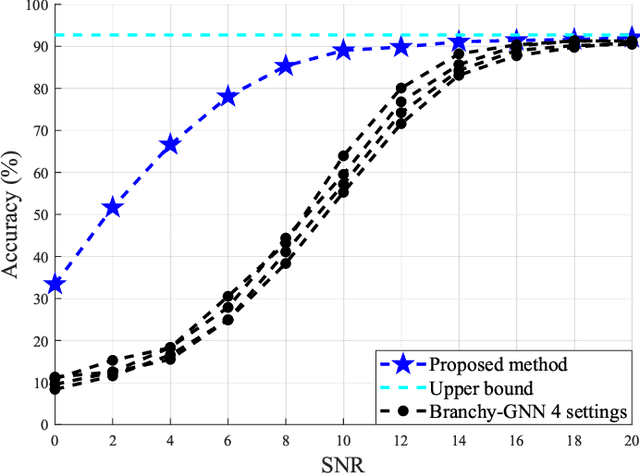
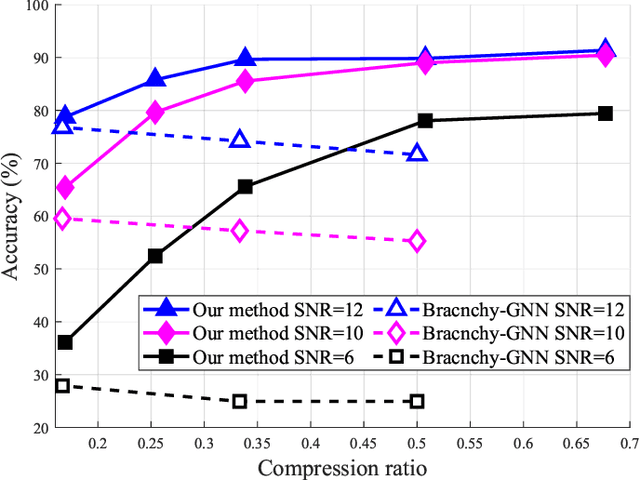
As three-dimensional (3D) data acquisition devices become increasingly prevalent, the demand for 3D point cloud transmission is growing. In this study, we introduce a semantic-aware communication system for robust point cloud classification that capitalizes on the advantages of pre-trained Point-BERT models. Our proposed method comprises four main components: the semantic encoder, channel encoder, channel decoder, and semantic decoder. By employing a two-stage training strategy, our system facilitates efficient and adaptable learning tailored to the specific classification tasks. The results show that the proposed system achieves classification accuracy of over 89\% when SNR is higher than 10 dB and still maintains accuracy above 66.6\% even at SNR of 4 dB. Compared to the existing method, our approach performs at 0.8\% to 48\% better across different SNR values, demonstrating robustness to channel noise. Our system also achieves a balance between accuracy and speed, being computationally efficient while maintaining high classification performance under noisy channel conditions. This adaptable and resilient approach holds considerable promise for a wide array of 3D scene understanding applications, effectively addressing the challenges posed by channel noise.
MIMO Precoding Design with QoS and Per-Antenna Power Constraints
Jun 04, 2023Precoding design for the downlink of multiuser multiple-input multiple-output (MU-MIMO) systems is a fundamental problem. In this paper, we aim to maximize the weighted sum rate (WSR) while considering both quality-of-service (QoS) constraints of each user and per-antenna power constraints (PAPCs) in the downlink MU-MIMO system. To solve the problem, we reformulate the original problem to an equivalent problem by using the well-known weighted minimal mean square error (WMMSE) framework, which can be tackled by iteratively solving three subproblems. Since the precoding matrices are coupled among the QoS constraints and PAPCs, we adopt alternating direction method of multipliers (ADMM) to obtain a distributed solution. Simulation results validate the effectiveness of the proposed algorithm.
Resource Allocation for Capacity Optimization in Joint Source-Channel Coding Systems
Nov 21, 2022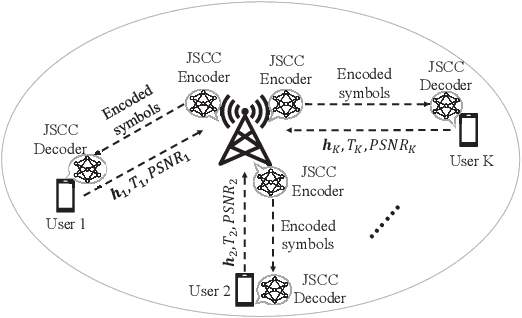
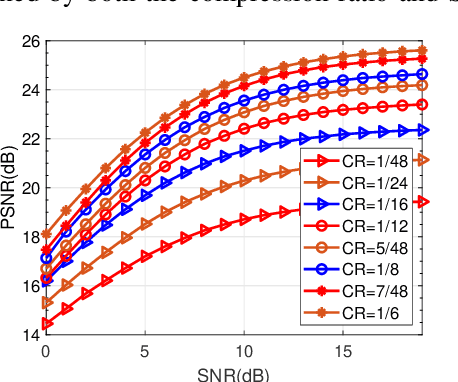
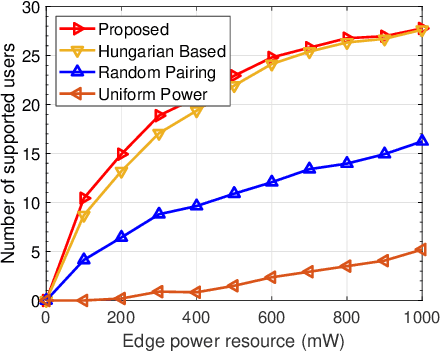
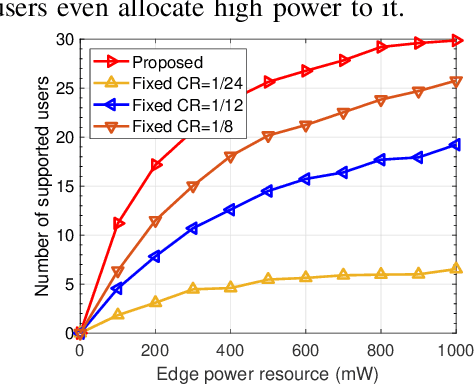
Benefited from the advances of deep learning (DL) techniques, deep joint source-channel coding (JSCC) has shown its great potential to improve the performance of wireless transmission. However, most of the existing works focus on the DL-based transceiver design of the JSCC model, while ignoring the resource allocation problem in wireless systems. In this paper, we consider a downlink resource allocation problem, where a base station (BS) jointly optimizes the compression ratio (CR) and power allocation as well as resource block (RB) assignment of each user according to the latency and performance constraints to maximize the number of users that successfully receive their requested content with desired quality. To solve this problem, we first decompose it into two subproblems without loss of optimality. The first subproblem is to minimize the required transmission power for each user under given RB allocation. We derive the closed-form expression of the optimal transmit power by searching the maximum feasible compression ratio. The second one aims at maximizing the number of supported users through optimal user-RB pairing, which we solve by utilizing bisection search as well as Karmarka' s algorithm. Simulation results validate the effectiveness of the proposed resource allocation method in terms of the number of satisfied users with given resources.