 Add to Chrome
 Add to Firefox
 Add to Edge
Efficient and Distributed Large-Scale Point Cloud Bundle Adjustment via Majorization-Minimization
Feb 26, 2025
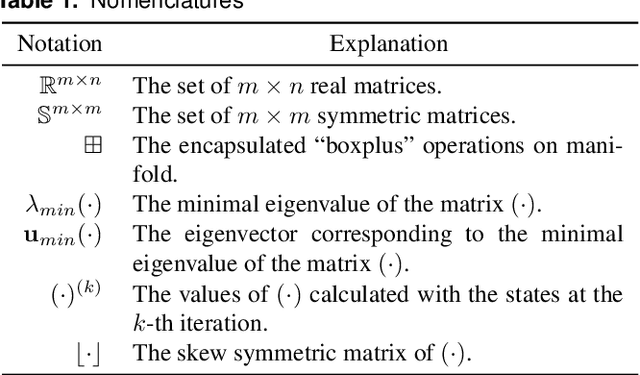
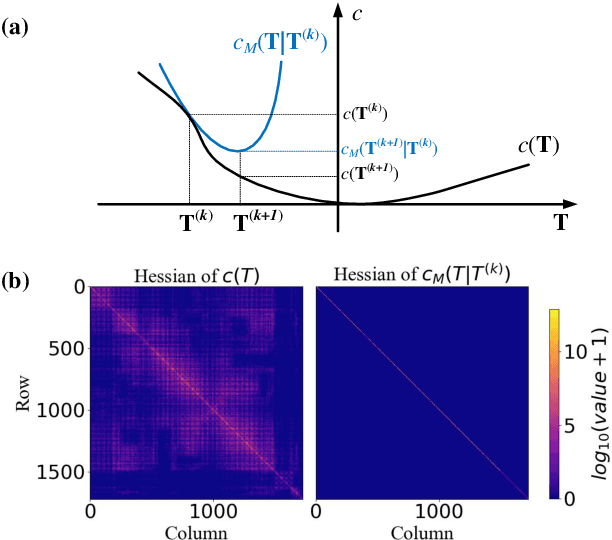
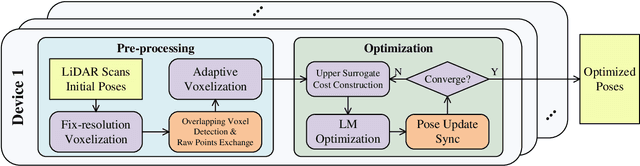
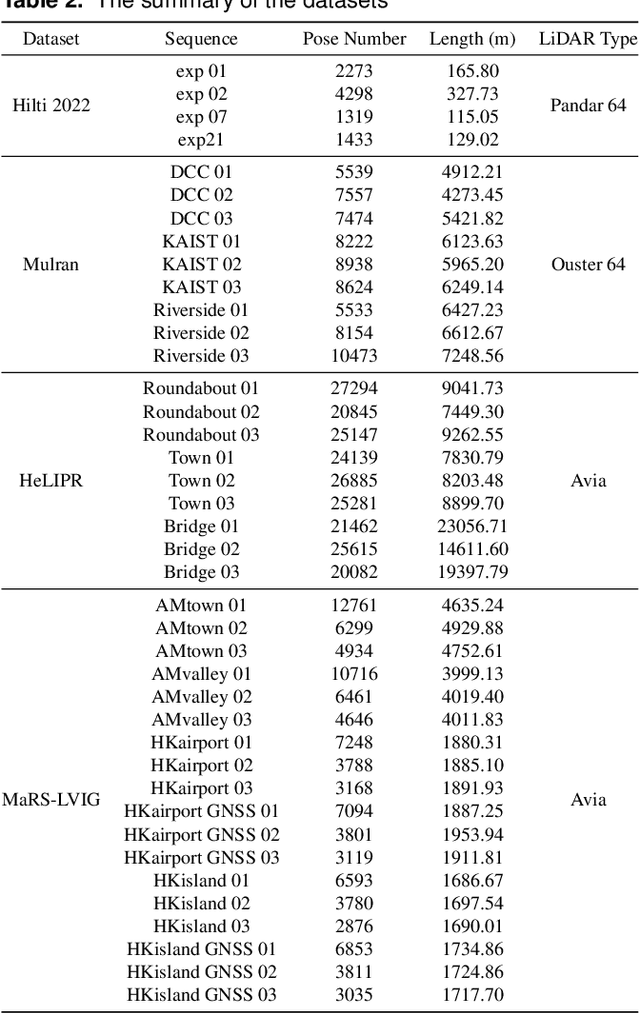
Point cloud bundle adjustment is critical in large-scale point cloud mapping. However, it is both computationally and memory intensive, with its complexity growing cubically as the number of scan poses increases. This paper presents BALM3.0, an efficient and distributed large-scale point cloud bundle adjustment method. The proposed method employs the majorization-minimization algorithm to decouple the scan poses in the bundle adjustment process, thus performing the point cloud bundle adjustment on large-scale data with improved computational efficiency. The key difficulty of applying majorization-minimization on bundle adjustment is to identify the proper surrogate cost function. In this paper, the proposed surrogate cost function is based on the point-to-plane distance. The primary advantages of decoupling the scan poses via a majorization-minimization algorithm stem from two key aspects. First, the decoupling of scan poses reduces the optimization time complexity from cubic to linear, significantly enhancing the computational efficiency of the bundle adjustment process in large-scale environments. Second, it lays the theoretical foundation for distributed bundle adjustment. By distributing both data and computation across multiple devices, this approach helps overcome the limitations posed by large memory and computational requirements, which may be difficult for a single device to handle. The proposed method is extensively evaluated in both simulated and real-world environments. The results demonstrate that the proposed method achieves the same optimal residual with comparable accuracy while offering up to 704 times faster optimization speed and reducing memory usage to 1/8. Furthermore, this paper also presented and implemented a distributed bundle adjustment framework and successfully optimized large-scale data (21,436 poses with 70 GB point clouds) with four consumer-level laptops.

MMTEB: Massive Multilingual Text Embedding Benchmark
Feb 19, 2025Text embeddings are typically evaluated on a limited set of tasks, which are constrained by language, domain, and task diversity. To address these limitations and provide a more comprehensive evaluation, we introduce the Massive Multilingual Text Embedding Benchmark (MMTEB) - a large-scale, community-driven expansion of MTEB, covering over 500 quality-controlled evaluation tasks across 250+ languages. MMTEB includes a diverse set of challenging, novel tasks such as instruction following, long-document retrieval, and code retrieval, representing the largest multilingual collection of evaluation tasks for embedding models to date. Using this collection, we develop several highly multilingual benchmarks, which we use to evaluate a representative set of models. We find that while large language models (LLMs) with billions of parameters can achieve state-of-the-art performance on certain language subsets and task categories, the best-performing publicly available model is multilingual-e5-large-instruct with only 560 million parameters. To facilitate accessibility and reduce computational cost, we introduce a novel downsampling method based on inter-task correlation, ensuring a diverse selection while preserving relative model rankings. Furthermore, we optimize tasks such as retrieval by sampling hard negatives, creating smaller but effective splits. These optimizations allow us to introduce benchmarks that drastically reduce computational demands. For instance, our newly introduced zero-shot English benchmark maintains a ranking order similar to the full-scale version but at a fraction of the computational cost.
HawkBench: Investigating Resilience of RAG Methods on Stratified Information-Seeking Tasks
Feb 19, 2025In real-world information-seeking scenarios, users have dynamic and diverse needs, requiring RAG systems to demonstrate adaptable resilience. To comprehensively evaluate the resilience of current RAG methods, we introduce HawkBench, a human-labeled, multi-domain benchmark designed to rigorously assess RAG performance across categorized task types. By stratifying tasks based on information-seeking behaviors, HawkBench provides a systematic evaluation of how well RAG systems adapt to diverse user needs. Unlike existing benchmarks, which focus primarily on specific task types (mostly factoid queries) and rely on varying knowledge bases, HawkBench offers: (1) systematic task stratification to cover a broad range of query types, including both factoid and rationale queries, (2) integration of multi-domain corpora across all task types to mitigate corpus bias, and (3) rigorous annotation for high-quality evaluation. HawkBench includes 1,600 high-quality test samples, evenly distributed across domains and task types. Using this benchmark, we evaluate representative RAG methods, analyzing their performance in terms of answer quality and response latency. Our findings highlight the need for dynamic task strategies that integrate decision-making, query interpretation, and global knowledge understanding to improve RAG generalizability. We believe HawkBench serves as a pivotal benchmark for advancing the resilience of RAG methods and their ability to achieve general-purpose information seeking.
MomentSeeker: A Comprehensive Benchmark and A Strong Baseline For Moment Retrieval Within Long Videos
Feb 18, 2025Retrieval augmented generation (RAG) holds great promise in addressing challenges associated with long video understanding. These methods retrieve useful moments from long videos for their presented tasks, thereby enabling multimodal large language models (MLLMs) to generate high-quality answers in a cost-effective way. In this work, we present MomentSeeker, a comprehensive benchmark to evaluate retrieval models' performance in handling general long-video moment retrieval (LVMR) tasks. MomentSeeker offers three key advantages. First, it incorporates long videos of over 500 seconds on average, making it the first benchmark specialized for long-video moment retrieval. Second, it covers a wide range of task categories (including Moment Search, Caption Alignment, Image-conditioned Moment Search, and Video-conditioned Moment Search) and diverse application scenarios (e.g., sports, movies, cartoons, and ego), making it a comprehensive tool for assessing retrieval models' general LVMR performance. Additionally, the evaluation tasks are carefully curated through human annotation, ensuring the reliability of assessment. We further fine-tune an MLLM-based LVMR retriever on synthetic data, which demonstrates strong performance on our benchmark. We perform extensive experiments with various popular multimodal retrievers based on our benchmark, whose results highlight the challenges of LVMR and limitations for existing methods. Our created resources will be shared with community to advance future research in this field.
Does RAG Really Perform Bad For Long-Context Processing?
Feb 17, 2025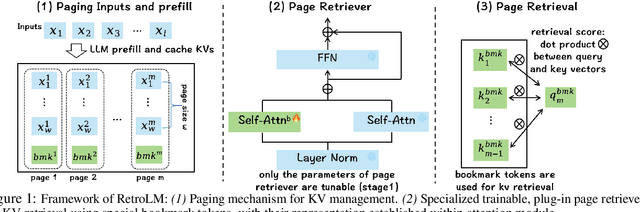

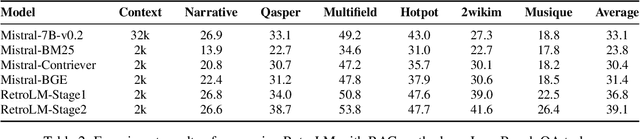
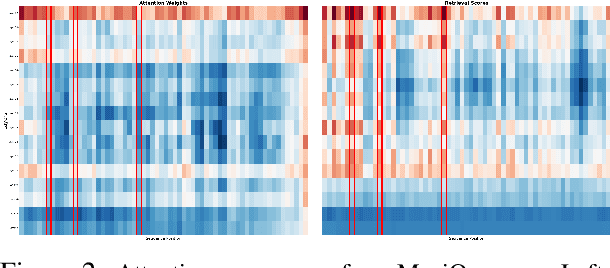
The efficient processing of long context poses a serious challenge for large language models (LLMs). Recently, retrieval-augmented generation (RAG) has emerged as a promising strategy for this problem, as it enables LLMs to make selective use of the long context for efficient computation. However, existing RAG approaches lag behind other long-context processing methods due to inherent limitations on inaccurate retrieval and fragmented contexts. To address these challenges, we introduce RetroLM, a novel RAG framework for long-context processing. Unlike traditional methods, RetroLM employs KV-level retrieval augmentation, where it partitions the LLM's KV cache into contiguous pages and retrieves the most crucial ones for efficient computation. This approach enhances robustness to retrieval inaccuracy, facilitates effective utilization of fragmented contexts, and saves the cost from repeated computation. Building on this framework, we further develop a specialized retriever for precise retrieval of critical pages and conduct unsupervised post-training to optimize the model's ability to leverage retrieved information. We conduct comprehensive evaluations with a variety of benchmarks, including LongBench, InfiniteBench, and RULER, where RetroLM significantly outperforms existing long-context LLMs and efficient long-context processing methods, particularly in tasks requiring intensive reasoning or extremely long-context comprehension.
Reinforced Information Retrieval
Feb 17, 2025While retrieval techniques are widely used in practice, they still face significant challenges in cross-domain scenarios. Recently, generation-augmented methods have emerged as a promising solution to this problem. These methods enhance raw queries by incorporating additional information from an LLM-based generator, facilitating more direct retrieval of relevant documents. However, existing methods struggle with highly specialized situations that require extensive domain expertise. To address this problem, we present \textbf{Reinforced-IR}, a novel approach that jointly adapts a pre-trained retriever and generator for precise cross-domain retrieval. A key innovation of Reinforced-IR is its \textbf{Self-Boosting} framework, which enables retriever and generator to learn from each other's feedback. Specifically, the generator is reinforced to generate query augmentations that enhance the retriever's performance, while the retriever is trained to better discriminate the relevant documents identified by the generator. This iterative process allows the end-to-end retrieval performance to be progressively optimized using an unlabeled corpus from the target domain. In our experiment, Reinforced-IR outperforms existing domain adaptation methods by a large margin, leading to substantial improvements in retrieval quality across a wide range of application scenarios.
Any Information Is Just Worth One Single Screenshot: Unifying Search With Visualized Information Retrieval
Feb 17, 2025With the popularity of multimodal techniques, it receives growing interests to acquire useful information in visual forms. In this work, we formally define an emerging IR paradigm called \textit{Visualized Information Retrieval}, or \textbf{Vis-IR}, where multimodal information, such as texts, images, tables and charts, is jointly represented by a unified visual format called \textbf{Screenshots}, for various retrieval applications. We further make three key contributions for Vis-IR. First, we create \textbf{VIRA} (Vis-IR Aggregation), a large-scale dataset comprising a vast collection of screenshots from diverse sources, carefully curated into captioned and question-answer formats. Second, we develop \textbf{UniSE} (Universal Screenshot Embeddings), a family of retrieval models that enable screenshots to query or be queried across arbitrary data modalities. Finally, we construct \textbf{MVRB} (Massive Visualized IR Benchmark), a comprehensive benchmark covering a variety of task forms and application scenarios. Through extensive evaluations on MVRB, we highlight the deficiency from existing multimodal retrievers and the substantial improvements made by UniSE. Our work will be shared with the community, laying a solid foundation for this emerging field.
O1 Embedder: Let Retrievers Think Before Action
Feb 12, 2025The growing power of large language models (LLMs) has revolutionized how people access and utilize information. Notably, the LLMs excel at performing fine-grained data representation, which facilitates precise retrieval of information. They also generate high-quality answers based on external references, enabling the production of useful knowledge. The recent introduction of reasoning models, like OpenAI O1 and DeepSeek R1, marks another leap forward, highlighting LLMs' ability to think progressively before delivering final answers. This breakthrough significantly improves the ability to address complex tasks, e.g., coding and math proofs. Inspired by this progress, we aim to develop similar capabilities for retrieval models, which hold great promise for tackling critical challenges in the field, including multi-task retrieval, zero-shot retrieval, and tasks requiring intensive reasoning of complex relationships. With this motivation, we propose a novel approach called O1 Embedder, which generates useful thoughts for the input query before making retrieval for the target documents. To realize this objective, we conquer two technical difficulties. First, we design a data synthesis workflow, creating training signals for O1 Embedder by generating initial thoughts from an LLM-expert and subsequently refining them using a retrieval committee. Second, we optimize the training process, enabling a pre-trained model to be jointly fine-tuned to generate retrieval thoughts via behavior cloning and perform dense retrieval through contrastive learning. Our approach is evaluated by comprehensive experiments, where substantial improvements are achieved across 12 popular datasets, spanning both in-domain and out-of-domain scenarios. These results highlight O1 Embedder's remarkable accuracy and generalizability, paving the way for the development of next-generation IR foundation models.
EfficientLLM: Scalable Pruning-Aware Pretraining for Architecture-Agnostic Edge Language Models
Feb 10, 2025Modern large language models (LLMs) driven by scaling laws, achieve intelligence emergency in large model sizes. Recently, the increasing concerns about cloud costs, latency, and privacy make it an urgent requirement to develop compact edge language models. Distinguished from direct pretraining that bounded by the scaling law, this work proposes the pruning-aware pretraining, focusing on retaining performance of much larger optimized models. It features following characteristics: 1) Data-scalable: we introduce minimal parameter groups in LLM and continuously optimize structural pruning, extending post-training pruning methods like LLM-Pruner and SparseGPT into the pretraining phase. 2) Architecture-agnostic: the LLM architecture is auto-designed using saliency-driven pruning, which is the first time to exceed SoTA human-designed LLMs in modern pretraining. We reveal that it achieves top-quality edge language models, termed EfficientLLM, by scaling up LLM compression and extending its boundary. EfficientLLM significantly outperforms SoTA baselines with $100M \sim 1B$ parameters, such as MobileLLM, SmolLM, Qwen2.5-0.5B, OLMo-1B, Llama3.2-1B in common sense benchmarks. As the first attempt, EfficientLLM bridges the performance gap between traditional LLM compression and direct pretraining methods, and we will fully open source at https://github.com/Xingrun-Xing2/EfficientLLM.
Matryoshka Re-Ranker: A Flexible Re-Ranking Architecture With Configurable Depth and Width
Jan 27, 2025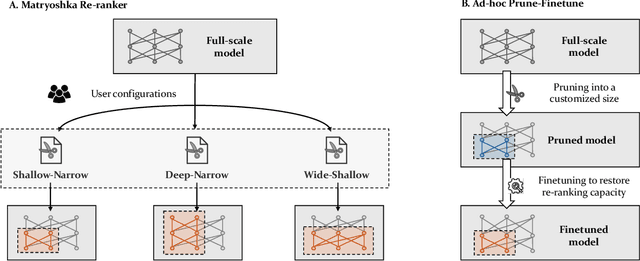
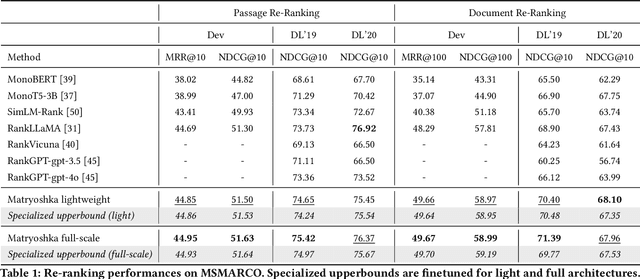
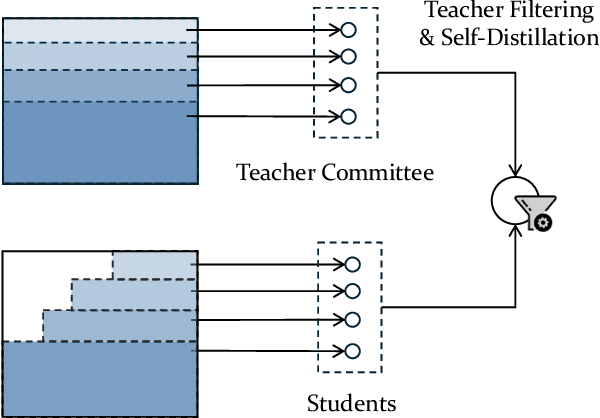
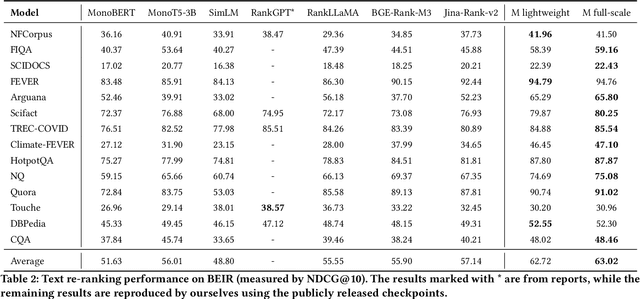
Large language models (LLMs) provide powerful foundations to perform fine-grained text re-ranking. However, they are often prohibitive in reality due to constraints on computation bandwidth. In this work, we propose a \textbf{flexible} architecture called \textbf{Matroyshka Re-Ranker}, which is designed to facilitate \textbf{runtime customization} of model layers and sequence lengths at each layer based on users' configurations. Consequently, the LLM-based re-rankers can be made applicable across various real-world situations. The increased flexibility may come at the cost of precision loss. To address this problem, we introduce a suite of techniques to optimize the performance. First, we propose \textbf{cascaded self-distillation}, where each sub-architecture learns to preserve a precise re-ranking performance from its super components, whose predictions can be exploited as smooth and informative teacher signals. Second, we design a \textbf{factorized compensation mechanism}, where two collaborative Low-Rank Adaptation modules, vertical and horizontal, are jointly employed to compensate for the precision loss resulted from arbitrary combinations of layer and sequence compression. We perform comprehensive experiments based on the passage and document retrieval datasets from MSMARCO, along with all public datasets from BEIR benchmark. In our experiments, Matryoshka Re-Ranker substantially outperforms the existing methods, while effectively preserving its superior performance across various forms of compression and different application scenarios.