 Add to Chrome
 Add to Firefox
 Add to Edge
Zero-Observation User Reactivation with Gap-Driven Dimensional Gating
Jul 22, 2026
Sequential recommendation (SR) models capture continuously observed behavior, but a returning user may have no interactions for months or years. We define this setting as Zero-Observation Reactivation: the user has a pre-gap history, while the platform observes no behavioral signals during a macro-gap Delta t. Under a chronologically aligned Gap-Synthesize Protocol on three Amazon datasets (Video Games, CDs & Vinyl, and Movies & TV), Hit@10 decreases monotonically across the evaluated gap buckets and reaches its lowest level beyond one year. The pattern appears across recurrent, unidirectional, and bidirectional SR backbones. We propose DeltaGate, a lightweight output-layer plugin that keeps the backbone frozen and routes each representation dimension between the personalized history and a learned, zero-initialized global prior. The gate is conditioned jointly on Delta t and the personalized representation. In a controlled diagnostic, we hold the personalized representation fixed and vary Delta t to isolate the trained gate's response to the gap input. In the >365d Video Games bucket, DG-SASRec reaches 0.047 Hit@10 versus 0.031 for SASRec, while DG-BERT4Rec reaches 0.046 versus 0.025 for BERT4Rec, with 66K trainable parameters (2--4% overhead). End-to-end retraining attains higher absolute accuracy but changes the backbone embeddings; the frozen plugin preserves zero backbone drift, uses about 40x fewer trainable parameters, and retains observable dimension-wise routing. The source code is available at https://github.com/jdding/DeltaGate.

SIDInspector: A Mapping-First Diagnostic Resource for Semantic-ID Tokenizers
Jun 09, 2026Semantic-ID (\sid) tokenizers are increasingly reused as standalone artifacts in generative recommendation: an exported item-to-code mapping becomes the address space that a later sequence generator must use. These mappings rarely come with a common inspection interface, so coverage gaps, full-code aliasing, behaviorally weak prefixes, tail compression, and prefix fan-out are often found only after downstream training. We present \tool, a mapping-first diagnostic resource for \sid tokenizer artifacts. \tool defines a small adapter contract over item mappings, metadata, interactions, and optional generator traces; validates the contract; and reports mapping-level probes for utilization, aliasing, neighborhood alignment, popularity allocation, and structural cost, with hooks for temporal churn and generator traces. \tool reports inspectable artifact profiles before downstream leaderboard scores. The released resource covers four tokenizer artifact lines: a same-item GRID/RQ-KMeans-style and ReSID/GAOQ contrast on 23,742 Musical items, plus released LETTER and LC-Rec item-index artifacts. In the Musical contrast, the GRID-style feature-text export has 3,749 unique full codes and a 0.977 full-code aliasing rate, while ReSID/GAOQ is aliasing-free in its exported mapping. Yet the strongest prefix--co-occurrence alignment comes from a deterministic category-prefix control, not from either learned export row (0.447 versus 0.154 and 0.055--0.080), showing that addressability and behaviorally meaningful prefixes should be inspected separately. Cross-domain, fixed-reranker, and mechanism-probe checks support the same diagnostic direction: prefix alignment is a candidate-exposure signal, while final ranking quality remains a downstream model question.
Beyond the Flat Sequence: Hierarchical and Preference-Aware Generative Recommendations
Mar 01, 2026Generative Recommenders (GRs), exemplified by the Hierarchical Sequential Transduction Unit (HSTU), have emerged as a powerful paradigm for modeling long user interaction sequences. However, we observe that their "flat-sequence" assumption overlooks the rich, intrinsic structure of user behavior. This leads to two key limitations: a failure to capture the temporal hierarchy of session-based engagement, and computational inefficiency, as dense attention introduces significant noise that obscures true preference signals within semantically sparse histories, which deteriorates the quality of the learned representations. To this end, we propose a novel framework named HPGR (Hierarchical and Preference-aware Generative Recommender), built upon a two-stage paradigm that injects these crucial structural priors into the model to handle the drawback. Specifically, HPGR comprises two synergistic stages. First, a structure-aware pre-training stage employs a session-based Masked Item Modeling (MIM) objective to learn a hierarchically-informed and semantically rich item representation space. Second, a preference-aware fine-tuning stage leverages these powerful representations to implement a Preference-Guided Sparse Attention mechanism, which dynamically constrains computation to only the most relevant historical items, enhancing both efficiency and signal-to-noise ratio. Empirical experiments on a large-scale proprietary industrial dataset from APPGallery and an online A/B test verify that HPGR achieves state-of-the-art performance over multiple strong baselines, including HSTU and MTGR.
* Accepted to the ACM Web Conference 2026 (WWW '26). 9 pages, 9 figures. Zerui Chen and Heng Chang contributed equally to this work
An Empirical Study and Comparison of Recent Few-Shot Object Detection Algorithms
Mar 27, 2022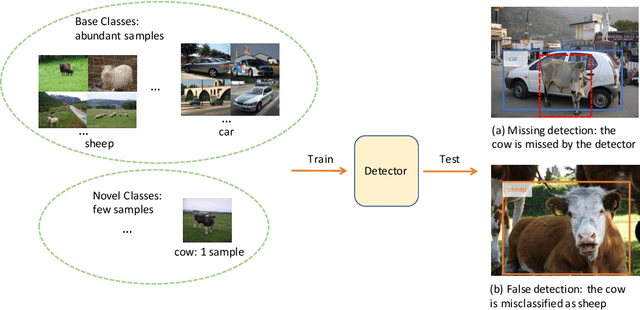


The generic object detection (GOD) task has been successfully tackled by recent deep neural networks, trained by an avalanche of annotated training samples from some common classes. However, it is still non-trivial to generalize these object detectors to the novel long-tailed object classes, which has only few labeled training samples. To this end, the Few-Shot Object Detection (FSOD) has been topical recently, as it mimics the humans' ability of learning to learn, and intelligently transfers the learnt generic object knowledge from the common heavy-tailed, to the novel long-tailed object classes. Especially, the research in this emerging field has been flourish in the recent years with various benchmarks, backbones, and methodologies proposed. To review these FSOD works, there are several insightful FSOD survey articles that systematically study and compare them as the groups of fine-tuning/transfer learning, and meta-learning methods. In contrast, we compare these FSOD algorithms from the new perspective and taxonomy of their contributions, i.e., data-oriented, model-oriented, and algorithm oriented ones. Thus, an empirical study and comparison has been conducted on the recent achievements of FSOD. Furthermore, we also analyze the technical challenges, the merits and demerits of these methods, and envision the future directions of FSOD. Specifically, we give an overview of FSOD, including the problem definition, common datasets, and evaluation protocols. A new taxonomy is then proposed based on the role of prior knowledge during object detection of novel classes. Following this taxonomy, we provide a systematic review of the advances in FSOD. Finally, further discussions on performance, challenges, and future directions are presented.