 Add to Chrome
 Add to Firefox
 Add to Edge
AudioTurbo: Fast Text-to-Audio Generation with Rectified Diffusion
May 28, 2025
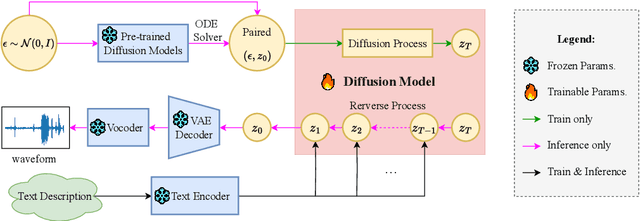
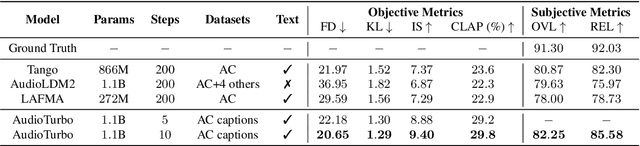
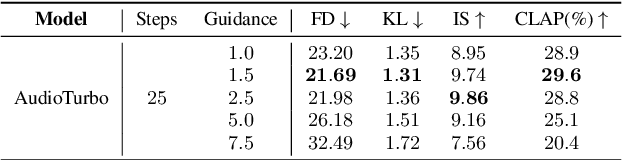
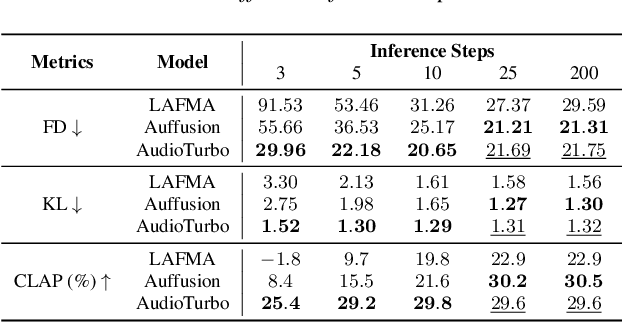
Diffusion models have significantly improved the quality and diversity of audio generation but are hindered by slow inference speed. Rectified flow enhances inference speed by learning straight-line ordinary differential equation (ODE) paths. However, this approach requires training a flow-matching model from scratch and tends to perform suboptimally, or even poorly, at low step counts. To address the limitations of rectified flow while leveraging the advantages of advanced pre-trained diffusion models, this study integrates pre-trained models with the rectified diffusion method to improve the efficiency of text-to-audio (TTA) generation. Specifically, we propose AudioTurbo, which learns first-order ODE paths from deterministic noise sample pairs generated by a pre-trained TTA model. Experiments on the AudioCaps dataset demonstrate that our model, with only 10 sampling steps, outperforms prior models and reduces inference to 3 steps compared to a flow-matching-based acceleration model.

TAG-INSTRUCT: Controlled Instruction Complexity Enhancement through Structure-based Augmentation
May 24, 2025High-quality instruction data is crucial for developing large language models (LLMs), yet existing approaches struggle to effectively control instruction complexity. We present TAG-INSTRUCT, a novel framework that enhances instruction complexity through structured semantic compression and controlled difficulty augmentation. Unlike previous prompt-based methods operating on raw text, TAG-INSTRUCT compresses instructions into a compact tag space and systematically enhances complexity through RL-guided tag expansion. Through extensive experiments, we show that TAG-INSTRUCT outperforms existing instruction complexity augmentation approaches. Our analysis reveals that operating in tag space provides superior controllability and stability across different instruction synthesis frameworks.
ImPart: Importance-Aware Delta-Sparsification for Improved Model Compression and Merging in LLMs
Apr 17, 2025With the proliferation of task-specific large language models, delta compression has emerged as a method to mitigate the resource challenges of deploying numerous such models by effectively compressing the delta model parameters. Previous delta-sparsification methods either remove parameters randomly or truncate singular vectors directly after singular value decomposition (SVD). However, these methods either disregard parameter importance entirely or evaluate it with too coarse a granularity. In this work, we introduce ImPart, a novel importance-aware delta sparsification approach. Leveraging SVD, it dynamically adjusts sparsity ratios of different singular vectors based on their importance, effectively retaining crucial task-specific knowledge even at high sparsity ratios. Experiments show that ImPart achieves state-of-the-art delta sparsification performance, demonstrating $2\times$ higher compression ratio than baselines at the same performance level. When integrated with existing methods, ImPart sets a new state-of-the-art on delta quantization and model merging.
Fin-R1: A Large Language Model for Financial Reasoning through Reinforcement Learning
Mar 21, 2025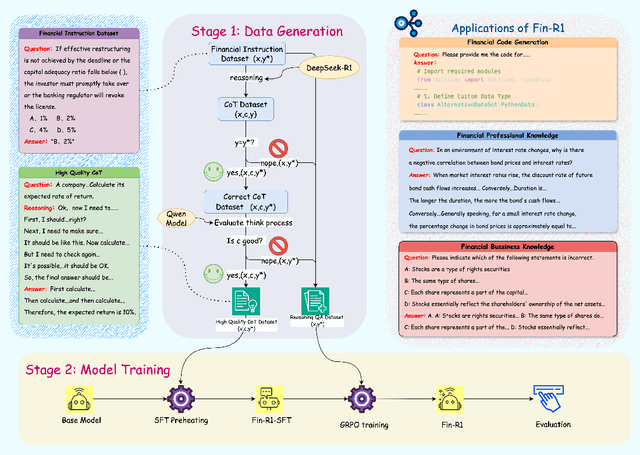
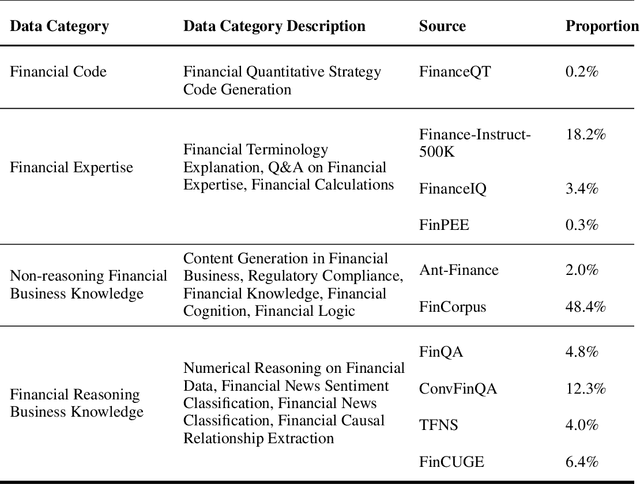
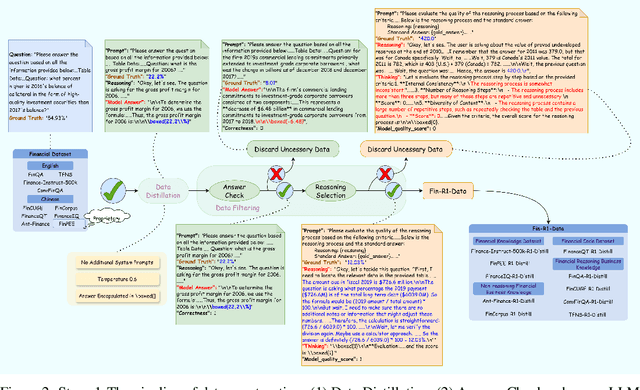
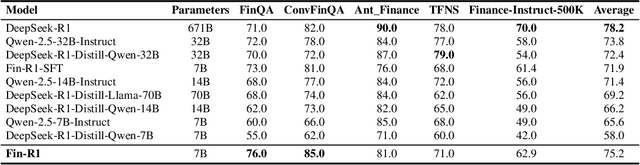
Reasoning large language models are rapidly evolving across various domains. However, their capabilities in handling complex financial tasks still require in-depth exploration. In this paper, we introduce Fin-R1, a reasoning large language model specifically designed for the financial sector. Fin-R1 is built using a two-stage architecture, leveraging a financial reasoning dataset distilled and processed based on DeepSeek-R1. Through supervised fine-tuning (SFT) and reinforcement learning (RL) training, it demonstrates performance close to DeepSeek-R1 with a parameter size of 7 billion across a range of financial reasoning tasks. It achieves the state-of-the-art (SOTA) in the FinQA and ConvFinQA tasks between those LLMs in our evaluation, surpassing larger models in other tasks as well. Fin-R1 showcases strong reasoning and decision-making capabilities, providing solutions to various problems encountered in the financial domain. Our code is available at https://github.com/SUFE-AIFLM-Lab/Fin-R1.
A Hybrid Model/Data-Driven Solution to Channel, Position and Orientation Tracking in mmWave Vehicular Systems
Mar 07, 2025Channel tracking in millimeter wave (mmWave) vehicular systems is crucial for maintaining robust vehicle-to-infrastructure (V2I) communication links, which can be leveraged to achieve high accuracy vehicle position and orientation tracking as a byproduct of communication. While prior work tends to simplify the system model by omitting critical system factors such as clock offsets, filtering effects, antenna array orientation offsets, and channel estimation errors, we address the challenges of a practical mmWave multiple-input multiple-output (MIMO) communication system between a single base station (BS) and a vehicle while tracking the vehicle's position and orientation (PO) considering realistic driving behaviors. We first develop a channel tracking algorithm based on multidimensional orthogonal matching pursuit (MOMP) with factoring (F-MOMP) to reduce computational complexity and enable high-resolution channel estimates during the tracking stage, suitable for PO estimation. Then, we develop a network called VO-ChAT (Vehicle Orientation-Channel Attention for orientation Tracking), which processes the channel estimate sequence for orientation prediction. Afterward, a weighted least squares (WLS) problem that exploits the channel geometry is formulated to create an initial estimate of the vehicle's 2D position. A second network named VP-ChAT (Vehicle Position-Channel Attention for position Tracking) refines the geometric position estimate. VP-ChAT is a Transformer inspired network processing the historical channel and position estimates to provide the correction for the initial geometric position estimate. The proposed solution is evaluated using raytracing generated channels in an urban canyon environment. For 80% of the cases it achieves a 2D position tracking accuracy of 26 cm while orientation errors are kept below 0.5 degree.
LayAlign: Enhancing Multilingual Reasoning in Large Language Models via Layer-Wise Adaptive Fusion and Alignment Strategy
Feb 17, 2025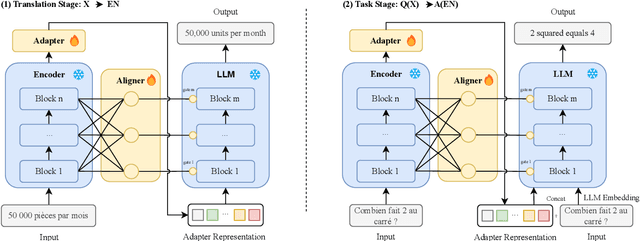
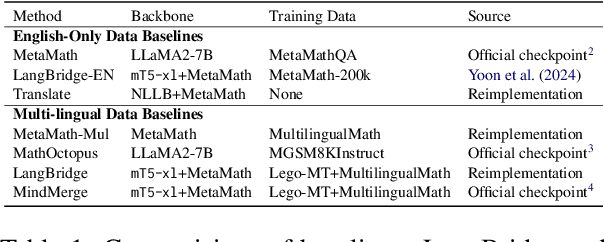
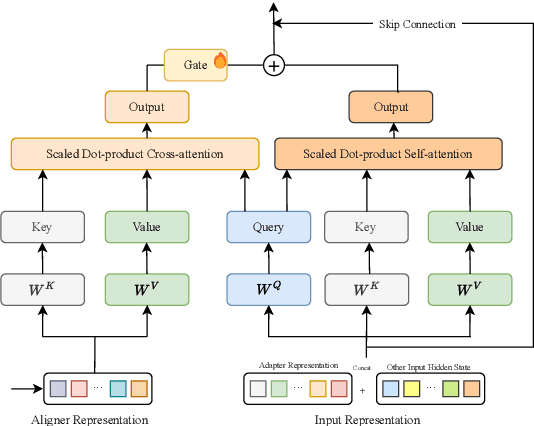
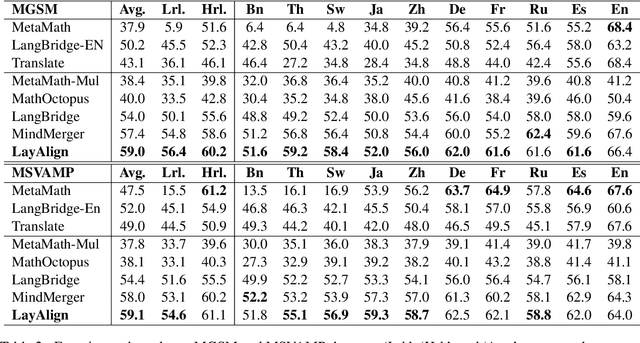
Despite being pretrained on multilingual corpora, large language models (LLMs) exhibit suboptimal performance on low-resource languages. Recent approaches have leveraged multilingual encoders alongside LLMs by introducing trainable parameters connecting the two models. However, these methods typically focus on the encoder's output, overlooking valuable information from other layers. We propose \aname (\mname), a framework that integrates representations from all encoder layers, coupled with the \attaname mechanism to enable layer-wise interaction between the LLM and the multilingual encoder. Extensive experiments on multilingual reasoning tasks, along with analyses of learned representations, show that our approach consistently outperforms existing baselines.
Revisiting Generative Policies: A Simpler Reinforcement Learning Algorithmic Perspective
Dec 02, 2024Generative models, particularly diffusion models, have achieved remarkable success in density estimation for multimodal data, drawing significant interest from the reinforcement learning (RL) community, especially in policy modeling in continuous action spaces. However, existing works exhibit significant variations in training schemes and RL optimization objectives, and some methods are only applicable to diffusion models. In this study, we compare and analyze various generative policy training and deployment techniques, identifying and validating effective designs for generative policy algorithms. Specifically, we revisit existing training objectives and classify them into two categories, each linked to a simpler approach. The first approach, Generative Model Policy Optimization (GMPO), employs a native advantage-weighted regression formulation as the training objective, which is significantly simpler than previous methods. The second approach, Generative Model Policy Gradient (GMPG), offers a numerically stable implementation of the native policy gradient method. We introduce a standardized experimental framework named GenerativeRL. Our experiments demonstrate that the proposed methods achieve state-of-the-art performance on various offline-RL datasets, offering a unified and practical guideline for training and deploying generative policies.
Compound-QA: A Benchmark for Evaluating LLMs on Compound Questions
Nov 15, 2024


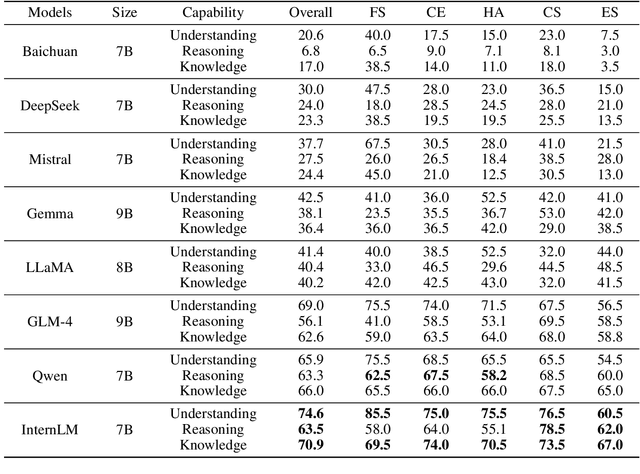
Large language models (LLMs) demonstrate remarkable performance across various tasks, prompting researchers to develop diverse evaluation benchmarks. However, existing benchmarks typically measure the ability of LLMs to respond to individual questions, neglecting the complex interactions in real-world applications. In this paper, we introduce Compound Question Synthesis (CQ-Syn) to create the Compound-QA benchmark, focusing on compound questions with multiple sub-questions. This benchmark is derived from existing QA datasets, annotated with proprietary LLMs and verified by humans for accuracy. It encompasses five categories: Factual-Statement, Cause-and-Effect, Hypothetical-Analysis, Comparison-and-Selection, and Evaluation-and-Suggestion. It evaluates the LLM capability in terms of three dimensions including understanding, reasoning, and knowledge. Our assessment of eight open-source LLMs using Compound-QA reveals distinct patterns in their responses to compound questions, which are significantly poorer than those to non-compound questions. Additionally, we investigate various methods to enhance LLMs performance on compound questions. The results indicate that these approaches significantly improve the models' comprehension and reasoning abilities on compound questions.
TSI: A Multi-View Representation Learning Approach for Time Series Forecasting
Sep 30, 2024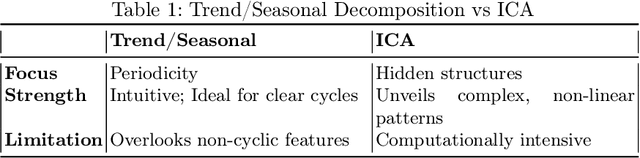

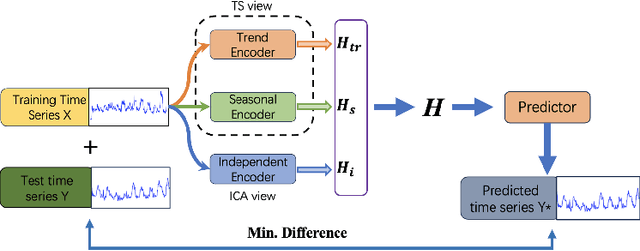
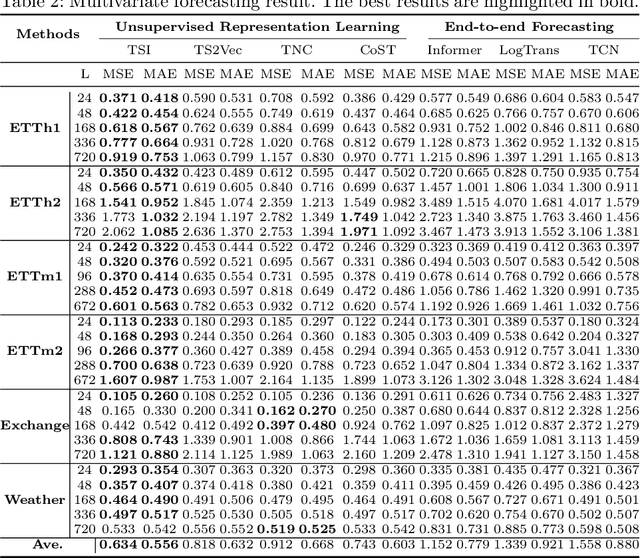
As the growing demand for long sequence time-series forecasting in real-world applications, such as electricity consumption planning, the significance of time series forecasting becomes increasingly crucial across various domains. This is highlighted by recent advancements in representation learning within the field. This study introduces a novel multi-view approach for time series forecasting that innovatively integrates trend and seasonal representations with an Independent Component Analysis (ICA)-based representation. Recognizing the limitations of existing methods in representing complex and high-dimensional time series data, this research addresses the challenge by combining TS (trend and seasonality) and ICA (independent components) perspectives. This approach offers a holistic understanding of time series data, going beyond traditional models that often miss nuanced, nonlinear relationships. The efficacy of TSI model is demonstrated through comprehensive testing on various benchmark datasets, where it shows superior performance over current state-of-the-art models, particularly in multivariate forecasting. This method not only enhances the accuracy of forecasting but also contributes significantly to the field by providing a more in-depth understanding of time series data. The research which uses ICA for a view lays the groundwork for further exploration and methodological advancements in time series forecasting, opening new avenues for research and practical applications.
G3R: Gradient Guided Generalizable Reconstruction
Sep 28, 2024Large scale 3D scene reconstruction is important for applications such as virtual reality and simulation. Existing neural rendering approaches (e.g., NeRF, 3DGS) have achieved realistic reconstructions on large scenes, but optimize per scene, which is expensive and slow, and exhibit noticeable artifacts under large view changes due to overfitting. Generalizable approaches or large reconstruction models are fast, but primarily work for small scenes/objects and often produce lower quality rendering results. In this work, we introduce G3R, a generalizable reconstruction approach that can efficiently predict high-quality 3D scene representations for large scenes. We propose to learn a reconstruction network that takes the gradient feedback signals from differentiable rendering to iteratively update a 3D scene representation, combining the benefits of high photorealism from per-scene optimization with data-driven priors from fast feed-forward prediction methods. Experiments on urban-driving and drone datasets show that G3R generalizes across diverse large scenes and accelerates the reconstruction process by at least 10x while achieving comparable or better realism compared to 3DGS, and also being more robust to large view changes.