 Add to Chrome
 Add to Firefox
 Add to Edge
Rewarding Better Thinking for LLM Preference Alignment
Jul 22, 2026
LLM preference alignment aims to optimize models toward human preferences across diverse user instructions. Reinforcement learning has become a major post-training approach for this goal, but existing proxy rewards are often outcome-level, mainly evaluating the final response while providing limited guidance for the reasoning trajectory. This can make credit assignment coarse when multiple responses receive similar final scores, leaving trajectory-level preferences under-specified. To address this limitation, we propose Thinking Checklist Reward (TCR), a process-oriented reward for RL-based preference alignment. TCR converts preference pairs into sample-specific thinking checklists and uses them to evaluate whether the generated reasoning trace addresses the preference-implied considerations. To reduce overlap with outcome-level supervision, TCR further introduces an exponential moving average (EMA) residual formulation to isolate a complementary thinking surplus beyond what is predictable from the outcome reward. Experiments on five models from three model families show that TCR consistently improves alignment performance across diverse benchmarks, with ablations further validating the importance of EMA-based residual formulation and sample-specific checklist supervision.

PolyBench: A Benchmark for Compositional Reasoning in Polyphonic Audio
Mar 05, 2026Large Audio Language Models (LALMs) are increasingly capable of reasoning over audio. However, existing benchmarks provide limited coverage of reasoning in polyphonic audio, where multiple sound events co-occur and induce compositional structure. In this work, we introduce PolyBench, a benchmark designed to evaluate compositional reasoning in polyphonic audio. PolyBench comprises five evaluation subsets covering counting, classification, detection, concurrency, and duration estimation, requiring reasoning over multiple concurrent events and their relations. Evaluation of state-of-the-art LALMs reveals consistent performance degradation in polyphonic audio, indicating a fundamental bottleneck in current LALMs.
From "What" to "How": Constrained Reasoning for Autoregressive Image Generation
Mar 03, 2026Autoregressive image generation has seen recent improvements with the introduction of chain-of-thought and reinforcement learning. However, current methods merely specify "What" details to depict by rewriting the input prompt, yet fundamentally fail to reason about "How" to structure the overall image. This inherent limitation gives rise to persistent issues, such as spatial ambiguity directly causing unrealistic object overlaps. To bridge this gap, we propose CoR-Painter, a novel framework that pioneers a "How-to-What" paradigm by introducing Constrained Reasoning to guide the autoregressive generation. Specifically, it first deduces "How to draw" by deriving a set of visual constraints from the input prompt, which explicitly govern spatial relationships, key attributes, and compositional rules. These constraints steer the subsequent generation of a detailed description "What to draw", providing a structurally sound and coherent basis for accurate visual synthesis. Additionally, we introduce a Dual-Objective GRPO strategy that specifically optimizes the textual constrained reasoning and visual projection processes to ensure the coherence and quality of the entire generation pipeline. Extensive experiments on T2I-CompBench, GenEval, and WISE demonstrate that our method achieves state-of-the-art performance, with significant improvements in spatial metrics (e.g., +5.41% on T2I-CompBench).
Scaling Speech Tokenizers with Diffusion Autoencoders
Feb 06, 2026Speech tokenizers are foundational to speech language models, yet existing approaches face two major challenges: (1) balancing trade-offs between encoding semantics for understanding and acoustics for reconstruction, and (2) achieving low bit rates and low token rates. We propose Speech Diffusion Tokenizer (SiTok), a diffusion autoencoder that jointly learns semantic-rich representations through supervised learning and enables high-fidelity audio reconstruction with diffusion. We scale SiTok to 1.6B parameters and train it on 2 million hours of speech. Experiments show that SiTok outperforms strong baselines on understanding, reconstruction and generation tasks, at an extremely low token rate of $12.5$ Hz and a bit-rate of 200 bits-per-second.
The Llama 4 Herd: Architecture, Training, Evaluation, and Deployment Notes
Jan 15, 2026This document consolidates publicly reported technical details about Metas Llama 4 model family. It summarizes (i) released variants (Scout and Maverick) and the broader herd context including the previewed Behemoth teacher model, (ii) architectural characteristics beyond a high-level MoE description covering routed/shared-expert structure, early-fusion multimodality, and long-context design elements reported for Scout (iRoPE and length generalization strategies), (iii) training disclosures spanning pre-training, mid-training for long-context extension, and post-training methodology (lightweight SFT, online RL, and lightweight DPO) as described in release materials, (iv) developer-reported benchmark results for both base and instruction-tuned checkpoints, and (v) practical deployment constraints observed across major serving environments, including provider-specific context limits and quantization packaging. The manuscript also summarizes licensing obligations relevant to redistribution and derivative naming, and reviews publicly described safeguards and evaluation practices. The goal is to provide a compact technical reference for researchers and practitioners who need precise, source-backed facts about Llama 4.
Omni-AVSR: Towards Unified Multimodal Speech Recognition with Large Language Models
Nov 10, 2025Large language models (LLMs) have recently achieved impressive results in speech recognition across multiple modalities, including Auditory Speech Recognition (ASR), Visual Speech Recognition (VSR), and Audio-Visual Speech Recognition (AVSR). Despite this progress, current LLM-based approaches typically address each task independently, training separate models that raise computational and deployment resource use while missing potential cross-task synergies. They also rely on fixed-rate token compression, which restricts flexibility in balancing accuracy with efficiency. These limitations highlight the need for a unified framework that can support ASR, VSR, and AVSR while enabling elastic inference. To this end, we present Omni-AVSR, a unified audio-visual LLM that combines efficient multi-granularity training with parameter-efficient adaptation. Specifically, we adapt the matryoshka representation learning paradigm to efficiently train across multiple audio and visual granularities, reducing its inherent training resource use. Furthermore, we explore three LoRA-based strategies for adapting the backbone LLM, balancing shared and task-specific specialization. Experiments on LRS2 and LRS3 show that Omni-AVSR achieves comparable or superior accuracy to state-of-the-art baselines while training a single model at substantially lower training and deployment resource use. The model also remains robust under acoustic noise, and we analyze its scaling behavior as LLM size increases, providing insights into the trade-off between performance and efficiency.
Noise-Robust Sound Event Detection and Counting via Language-Queried Sound Separation
Aug 10, 2025Most sound event detection (SED) systems perform well on clean datasets but degrade significantly in noisy environments. Language-queried audio source separation (LASS) models show promise for robust SED by separating target events; existing methods require elaborate multi-stage training and lack explicit guidance for target events. To address these challenges, we introduce event appearance detection (EAD), a counting-based approach that counts event occurrences at both the clip and frame levels. Based on EAD, we propose a co-training-based multi-task learning framework for EAD and SED to enhance SED's performance in noisy environments. First, SED struggles to learn the same patterns as EAD. Then, a task-based constraint is designed to improve prediction consistency between SED and EAD. This framework provides more reliable clip-level predictions for LASS models and strengthens timestamp detection capability. Experiments on DESED and WildDESED datasets demonstrate better performance compared to existing methods, with advantages becoming more pronounced at higher noise levels.
AudioTurbo: Fast Text-to-Audio Generation with Rectified Diffusion
May 28, 2025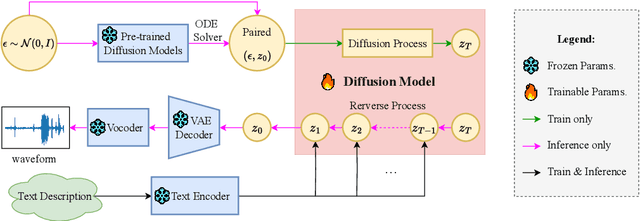
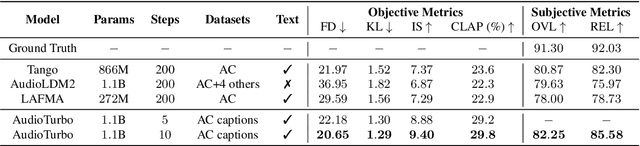
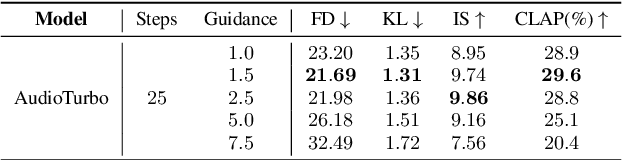
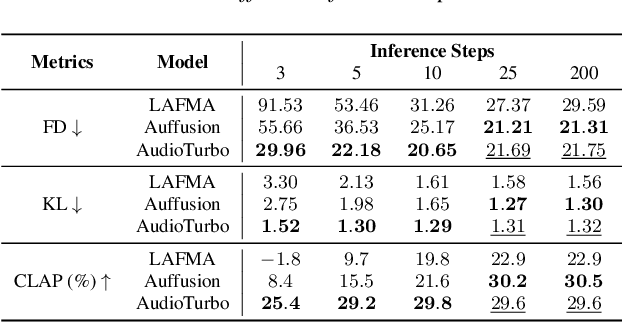
Diffusion models have significantly improved the quality and diversity of audio generation but are hindered by slow inference speed. Rectified flow enhances inference speed by learning straight-line ordinary differential equation (ODE) paths. However, this approach requires training a flow-matching model from scratch and tends to perform suboptimally, or even poorly, at low step counts. To address the limitations of rectified flow while leveraging the advantages of advanced pre-trained diffusion models, this study integrates pre-trained models with the rectified diffusion method to improve the efficiency of text-to-audio (TTA) generation. Specifically, we propose AudioTurbo, which learns first-order ODE paths from deterministic noise sample pairs generated by a pre-trained TTA model. Experiments on the AudioCaps dataset demonstrate that our model, with only 10 sampling steps, outperforms prior models and reduces inference to 3 steps compared to a flow-matching-based acceleration model.
ProDS: Preference-oriented Data Selection for Instruction Tuning
May 19, 2025Instruction data selection aims to identify a high-quality subset from the training set that matches or exceeds the performance of the full dataset on target tasks. Existing methods focus on the instruction-to-response mapping, but neglect the human preference for diverse responses. In this paper, we propose Preference-oriented Data Selection method (ProDS) that scores training samples based on their alignment with preferences observed in the target set. Our key innovation lies in shifting the data selection criteria from merely estimating features for accurate response generation to explicitly aligning training samples with human preferences in target tasks. Specifically, direct preference optimization (DPO) is employed to estimate human preferences across diverse responses. Besides, a bidirectional preference synthesis strategy is designed to score training samples according to both positive preferences and negative preferences. Extensive experimental results demonstrate our superiority to existing task-agnostic and targeted methods.
Audio-Visual Class-Incremental Learning for Fish Feeding intensity Assessment in Aquaculture
Apr 21, 2025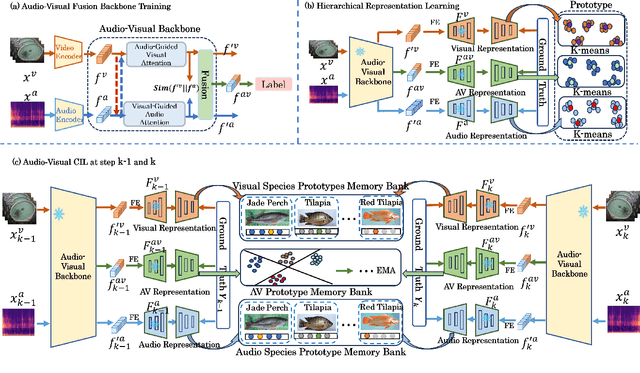
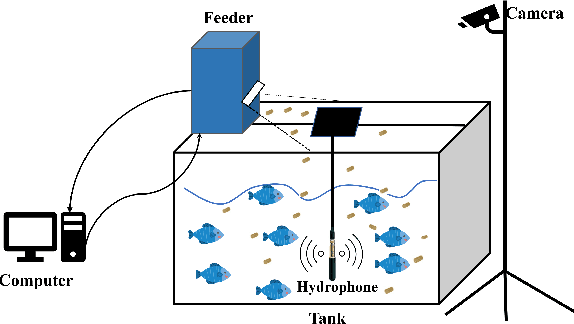
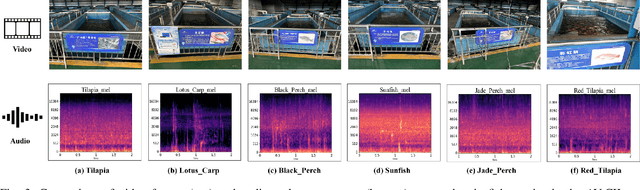
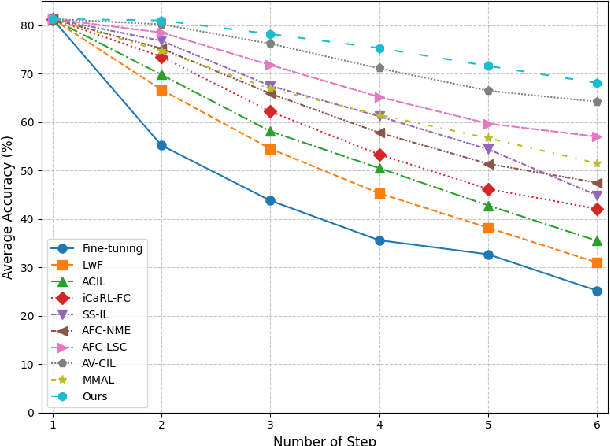
Fish Feeding Intensity Assessment (FFIA) is crucial in industrial aquaculture management. Recent multi-modal approaches have shown promise in improving FFIA robustness and efficiency. However, these methods face significant challenges when adapting to new fish species or environments due to catastrophic forgetting and the lack of suitable datasets. To address these limitations, we first introduce AV-CIL-FFIA, a new dataset comprising 81,932 labelled audio-visual clips capturing feeding intensities across six different fish species in real aquaculture environments. Then, we pioneer audio-visual class incremental learning (CIL) for FFIA and demonstrate through benchmarking on AV-CIL-FFIA that it significantly outperforms single-modality methods. Existing CIL methods rely heavily on historical data. Exemplar-based approaches store raw samples, creating storage challenges, while exemplar-free methods avoid data storage but struggle to distinguish subtle feeding intensity variations across different fish species. To overcome these limitations, we introduce HAIL-FFIA, a novel audio-visual class-incremental learning framework that bridges this gap with a prototype-based approach that achieves exemplar-free efficiency while preserving essential knowledge through compact feature representations. Specifically, HAIL-FFIA employs hierarchical representation learning with a dual-path knowledge preservation mechanism that separates general intensity knowledge from fish-specific characteristics. Additionally, it features a dynamic modality balancing system that adaptively adjusts the importance of audio versus visual information based on feeding behaviour stages. Experimental results show that HAIL-FFIA is superior to SOTA methods on AV-CIL-FFIA, achieving higher accuracy with lower storage needs while effectively mitigating catastrophic forgetting in incremental fish species learning.