 Add to Chrome
 Add to Firefox
 Add to Edge
Lightweight Wrappers for Adapting Time Series Foundation Models to Regional Drought Forecasting
Jul 20, 2026
Large \emph{Time Series Foundation Models} (TSFMs) demonstrate strong zero-shot forecasting capabilities across diverse domains. However, their application to regional climate forecasting faces practical challenges: model weights are often proprietary, local training records are limited, and computational budgets are constrained, making traditional fine-tuning approaches infeasible. To address these constraints, we introduce a lightweight, black-box adaptation framework (requiring no access to backbone parameters and no backbone fine-tuning) that enhances frozen TSFMs at inference time through two plug-and-play wrappers: \textbf{SMR\textsuperscript{2}} (Stationarity aware multi-resolution Residual), which decomposes the input into multi-resolution temporal views, learns stride specific residual corrections that capture regional dynamics, then adaptively ensembles them into a single forecast, and \textbf{MBB} (Moving Block Bootstrap), which preserves temporal dependencies through block resampling and ensembles over temporally coherent residual perturbations to stabilize the point forecast. Both wrappers instantiate the same bagging style principle: they build diverse views of the input or its residuals, forecast each with the same frozen backbone, and aggregate, so all adaptation comes from inference time ensembling rather than any weight update. Evaluated on one month ahead Standardized Precipitation Evapotranspiration Index (SPEI) prediction across multiple sites in South Australia, our framework consistently improves forecasting performance across several backbone models, demonstrating up to 26\% mean squared error (MSE) reduction over the corresponding frozen backbone while enabling practical deployment in resource constrained regional forecasting systems.

Residual-Guided Multi-Resolution Refinement of Foundation Models: A Case Study in Drought Forecasting
Jul 20, 2026Regional climate prediction presents unique challenges for time series foundation models, which typically process temporal patterns through single-pass inference. Expert climatologists, in contrast, employ multi-scale temporal analysis and iterative refinement based on systematic error diagnosis. We present RGMR (Residual-Guided Multi-Resolution Refinement), an inference-time framework that adapts pre-trained foundation models to perform structured coarse-to-fine refinement for climate forecasting without updating backbone parameters. Applied to drought forecasting using the Standardized Precipitation Evapotranspiration Index (SPEI), RGMR is architecture-agnostic across the three TSFM backbones evaluated per site (TimesFM, TimeGPT, TabPFN) and consistently lowers test-set MSE on three South Australian sites and three additional regions outside South Australia. Applied to TimesFM, the wrapper reduces one-month-ahead SPEI MSE by up to 18.9\% across the three South Australian sites (mean reduction $\approx$18.7\%). Overall, RGMR provides a practical route for deploying frozen TSFMs in regional climate forecasting workflows.
Alignment-Guided Largest Table Overlap Size Estimation
Jul 03, 2026Fast estimation of the size of the largest overlap between tables enables blocking and query-by-table retrieval in large table repositories. The first and the state-of-the-art estimator Armadillo improves efficiency by embedding each table independently and approximating overlap ratio via embedding similarity. However, accurate estimation in heterogeneous repositories remains limited by three challenges: (C1) overlap depends on row-column structure, i.e., each matched cell must preserve both its row and column membership under a joint alignment of the two tables, but existing encodings leave this structure to be inferred indirectly; (C2) independent encoding provides no explicit channel for inter-table alignment signals, biasing prediction toward global similarity; (C3) naive value encodings overfit to corpus-specific distributions, causing cross-domain degradation. Hence, we propose ALORE, a scalable and domain-robust overlap ratio estimator built on three principles: (P1) explicitly represent row-column structure; (P2) expose inter-table alignment signals during training without expensive alignment search; (P3) reduce sensitivity to corpus-specific value distributions. ALORE instantiates these principles with a Two-View Row-Column Hypergraph encoder, alignment-guided objectives with inexpensive interaction signals, and a domain-robust value mapping. Experiments on multiple datasets spanning diverse domains and scales, including a large real-world corpus beyond prior benchmarks, show that ALORE outperforms the state of the art. ALORE reduces MAE by up to 55% overall and 69% in zero-shot transfer, while achieving up to 89x speedup. We further validate its effectiveness for query-by-table retrieval.
TSI: A Multi-View Representation Learning Approach for Time Series Forecasting
Sep 30, 2024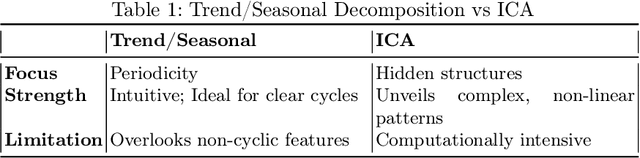

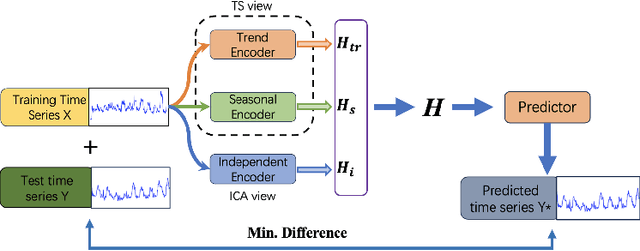
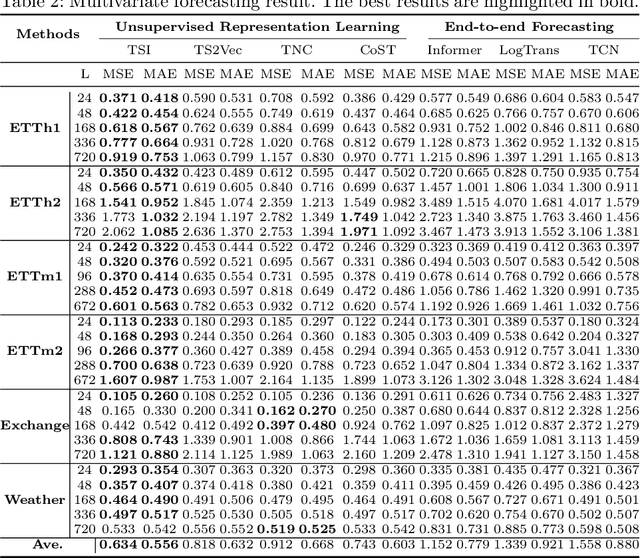
As the growing demand for long sequence time-series forecasting in real-world applications, such as electricity consumption planning, the significance of time series forecasting becomes increasingly crucial across various domains. This is highlighted by recent advancements in representation learning within the field. This study introduces a novel multi-view approach for time series forecasting that innovatively integrates trend and seasonal representations with an Independent Component Analysis (ICA)-based representation. Recognizing the limitations of existing methods in representing complex and high-dimensional time series data, this research addresses the challenge by combining TS (trend and seasonality) and ICA (independent components) perspectives. This approach offers a holistic understanding of time series data, going beyond traditional models that often miss nuanced, nonlinear relationships. The efficacy of TSI model is demonstrated through comprehensive testing on various benchmark datasets, where it shows superior performance over current state-of-the-art models, particularly in multivariate forecasting. This method not only enhances the accuracy of forecasting but also contributes significantly to the field by providing a more in-depth understanding of time series data. The research which uses ICA for a view lays the groundwork for further exploration and methodological advancements in time series forecasting, opening new avenues for research and practical applications.
A Deconfounding Approach to Climate Model Bias Correction
Aug 22, 2024
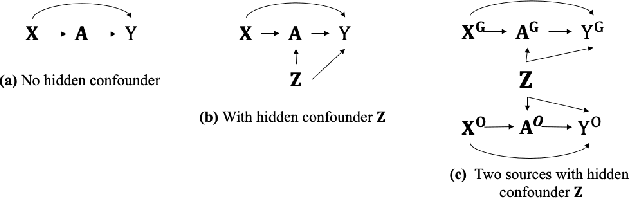

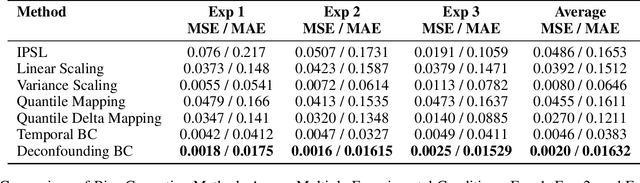
Global Climate Models (GCMs) are crucial for predicting future climate changes by simulating the Earth systems. However, GCM outputs exhibit systematic biases due to model uncertainties, parameterization simplifications, and inadequate representation of complex climate phenomena. Traditional bias correction methods, which rely on historical observation data and statistical techniques, often neglect unobserved confounders, leading to biased results. This paper proposes a novel bias correction approach to utilize both GCM and observational data to learn a factor model that captures multi-cause latent confounders. Inspired by recent advances in causality based time series deconfounding, our method first constructs a factor model to learn latent confounders from historical data and then applies them to enhance the bias correction process using advanced time series forecasting models. The experimental results demonstrate significant improvements in the accuracy of precipitation outputs. By addressing unobserved confounders, our approach offers a robust and theoretically grounded solution for climate model bias correction.