 Add to Chrome
 Add to Firefox
 Add to Edge
Empowering Feed-Forward Reconstruction Models with Metric Scale via Satellite Images
Jun 06, 2026
Feed-forward 3D reconstruction models have recently shown strong generalization across diverse scenes, yet most of them recover geometry only up to an unknown global scale. This scale ambiguity limits their use in applications that require metric understanding of the environment. Existing metric reconstruction methods commonly rely on large-scale metric annotations or accurate camera calibration, both of which are costly or unreliable in many real-world settings. We propose a satellite-guided framework for resolving scale ambiguity in feed-forward 3D reconstruction. The key idea is to use readily available satellite imagery as a global metric reference. Given a coarse camera pose, our method retrieves a local satellite patch and integrates it with a feed-forward reconstruction backbone through bidirectional cross-view interaction. By enforcing consistency between the reconstructed scene and the satellite reference, the model infers absolute scale, refines scene geometry, and estimates camera pose in a metric coordinate frame. Experiments on KITTI, nuScenes, and Oxford RobotCar show consistent improvements in metric depth estimation, multi-view point-cloud reconstruction, and cross-view camera localization, while preserving strong generalization across datasets and geographic regions.

ForeSplat: Optimization-Aware Foresight for Feed-Forward 3D Gaussian Splatting
May 21, 2026Feed-forward 3D Gaussian Splatting (3DGS) models offer fast single-pass reconstruction,but scaling them to match per-scene optimization quality is fundamentally hindered by the scarcity of large-scale 3D annotations.A practical compromise is predict-then-refine,where post-prediction optimization compensates for the limited capacity of the feed-forward network.However,standard feed-forward 3DGS is trained solely for zero-step rendering error,ignoring whether its output constitutes a good initialization for the downstream optimizer.We present ForeSplat,an optimization-aware training framework that equips feed-forward 3DGS models to produce initializations explicitly designed for rapid,effective refinement.By offloading part of the scene-modeling burden to the optimizer,ForeSplat substantially reduces the capacity pressure on the feed-forward model,making high-quality reconstruction feasible even with compact networks.At its core is MetaGrad,a lightweight multi-anchor meta-gradient training rule that bypasses costly higher-order differentiation through the 3DGS optimizer.MetaGrad unrolls a short inner-loop refinement trajectory,samples anchor states,and back-propagates aggregated first-order gradients to the prediction head as a surrogate optimization-aware signal.This fine-tuning adds no inference cost and enables high-quality reconstruction within seconds after a few refinement steps.We instantiate ForeSplat on diverse backbones,including AnySplat,Pi3X,and a distilled variant tailored for edge deployment.Across all tested architectures,a ForeSplat-trained initialization converges in fewer refinement steps and reaches a higher peak reconstruction quality than its vanilla counterpart,even fully converged.The framework consistently bridges the gap between amortized prediction and per-scene optimization,establishing a practical path toward lightweight,high-fidelity 3D reconstruction.
PanoVGGT: Feed-Forward 3D Reconstruction from Panoramic Imagery
Mar 18, 2026Panoramic imagery offers a full 360° field of view and is increasingly common in consumer devices. However, it introduces non-pinhole distortions that challenge joint pose estimation and 3D reconstruction. Existing feed-forward models, built for perspective cameras, generalize poorly to this setting. We propose PanoVGGT, a permutation-equivariant Transformer framework that jointly predicts camera poses, depth maps, and 3D point clouds from one or multiple panoramas in a single forward pass. The model incorporates spherical-aware positional embeddings and a panorama-specific three-axis SO(3) rotation augmentation, enabling effective geometric reasoning in the spherical domain. To resolve inherent global-frame ambiguity, we further introduce a stochastic anchoring strategy during training. In addition, we contribute PanoCity, a large-scale outdoor panoramic dataset with dense depth and 6-DoF pose annotations. Extensive experiments on PanoCity and standard benchmarks demonstrate that PanoVGGT achieves competitive accuracy, strong robustness, and improved cross-domain generalization. Code and dataset will be released.
AffordGrasp: Cross-Modal Diffusion for Affordance-Aware Grasp Synthesis
Mar 09, 2026Generating human grasping poses that accurately reflect both object geometry and user-specified interaction semantics is essential for natural hand-object interactions in AR/VR and embodied AI. However, existing semantic grasping approaches struggle with the large modality gap between 3D object representations and textual instructions, and often lack explicit spatial or semantic constraints, leading to physically invalid or semantically inconsistent grasps. In this work, we present AffordGrasp, a diffusion-based framework that produces physically stable and semantically faithful human grasps with high precision. We first introduce a scalable annotation pipeline that automatically enriches hand-object interaction datasets with fine-grained structured language labels capturing interaction intent. Building upon these annotations, AffordGrasp integrates an affordance-aware latent representation of hand poses with a dual-conditioning diffusion process, enabling the model to jointly reason over object geometry, spatial affordances, and instruction semantics. A distribution adjustment module further enforces physical contact consistency and semantic alignment. We evaluate AffordGrasp across four instruction-augmented benchmarks derived from HO-3D, OakInk, GRAB, and AffordPose, and observe substantial improvements over state-of-the-art methods in grasp quality, semantic accuracy, and diversity.
CityGo: Lightweight Urban Modeling and Rendering with Proxy Buildings and Residual Gaussians
May 28, 2025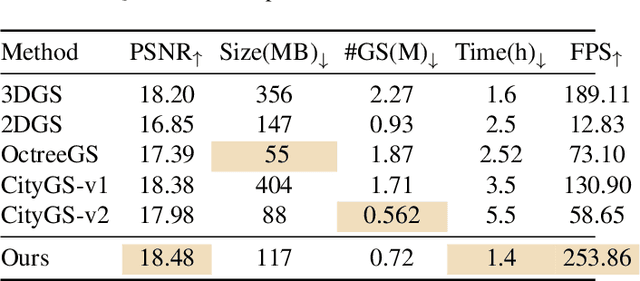
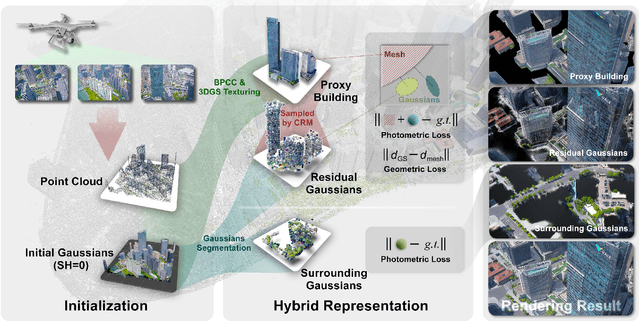

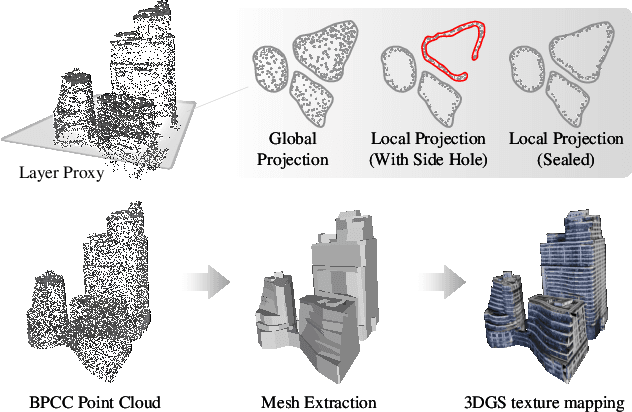
Accurate and efficient modeling of large-scale urban scenes is critical for applications such as AR navigation, UAV based inspection, and smart city digital twins. While aerial imagery offers broad coverage and complements limitations of ground-based data, reconstructing city-scale environments from such views remains challenging due to occlusions, incomplete geometry, and high memory demands. Recent advances like 3D Gaussian Splatting (3DGS) improve scalability and visual quality but remain limited by dense primitive usage, long training times, and poor suit ability for edge devices. We propose CityGo, a hybrid framework that combines textured proxy geometry with residual and surrounding 3D Gaussians for lightweight, photorealistic rendering of urban scenes from aerial perspectives. Our approach first extracts compact building proxy meshes from MVS point clouds, then uses zero order SH Gaussians to generate occlusion-free textures via image-based rendering and back-projection. To capture high-frequency details, we introduce residual Gaussians placed based on proxy-photo discrepancies and guided by depth priors. Broader urban context is represented by surrounding Gaussians, with importance-aware downsampling applied to non-critical regions to reduce redundancy. A tailored optimization strategy jointly refines proxy textures and Gaussian parameters, enabling real-time rendering of complex urban scenes on mobile GPUs with significantly reduced training and memory requirements. Extensive experiments on real-world aerial datasets demonstrate that our hybrid representation significantly reduces training time, achieving on average 1.4x speedup, while delivering comparable visual fidelity to pure 3D Gaussian Splatting approaches. Furthermore, CityGo enables real-time rendering of large-scale urban scenes on mobile consumer GPUs, with substantially reduced memory usage and energy consumption.
DynOPETs: A Versatile Benchmark for Dynamic Object Pose Estimation and Tracking in Moving Camera Scenarios
Mar 25, 2025In the realm of object pose estimation, scenarios involving both dynamic objects and moving cameras are prevalent. However, the scarcity of corresponding real-world datasets significantly hinders the development and evaluation of robust pose estimation models. This is largely attributed to the inherent challenges in accurately annotating object poses in dynamic scenes captured by moving cameras. To bridge this gap, this paper presents a novel dataset DynOPETs and a dedicated data acquisition and annotation pipeline tailored for object pose estimation and tracking in such unconstrained environments. Our efficient annotation method innovatively integrates pose estimation and pose tracking techniques to generate pseudo-labels, which are subsequently refined through pose graph optimization. The resulting dataset offers accurate pose annotations for dynamic objects observed from moving cameras. To validate the effectiveness and value of our dataset, we perform comprehensive evaluations using 18 state-of-the-art methods, demonstrating its potential to accelerate research in this challenging domain. The dataset will be made publicly available to facilitate further exploration and advancement in the field.
BevSplat: Resolving Height Ambiguity via Feature-Based Gaussian Primitives for Weakly-Supervised Cross-View Localization
Feb 13, 2025


This paper addresses the problem of weakly supervised cross-view localization, where the goal is to estimate the pose of a ground camera relative to a satellite image with noisy ground truth annotations. A common approach to bridge the cross-view domain gap for pose estimation is Bird's-Eye View (BEV) synthesis. However, existing methods struggle with height ambiguity due to the lack of depth information in ground images and satellite height maps. Previous solutions either assume a flat ground plane or rely on complex models, such as cross-view transformers. We propose BevSplat, a novel method that resolves height ambiguity by using feature-based Gaussian primitives. Each pixel in the ground image is represented by a 3D Gaussian with semantic and spatial features, which are synthesized into a BEV feature map for relative pose estimation. Additionally, to address challenges with panoramic query images, we introduce an icosphere-based supervision strategy for the Gaussian primitives. We validate our method on the widely used KITTI and VIGOR datasets, which include both pinhole and panoramic query images. Experimental results show that BevSplat significantly improves localization accuracy over prior approaches.
Controllable Satellite-to-Street-View Synthesis with Precise Pose Alignment and Zero-Shot Environmental Control
Feb 05, 2025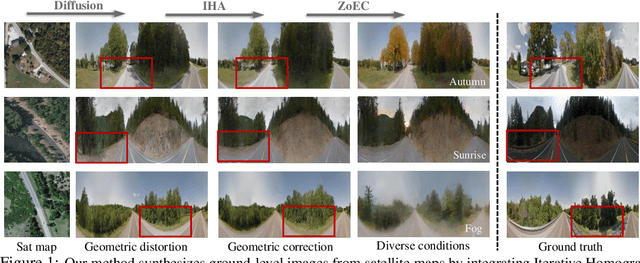
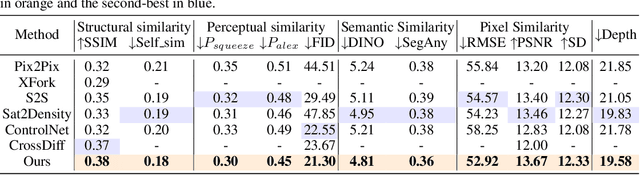
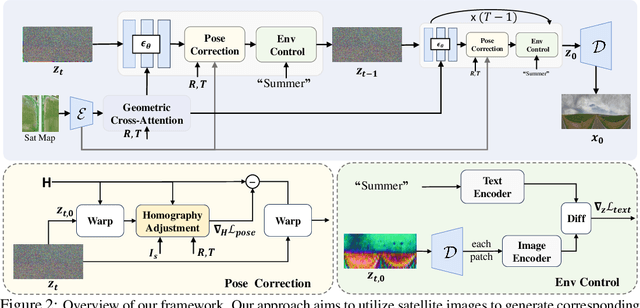
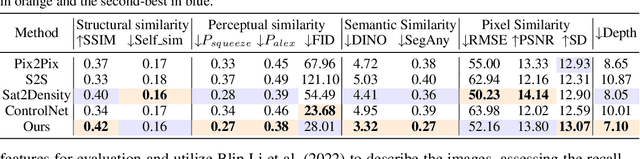
Generating street-view images from satellite imagery is a challenging task, particularly in maintaining accurate pose alignment and incorporating diverse environmental conditions. While diffusion models have shown promise in generative tasks, their ability to maintain strict pose alignment throughout the diffusion process is limited. In this paper, we propose a novel Iterative Homography Adjustment (IHA) scheme applied during the denoising process, which effectively addresses pose misalignment and ensures spatial consistency in the generated street-view images. Additionally, currently, available datasets for satellite-to-street-view generation are limited in their diversity of illumination and weather conditions, thereby restricting the generalizability of the generated outputs. To mitigate this, we introduce a text-guided illumination and weather-controlled sampling strategy that enables fine-grained control over the environmental factors. Extensive quantitative and qualitative evaluations demonstrate that our approach significantly improves pose accuracy and enhances the diversity and realism of generated street-view images, setting a new benchmark for satellite-to-street-view generation tasks.
CADSpotting: Robust Panoptic Symbol Spotting on Large-Scale CAD Drawings
Dec 10, 2024We introduce CADSpotting, an efficient method for panoptic symbol spotting in large-scale architectural CAD drawings. Existing approaches struggle with the diversity of symbols, scale variations, and overlapping elements in CAD designs. CADSpotting overcomes these challenges by representing each primitive with dense points instead of a single primitive point, described by essential attributes like coordinates and color. Building upon a unified 3D point cloud model for joint semantic, instance, and panoptic segmentation, CADSpotting learns robust feature representations. To enable accurate segmentation in large, complex drawings, we further propose a novel Sliding Window Aggregation (SWA) technique, combining weighted voting and Non-Maximum Suppression (NMS). Moreover, we introduce a large-scale CAD dataset named LS-CAD to support our experiments. Each floorplan in LS-CAD has an average coverage of 1,000 square meter(versus 100 square meter in the existing dataset), providing a valuable benchmark for symbol spotting research. Experimental results on FloorPlanCAD and LS-CAD datasets demonstrate that CADSpotting outperforms existing methods, showcasing its robustness and scalability for real-world CAD applications.
Geometry-guided Cross-view Diffusion for One-to-many Cross-view Image Synthesis
Dec 04, 2024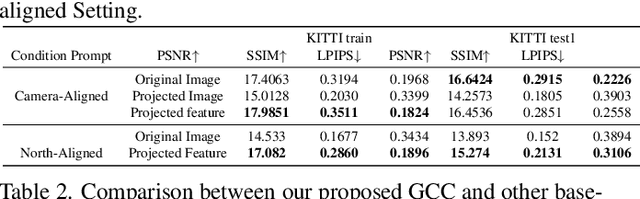
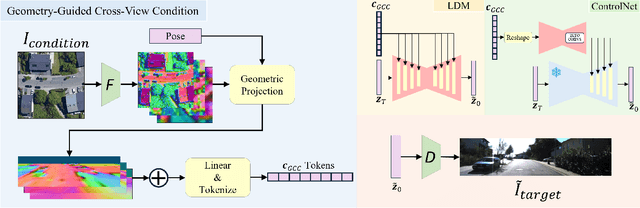
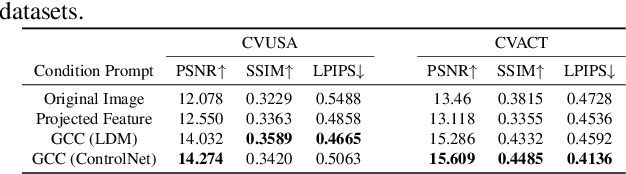
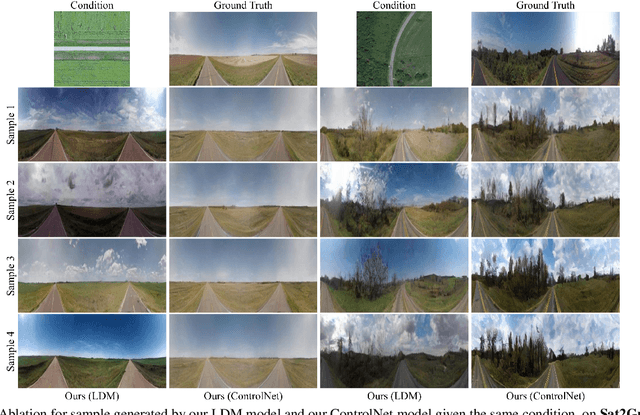
This paper presents a novel approach for cross-view synthesis aimed at generating plausible ground-level images from corresponding satellite imagery or vice versa. We refer to these tasks as satellite-to-ground (Sat2Grd) and ground-to-satellite (Grd2Sat) synthesis, respectively. Unlike previous works that typically focus on one-to-one generation, producing a single output image from a single input image, our approach acknowledges the inherent one-to-many nature of the problem. This recognition stems from the challenges posed by differences in illumination, weather conditions, and occlusions between the two views. To effectively model this uncertainty, we leverage recent advancements in diffusion models. Specifically, we exploit random Gaussian noise to represent the diverse possibilities learnt from the target view data. We introduce a Geometry-guided Cross-view Condition (GCC) strategy to establish explicit geometric correspondences between satellite and street-view features. This enables us to resolve the geometry ambiguity introduced by camera pose between image pairs, boosting the performance of cross-view image synthesis. Through extensive quantitative and qualitative analyses on three benchmark cross-view datasets, we demonstrate the superiority of our proposed geometry-guided cross-view condition over baseline methods, including recent state-of-the-art approaches in cross-view image synthesis. Our method generates images of higher quality, fidelity, and diversity than other state-of-the-art approaches.