 Add to Chrome
 Add to Firefox
 Add to Edge
ForeSplat: Optimization-Aware Foresight for Feed-Forward 3D Gaussian Splatting
May 21, 2026
Feed-forward 3D Gaussian Splatting (3DGS) models offer fast single-pass reconstruction,but scaling them to match per-scene optimization quality is fundamentally hindered by the scarcity of large-scale 3D annotations.A practical compromise is predict-then-refine,where post-prediction optimization compensates for the limited capacity of the feed-forward network.However,standard feed-forward 3DGS is trained solely for zero-step rendering error,ignoring whether its output constitutes a good initialization for the downstream optimizer.We present ForeSplat,an optimization-aware training framework that equips feed-forward 3DGS models to produce initializations explicitly designed for rapid,effective refinement.By offloading part of the scene-modeling burden to the optimizer,ForeSplat substantially reduces the capacity pressure on the feed-forward model,making high-quality reconstruction feasible even with compact networks.At its core is MetaGrad,a lightweight multi-anchor meta-gradient training rule that bypasses costly higher-order differentiation through the 3DGS optimizer.MetaGrad unrolls a short inner-loop refinement trajectory,samples anchor states,and back-propagates aggregated first-order gradients to the prediction head as a surrogate optimization-aware signal.This fine-tuning adds no inference cost and enables high-quality reconstruction within seconds after a few refinement steps.We instantiate ForeSplat on diverse backbones,including AnySplat,Pi3X,and a distilled variant tailored for edge deployment.Across all tested architectures,a ForeSplat-trained initialization converges in fewer refinement steps and reaches a higher peak reconstruction quality than its vanilla counterpart,even fully converged.The framework consistently bridges the gap between amortized prediction and per-scene optimization,establishing a practical path toward lightweight,high-fidelity 3D reconstruction.

NeighborDiv: Training-free Zero-shot Generalist Graph Anomaly Detection via Neighbor Diversity
May 20, 2026Graph Anomaly Detection (GAD) is increasingly shifting to Generalist GAD (GGAD) for cross-domain "one-for-all" detection, but existing GGAD methods predominantly rely on the neighbor consistency principle, falling into the \textbf{Node-to-Neighbor Consistency Paradigm} for anomaly quantification. These methods suffer from complex training pipelines, heavy training data dependency, high computational costs, and unstable cross-domain generalization. To address these limitations, we propose NeighborDiv, a training-free generalist graph anomaly detection framework based on neighbor diversity. Departing from the dominant Node-to-Neighbor Consistency Paradigm, we shift the focus to the \textbf{Neighbor-to-Neighbor Diversity Paradigm}, and uncover that the internal structural dispersion of a node's neighbor set is a powerful, independently discriminative anomaly signal. We quantify neighbor diversity via the variance of inter-neighbor feature similarities, which captures how a node organizes its local graph environment, and operates independently of conventional node-to-neighbor consistency frameworks. Extensive experiments under two standard GGAD evaluation paradigms show NeighborDiv achieves state-of-the-art performance, with relative gains of 10.25% in average AUC and 17.78% in average AP over the second-best baseline under Single-Domain Independent Training (SDIT), and 6.89%/9.58% in AUC/AP under Unified Multi-Domain Training (UMDT), respectively. Notably, NeighborDiv yields zero performance volatility across all datasets, eliminating training-set dependency and establishing a lightweight and highly practical GGAD framework.
From Generalist to Specialist Representation
May 12, 2026Given a generalist model, learning a task-relevant specialist representation is fundamental for downstream applications. Identifiability, the asymptotic guarantee of recovering the ground-truth representation, is critical because it sets the ultimate limit of any model, even with infinite data and computation. We study this problem in a completely nonparametric setting, without relying on interventions, parametric forms, or structural constraints. We first prove that the structure between time steps and tasks is identifiable in a fully unsupervised manner, even when sequences lack strict temporal dependence and may exhibit disconnections, and task assignments can follow arbitrarily complex and interleaving structures. We then prove that, within each time step, the task-relevant latent representation can be disentangled from the irrelevant part under a simple sparsity regularization, without any additional information or parametric constraints. Together, these results establish a hierarchical foundation: task structure is identifiable across time steps, and task-relevant latent representations are identifiable within each step. To our knowledge, each result provides a first general nonparametric identifiability guarantee, and together they mark a step toward provably moving from generalist to specialist models.
Joint Design of Doppler-Resilient Unimodular Discrete-Phase Waveforms and Receiving Filters for MIMO Radars
Apr 28, 2026Designing Doppler-resilient unimodular discrete phase-coded waveforms (DPWs) with low delay-Doppler sidelobes is critical for multiple-input multiple-output (MIMO) radar. Existing block coordinate descent (BCD) methods suffer from high computational cost for designing long sequences or large waveform sets. Meanwhile, learning-based alternatives such as the soft-quantization network (SQN) only address correlation optimization in the delay domain, without considering ambiguity function (AF) optimization in the joint delay-Doppler domain. To address these issues, this paper proposes a novel Doppler-resilient DPW design framework, termed SQNGD, for joint transmit-receive optimization that simultaneously optimizes the auto-AF, cross-AF (CAF), and signal-to-noise ratio loss (SNRL) under unimodular constraints. To solve the multi-objective optimization problem (MOOP), a joint transmit-receive design and an alternating optimization strategy are developed. The transmit waveforms are optimized via soft-quantization-based differentiable parameterization, while the receive filters are updated by gradient descent (GD) with an energy constraint and SNRL penalty. An FFT-accelerated evaluation of the AF and CAF is further incorporated, reducing the optimization time by 1.9x - 11x compared with the state-of-the-art (SOTA) majorization-minimization-coordinate descent (MMCD) method. Numerical results show that SQNGD achieves a peak sidelobe level (PSL) of approximately -43 dB over the Doppler range [-0.5,0.5] and -31 dB over [-600,600], respectively, outperforming MMCD by 5.85 dB and 3.45 dB, while maintaining the same SNRL of 0.5 dB.
DiffVC: A Non-autoregressive Framework Based on Diffusion Model for Video Captioning
Apr 09, 2026Current video captioning methods usually use an encoder-decoder structure to generate text autoregressively. However, autoregressive methods have inherent limitations such as slow generation speed and large cumulative error. Furthermore, the few non-autoregressive counterparts suffer from deficiencies in generation quality due to the lack of sufficient multimodal interaction modeling. Therefore, we propose a non-autoregressive framework based on Diffusion model for Video Captioning (DiffVC) to address these issues. Its parallel decoding can effectively solve the problems of generation speed and cumulative error. At the same time, our proposed discriminative conditional Diffusion Model can generate higher-quality textual descriptions. Specifically, we first encode the video into a visual representation. During training, Gaussian noise is added to the textual representation of the ground-truth caption. Then, a new textual representation is generated via the discriminative denoiser with the visual representation as a conditional constraint. Finally, we input the new textual representation into a non-autoregressive language model to generate captions. During inference, we directly sample noise from the Gaussian distribution for generation. Experiments on MSVD, MSR-VTT, and VATEX show that our method can outperform previous non-autoregressive methods and achieve comparable performance to autoregressive methods, e.g., it achieved a maximum improvement of 9.9 on the CIDEr and improvement of 2.6 on the B@4, while having faster generation speed. The source code will be available soon.
EPIR: An Efficient Patch Tokenization, Integration and Representation Framework for Micro-expression Recognition
Apr 09, 2026Micro-expression recognition can obtain the real emotion of the individual at the current moment. Although deep learning-based methods, especially Transformer-based methods, have achieved impressive results, these methods have high computational complexity due to the large number of tokens in the multi-head self-attention. In addition, the existing micro-expression datasets are small-scale, which makes it difficult for Transformer-based models to learn effective micro-expression representations. Therefore, we propose a novel Efficient Patch tokenization, Integration and Representation framework (EPIR), which can balance high recognition performance and low computational complexity. Specifically, we first propose a dual norm shifted tokenization (DNSPT) module to learn the spatial relationship between neighboring pixels in the face region, which is implemented by a refined spatial transformation and dual norm projection. Then, we propose a token integration module to integrate partial tokens among multiple cascaded Transformer blocks, thereby reducing the number of tokens without information loss. Furthermore, we design a discriminative token extractor, which first improves the attention in the Transformer block to reduce the unnecessary focus of the attention calculation on self-tokens, and uses the dynamic token selection module (DTSM) to select key tokens, thereby capturing more discriminative micro-expression representations. We conduct extensive experiments on four popular public datasets (i.e., CASME II, SAMM, SMIC, and CAS(ME)3. The experimental results show that our method achieves significant performance gains over the state-of-the-art methods, such as 9.6% improvement on the CAS(ME)$^3$ dataset in terms of UF1 and 4.58% improvement on the SMIC dataset in terms of UAR metric.
SARE: Sample-wise Adaptive Reasoning for Training-free Fine-grained Visual Recognition
Mar 18, 2026Recent advances in Large Vision-Language Models (LVLMs) have enabled training-free Fine-Grained Visual Recognition (FGVR). However, effectively exploiting LVLMs for FGVR remains challenging due to the inherent visual ambiguity of subordinate-level categories. Existing methods predominantly adopt either retrieval-oriented or reasoning-oriented paradigms to tackle this challenge, but both are constrained by two fundamental limitations:(1) They apply the same inference pipeline to all samples without accounting for uneven recognition difficulty, thereby leading to suboptimal accuracy and efficiency; (2) The lack of mechanisms to consolidate and reuse error-specific experience causes repeated failures on similar challenging cases. To address these limitations, we propose SARE, a Sample-wise Adaptive textbfREasoning framework for training-free FGVR. Specifically, SARE adopts a cascaded design that combines fast candidate retrieval with fine-grained reasoning, invoking the latter only when necessary. In the reasoning process, SARE incorporates a self-reflective experience mechanism that leverages past failures to provide transferable discriminative guidance during inference, without any parameter updates. Extensive experiments across 14 datasets substantiate that SARE achieves state-of-the-art performance while substantially reducing computational overhead.
SELECT: Detecting Label Errors in Real-world Scene Text Data
Dec 16, 2025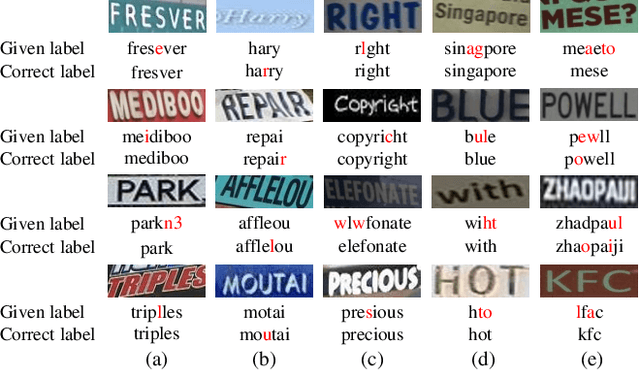
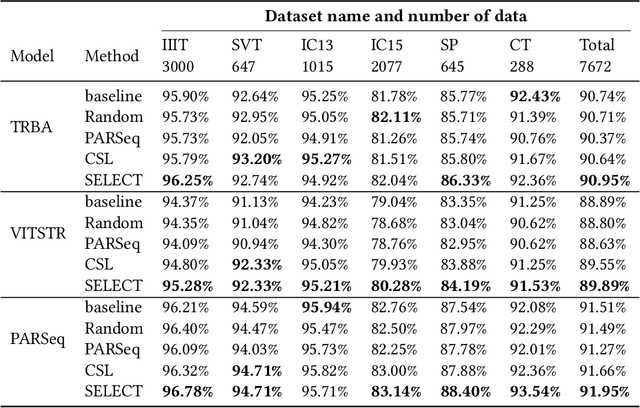
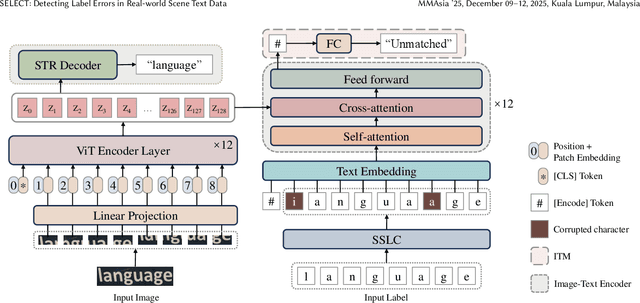
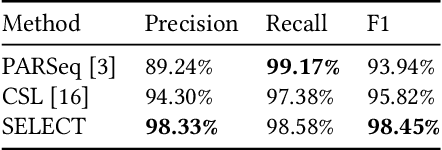
We introduce SELECT (Scene tExt Label Errors deteCTion), a novel approach that leverages multi-modal training to detect label errors in real-world scene text datasets. Utilizing an image-text encoder and a character-level tokenizer, SELECT addresses the issues of variable-length sequence labels, label sequence misalignment, and character-level errors, outperforming existing methods in accuracy and practical utility. In addition, we introduce Similarity-based Sequence Label Corruption (SSLC), a process that intentionally introduces errors into the training labels to mimic real-world error scenarios during training. SSLC not only can cause a change in the sequence length but also takes into account the visual similarity between characters during corruption. Our method is the first to detect label errors in real-world scene text datasets successfully accounting for variable-length labels. Experimental results demonstrate the effectiveness of SELECT in detecting label errors and improving STR accuracy on real-world text datasets, showcasing its practical utility.
XEmoRAG: Cross-Lingual Emotion Transfer with Controllable Intensity Using Retrieval-Augmented Generation
Aug 12, 2025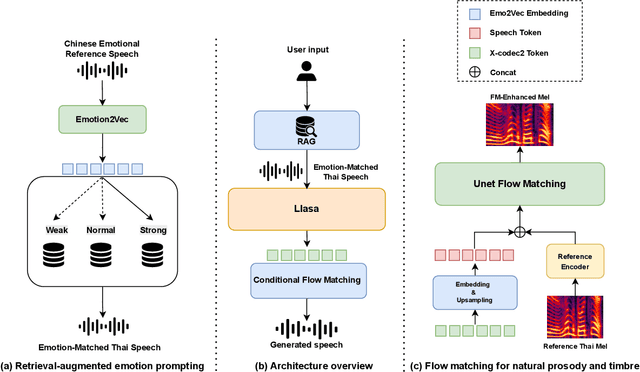
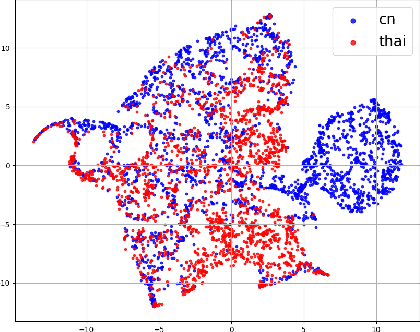
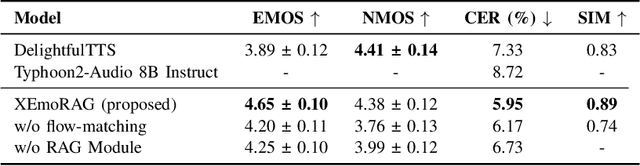
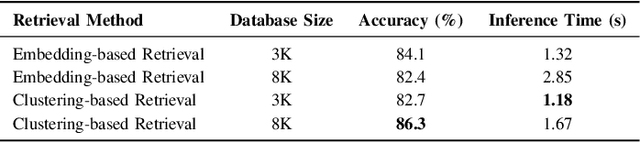
Zero-shot emotion transfer in cross-lingual speech synthesis refers to generating speech in a target language, where the emotion is expressed based on reference speech from a different source language. However, this task remains challenging due to the scarcity of parallel multilingual emotional corpora, the presence of foreign accent artifacts, and the difficulty of separating emotion from language-specific prosodic features. In this paper, we propose XEmoRAG, a novel framework to enable zero-shot emotion transfer from Chinese to Thai using a large language model (LLM)-based model, without relying on parallel emotional data. XEmoRAG extracts language-agnostic emotional embeddings from Chinese speech and retrieves emotionally matched Thai utterances from a curated emotional database, enabling controllable emotion transfer without explicit emotion labels. Additionally, a flow-matching alignment module minimizes pitch and duration mismatches, ensuring natural prosody. It also blends Chinese timbre into the Thai synthesis, enhancing rhythmic accuracy and emotional expression, while preserving speaker characteristics and emotional consistency. Experimental results show that XEmoRAG synthesizes expressive and natural Thai speech using only Chinese reference audio, without requiring explicit emotion labels. These results highlight XEmoRAG's capability to achieve flexible and low-resource emotional transfer across languages. Our demo is available at https://tlzuo-lesley.github.io/Demo-page/ .
CityGo: Lightweight Urban Modeling and Rendering with Proxy Buildings and Residual Gaussians
May 28, 2025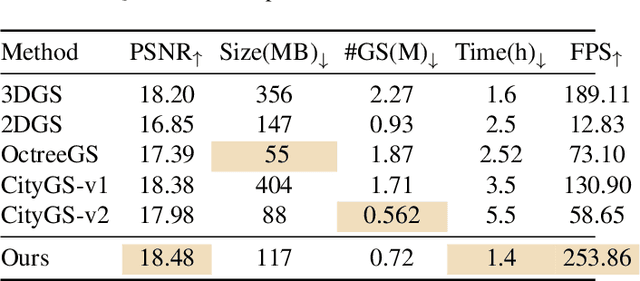
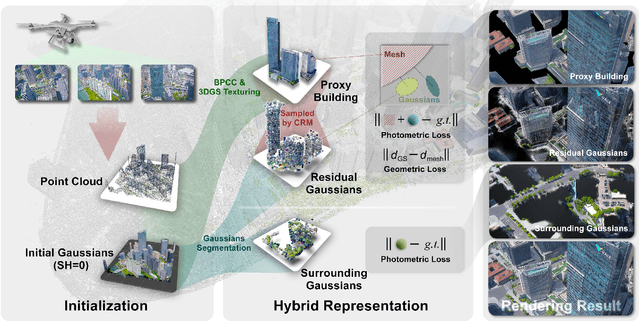

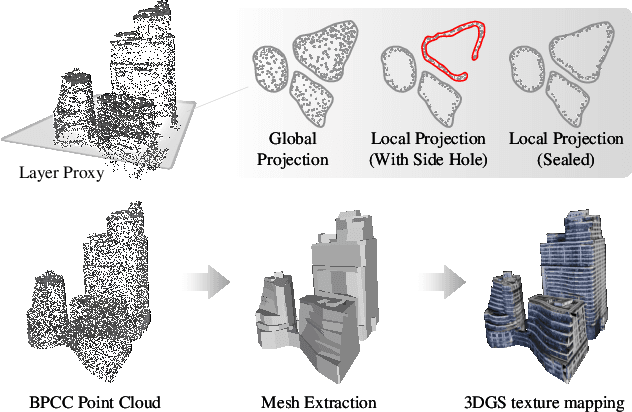
Accurate and efficient modeling of large-scale urban scenes is critical for applications such as AR navigation, UAV based inspection, and smart city digital twins. While aerial imagery offers broad coverage and complements limitations of ground-based data, reconstructing city-scale environments from such views remains challenging due to occlusions, incomplete geometry, and high memory demands. Recent advances like 3D Gaussian Splatting (3DGS) improve scalability and visual quality but remain limited by dense primitive usage, long training times, and poor suit ability for edge devices. We propose CityGo, a hybrid framework that combines textured proxy geometry with residual and surrounding 3D Gaussians for lightweight, photorealistic rendering of urban scenes from aerial perspectives. Our approach first extracts compact building proxy meshes from MVS point clouds, then uses zero order SH Gaussians to generate occlusion-free textures via image-based rendering and back-projection. To capture high-frequency details, we introduce residual Gaussians placed based on proxy-photo discrepancies and guided by depth priors. Broader urban context is represented by surrounding Gaussians, with importance-aware downsampling applied to non-critical regions to reduce redundancy. A tailored optimization strategy jointly refines proxy textures and Gaussian parameters, enabling real-time rendering of complex urban scenes on mobile GPUs with significantly reduced training and memory requirements. Extensive experiments on real-world aerial datasets demonstrate that our hybrid representation significantly reduces training time, achieving on average 1.4x speedup, while delivering comparable visual fidelity to pure 3D Gaussian Splatting approaches. Furthermore, CityGo enables real-time rendering of large-scale urban scenes on mobile consumer GPUs, with substantially reduced memory usage and energy consumption.