 Add to Chrome
 Add to Firefox
 Add to Edge
PanoVGGT: Feed-Forward 3D Reconstruction from Panoramic Imagery
Mar 18, 2026
Panoramic imagery offers a full 360° field of view and is increasingly common in consumer devices. However, it introduces non-pinhole distortions that challenge joint pose estimation and 3D reconstruction. Existing feed-forward models, built for perspective cameras, generalize poorly to this setting. We propose PanoVGGT, a permutation-equivariant Transformer framework that jointly predicts camera poses, depth maps, and 3D point clouds from one or multiple panoramas in a single forward pass. The model incorporates spherical-aware positional embeddings and a panorama-specific three-axis SO(3) rotation augmentation, enabling effective geometric reasoning in the spherical domain. To resolve inherent global-frame ambiguity, we further introduce a stochastic anchoring strategy during training. In addition, we contribute PanoCity, a large-scale outdoor panoramic dataset with dense depth and 6-DoF pose annotations. Extensive experiments on PanoCity and standard benchmarks demonstrate that PanoVGGT achieves competitive accuracy, strong robustness, and improved cross-domain generalization. Code and dataset will be released.

AerialGo: Walking-through City View Generation from Aerial Perspectives
Nov 29, 2024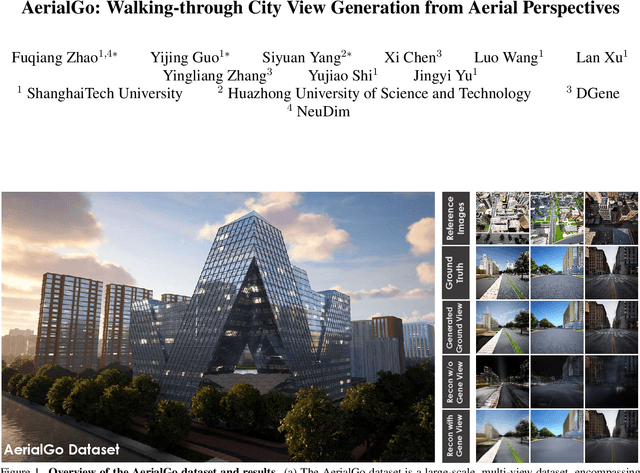


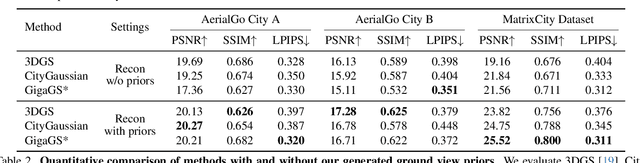
High-quality 3D urban reconstruction is essential for applications in urban planning, navigation, and AR/VR. However, capturing detailed ground-level data across cities is both labor-intensive and raises significant privacy concerns related to sensitive information, such as vehicle plates, faces, and other personal identifiers. To address these challenges, we propose AerialGo, a novel framework that generates realistic walking-through city views from aerial images, leveraging multi-view diffusion models to achieve scalable, photorealistic urban reconstructions without direct ground-level data collection. By conditioning ground-view synthesis on accessible aerial data, AerialGo bypasses the privacy risks inherent in ground-level imagery. To support the model training, we introduce AerialGo dataset, a large-scale dataset containing diverse aerial and ground-view images, paired with camera and depth information, designed to support generative urban reconstruction. Experiments show that AerialGo significantly enhances ground-level realism and structural coherence, providing a privacy-conscious, scalable solution for city-scale 3D modeling.