 Add to Chrome
 Add to Firefox
 Add to Edge
TrialBench: Multi-Modal Artificial Intelligence-Ready Clinical Trial Datasets
Jun 30, 2024


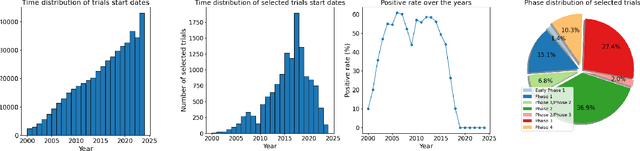

Clinical trials are pivotal for developing new medical treatments, yet they typically pose some risks such as patient mortality, adverse events, and enrollment failure that waste immense efforts spanning over a decade. Applying artificial intelligence (AI) to forecast or simulate key events in clinical trials holds great potential for providing insights to guide trial designs. However, complex data collection and question definition requiring medical expertise and a deep understanding of trial designs have hindered the involvement of AI thus far. This paper tackles these challenges by presenting a comprehensive suite of meticulously curated AIready datasets covering multi-modal data (e.g., drug molecule, disease code, text, categorical/numerical features) and 8 crucial prediction challenges in clinical trial design, encompassing prediction of trial duration, patient dropout rate, serious adverse event, mortality rate, trial approval outcome, trial failure reason, drug dose finding, design of eligibility criteria. Furthermore, we provide basic validation methods for each task to ensure the datasets' usability and reliability. We anticipate that the availability of such open-access datasets will catalyze the development of advanced AI approaches for clinical trial design, ultimately advancing clinical trial research and accelerating medical solution development. The curated dataset, metrics, and basic models are publicly available at https://github.com/ML2Health/ML2ClinicalTrials/tree/main/AI4Trial.

Fantastic Copyrighted Beasts and How (Not) to Generate Them
Jun 20, 2024Recent studies show that image and video generation models can be prompted to reproduce copyrighted content from their training data, raising serious legal concerns around copyright infringement. Copyrighted characters, in particular, pose a difficult challenge for image generation services, with at least one lawsuit already awarding damages based on the generation of these characters. Yet, little research has empirically examined this issue. We conduct a systematic evaluation to fill this gap. First, we build CopyCat, an evaluation suite consisting of diverse copyrighted characters and a novel evaluation pipeline. Our evaluation considers both the detection of similarity to copyrighted characters and generated image's consistency with user input. Our evaluation systematically shows that both image and video generation models can still generate characters even if characters' names are not explicitly mentioned in the prompt, sometimes with only two generic keywords (e.g., prompting with "videogame, plumber" consistently generates Nintendo's Mario character). We then introduce techniques to semi-automatically identify such keywords or descriptions that trigger character generation. Using our evaluation suite, we study runtime mitigation strategies, including both existing methods and new strategies we propose. Our findings reveal that commonly employed strategies, such as prompt rewriting in the DALL-E system, are not sufficient as standalone guardrails. These strategies must be coupled with other approaches, like negative prompting, to effectively reduce the unintended generation of copyrighted characters. Our work provides empirical grounding to the discussion of copyright mitigation strategies and offers actionable insights for model deployers actively implementing them.
DistillNeRF: Perceiving 3D Scenes from Single-Glance Images by Distilling Neural Fields and Foundation Model Features
Jun 17, 2024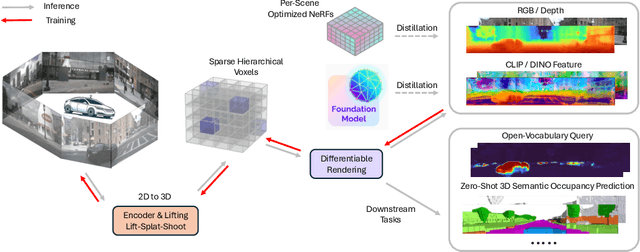
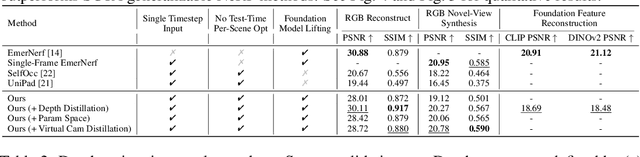
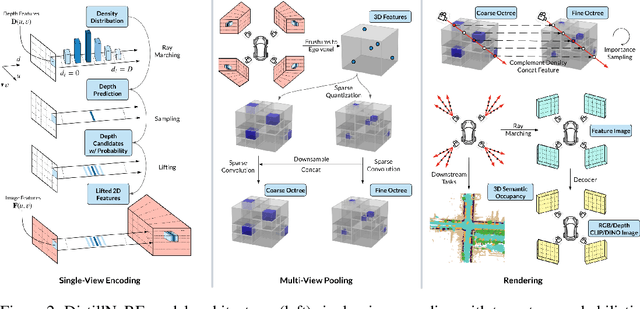
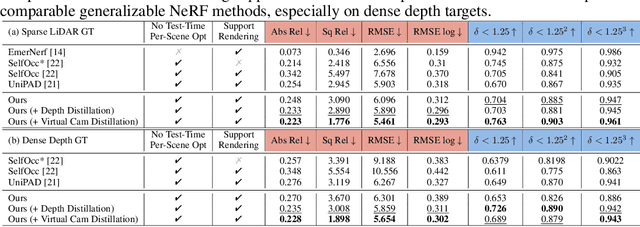
We propose DistillNeRF, a self-supervised learning framework addressing the challenge of understanding 3D environments from limited 2D observations in autonomous driving. Our method is a generalizable feedforward model that predicts a rich neural scene representation from sparse, single-frame multi-view camera inputs, and is trained self-supervised with differentiable rendering to reconstruct RGB, depth, or feature images. Our first insight is to exploit per-scene optimized Neural Radiance Fields (NeRFs) by generating dense depth and virtual camera targets for training, thereby helping our model to learn 3D geometry from sparse non-overlapping image inputs. Second, to learn a semantically rich 3D representation, we propose distilling features from pre-trained 2D foundation models, such as CLIP or DINOv2, thereby enabling various downstream tasks without the need for costly 3D human annotations. To leverage these two insights, we introduce a novel model architecture with a two-stage lift-splat-shoot encoder and a parameterized sparse hierarchical voxel representation. Experimental results on the NuScenes dataset demonstrate that DistillNeRF significantly outperforms existing comparable self-supervised methods for scene reconstruction, novel view synthesis, and depth estimation; and it allows for competitive zero-shot 3D semantic occupancy prediction, as well as open-world scene understanding through distilled foundation model features. Demos and code will be available at https://distillnerf.github.io/.
An effective software risk prediction management analysis of data using machine learning and data mining method
Jun 13, 2024For one to guarantee higher-quality software development processes, risk management is essential. Furthermore, risks are those that could negatively impact an organization's operations or a project's progress. The appropriate prioritisation of software project risks is a crucial factor in ascertaining the software project's performance features and eventual success. They can be used harmoniously with the same training samples and have good complement and compatibility. We carried out in-depth tests on four benchmark datasets to confirm the efficacy of our CIA approach in closed-world and open-world scenarios, with and without defence. We also present a sequential augmentation parameter optimisation technique that captures the interdependencies of the latest deep learning state-of-the-art WF attack models. To achieve precise software risk assessment, the enhanced crow search algorithm (ECSA) is used to modify the ANFIS settings. Solutions that very slightly alter the local optimum and stay inside it are extracted using the ECSA. ANFIS variable when utilising the ANFIS technique. An experimental validation with NASA 93 dataset and 93 software project values was performed. This method's output presents a clear image of the software risk elements that are essential to achieving project performance. The results of our experiments show that, when compared to other current methods, our integrative fuzzy techniques may perform more accurately and effectively in the evaluation of software project risks.
A Superalignment Framework in Autonomous Driving with Large Language Models
Jun 09, 2024Over the last year, significant advancements have been made in the realms of large language models (LLMs) and multi-modal large language models (MLLMs), particularly in their application to autonomous driving. These models have showcased remarkable abilities in processing and interacting with complex information. In autonomous driving, LLMs and MLLMs are extensively used, requiring access to sensitive vehicle data such as precise locations, images, and road conditions. These data are transmitted to an LLM-based inference cloud for advanced analysis. However, concerns arise regarding data security, as the protection against data and privacy breaches primarily depends on the LLM's inherent security measures, without additional scrutiny or evaluation of the LLM's inference outputs. Despite its importance, the security aspect of LLMs in autonomous driving remains underexplored. Addressing this gap, our research introduces a novel security framework for autonomous vehicles, utilizing a multi-agent LLM approach. This framework is designed to safeguard sensitive information associated with autonomous vehicles from potential leaks, while also ensuring that LLM outputs adhere to driving regulations and align with human values. It includes mechanisms to filter out irrelevant queries and verify the safety and reliability of LLM outputs. Utilizing this framework, we evaluated the security, privacy, and cost aspects of eleven large language model-driven autonomous driving cues. Additionally, we performed QA tests on these driving prompts, which successfully demonstrated the framework's efficacy.
Mmm whatcha say? Uncovering distal and proximal context effects in first and second-language word perception using psychophysical reverse correlation
Jun 08, 2024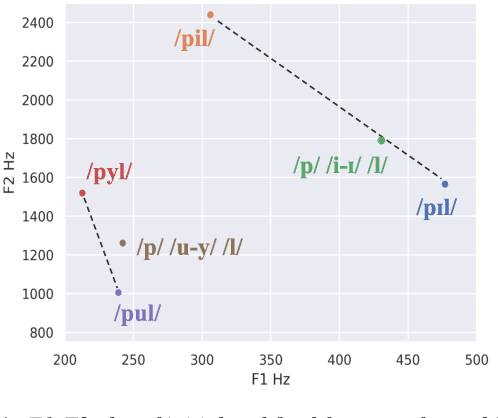
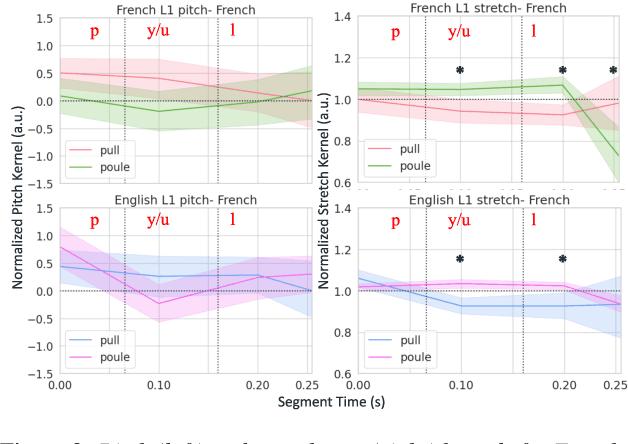
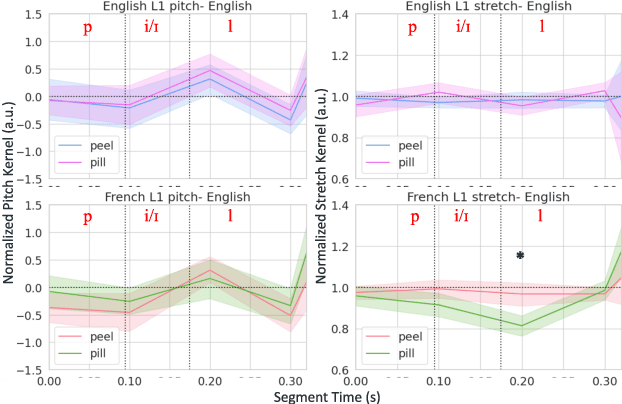
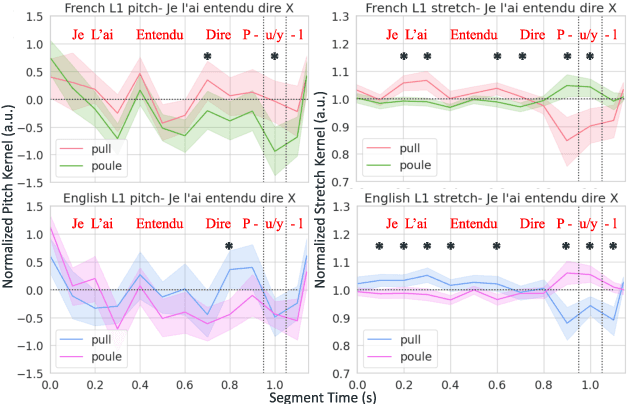
Acoustic context effects, where surrounding changes in pitch, rate or timbre influence the perception of a sound, are well documented in speech perception, but how they interact with language background remains unclear. Using a reverse-correlation approach, we systematically varied the pitch and speech rate in phrases around different pairs of vowels for second language (L2) speakers of English (/i/-/I/) and French (/u/-/y/), thus reconstructing, in a data-driven manner, the prosodic profiles that bias their perception. Testing English and French speakers (n=25), we showed that vowel perception is in fact influenced by conflicting effects from the surrounding pitch and speech rate: a congruent proximal effect 0.2s pre-target and a distal contrastive effect up to 1s before; and found that L1 and L2 speakers exhibited strikingly similar prosodic profiles in perception. We provide a novel method to investigate acoustic context effects across stimuli, timescales, and acoustic domain.
A novel robust meta-analysis model using the $t$ distribution for outlier accommodation and detection
Jun 06, 2024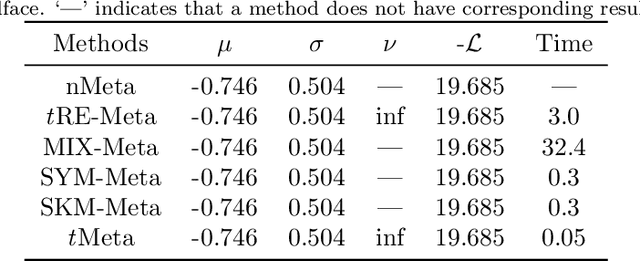


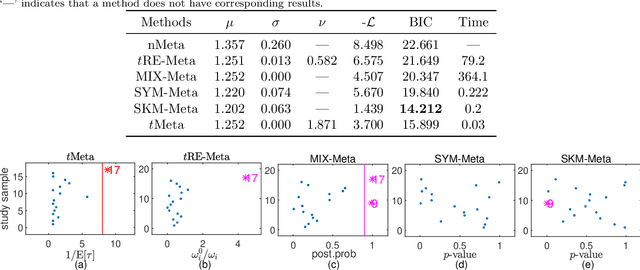
Random effects meta-analysis model is an important tool for integrating results from multiple independent studies. However, the standard model is based on the assumption of normal distributions for both random effects and within-study errors, making it susceptible to outlying studies. Although robust modeling using the $t$ distribution is an appealing idea, the existing work, that explores the use of the $t$ distribution only for random effects, involves complicated numerical integration and numerical optimization. In this paper, a novel robust meta-analysis model using the $t$ distribution is proposed ($t$Meta). The novelty is that the marginal distribution of the effect size in $t$Meta follows the $t$ distribution, enabling that $t$Meta can simultaneously accommodate and detect outlying studies in a simple and adaptive manner. A simple and fast EM-type algorithm is developed for maximum likelihood estimation. Due to the mathematical tractability of the $t$ distribution, $t$Meta frees from numerical integration and allows for efficient optimization. Experiments on real data demonstrate that $t$Meta is compared favorably with related competitors in situations involving mild outliers. Moreover, in the presence of gross outliers, while related competitors may fail, $t$Meta continues to perform consistently and robustly.
Why is "Problems" Predictive of Positive Sentiment? A Case Study of Explaining Unintuitive Features in Sentiment Classification
Jun 05, 2024Explainable AI (XAI) algorithms aim to help users understand how a machine learning model makes predictions. To this end, many approaches explain which input features are most predictive of a target label. However, such explanations can still be puzzling to users (e.g., in product reviews, the word "problems" is predictive of positive sentiment). If left unexplained, puzzling explanations can have negative impacts. Explaining unintuitive associations between an input feature and a target label is an underexplored area in XAI research. We take an initial effort in this direction using unintuitive associations learned by sentiment classifiers as a case study. We propose approaches for (1) automatically detecting associations that can appear unintuitive to users and (2) generating explanations to help users understand why an unintuitive feature is predictive. Results from a crowdsourced study (N=300) found that our proposed approaches can effectively detect and explain predictive but unintuitive features in sentiment classification.
M3DM-NR: RGB-3D Noisy-Resistant Industrial Anomaly Detection via Multimodal Denoising
Jun 04, 2024Existing industrial anomaly detection methods primarily concentrate on unsupervised learning with pristine RGB images. Yet, both RGB and 3D data are crucial for anomaly detection, and the datasets are seldom completely clean in practical scenarios. To address above challenges, this paper initially delves into the RGB-3D multi-modal noisy anomaly detection, proposing a novel noise-resistant M3DM-NR framework to leveraging strong multi-modal discriminative capabilities of CLIP. M3DM-NR consists of three stages: Stage-I introduces the Suspected References Selection module to filter a few normal samples from the training dataset, using the multimodal features extracted by the Initial Feature Extraction, and a Suspected Anomaly Map Computation module to generate a suspected anomaly map to focus on abnormal regions as reference. Stage-II uses the suspected anomaly maps of the reference samples as reference, and inputs image, point cloud, and text information to achieve denoising of the training samples through intra-modal comparison and multi-scale aggregation operations. Finally, Stage-III proposes the Point Feature Alignment, Unsupervised Feature Fusion, Noise Discriminative Coreset Selection, and Decision Layer Fusion modules to learn the pattern of the training dataset, enabling anomaly detection and segmentation while filtering out noise. Extensive experiments show that M3DM-NR outperforms state-of-the-art methods in 3D-RGB multi-modal noisy anomaly detection.
Non-Asymptotic Analysis for Single-Loop Actor-Critic with Compatible Function Approximation
Jun 03, 2024Actor-critic (AC) is a powerful method for learning an optimal policy in reinforcement learning, where the critic uses algorithms, e.g., temporal difference (TD) learning with function approximation, to evaluate the current policy and the actor updates the policy along an approximate gradient direction using information from the critic. This paper provides the \textit{tightest} non-asymptotic convergence bounds for both the AC and natural AC (NAC) algorithms. Specifically, existing studies show that AC converges to an $\epsilon+\varepsilon_{\text{critic}}$ neighborhood of stationary points with the best known sample complexity of $\mathcal{O}(\epsilon^{-2})$ (up to a log factor), and NAC converges to an $\epsilon+\varepsilon_{\text{critic}}+\sqrt{\varepsilon_{\text{actor}}}$ neighborhood of the global optimum with the best known sample complexity of $\mathcal{O}(\epsilon^{-3})$, where $\varepsilon_{\text{critic}}$ is the approximation error of the critic and $\varepsilon_{\text{actor}}$ is the approximation error induced by the insufficient expressive power of the parameterized policy class. This paper analyzes the convergence of both AC and NAC algorithms with compatible function approximation. Our analysis eliminates the term $\varepsilon_{\text{critic}}$ from the error bounds while still achieving the best known sample complexities. Moreover, we focus on the challenging single-loop setting with a single Markovian sample trajectory. Our major technical novelty lies in analyzing the stochastic bias due to policy-dependent and time-varying compatible function approximation in the critic, and handling the non-ergodicity of the MDP due to the single Markovian sample trajectory. Numerical results are also provided in the appendix.