 Add to Chrome
 Add to Firefox
 Add to Edge
Coupled Graph--Policy Distillation for Personalized Medication Safety in Older Adults with Multimorbidity
Aug 10, 2026
Large language model (LLM) agents can support medication review between clinical visits, but safe choices for older adults with multimorbidity depend on conditions, medications, and geriatric risks that users may omit. We introduce ATLAS, a coupled graph--policy distillation framework for patient-adaptive medication safety. ATLAS structures guideline evidence as a medication-safety graph. Targeted questions update the patient state and distill relevant relations into a patient-specific medication conflict graph (PMCG). A risk-first multi-agent policy uses the PMCG to screen contraindications, assess cautions and monitoring needs, identify safer alternatives, and verify the final medication plan. We also introduce GeriMedBench, an interactive benchmark that tests safety-critical information acquisition and evidence-based decision revision. Across a European non-interactive multimorbidity benchmark, an Asian interactive multimorbidity benchmark, and an Asian non-interactive cross-guideline benchmark, ATLAS achieves the strongest complete-decision performance among the compared systems. On the European non-interactive multimorbidity benchmark, it exceeds the strongest proprietary LLM baseline by 53.73 points in Strict Success Rate and 14.63 points in overall safety reasoning score (OSRS), with no unsafe recommendations under the automated evaluator. A blinded clinician evaluation gives ATLAS higher mean ratings across all five criteria and flags potentially unsafe recommendations in one ATLAS case and two Gemini cases.

MIND: Multimodal Intent-Driven Network via Diffusion Transformers for Medical Image Fusion
Jul 30, 2026Medical image fusion aims to integrate complementary information from diverse imaging modalities to support clinical diagnosis. Existing methods typically apply uniform fusion rules globally, lacking a deep understanding of diagnostic intents and pathological structures. To address these limitations, we propose MIND, a Multimodal Intent-Driven Network via Diffusion Transformers (DiTs) for medical image fusion. Specifically, we utilize BioMedGPT to generate intent-driven fusion texts from source images, guiding the fusion process with pathology-aware diagnostic intents. To combat the loss of 2D spatial continuity caused by 1D sequence flattening in DiTs, we design a Multi-scale Latent Adapter. This module explicitly extracts source image features before serialization, injecting them into the network via strict dimensional alignment to effectively supplement image features. To resolve the semantic shift caused by decoupling image outputs from diagnostic intents, we design a medical semantic consistency loss. This loss ensures deep semantic locking between fused images and fusion texts while maintaining the stability of the underlying physical manifold reconstruction. Comprehensive experiments on the Harvard, BraTS, and GFP datasets reveal that MIND delivers superior fusion quality, significantly improves downstream brain tumor segmentation accuracy, and enables flexible interactive fusion, holding significant promise for intent-driven intelligent clinical decision support systems.
LongMedBench: Benchmarking Medical Agents for Long-Horizon Clinical Decision-Making
Jul 13, 2026In this work, we introduce LongMedBench, a real-world EHR-based benchmark for long-horizon clinical decision-making. Prior evaluations of LLM-based medical agents have largely emphasized short-context knowledge QA and tool use. However, real-world medical care is inherently longitudinal, and clinicians must aggregate evidence across repeated visits, tests, and evolving treatments. Therefore, long-horizon interaction is essential for realistic assessment. LongMedBench is constructed via a reproducible pipeline that integrates MIMIC-IV admission records and clinical notes into time-series event streams and long-context memory datasets, enabling long-horizon, multi-session interactions between agents and a clinical environment. It comprises 335 patients, with 19.72 inpatient visits per patient on average and 44.91 medical events per visit. Guided by the long-horizon decision process, we propose an evaluation taxonomy with three suites: fact-based QA, temporal reasoning, and long-horizon decision-making. This taxonomy measures how agents understand and leverage historical patient information over extended horizons. Our experiments show that while recent LLMs can make good use of explicit timestamps, they have challenges in implicit time inference; The RAG and agent memory system can improve the performance of information retrieval tasks, but the performance of decision-making tasks is highly dependent on the model's immediate context.
Geometric Gradient Rectification for Safe Open-Set Semi-Supervised Learning
Jun 25, 2026Open-set semi-supervised learning aims to leverage unlabeled data that may contain out-of-distribution outliers while maintaining performance on in-distribution classes. Existing methods mainly follow two paradigms: filtering suspicious samples or incorporating unlabeled objectives with soft weighting. We argue that both face a common trade-off: aggressive filtering can discard informative but hard ID samples, whereas utilization can introduce auxiliary gradients that conflict with supervised learning when pseudo labels are wrong. We therefore shift the focus from sample selection to gradient-level control. We propose \textit{Geometric Gradient Rectification} (GGR), a plug-in framework that uses the supervised gradient as an anchor and projects conflicting auxiliary gradients onto an admissible region in gradient space. This makes the applied auxiliary update first-order non-opposing within the rectified coordinate block while preserving orthogonal components that may still carry useful representation signals. We further extend GGR with subspace-aware rectification to stabilize the anchor under noisy mini-batch gradients. Experiments on CIFAR and ImageNet benchmarks show that GGR improves representative OSSL baselines in most settings and yields gains in both closed-set generalization and open-set robustness. Code will be available at https://github.com/JiaheChen2002/GGR.
Learning What Matters: Dynamic Dimension Selection and Aggregation for Interpretable Vision-Language Reward Modeling
Apr 07, 2026Vision-language reward modeling faces a dilemma: generative approaches are interpretable but slow, while discriminative ones are efficient but act as opaque "black boxes." To bridge this gap, we propose VL-MDR (Vision-Language Multi-Dimensional Reward), a framework that dynamically decomposes evaluation into granular, interpretable dimensions. Instead of outputting a monolithic scalar, VL-MDR employs a visual-aware gating mechanism to identify relevant dimensions and adaptively weight them (e.g., Hallucination, Reasoning) for each specific input. To support this, we curate a dataset of 321k vision-language preference pairs annotated across 21 fine-grained dimensions. Extensive experiments show that VL-MDR consistently outperforms existing open-source reward models on benchmarks like VL-RewardBench. Furthermore, we show that VL-MDR-constructed preference pairs effectively enable DPO alignment to mitigate visual hallucinations and improve reliability, providing a scalable solution for VLM alignment.
Med-Scout: Curing MLLMs' Geometric Blindness in Medical Perception via Geometry-Aware RL Post-Training
Jan 30, 2026Despite recent Multimodal Large Language Models (MLLMs)' linguistic prowess in medical diagnosis, we find even state-of-the-art MLLMs suffer from a critical perceptual deficit: geometric blindness. This failure to ground outputs in objective geometric constraints leads to plausible yet factually incorrect hallucinations, rooted in training paradigms that prioritize linguistic fluency over geometric fidelity. This paper introduces Med-Scout, a novel framework that "cures" this blindness via Reinforcement Learning (RL) that leverages the intrinsic geometric logic latent within unlabeled medical images. Instead of relying on costly expert annotations, Med-Scout derives verifiable supervision signals through three strategic proxy tasks: Hierarchical Scale Localization, Topological Jigsaw Reconstruction, and Anomaly Consistency Detection. To rigorously quantify this deficit, we present Med-Scout-Bench, a new benchmark specifically designed to evaluate geometric perception. Extensive evaluations show that Med-Scout significantly mitigates geometric blindness, outperforming leading proprietary and open-source MLLMs by over 40% on our benchmark. Furthermore, this enhanced geometric perception generalizes to broader medical understanding, achieving superior results on radiological and comprehensive medical VQA tasks.
ALEX:A Light Editing-knowledge Extractor
Nov 18, 2025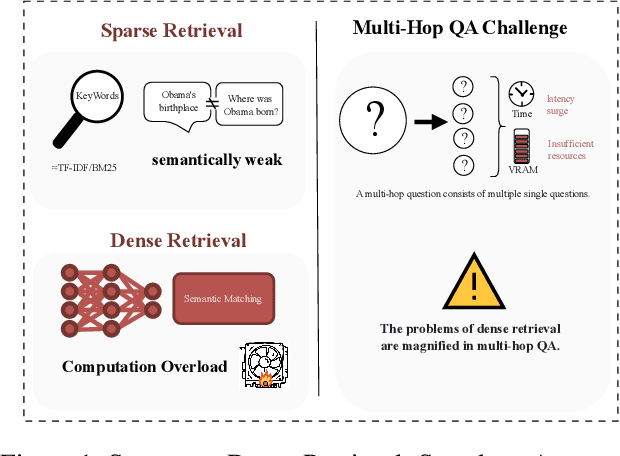
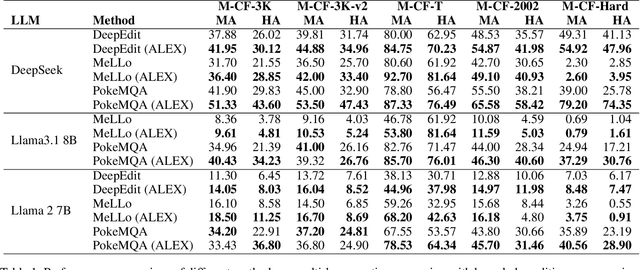
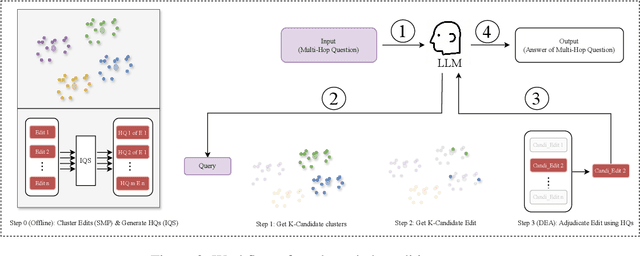
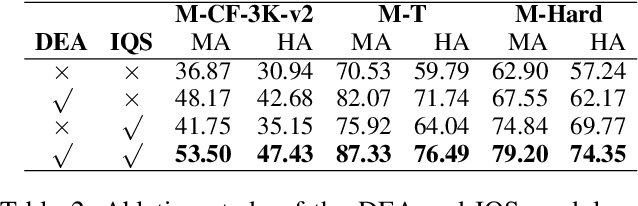
The static nature of knowledge within Large Language Models (LLMs) makes it difficult for them to adapt to evolving information, rendering knowledge editing a critical task. However, existing methods struggle with challenges of scalability and retrieval efficiency, particularly when handling complex, multi-hop questions that require multi-step reasoning. To address these challenges, this paper introduces ALEX (A Light Editing-knowledge Extractor), a lightweight knowledge editing framework. The core innovation of ALEX is its hierarchical memory architecture, which organizes knowledge updates (edits) into semantic clusters. This design fundamentally reduces retrieval complexity from a linear O(N) to a highly scalable O(K+N/C). Furthermore, the framework integrates an Inferential Query Synthesis (IQS) module to bridge the semantic gap between queries and facts , and a Dynamic Evidence Adjudication (DEA) engine that executes an efficient two-stage retrieval process. Experiments on the MQUAKE benchmark demonstrate that ALEX significantly improves both the accuracy of multi-hop answers (MultiHop-ACC) and the reliability of reasoning paths (HopWise-ACC). It also reduces the required search space by over 80% , presenting a promising path toward building scalable, efficient, and accurate knowledge editing systems.
WDT-MD: Wavelet Diffusion Transformers for Microaneurysm Detection in Fundus Images
Nov 16, 2025Microaneurysms (MAs), the earliest pathognomonic signs of Diabetic Retinopathy (DR), present as sub-60 $μm$ lesions in fundus images with highly variable photometric and morphological characteristics, rendering manual screening not only labor-intensive but inherently error-prone. While diffusion-based anomaly detection has emerged as a promising approach for automated MA screening, its clinical application is hindered by three fundamental limitations. First, these models often fall prey to "identity mapping", where they inadvertently replicate the input image. Second, they struggle to distinguish MAs from other anomalies, leading to high false positives. Third, their suboptimal reconstruction of normal features hampers overall performance. To address these challenges, we propose a Wavelet Diffusion Transformer framework for MA Detection (WDT-MD), which features three key innovations: a noise-encoded image conditioning mechanism to avoid "identity mapping" by perturbing image conditions during training; pseudo-normal pattern synthesis via inpainting to introduce pixel-level supervision, enabling discrimination between MAs and other anomalies; and a wavelet diffusion Transformer architecture that combines the global modeling capability of diffusion Transformers with multi-scale wavelet analysis to enhance reconstruction of normal retinal features. Comprehensive experiments on the IDRiD and e-ophtha MA datasets demonstrate that WDT-MD outperforms state-of-the-art methods in both pixel-level and image-level MA detection. This advancement holds significant promise for improving early DR screening.
Mitigating Hallucination of Large Vision-Language Models via Dynamic Logits Calibration
Jun 26, 2025Large Vision-Language Models (LVLMs) have demonstrated significant advancements in multimodal understanding, yet they are frequently hampered by hallucination-the generation of text that contradicts visual input. Existing training-free decoding strategies exhibit critical limitations, including the use of static constraints that do not adapt to semantic drift during generation, inefficiency stemming from the need for multiple forward passes, and degradation of detail due to overly rigid intervention rules. To overcome these challenges, this paper introduces Dynamic Logits Calibration (DLC), a novel training-free decoding framework designed to dynamically align text generation with visual evidence at inference time. At the decoding phase, DLC step-wise employs CLIP to assess the semantic alignment between the input image and the generated text sequence. Then, the Relative Visual Advantage (RVA) of candidate tokens is evaluated against a dynamically updated contextual baseline, adaptively adjusting output logits to favor tokens that are visually grounded. Furthermore, an adaptive weighting mechanism, informed by a real-time context alignment score, carefully balances the visual guidance while ensuring the overall quality of the textual output. Extensive experiments conducted across diverse benchmarks and various LVLM architectures (such as LLaVA, InstructBLIP, and MiniGPT-4) demonstrate that DLC significantly reduces hallucinations, outperforming current methods while maintaining high inference efficiency by avoiding multiple forward passes. Overall, we present an effective and efficient decoding-time solution to mitigate hallucinations, thereby enhancing the reliability of LVLMs for more practices. Code will be released on Github.
Med-U1: Incentivizing Unified Medical Reasoning in LLMs via Large-scale Reinforcement Learning
Jun 14, 2025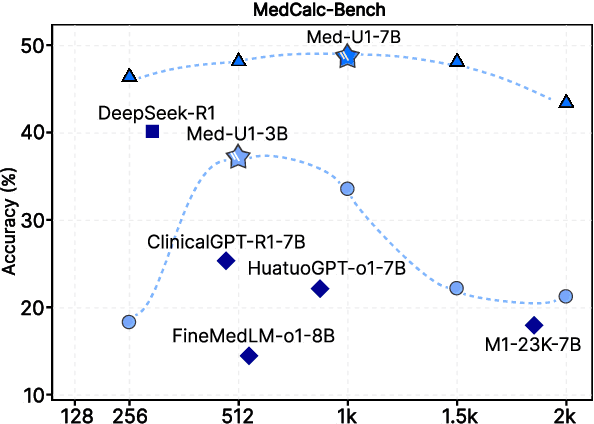
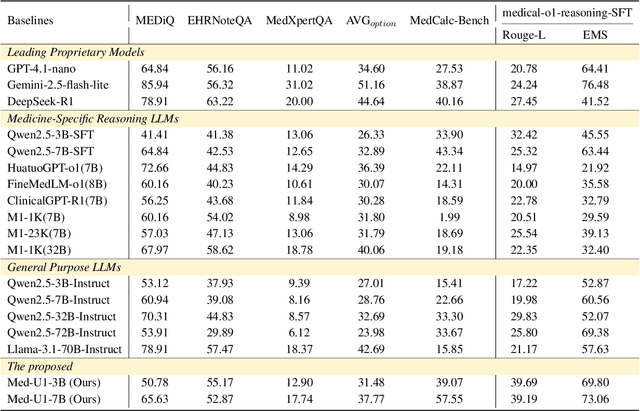
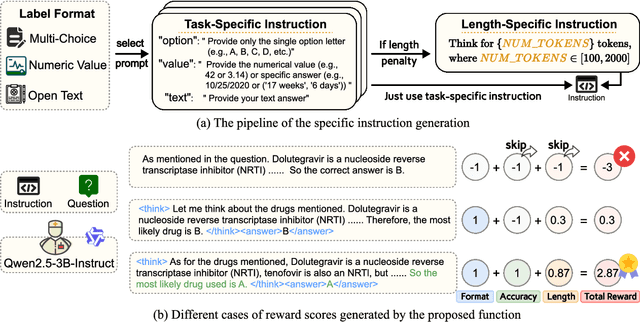
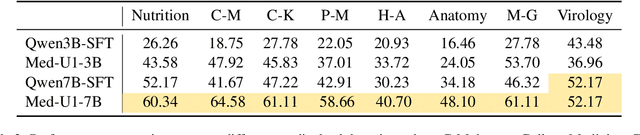
Medical Question-Answering (QA) encompasses a broad spectrum of tasks, including multiple choice questions (MCQ), open-ended text generation, and complex computational reasoning. Despite this variety, a unified framework for delivering high-quality medical QA has yet to emerge. Although recent progress in reasoning-augmented large language models (LLMs) has shown promise, their ability to achieve comprehensive medical understanding is still largely unexplored. In this paper, we present Med-U1, a unified framework for robust reasoning across medical QA tasks with diverse output formats, ranging from MCQs to complex generation and computation tasks. Med-U1 employs pure large-scale reinforcement learning with mixed rule-based binary reward functions, incorporating a length penalty to manage output verbosity. With multi-objective reward optimization, Med-U1 directs LLMs to produce concise and verifiable reasoning chains. Empirical results reveal that Med-U1 significantly improves performance across multiple challenging Med-QA benchmarks, surpassing even larger specialized and proprietary models. Furthermore, Med-U1 demonstrates robust generalization to out-of-distribution (OOD) tasks. Extensive analysis presents insights into training strategies, reasoning chain length control, and reward design for medical LLMs. The code will be released.