 Add to Chrome
 Add to Firefox
 Add to Edge
Covertly improving intelligibility with data-driven adaptations of speech timing
Mar 31, 2026
Human talkers often address listeners with language-comprehension challenges, such as hard-of-hearing or non-native adults, by globally slowing down their speech. However, it remains unclear whether this strategy actually makes speech more intelligible. Here, we take advantage of recent advancements in machine-generated speech allowing more precise control of speech rate in order to systematically examine how targeted speech-rate adjustments may improve comprehension. We first use reverse-correlation experiments to show that the temporal influence of speech rate prior to a target vowel contrast (ex. the tense-lax distinction) in fact manifests in a scissor-like pattern, with opposite effects in early versus late context windows; this pattern is remarkably stable both within individuals and across native L1-English listeners and L2-English listeners with French, Mandarin, and Japanese L1s. Second, we show that this speech rate structure not only facilitates L2 listeners' comprehension of the target vowel contrast, but that native listeners also rely on this pattern in challenging acoustic conditions. Finally, we build a data-driven text-to-speech algorithm that replicates this temporal structure on novel speech sequences. Across a variety of sentences and vowel contrasts, listeners remained unaware that such targeted slowing improved word comprehension. Strikingly, participants instead judged the common strategy of global slowing as clearer, even though it actually increased comprehension errors. Together, these results show that targeted adjustments to speech rate significantly aid intelligibility under challenging conditions, while often going unnoticed. More generally, this paper provides a data-driven methodology to improve the accessibility of machine-generated speech which can be extended to other aspects of speech comprehension and a wide variety of listeners and environments.

Mmm whatcha say? Uncovering distal and proximal context effects in first and second-language word perception using psychophysical reverse correlation
Jun 08, 2024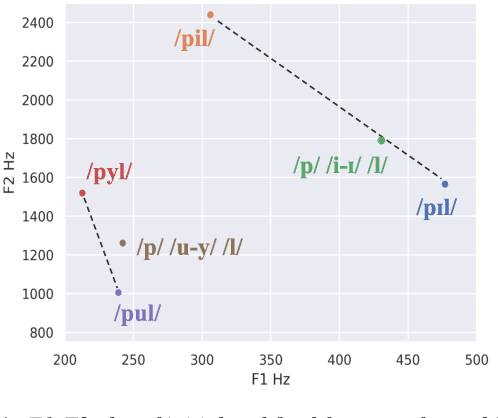
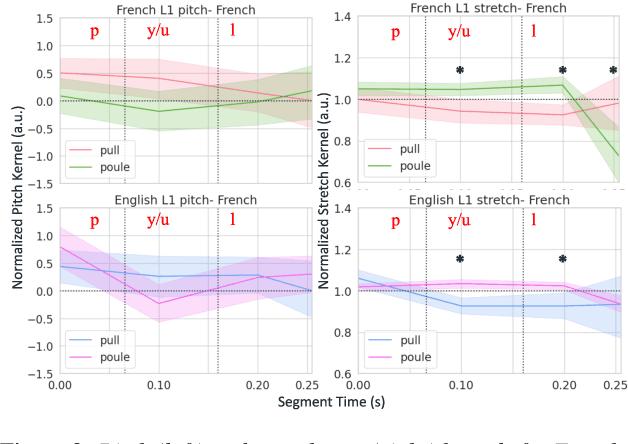
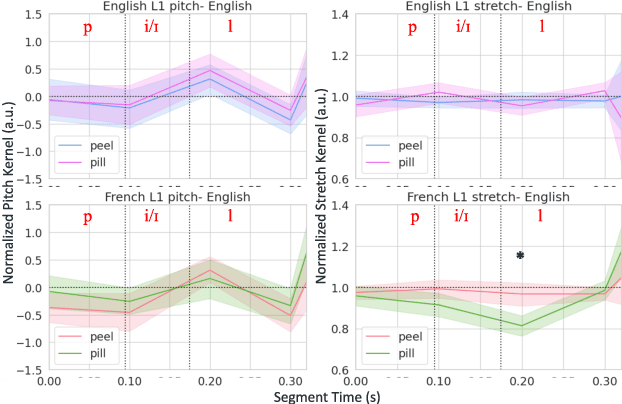
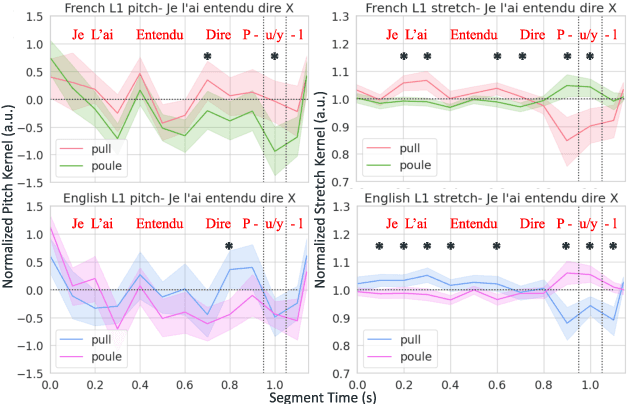
Acoustic context effects, where surrounding changes in pitch, rate or timbre influence the perception of a sound, are well documented in speech perception, but how they interact with language background remains unclear. Using a reverse-correlation approach, we systematically varied the pitch and speech rate in phrases around different pairs of vowels for second language (L2) speakers of English (/i/-/I/) and French (/u/-/y/), thus reconstructing, in a data-driven manner, the prosodic profiles that bias their perception. Testing English and French speakers (n=25), we showed that vowel perception is in fact influenced by conflicting effects from the surrounding pitch and speech rate: a congruent proximal effect 0.2s pre-target and a distal contrastive effect up to 1s before; and found that L1 and L2 speakers exhibited strikingly similar prosodic profiles in perception. We provide a novel method to investigate acoustic context effects across stimuli, timescales, and acoustic domain.