 Add to Chrome
 Add to Firefox
 Add to Edge
Multimodal Policies with Physics-informed Representations
Oct 20, 2024
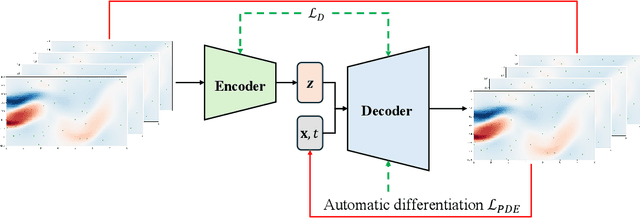
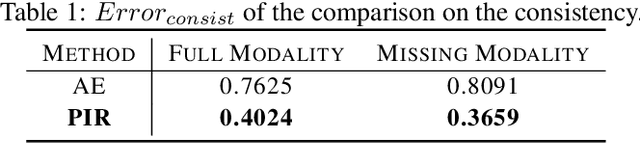
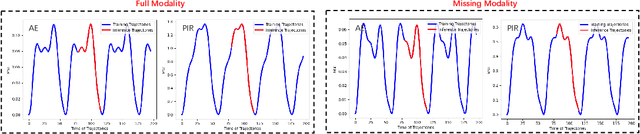
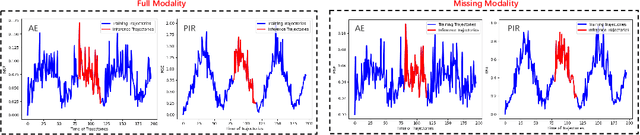
In the control problems of the PDE systems, observation is important to make the decision. However, the observation is generally sparse and missing in practice due to the limitation and fault of sensors. The above challenges cause observations with uncertain quantities and modalities. Therefore, how to leverage the uncertain observations as the states in control problems of the PDE systems has become a scientific problem. The dynamics of PDE systems rely on the initial conditions, boundary conditions, and PDE formula. Given the above three elements, PINNs can be used to solve the PDE systems. In this work, we discover that the neural network can also be used to identify and represent the PDE systems using PDE loss and sparse data loss. Inspired by the above discovery, we propose a Physics-Informed Representation (PIR) algorithm for multimodal policies in PDE systems' control. It leverages PDE loss to fit the neural network and data loss calculated on the observations with random quantities and modalities to propagate the information of initial conditions and boundary conditions into the inputs. The inputs can be the learnable parameters or the output of the encoders. Then, under the environments of the PDE systems, such inputs are the representation of the current state. In our experiments, the PIR illustrates the superior consistency with the features of the ground truth compared with baselines, even when there are missing modalities. Furthermore, PIR has been successfully applied in the downstream control tasks where the robot leverages the learned state by PIR faster and more accurately, passing through the complex vortex street from a random starting location to reach a random target.

HumanEval-V: Evaluating Visual Understanding and Reasoning Abilities of Large Multimodal Models Through Coding Tasks
Oct 16, 2024


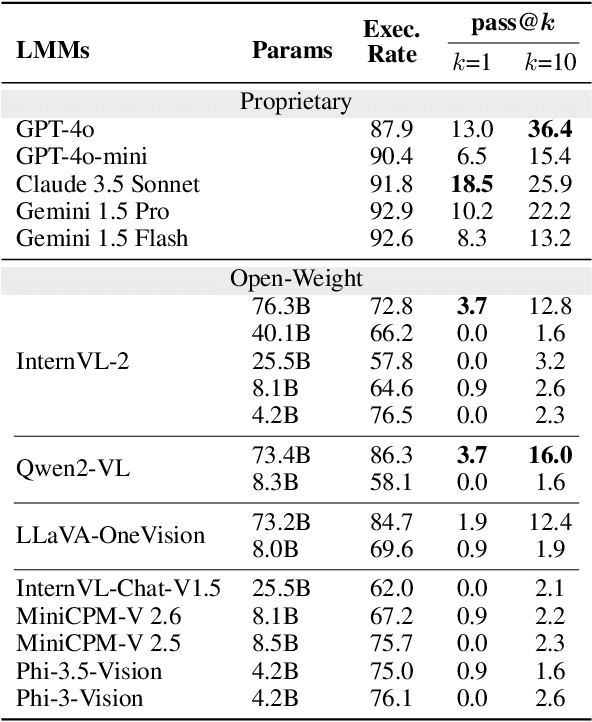
Coding tasks have been valuable for evaluating Large Language Models (LLMs), as they demand the comprehension of high-level instructions, complex reasoning, and the implementation of functional programs -- core capabilities for advancing Artificial General Intelligence. Despite the progress in Large Multimodal Models (LMMs), which extend LLMs with visual perception and understanding capabilities, there remains a notable lack of coding benchmarks that rigorously assess these models, particularly in tasks that emphasize visual reasoning. To address this gap, we introduce HumanEval-V, a novel and lightweight benchmark specifically designed to evaluate LMMs' visual understanding and reasoning capabilities through code generation. HumanEval-V includes 108 carefully crafted, entry-level Python coding tasks derived from platforms like CodeForces and Stack Overflow. Each task is adapted by modifying the context and algorithmic patterns of the original problems, with visual elements redrawn to ensure distinction from the source, preventing potential data leakage. LMMs are required to complete the code solution based on the provided visual context and a predefined Python function signature outlining the task requirements. Every task is equipped with meticulously handcrafted test cases to ensure a thorough and reliable evaluation of model-generated solutions. We evaluate 19 state-of-the-art LMMs using HumanEval-V, uncovering significant challenges. Proprietary models like GPT-4o achieve only 13% pass@1 and 36.4% pass@10, while open-weight models with 70B parameters score below 4% pass@1. Ablation studies further reveal the limitations of current LMMs in vision reasoning and coding capabilities. These results underscore key areas for future research to enhance LMMs' capabilities. We have open-sourced our code and benchmark at https://github.com/HumanEval-V/HumanEval-V-Benchmark.
LoGS: Visual Localization via Gaussian Splatting with Fewer Training Images
Oct 15, 2024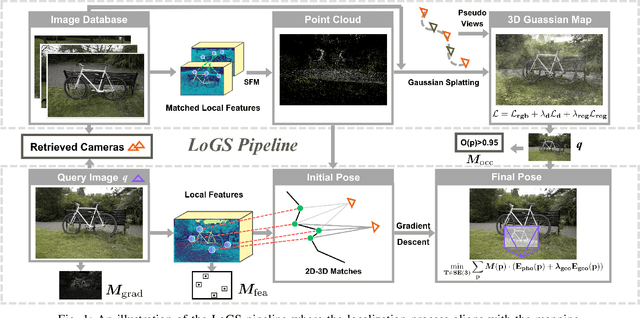
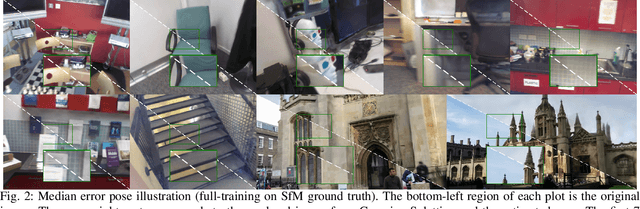
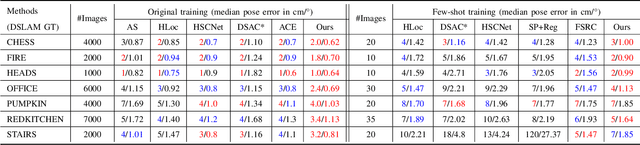
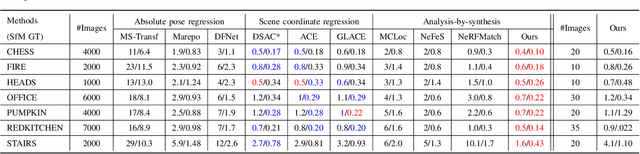
Visual localization involves estimating a query image's 6-DoF (degrees of freedom) camera pose, which is a fundamental component in various computer vision and robotic tasks. This paper presents LoGS, a vision-based localization pipeline utilizing the 3D Gaussian Splatting (GS) technique as scene representation. This novel representation allows high-quality novel view synthesis. During the mapping phase, structure-from-motion (SfM) is applied first, followed by the generation of a GS map. During localization, the initial position is obtained through image retrieval, local feature matching coupled with a PnP solver, and then a high-precision pose is achieved through the analysis-by-synthesis manner on the GS map. Experimental results on four large-scale datasets demonstrate the proposed approach's SoTA accuracy in estimating camera poses and robustness under challenging few-shot conditions.
Aria: An Open Multimodal Native Mixture-of-Experts Model
Oct 08, 2024


Information comes in diverse modalities. Multimodal native AI models are essential to integrate real-world information and deliver comprehensive understanding. While proprietary multimodal native models exist, their lack of openness imposes obstacles for adoptions, let alone adaptations. To fill this gap, we introduce Aria, an open multimodal native model with best-in-class performance across a wide range of multimodal, language, and coding tasks. Aria is a mixture-of-expert model with 3.9B and 3.5B activated parameters per visual token and text token, respectively. It outperforms Pixtral-12B and Llama3.2-11B, and is competitive against the best proprietary models on various multimodal tasks. We pre-train Aria from scratch following a 4-stage pipeline, which progressively equips the model with strong capabilities in language understanding, multimodal understanding, long context window, and instruction following. We open-source the model weights along with a codebase that facilitates easy adoptions and adaptations of Aria in real-world applications.
Scene Flow as a Partial Differential Equation
Oct 02, 2024
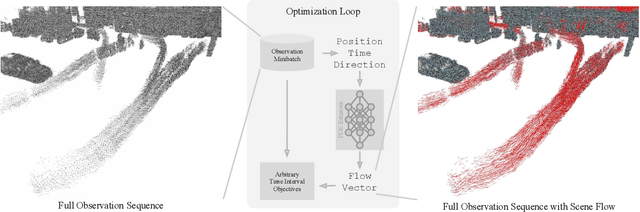


We reframe scene flow as the problem of estimating a continuous space and time PDE that describes motion for an entire observation sequence, represented with a neural prior. Our resulting unsupervised method, EulerFlow, produces high quality scene flow on real-world data across multiple domains, including large-scale autonomous driving scenes and dynamic tabletop settings. Notably, EulerFlow produces high quality flow on small, fast moving objects like birds and tennis balls, and exhibits emergent 3D point tracking behavior by solving its estimated PDE over long time horizons. On the Argoverse 2 2024 Scene Flow Challenge, EulerFlow outperforms all prior art, beating the next best unsupervised method by over 2.5x and the next best supervised method by over 10%.
HR-Extreme: A High-Resolution Dataset for Extreme Weather Forecasting
Sep 27, 2024

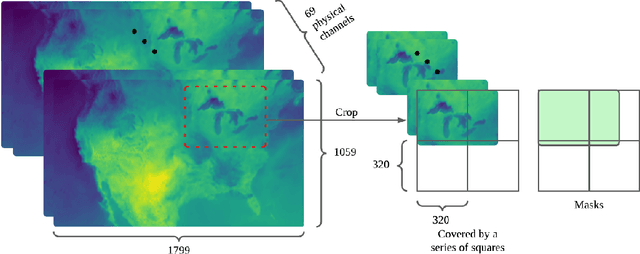

The application of large deep learning models in weather forecasting has led to significant advancements in the field, including higher-resolution forecasting and extended prediction periods exemplified by models such as Pangu and Fuxi. Despite these successes, previous research has largely been characterized by the neglect of extreme weather events, and the availability of datasets specifically curated for such events remains limited. Given the critical importance of accurately forecasting extreme weather, this study introduces a comprehensive dataset that incorporates high-resolution extreme weather cases derived from the High-Resolution Rapid Refresh (HRRR) data, a 3-km real-time dataset provided by NOAA. We also evaluate the current state-of-the-art deep learning models and Numerical Weather Prediction (NWP) systems on HR-Extreme, and provide a improved baseline deep learning model called HR-Heim which has superior performance on both general loss and HR-Extreme compared to others. Our results reveal that the errors of extreme weather cases are significantly larger than overall forecast error, highlighting them as an crucial source of loss in weather prediction. These findings underscore the necessity for future research to focus on improving the accuracy of extreme weather forecasts to enhance their practical utility.
LiLoc: Lifelong Localization using Adaptive Submap Joining and Egocentric Factor Graph
Sep 16, 2024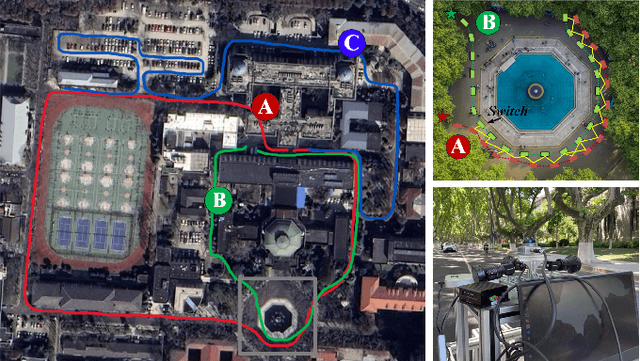
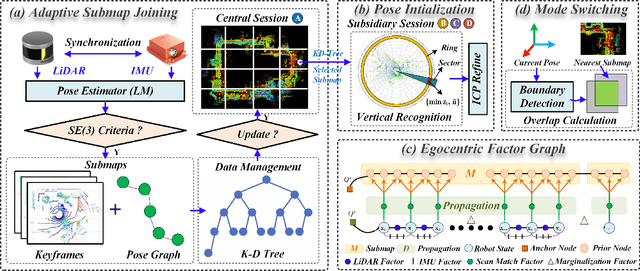

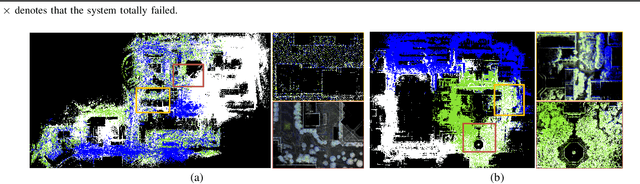
This paper proposes a versatile graph-based lifelong localization framework, LiLoc, which enhances its timeliness by maintaining a single central session while improves the accuracy through multi-modal factors between the central and subsidiary sessions. First, an adaptive submap joining strategy is employed to generate prior submaps (keyframes and poses) for the central session, and to provide priors for subsidiaries when constraints are needed for robust localization. Next, a coarse-to-fine pose initialization for subsidiary sessions is performed using vertical recognition and ICP refinement in the global coordinate frame. To elevate the accuracy of subsequent localization, we propose an egocentric factor graph (EFG) module that integrates the IMU preintegration, LiDAR odometry and scan match factors in a joint optimization manner. Specifically, the scan match factors are constructed by a novel propagation model that efficiently distributes the prior constrains as edges to the relevant prior pose nodes, weighted by noises based on keyframe registration errors. Additionally, the framework supports flexible switching between two modes: relocalization (RLM) and incremental localization (ILM) based on the proposed overlap-based mechanism to select or update the prior submaps from central session. The proposed LiLoc is tested on public and custom datasets, demonstrating accurate localization performance against state-of-the-art methods. Our codes will be publicly available on https://github.com/Yixin-F/LiLoc.
Safety Verification and Navigation for Autonomous Vehicles based on Signal Temporal Logic Constraints
Sep 16, 2024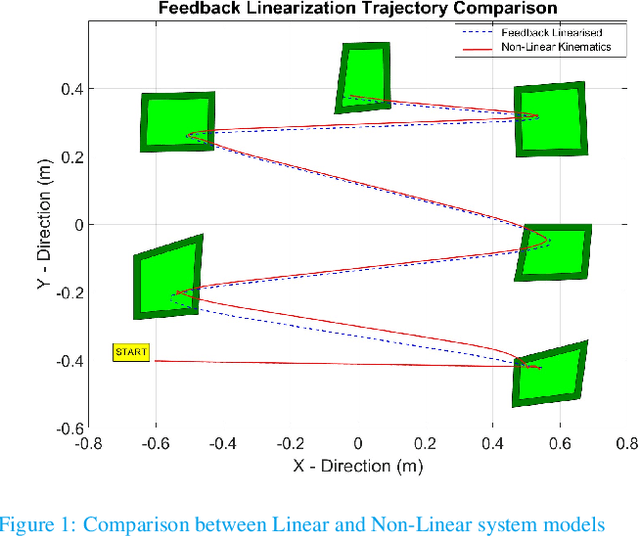
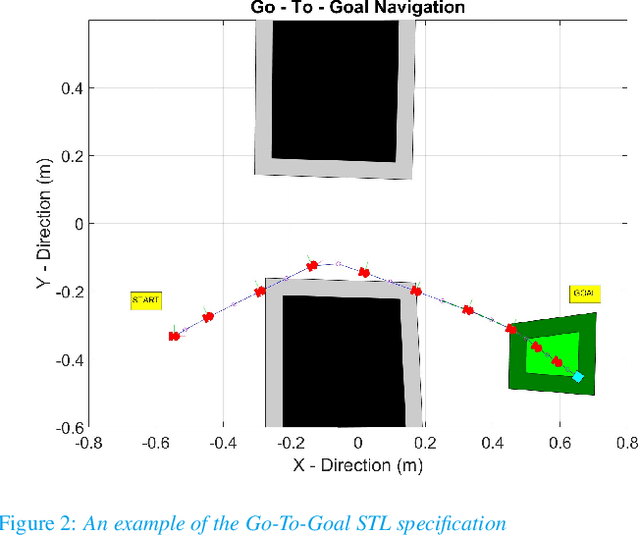
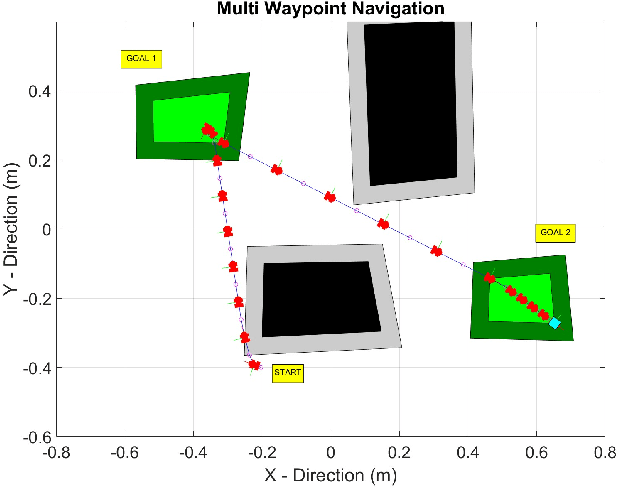
The software architecture behind modern autonomous vehicles (AV) is becoming more complex steadily. Safety verification is now an imminent task prior to the large-scale deployment of such convoluted models. For safety-critical tasks in navigation, it becomes imperative to perform a verification procedure on the trajectories proposed by the planning algorithm prior to deployment. Signal Temporal Logic (STL) constraints can dictate the safety requirements for an AV. A combination of STL constraints is called a specification. A key difference between STL and other logic constraints is that STL allows us to work on continuous signals. We verify the satisfaction of the STL specifications by calculating the robustness value for each signal within the specification. Higher robustness values indicate a safer system. Model Predictive Control (MPC) is one of the most widely used methods to control the navigation of an AV, with an underlying set of state and input constraints. Our research aims to formulate and test an MPC controller, with STL specifications as constraints, that can safely navigate an AV. The primary goal of the cost function is to minimize the control inputs. STL constraints will act as an additional layer of constraints that would change based on the scenario and task on hand. We propose using sTaliro, a MATLAB-based robustness calculator for STL specifications, formulated in a receding horizon control fashion for an AV navigation task. It inputs a simplified AV state space model and a set of STL specifications, for which it constructs a closed-loop controller. We test out our controller for different test cases/scenarios and verify the safe navigation of our AV model.
RING#: PR-by-PE Global Localization with Roto-translation Equivariant Gram Learning
Aug 30, 2024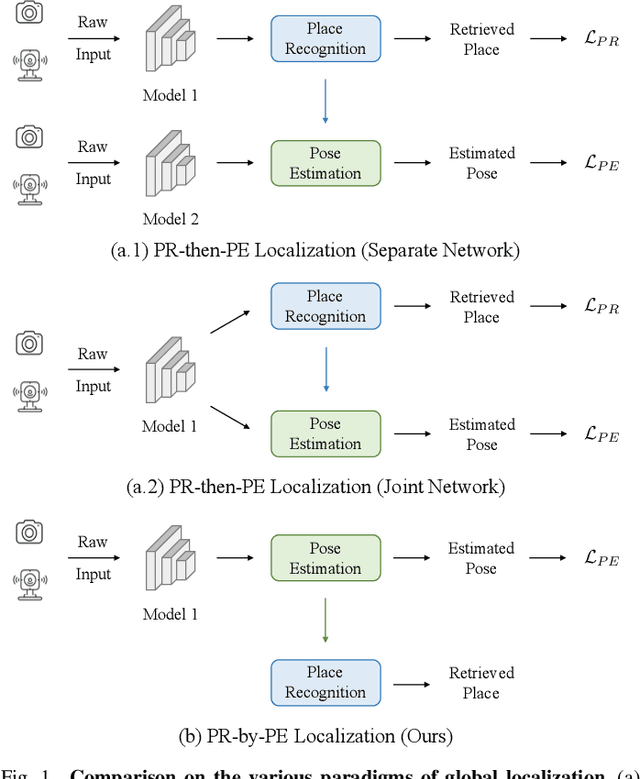

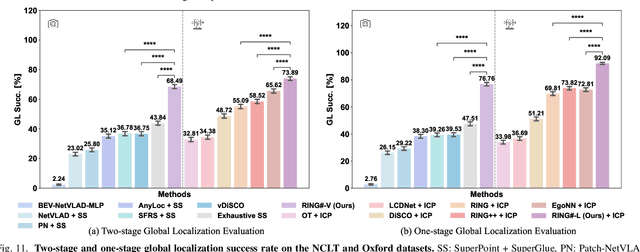

Global localization using onboard perception sensors, such as cameras and LiDARs, is crucial in autonomous driving and robotics applications when GPS signals are unreliable. Most approaches achieve global localization by sequential place recognition and pose estimation. Some of them train separate models for each task, while others employ a single model with dual heads, trained jointly with separate task-specific losses. However, the accuracy of localization heavily depends on the success of place recognition, which often fails in scenarios with significant changes in viewpoint or environmental appearance. Consequently, this renders the final pose estimation of localization ineffective. To address this, we propose a novel paradigm, PR-by-PE localization, which improves global localization accuracy by deriving place recognition directly from pose estimation. Our framework, RING#, is an end-to-end PR-by-PE localization network operating in the bird's-eye view (BEV) space, designed to support both vision and LiDAR sensors. It introduces a theoretical foundation for learning two equivariant representations from BEV features, which enables globally convergent and computationally efficient pose estimation. Comprehensive experiments on the NCLT and Oxford datasets across both vision and LiDAR modalities demonstrate that our method outperforms state-of-the-art approaches. Furthermore, we provide extensive analyses to confirm the effectiveness of our method. The code will be publicly released.
OmniRe: Omni Urban Scene Reconstruction
Aug 29, 2024We introduce OmniRe, a holistic approach for efficiently reconstructing high-fidelity dynamic urban scenes from on-device logs. Recent methods for modeling driving sequences using neural radiance fields or Gaussian Splatting have demonstrated the potential of reconstructing challenging dynamic scenes, but often overlook pedestrians and other non-vehicle dynamic actors, hindering a complete pipeline for dynamic urban scene reconstruction. To that end, we propose a comprehensive 3DGS framework for driving scenes, named OmniRe, that allows for accurate, full-length reconstruction of diverse dynamic objects in a driving log. OmniRe builds dynamic neural scene graphs based on Gaussian representations and constructs multiple local canonical spaces that model various dynamic actors, including vehicles, pedestrians, and cyclists, among many others. This capability is unmatched by existing methods. OmniRe allows us to holistically reconstruct different objects present in the scene, subsequently enabling the simulation of reconstructed scenarios with all actors participating in real-time (~60Hz). Extensive evaluations on the Waymo dataset show that our approach outperforms prior state-of-the-art methods quantitatively and qualitatively by a large margin. We believe our work fills a critical gap in driving reconstruction.