 Add to Chrome
 Add to Firefox
 Add to Edge
MLP Splatting: Object-Centric Neural Fields
Jun 02, 2026
3D representations are fundamental to scene rendering, understanding, and interaction. Recent approaches, such as 3D Gaussian Splatting and Neural Radiance Fields, achieve impressive photorealistic novel-view synthesis, but lack the ability to easily decompose scene elements into a few primitives, requiring additional segmentation or grouping for object-level manipulation. We present MLP-Splatting, a method that enables scene decomposition via a few expressive light-field primitives while providing photorealistic novel-view synthesis. MLP-Splatting models each primitive as an independent compact MLP with localized spatial support that predicts radiance and opacity. In contrast to low-level Gaussian primitives or a single global radiance field, our neural primitives provide greater expressive capacity while remaining spatially localized. Rendering is performed through efficient sparse volumetric compositing over ray-primitive interactions. Our primitives are supervised using RGB supervision alone, which yields primitives that represent local scene regions often corresponding to objects or object parts, enabling interactive object-level editing without segmentation masks by selecting a handful of primitives. Our method, augmented with optional semantic feature distillation, enables open-vocabulary scene interaction and open-set instant segmentation. Compared to state-of-the-art methods, we achieve substantially lower memory usage (1/15$\times$) and faster rendering (3$\times$), as we show in our experiments compared to semantic 3DGS methods. Project Page: https://shinjeongkim.com/mlp-splatting

LoGS: Visual Localization via Gaussian Splatting with Fewer Training Images
Oct 15, 2024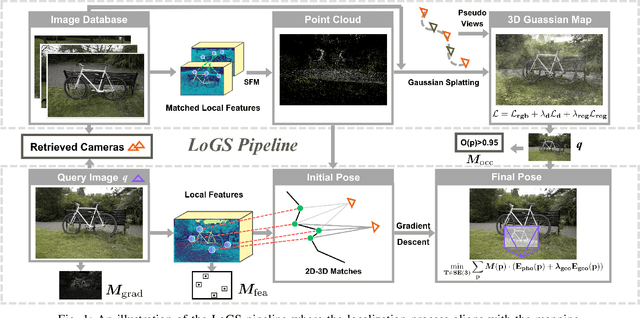
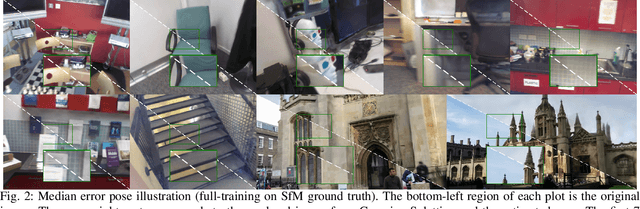
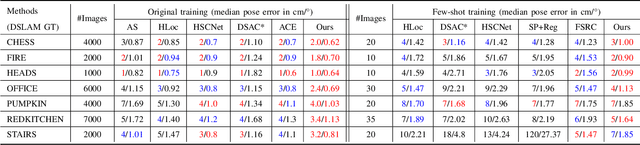
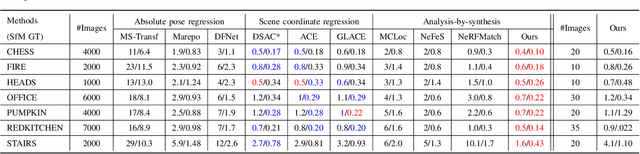
Visual localization involves estimating a query image's 6-DoF (degrees of freedom) camera pose, which is a fundamental component in various computer vision and robotic tasks. This paper presents LoGS, a vision-based localization pipeline utilizing the 3D Gaussian Splatting (GS) technique as scene representation. This novel representation allows high-quality novel view synthesis. During the mapping phase, structure-from-motion (SfM) is applied first, followed by the generation of a GS map. During localization, the initial position is obtained through image retrieval, local feature matching coupled with a PnP solver, and then a high-precision pose is achieved through the analysis-by-synthesis manner on the GS map. Experimental results on four large-scale datasets demonstrate the proposed approach's SoTA accuracy in estimating camera poses and robustness under challenging few-shot conditions.