 Add to Chrome
 Add to Firefox
 Add to Edge
UniPixie: Unified and Probabilistic 3D Physics Learning via Flow Matching
Jun 03, 2026
Existing feed-forward networks excel at predicting a single set of physical properties from visual appearance, but this point-estimate paradigm fundamentally fails to capture the real world's inherent physical ambiguity. We address this by reframing physics prediction as a task of learning a controllable, continuous distribution of material properties. We introduce UNIPIXIE, a framework trained to predict a continuous and parameterized path of physically plausible material properties from a single visual input. By learning a direct mapping along an object's softest-to-stiffest spectrum on our PIXIEMULTIVERSE dataset, UNIPIXIE allows for controllable generation of diverse, physically valid material fields via a single intuitive parameter. Crucially, UNIPIXIE introduces a novel unified architecture to produce simulation-ready parameters for diverse physics solvers, including continuum-based Material Point Method (MPM), reduced-order deformation based on Linear Blend Skinning (LBS), and anchor-based Spring-Mass systems, addressing a key portability issue in prior work. Experiments show our approach not only generates a rich variety of plausible dynamics but also reduces Young's Modulus prediction error by over 50% against the strongest deterministic baseline, bridging the gap between static point estimates and the continuous nature of physical reality. Project page: https://unipixie.github.io/

Behavior-Consistent Deep Reinforcement Learning
May 21, 2026Reinforcement learning (RL) often exhibits high variance across training runs, leading to unreliable performance and posing a major challenge to deployment in real-world domains. In this work, we address the challenge of cross-run policy divergence by formalizing the problem of behavior-consistent RL, where the objective is to obtain policies that are both high-performing and distributionally similar across training runs. Our key observation is that maximum-entropy RL provides a direct mechanism for controlling behavioral divergence by anchoring runs to a common (uniform) prior. We prove that, for Boltzmann policies, choosing the temperature proportional to $Q$-function disagreement bounds the pairwise KL divergence between the induced policies. However, we also show that naïvely increasing entropy might impair policy optimization while amplifying off-policy error. Building upon these observations, we propose $Q$-value Expectile Disagreement (QED), a state-dependent temperature schedule that uses double-critic disagreement as a single-run proxy for cross-run disagreement. Empirically, we demonstrate that across 18 continuous-control tasks, QED reduces across-run divergence by two orders of magnitude without sacrificing performance, resulting in a considerable reduction in return variance at modest sample-efficiency costs.
Recovery Guarantees for Continual Learning of Dependent Tasks: Memory, Data-Dependent Regularization, and Data-Dependent Weights
Apr 19, 2026Continual learning (CL) is concerned with learning multiple tasks sequentially without forgetting previously learned tasks. Despite substantial empirical advances over recent years, the theoretical development of CL remains in its infancy. At the heart of developing CL theory lies the challenge that the data distribution varies across tasks, and we argue that properly addressing this challenge requires understanding this variation--dependency among tasks. To explicitly model task dependency, we consider nonlinear regression tasks and propose the assumption that these tasks are dependent in such a way that the data of the current task is a nonlinear transformation of previous data. With this model and under natural assumptions, we prove statistical recovery guarantees (more specifically, bounds on estimation errors) for several CL paradigms in practical use, including experience replay with data-independent regularization and data-independent weights that balance the losses of tasks, replay with data-dependent weights, and continual learning with data-dependent regularization (e.g., knowledge distillation). To the best of our knowledge, our bounds are informative in cases where prior work gives vacuous bounds.
OmniGuide: Universal Guidance Fields for Enhancing Generalist Robot Policies
Mar 09, 2026Vision-language-action(VLA) models have shown great promise as generalist policies for a large range of relatively simple tasks. However, they demonstrate limited performance on more complex tasks, such as those requiring complex spatial or semantic understanding, manipulation in clutter, or precise manipulation. We propose OMNIGUIDE, a flexible framework that improves VLA performance on such tasks by leveraging arbitrary sources of guidance, such as 3D foundation models, semantic-reasoning VLMs, and human pose models. We show how many kinds of guidance can be naturally expressed as differentiable energy functions with task-specific attractors and repellers located in 3D space, that influence the sampling of VLA actions. In this way, OMNIGUIDE enables guidance sources with complementary task-relevant strengths to improve a VLA model's performance on challenging tasks. Extensive experiments in both simulation and real-world environments, across diverse sources of guidance, demonstrate that OMNIGUIDE enhances the performance of state-of-the-art generalist policies (e.g., $π_{0.5}$, GR00T N1.6) significantly across success and safety rates. Critically, our unified framework matches or surpasses the performance of prior methods designed to incorporate specific sources of guidance into VLA policies. Project Page: $\href{https://omniguide.github.io/}{this \; url}$
Model Agreement via Anchoring
Feb 26, 2026Numerous lines of aim to control $\textit{model disagreement}$ -- the extent to which two machine learning models disagree in their predictions. We adopt a simple and standard notion of model disagreement in real-valued prediction problems, namely the expected squared difference in predictions between two models trained on independent samples, without any coordination of the training processes. We would like to be able to drive disagreement to zero with some natural parameter(s) of the training procedure using analyses that can be applied to existing training methodologies. We develop a simple general technique for proving bounds on independent model disagreement based on $\textit{anchoring}$ to the average of two models within the analysis. We then apply this technique to prove disagreement bounds for four commonly used machine learning algorithms: (1) stacked aggregation over an arbitrary model class (where disagreement is driven to 0 with the number of models $k$ being stacked) (2) gradient boosting (where disagreement is driven to 0 with the number of iterations $k$) (3) neural network training with architecture search (where disagreement is driven to 0 with the size $n$ of the architecture being optimized over) and (4) regression tree training over all regression trees of fixed depth (where disagreement is driven to 0 with the depth $d$ of the tree architecture). For clarity, we work out our initial bounds in the setting of one-dimensional regression with squared error loss -- but then show that all of our results generalize to multi-dimensional regression with any strongly convex loss.
Iterative Compositional Data Generation for Robot Control
Dec 20, 2025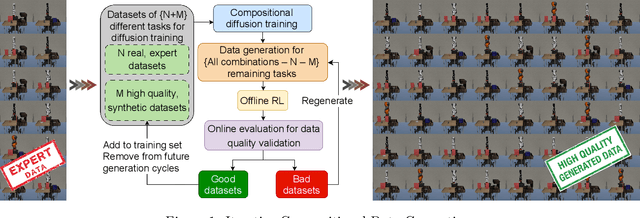
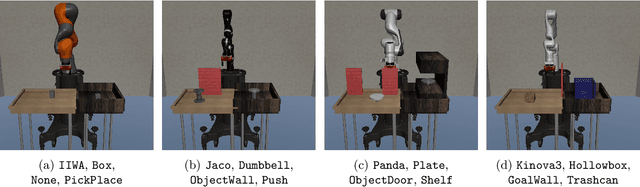

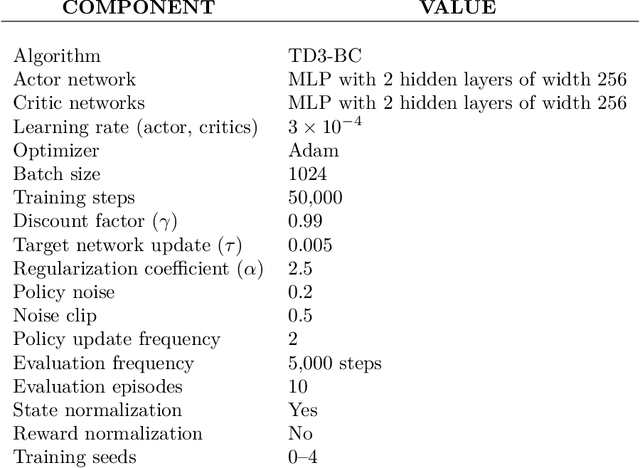
Collecting robotic manipulation data is expensive, making it impractical to acquire demonstrations for the combinatorially large space of tasks that arise in multi-object, multi-robot, and multi-environment settings. While recent generative models can synthesize useful data for individual tasks, they do not exploit the compositional structure of robotic domains and struggle to generalize to unseen task combinations. We propose a semantic compositional diffusion transformer that factorizes transitions into robot-, object-, obstacle-, and objective-specific components and learns their interactions through attention. Once trained on a limited subset of tasks, we show that our model can zero-shot generate high-quality transitions from which we can learn control policies for unseen task combinations. Then, we introduce an iterative self-improvement procedure in which synthetic data is validated via offline reinforcement learning and incorporated into subsequent training rounds. Our approach substantially improves zero-shot performance over monolithic and hard-coded compositional baselines, ultimately solving nearly all held-out tasks and demonstrating the emergence of meaningful compositional structure in the learned representations.
A Multi-Robot Platform for Robotic Triage Combining Onboard Sensing and Foundation Models
Dec 09, 2025
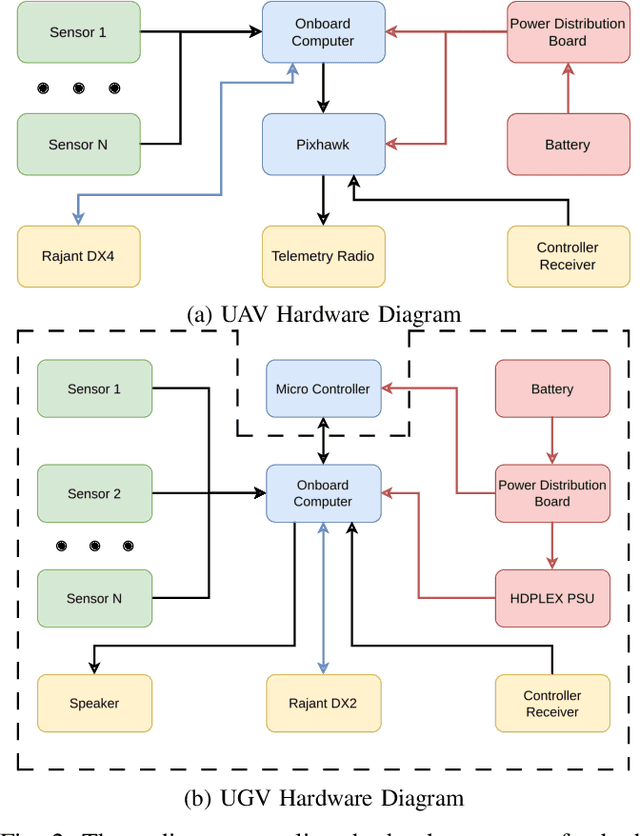
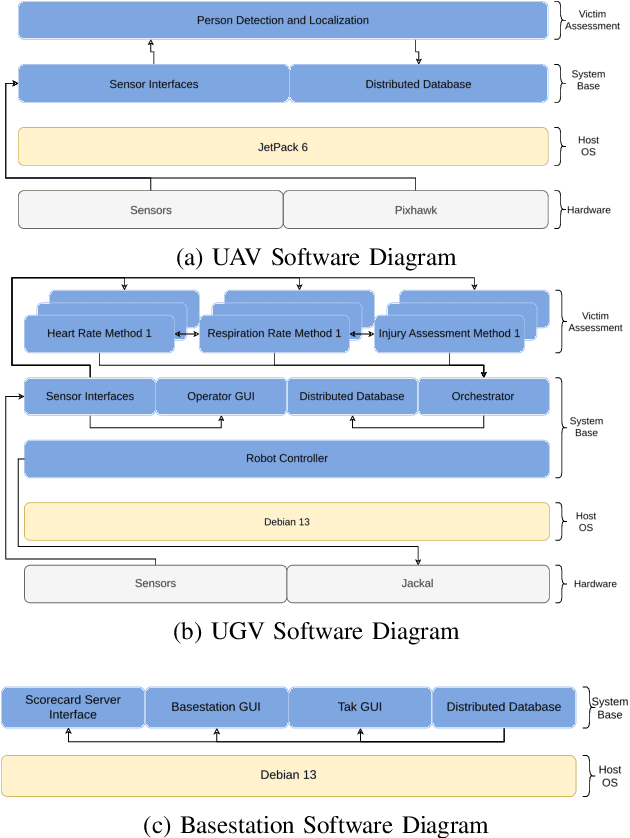
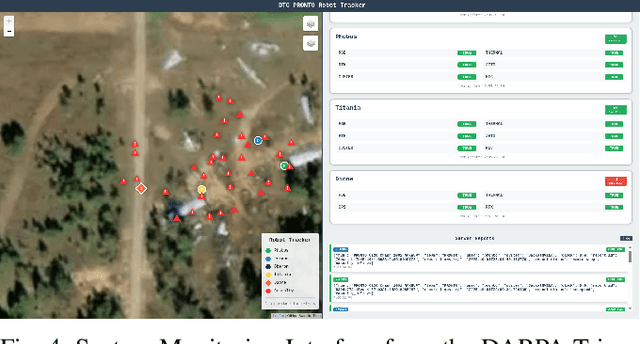
This report presents a heterogeneous robotic system designed for remote primary triage in mass-casualty incidents (MCIs). The system employs a coordinated air-ground team of unmanned aerial vehicles (UAVs) and unmanned ground vehicles (UGVs) to locate victims, assess their injuries, and prioritize medical assistance without risking the lives of first responders. The UAV identify and provide overhead views of casualties, while UGVs equipped with specialized sensors measure vital signs and detect and localize physical injuries. Unlike previous work that focused on exploration or limited medical evaluation, this system addresses the complete triage process: victim localization, vital sign measurement, injury severity classification, mental status assessment, and data consolidation for first responders. Developed as part of the DARPA Triage Challenge, this approach demonstrates how multi-robot systems can augment human capabilities in disaster response scenarios to maximize lives saved.
Replicable Reinforcement Learning with Linear Function Approximation
Sep 10, 2025Replication of experimental results has been a challenge faced by many scientific disciplines, including the field of machine learning. Recent work on the theory of machine learning has formalized replicability as the demand that an algorithm produce identical outcomes when executed twice on different samples from the same distribution. Provably replicable algorithms are especially interesting for reinforcement learning (RL), where algorithms are known to be unstable in practice. While replicable algorithms exist for tabular RL settings, extending these guarantees to more practical function approximation settings has remained an open problem. In this work, we make progress by developing replicable methods for linear function approximation in RL. We first introduce two efficient algorithms for replicable random design regression and uncentered covariance estimation, each of independent interest. We then leverage these tools to provide the first provably efficient replicable RL algorithms for linear Markov decision processes in both the generative model and episodic settings. Finally, we evaluate our algorithms experimentally and show how they can inspire more consistent neural policies.
Future Slot Prediction for Unsupervised Object Discovery in Surgical Video
Jul 02, 2025Object-centric slot attention is an emerging paradigm for unsupervised learning of structured, interpretable object-centric representations (slots). This enables effective reasoning about objects and events at a low computational cost and is thus applicable to critical healthcare applications, such as real-time interpretation of surgical video. The heterogeneous scenes in real-world applications like surgery are, however, difficult to parse into a meaningful set of slots. Current approaches with an adaptive slot count perform well on images, but their performance on surgical videos is low. To address this challenge, we propose a dynamic temporal slot transformer (DTST) module that is trained both for temporal reasoning and for predicting the optimal future slot initialization. The model achieves state-of-the-art performance on multiple surgical databases, demonstrating that unsupervised object-centric methods can be applied to real-world data and become part of the common arsenal in healthcare applications.
Intersectional Fairness in Reinforcement Learning with Large State and Constraint Spaces
Feb 17, 2025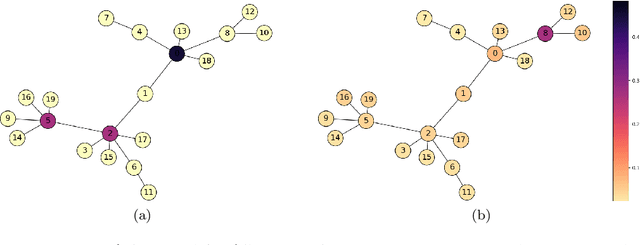
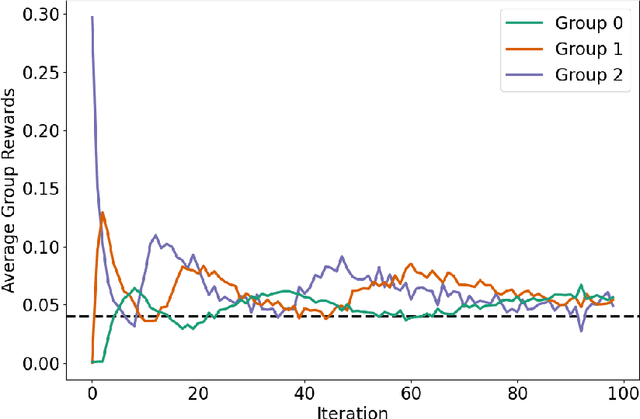
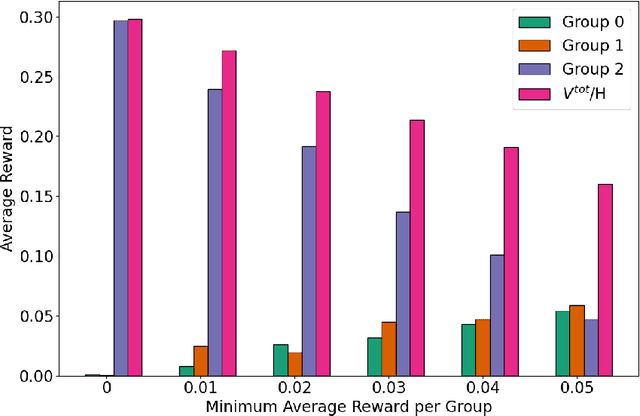
In traditional reinforcement learning (RL), the learner aims to solve a single objective optimization problem: find the policy that maximizes expected reward. However, in many real-world settings, it is important to optimize over multiple objectives simultaneously. For example, when we are interested in fairness, states might have feature annotations corresponding to multiple (intersecting) demographic groups to whom reward accrues, and our goal might be to maximize the reward of the group receiving the minimal reward. In this work, we consider a multi-objective optimization problem in which each objective is defined by a state-based reweighting of a single scalar reward function. This generalizes the problem of maximizing the reward of the minimum reward group. We provide oracle-efficient algorithms to solve these multi-objective RL problems even when the number of objectives is exponentially large-for tabular MDPs, as well as for large MDPs when the group functions have additional structure. Finally, we experimentally validate our theoretical results and demonstrate applications on a preferential attachment graph MDP.