 Add to Chrome
 Add to Firefox
 Add to Edge
Hyper-YOLO: When Visual Object Detection Meets Hypergraph Computation
Aug 09, 2024
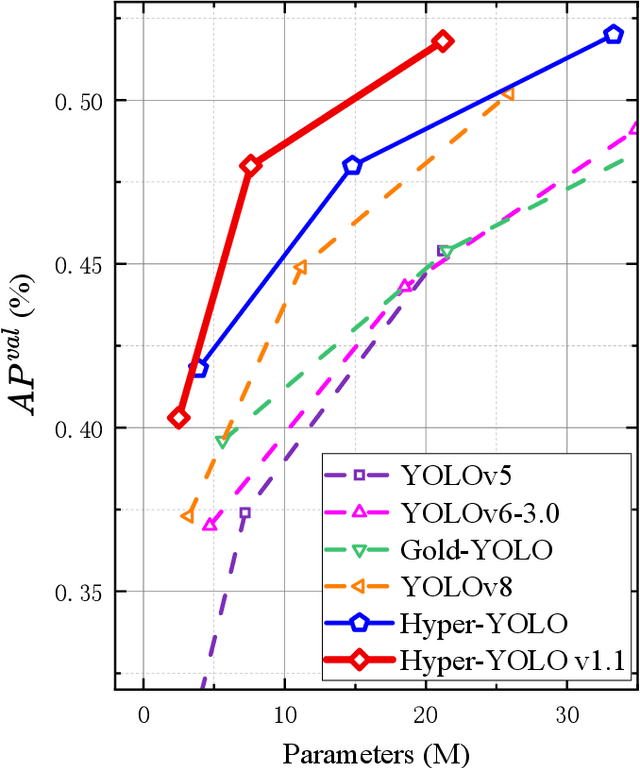
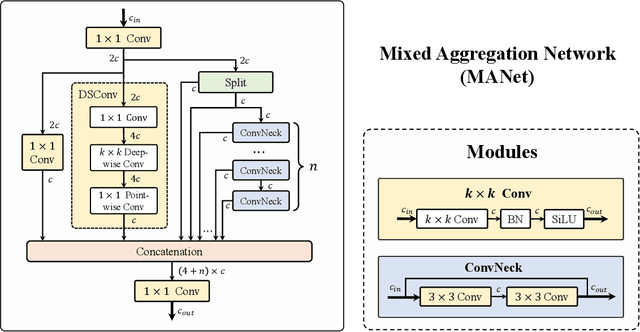

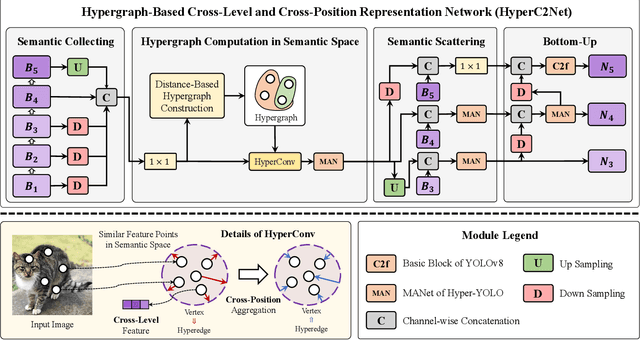
We introduce Hyper-YOLO, a new object detection method that integrates hypergraph computations to capture the complex high-order correlations among visual features. Traditional YOLO models, while powerful, have limitations in their neck designs that restrict the integration of cross-level features and the exploitation of high-order feature interrelationships. To address these challenges, we propose the Hypergraph Computation Empowered Semantic Collecting and Scattering (HGC-SCS) framework, which transposes visual feature maps into a semantic space and constructs a hypergraph for high-order message propagation. This enables the model to acquire both semantic and structural information, advancing beyond conventional feature-focused learning. Hyper-YOLO incorporates the proposed Mixed Aggregation Network (MANet) in its backbone for enhanced feature extraction and introduces the Hypergraph-Based Cross-Level and Cross-Position Representation Network (HyperC2Net) in its neck. HyperC2Net operates across five scales and breaks free from traditional grid structures, allowing for sophisticated high-order interactions across levels and positions. This synergy of components positions Hyper-YOLO as a state-of-the-art architecture in various scale models, as evidenced by its superior performance on the COCO dataset. Specifically, Hyper-YOLO-N significantly outperforms the advanced YOLOv8-N and YOLOv9-T with 12\% $\text{AP}^{val}$ and 9\% $\text{AP}^{val}$ improvements. The source codes are at ttps://github.com/iMoonLab/Hyper-YOLO.

SplitLoRA: A Split Parameter-Efficient Fine-Tuning Framework for Large Language Models
Jul 01, 2024The scalability of large language models (LLMs) in handling high-complexity models and large-scale datasets has led to tremendous successes in pivotal domains. While there is an urgent need to acquire more training data for LLMs, a concerning reality is the depletion of high-quality public datasets within a few years. In view of this, the federated learning (FL) LLM fine-tuning paradigm recently has been proposed to facilitate collaborative LLM fine-tuning on distributed private data, where multiple data owners collaboratively fine-tune a shared LLM without sharing raw data. However, the staggering model size of LLMs imposes heavy computing and communication burdens on clients, posing significant barriers to the democratization of the FL LLM fine-tuning paradigm. To address this issue, split learning (SL) has emerged as a promising solution by offloading the primary training workload to a server via model partitioning while exchanging activation/activation's gradients with smaller data sizes rather than the entire LLM. Unfortunately, research on the SL LLM fine-tuning paradigm is still in its nascent stage. To fill this gap, in this paper, we propose the first SL LLM fine-tuning framework, named SplitLoRA. SplitLoRA is built on the split federated learning (SFL) framework, amalgamating the advantages of parallel training from FL and model splitting from SL and thus greatly enhancing the training efficiency. It is worth noting that SplitLoRA is the inaugural open-source benchmark for SL LLM fine-tuning, providing a foundation for research efforts dedicated to advancing SL LLM fine-tuning. Extensive simulations validate that SplitLoRA achieves target accuracy in significantly less time than state-of-the-art LLM fine-tuning frameworks, demonstrating the superior training performance of SplitLoRA. The project page is available at https://fduinc.github.io/splitlora/.
Zero-Shot Image Denoising for High-Resolution Electron Microscopy
Jun 20, 2024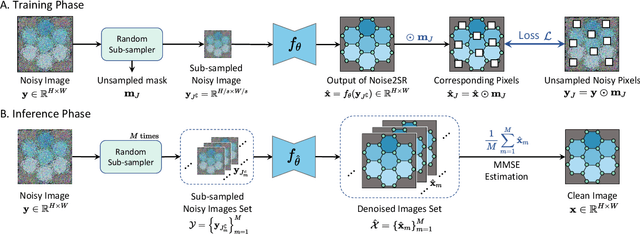
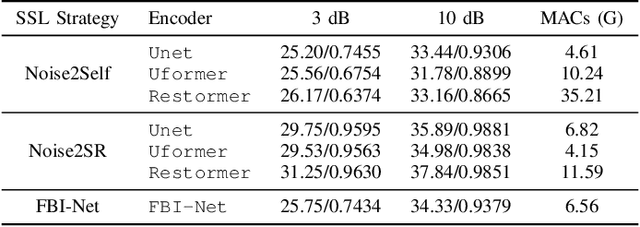
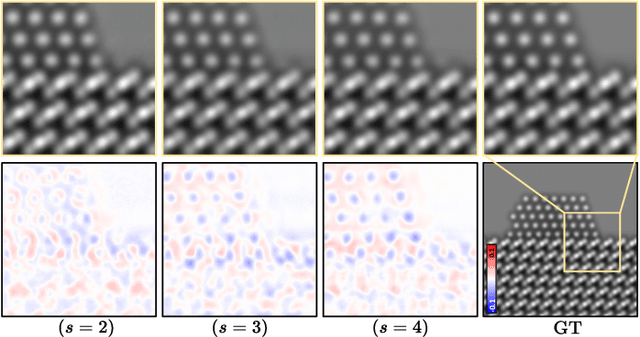
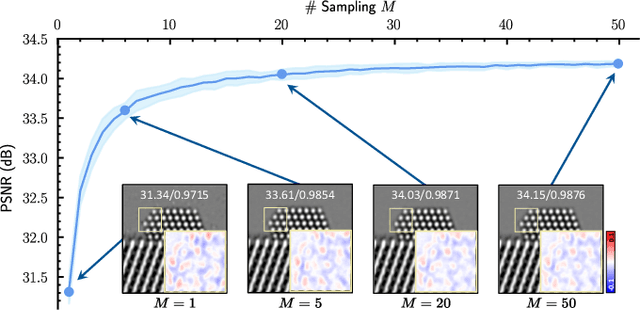
High-resolution electron microscopy (HREM) imaging technique is a powerful tool for directly visualizing a broad range of materials in real-space. However, it faces challenges in denoising due to ultra-low signal-to-noise ratio (SNR) and scarce data availability. In this work, we propose Noise2SR, a zero-shot self-supervised learning (ZS-SSL) denoising framework for HREM. Within our framework, we propose a super-resolution (SR) based self-supervised training strategy, incorporating the Random Sub-sampler module. The Random Sub-sampler is designed to generate approximate infinite noisy pairs from a single noisy image, serving as an effective data augmentation in zero-shot denoising. Noise2SR trains the network with paired noisy images of different resolutions, which is conducted via SR strategy. The SR-based training facilitates the network adopting more pixels for supervision, and the random sub-sampling helps compel the network to learn continuous signals enhancing the robustness. Meanwhile, we mitigate the uncertainty caused by random-sampling by adopting minimum mean squared error (MMSE) estimation for the denoised results. With the distinctive integration of training strategy and proposed designs, Noise2SR can achieve superior denoising performance using a single noisy HREM image. We evaluate the performance of Noise2SR in both simulated and real HREM denoising tasks. It outperforms state-of-the-art ZS-SSL methods and achieves comparable denoising performance with supervised methods. The success of Noise2SR suggests its potential for improving the SNR of images in material imaging domains.
SATSense: Multi-Satellite Collaborative Framework for Spectrum Sensing
May 24, 2024Low Earth Orbit satellite Internet has recently been deployed, providing worldwide service with non-terrestrial networks. With the large-scale deployment of both non-terrestrial and terrestrial networks, limited spectrum resources will not be allocated enough. Consequently, dynamic spectrum sharing is crucial for their coexistence in the same spectrum, where accurate spectrum sensing is essential. However, spectrum sensing in space is more challenging than in terrestrial networks due to variable channel conditions, making single-satellite sensing unstable. Therefore, we first attempt to design a collaborative sensing scheme utilizing diverse data from multiple satellites. However, it is non-trivial to achieve this collaboration due to heterogeneous channel quality, considerable raw sampling data, and packet loss. To address the above challenges, we first establish connections between the satellites by modeling their sensing data as a graph and devising a graph neural network-based algorithm to achieve effective spectrum sensing. Meanwhile, we establish a joint sub-Nyquist sampling and autoencoder data compression framework to reduce the amount of transmitted sensing data. Finally, we propose a contrastive learning-based mechanism compensates for missing packets. Extensive experiments demonstrate that our proposed strategy can achieve efficient spectrum sensing performance and outperform the conventional deep learning algorithm in spectrum sensing accuracy.
Edge Information Hub-Empowered 6G NTN: Latency-Oriented Resource Orchestration and Configuration
May 21, 2024
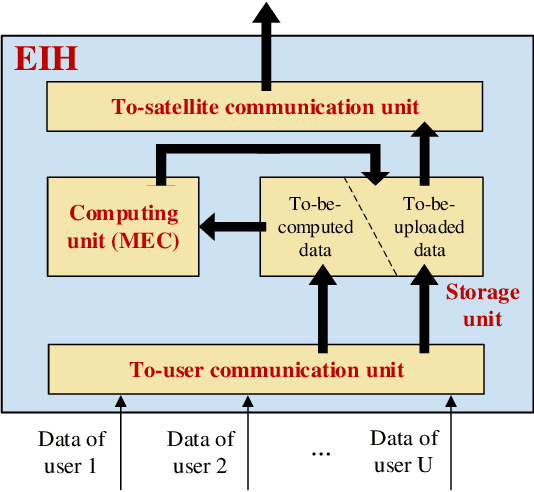
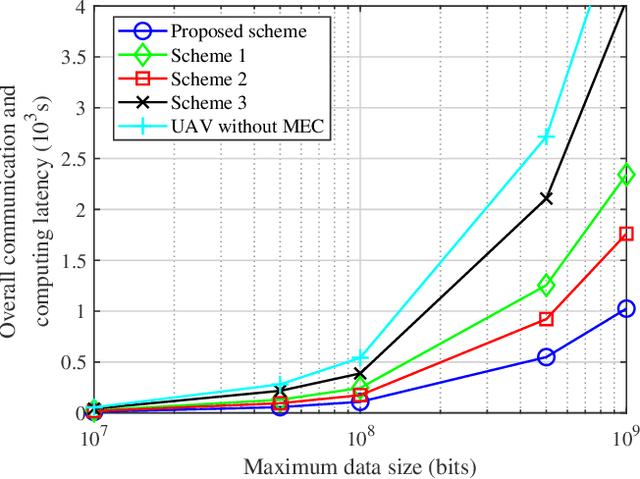
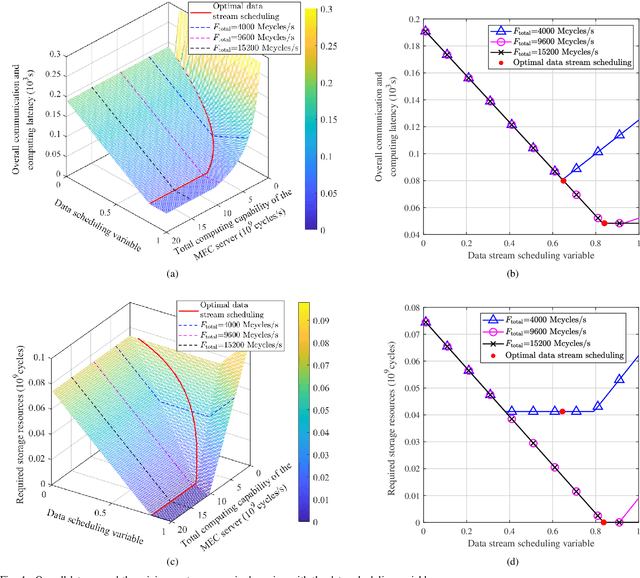
Quick response to disasters is crucial for saving lives and reducing loss. This requires low-latency uploading of situation information to the remote command center. Since terrestrial infrastructures are often damaged in disaster areas, non-terrestrial networks (NTNs) are preferable to provide network coverage, and mobile edge computing (MEC) could be integrated to improve the latency performance. Nevertheless, the communications and computing in MEC-enabled NTNs are strongly coupled, which complicates the system design. In this paper, an edge information hub (EIH) that incorporates communication, computing and storage capabilities is proposed to synergize communication and computing and enable systematic design. We first address the joint data scheduling and resource orchestration problem to minimize the latency for uploading sensing data. The problem is solved using an optimal resource orchestration algorithm. On that basis, we propose the principles for resource configuration of the EIH considering payload constraints on size, weight and energy supply. Simulation results demonstrate the superiority of our proposed scheme in reducing the overall upload latency, thus enabling quick emergency rescue.
Automated Federated Pipeline for Parameter-Efficient Fine-Tuning of Large Language Models
Apr 09, 2024Recently, there has been a surge in the development of advanced intelligent generative content (AIGC), especially large language models (LLMs). However, for many downstream tasks, it is necessary to fine-tune LLMs using private data. While federated learning offers a promising privacy-preserving solution to LLM fine-tuning, the substantial size of an LLM, combined with high computational and communication demands, makes it hard to apply to downstream tasks. More importantly, private edge servers often possess varying computing and network resources in real-world scenarios, introducing additional complexities to LLM fine-tuning. To tackle these problems, we design and implement an automated federated pipeline, named FedPipe, to fine-tune LLMs with minimal training cost but without adding any inference latency. FedPipe firstly identifies the weights to be fine-tuned based on their contributions to the LLM training. It then configures a low-rank adapter for each selected weight to train local low-rank adapters on an edge server, and aggregate local adapters of all edge servers to fine-tune the whole LLM. Finally, it appropriately quantizes the parameters of LLM to reduce memory space according to the requirements of edge servers. Extensive experiments demonstrate that FedPipe expedites the model training and achieves higher accuracy than state-of-the-art benchmarks.
Panoptic Perception: A Novel Task and Fine-grained Dataset for Universal Remote Sensing Image Interpretation
Apr 06, 2024


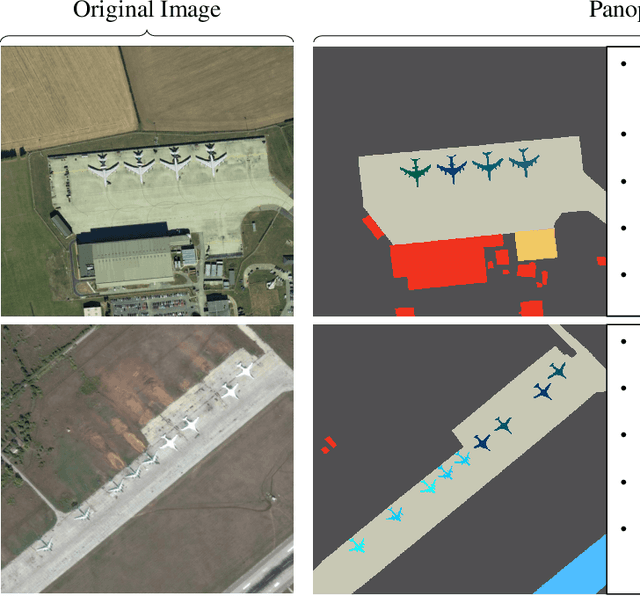
Current remote-sensing interpretation models often focus on a single task such as detection, segmentation, or caption. However, the task-specific designed models are unattainable to achieve the comprehensive multi-level interpretation of images. The field also lacks support for multi-task joint interpretation datasets. In this paper, we propose Panoptic Perception, a novel task and a new fine-grained dataset (FineGrip) to achieve a more thorough and universal interpretation for RSIs. The new task, 1) integrates pixel-level, instance-level, and image-level information for universal image perception, 2) captures image information from coarse to fine granularity, achieving deeper scene understanding and description, and 3) enables various independent tasks to complement and enhance each other through multi-task learning. By emphasizing multi-task interactions and the consistency of perception results, this task enables the simultaneous processing of fine-grained foreground instance segmentation, background semantic segmentation, and global fine-grained image captioning. Concretely, the FineGrip dataset includes 2,649 remote sensing images, 12,054 fine-grained instance segmentation masks belonging to 20 foreground things categories, 7,599 background semantic masks for 5 stuff classes and 13,245 captioning sentences. Furthermore, we propose a joint optimization-based panoptic perception model. Experimental results on FineGrip demonstrate the feasibility of the panoptic perception task and the beneficial effect of multi-task joint optimization on individual tasks. The dataset will be publicly available.
Enhancing Human-Computer Interaction in Chest X-ray Analysis using Vision and Language Model with Eye Gaze Patterns
Apr 03, 2024Recent advancements in Computer Assisted Diagnosis have shown promising performance in medical imaging tasks, particularly in chest X-ray analysis. However, the interaction between these models and radiologists has been primarily limited to input images. This work proposes a novel approach to enhance human-computer interaction in chest X-ray analysis using Vision-Language Models (VLMs) enhanced with radiologists' attention by incorporating eye gaze data alongside textual prompts. Our approach leverages heatmaps generated from eye gaze data, overlaying them onto medical images to highlight areas of intense radiologist's focus during chest X-ray evaluation. We evaluate this methodology in tasks such as visual question answering, chest X-ray report automation, error detection, and differential diagnosis. Our results demonstrate the inclusion of eye gaze information significantly enhances the accuracy of chest X-ray analysis. Also, the impact of eye gaze on fine-tuning was confirmed as it outperformed other medical VLMs in all tasks except visual question answering. This work marks the potential of leveraging both the VLM's capabilities and the radiologist's domain knowledge to improve the capabilities of AI models in medical imaging, paving a novel way for Computer Assisted Diagnosis with a human-centred AI.
A Survey on Hypergraph Neural Networks: An In-Depth and Step-By-Step Guide
Apr 01, 2024


Higher-order interactions (HOIs) are ubiquitous in real-world complex systems and applications, and thus investigation of deep learning for HOIs has become a valuable agenda for the data mining and machine learning communities. As networks of HOIs are expressed mathematically as hypergraphs, hypergraph neural networks (HNNs) have emerged as a powerful tool for representation learning on hypergraphs. Given the emerging trend, we present the first survey dedicated to HNNs, with an in-depth and step-by-step guide. Broadly, the present survey overviews HNN architectures, training strategies, and applications. First, we break existing HNNs down into four design components: (i) input features, (ii) input structures, (iii) message-passing schemes, and (iv) training strategies. Second, we examine how HNNs address and learn HOIs with each of their components. Third, we overview the recent applications of HNNs in recommendation, biological and medical science, time series analysis, and computer vision. Lastly, we conclude with a discussion on limitations and future directions.
Hypergraph-based Multi-View Action Recognition using Event Cameras
Mar 28, 2024Action recognition from video data forms a cornerstone with wide-ranging applications. Single-view action recognition faces limitations due to its reliance on a single viewpoint. In contrast, multi-view approaches capture complementary information from various viewpoints for improved accuracy. Recently, event cameras have emerged as innovative bio-inspired sensors, leading to advancements in event-based action recognition. However, existing works predominantly focus on single-view scenarios, leaving a gap in multi-view event data exploitation, particularly in challenges like information deficit and semantic misalignment. To bridge this gap, we introduce HyperMV, a multi-view event-based action recognition framework. HyperMV converts discrete event data into frame-like representations and extracts view-related features using a shared convolutional network. By treating segments as vertices and constructing hyperedges using rule-based and KNN-based strategies, a multi-view hypergraph neural network that captures relationships across viewpoint and temporal features is established. The vertex attention hypergraph propagation is also introduced for enhanced feature fusion. To prompt research in this area, we present the largest multi-view event-based action dataset $\text{THU}^{\text{MV-EACT}}\text{-50}$, comprising 50 actions from 6 viewpoints, which surpasses existing datasets by over tenfold. Experimental results show that HyperMV significantly outperforms baselines in both cross-subject and cross-view scenarios, and also exceeds the state-of-the-arts in frame-based multi-view action recognition.