 Add to Chrome
 Add to Firefox
 Add to Edge
Ambiguity-Resolved Micro-Doppler Construction for Asynchronous Bistatic Sensing
Jul 22, 2026
Integrated sensing and communications (ISAC) can turn wireless networks into pervasive sensing platforms, but bistatic deployments are impaired by transceiver clock asynchrony, which induces random phase fluctuations in channel state information (CSI). CSI-ratio sanitization introduces nonlinear distortion that limits multi-target scalability and complicates delay- and angle-of-arrival (AoA)-domain processing. Cross-antenna conjugate multiplication (CACC) preserves a linear structure, but leaves mirror ambiguity and second-order by-products that corrupt motion-induced Doppler signatures. We develop a micro-Doppler construction framework that resolves the ambiguity and suppresses these residual by-products. Cyclic differencing first attenuates the dominant mirror component. We then exploit the facts that residual terms occur at differenced delay coordinates and lack an ordered AoA steering structure, designing a lightweight delay-AoA-Doppler pipeline that isolates the desired kinematic response without coherently accumulating residuals at target bins. The filtered responses are aggregated into a higher-SNR micro-Doppler representation. Ablation studies confirm the value of residual suppression and multidimensional filtering. On a large-scale WiFi gesture dataset, the proposed representation generalizes across four domain factors, attaining 90.1%-98.2% accuracy and outperforming representative baselines by about 18 percentage points on average.

WiFi Sensing via Reservoir Computing
Jul 22, 2026Practical WiFi sensing must handle clock-asynchronous links, cross-domain variation, and post-deployment updating under the limited compute budget of access point (AP), router, and embedded Internet-of-Things platforms such as ESP-class devices. Reservoir computing (RC) is attractive in this setting because its temporal encoder can remain fixed while only a lightweight readout needs to be optimized and updated. To address these deployment challenges under tight compute budgets, we present ReWiS, a WiFi-sensing-oriented reservoir framework that transforms channel state information (CSI) into structured micro-Doppler streams with common, antenna-specific, and differential motion cues, encodes them with a graph-coupled reservoir, and adapts to a new domain after deployment by freezing the reservoir and fine-tuning only a compact readout with a few labeled target samples. On a large-scale WiFi sensing benchmark, ReWiS achieves 89.2% in-domain macro-F1 and 82.0% mean cross-domain macro-F1 with only a 0.72M trainable readout, improves to 88.5\% after lightweight post-deployment adaptation, and remains competitive with recent deep baselines evaluated under the same protocol, which achieve 87.5%-89.2% mean cross-domain macro-F1, while requiring lower optimization cost and lower CPU latency. These results indicate that ReWiS provides a practical reservoir-based design for deployable WiFi sensing, with further potential for low-power hardware realization.
Federated Low-Rank Koopman Learning for Multivariate Time-Series Anomaly Detection in IoT Systems
Jul 09, 2026Distributed IoT systems generate multivariate time-series streams for monitoring physical assets, servers, and embedded sensing platforms. Detecting abnormal temporal behavior is critical for fault diagnosis, predictive maintenance, and security. However, practical IoT anomaly detection is hindered by decentralized and non-IID data, limited bandwidth, and the constrained computation and memory of edge devices. This paper proposes FedKAD, a resource-efficient federated Koopman anomaly detection framework for distributed IoT multivariate time series. Unlike deep-learning-based anomaly detectors that require training and communicating large neural models, FedKAD learns normal temporal dynamics through lightweight sliding-window Koopman representations. Federated training is formulated as a low-rank consensus problem, where raw sensor streams and local reduced dynamics remain on device while only compact subspace variables are exchanged with the server. To optimize the shared representation under orthonormality constraints, we develop a federated Stiefel-ADMM algorithm and provide convergence and stationarity analysis under partial client participation. During inference, each client detects anomalies locally by measuring the prediction residual between observed future trajectories and the learned Koopman dynamics. Experiments on four widely used multivariate time-series anomaly detection benchmarks show that FedKAD maintains or improves detection performance compared with federated deep-learning baselines. More importantly for IoT deployment, FedKAD provides up to $2.1\times10^3$ faster training, $80\times$ lower communication, and $79\times$ lower inference latency than neural baselines, confirming its suitability for resource-constrained edge devices.
Networked Tracking of Multiple Moving Targets in 6G Network
Apr 21, 2026This paper considers a networked tracking architecture in 6G integrated sensing and communication (ISAC) systems, where multiple base stations (BSs) cooperatively transmit radio signals and process received echo signals to track multiple moving targets. Compared to the single-BS counterpart, networked tracking allows the moving targets to be associated with different BSs over time such that the wireless resources can be dynamically allocated among BSs based on target locations. However, networked tracking imposes new challenges for algorithm design and resource allocation. In this paper, we first design the networked Kalman Filter (NKF) that is suitable for multi-BS based tracking, then characterize the posterior Cramer-Rao bound (PCRB) under this NKF, and last design the beamforming vectors of all the BSs to minimize the tracking PCRB. Numerical results show that our dynamic beamforming design can properly associate the targets to the suitable BSs at various sensing blocks and reduce the tracking mean-squared error (MSE).
Semantic Sensing: A Task-Oriented Paradigm
Mar 31, 2026Sensing and communication are fundamental enablers of next-generation networks. While communication technologies have advanced significantly, sensing remains limited to conventional parameter estimation and is far from fully explored. Motivated by these limitations, we propose semantic sensing (SemS), a novel framework that shifts the design objective from reconstruction fidelity to semantic effective recognition. Specifically, we mathematically formulate the interaction between transmit waveforms and semantic entities, thereby establishing SemS as a semantics-oriented transceiver design. Within this architecture, we leverage the information bottleneck (IB) principle as a theoretical criterion to derive a unified objective, guiding the sensing pipeline to maximize task-relevant information extraction. To practically solve this optimization problem, we develop a deep learning (DL)-based framework that jointly designs transmit waveform parameters and receiver representations. The framework is implemented in an orthogonal frequency division multiplexing (OFDM) system, featuring a shared semantic encoder that employs a Gumbel-Softmax-based pilot selector to discretely mask task-irrelevant resources. At the receiver, we design distinct decoding architectures tailored to specific sensing objectives, comprising a 2D residual network (ResNet)-based classifier for target recognition and a correlation-driven 1D regression network for high-precision delay estimation. Numerical results demonstrate that the proposed semantic pilot design achieves superior classification accuracy and ranging precision compared to reconstruction-based baselines, particularly under constrained resource budgets.
Uplink Networked Sensing via Multiuser Correlation Exploitation
Mar 17, 2026In this correspondence, we investigate networked sensing in perceptive mobile networks under a bistatic multi-transmitter single-receiver uplink topology, where multiple user equipments (UEs) transmit signals over orthogonal frequency-division multiple access (OFDMA) resources and a single base station performs joint sensing. Uplink clock asynchronism introduces offsets that destroy inter-packet coherence and hinder high-resolution sensing, while multi-user observations exhibit exploitable cross-user correlation. We therefore formulate an asynchronous multi-user uplink OFDMA sensing model and exploit common delay-cluster sparsity across UEs. A line-of-sight (LoS)-referenced calibration first suppresses the offsets, after which a shared-private delay-domain sparse Bayesian learning (SBL) model is used for delay support recovery and user grouping. Doppler and angle of arrival are then estimated from temporal and spatial phase differences. Simulation results show that the proposed scheme outperforms per-user processing, particularly under limited subcarrier budgets and in low signal-to-noise ratio (SNR) regimes.
Rethinking RSSI for WiFi Sensing
Feb 15, 2026The Received Signal Strength Indicator (RSSI) is widely available on commodity WiFi devices but is commonly regarded as too coarse for fine-grained sensing. This paper revisits its sensing potential and presents WiRSSI, a bistatic WiFi sensing framework for passive human tracking using only RSSI measurements. WiRSSI adopts a 1Tx-3Rx configuration and is readily extensible to Multiple-Input Multiple-Output (MIMO) deployments. We first reveal how CSI power implicitly encodes phase-related information and how this relationship carries over to RSSI, showing that RSSI preserves exploitable Doppler, Angle-of-Arrival (AoA), and delay cues associated with human motion. WiRSSI then extracts Doppler-AoA features via a 2D Fast Fourier Transform and infers delay from amplitude-only information in the absence of subcarrier-level phase. The estimated AoA and delay are then mapped to Cartesian coordinates and denoised to recover motion trajectories. Experiments in practical environments show that WiRSSI achieves median XY localization errors of 0.905 m, 0.784 m, and 0.785 m for elliptical, linear, and rectangular trajectories, respectively. In comparison, a representative CSI-based method attains median errors of 0.574 m, 0.599 m, and 0.514 m, corresponding to an average accuracy gap of 0.26 m. These results demonstrate that, despite its lower resolution, RSSI can support practical passive sensing and offers a low-cost alternative to CSI-based WiFi sensing.
Towards SISO Bistatic Sensing for ISAC
Aug 18, 2025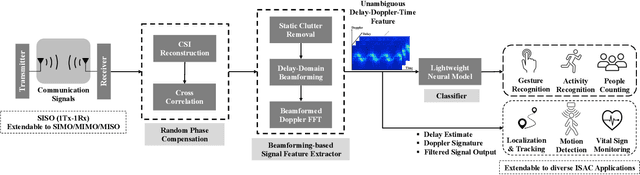
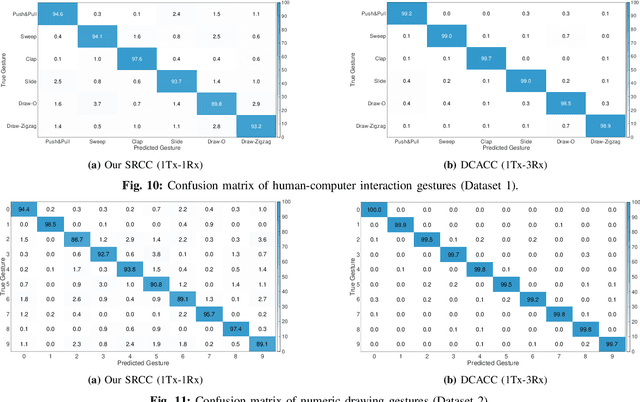
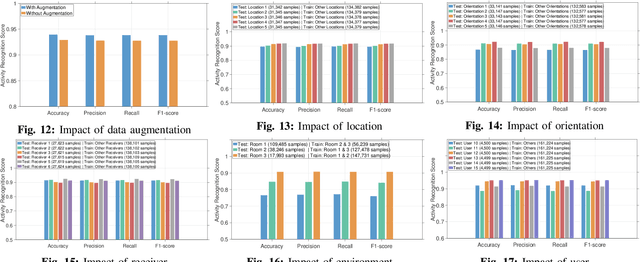
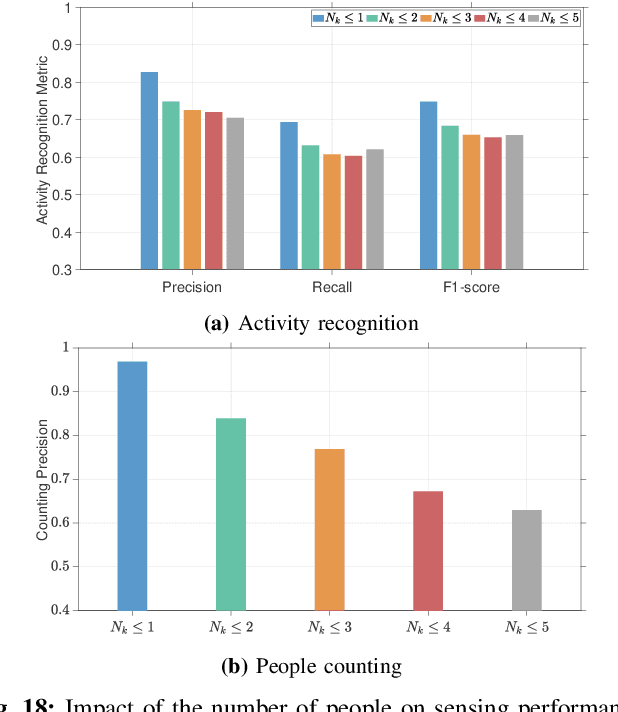
Integrated Sensing and Communication (ISAC) is a key enabler for next-generation wireless systems. However, real-world deployment is often limited to low-cost, single-antenna transceivers. In such bistatic Single-Input Single-Output (SISO) setup, clock asynchrony introduces random phase offsets in Channel State Information (CSI), which cannot be mitigated using conventional multi-antenna methods. This work proposes WiDFS 3.0, a lightweight bistatic SISO sensing framework that enables accurate delay and Doppler estimation from distorted CSI by effectively suppressing Doppler mirroring ambiguity. It operates with only a single antenna at both the transmitter and receiver, making it suitable for low-complexity deployments. We propose a self-referencing cross-correlation (SRCC) method for SISO random phase removal and employ delay-domain beamforming to resolve Doppler ambiguity. The resulting unambiguous delay-Doppler-time features enable robust sensing with compact neural networks. Extensive experiments show that WiDFS 3.0 achieves accurate parameter estimation, with performance comparable to or even surpassing that of prior multi-antenna methods, especially in delay estimation. Validated under single- and multi-target scenarios, the extracted ambiguity-resolved features show strong sensing accuracy and generalization. For example, when deployed on the embedded-friendly MobileViT-XXS with only 1.3M parameters, WiDFS 3.0 consistently outperforms conventional features such as CSI amplitude, mirrored Doppler, and multi-receiver aggregated Doppler.
Water Level Sensing via Communication Signals in a Bi-Static System
May 26, 2025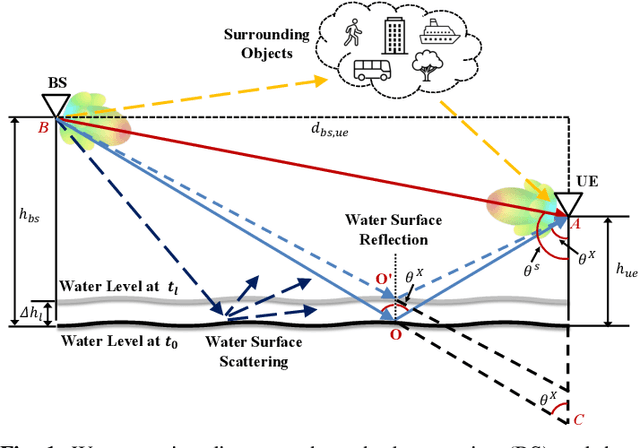
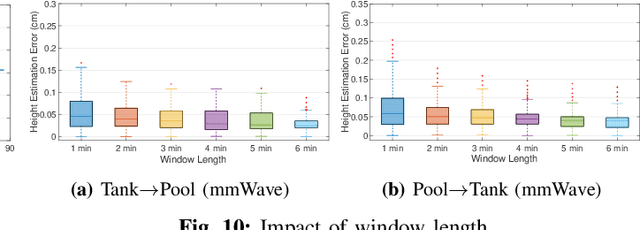

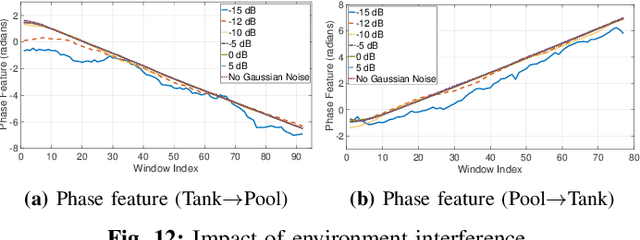
Accurate water level sensing is essential for flood monitoring, agricultural irrigation, and water resource optimization. Traditional methods require dedicated sensor deployments, leading to high installation costs, vulnerability to interference, and limited resolution. This work proposes PMNs-WaterSense, a novel scheme leveraging Channel State Information (CSI) from existing mobile networks for water level sensing. Our scheme begins with a CSI-power method to eliminate phase offsets caused by clock asynchrony in bi-static systems. We then apply multi-domain filtering across the time (Doppler), frequency (delay), and spatial (Angle-of-Arrival, AoA) domains to extract phase features that finely capture variations in path length over water. To resolve the $2\pi$ phase ambiguity, we introduce a Kalman filter-based unwrapping technique. Additionally, we exploit transceiver geometry to convert path length variations into water level height changes, even with limited antenna configurations. We validate our framework through controlled experiments with 28 GHz mmWave and 3.1 GHz LTE signals in real time, achieving average height estimation errors of 0.025 cm and 0.198 cm, respectively. Moreover, real-world river monitoring with 2.6 GHz LTE signals achieves an average error of 4.8 cm for a 1-meter water level change, demonstrating its effectiveness in practical deployments.
Subspace-Based Super-Resolution Sensing for Bi-Static ISAC with Clock Asynchronism
May 15, 2025Bi-static sensing is an attractive configuration for integrated sensing and communications (ISAC) systems; however, clock asynchronism between widely separated transmitters and receivers introduces time-varying time offsets (TO) and phase offsets (PO), posing significant challenges. This paper introduces a signal-subspace-based framework that estimates decoupled angles, delays, and complex gain sequences (CGS)-- the target-reflected signals -- for multiple dynamic target paths. The proposed framework begins with a novel TO alignment algorithm, leveraging signal subspace or covariance, to mitigate TO variations across temporal snapshots, enabling coherent delay-domain analysis. Subsequently, subspace-based methods are developed to compensate for TO residuals and to perform joint angle-delay estimation. Finally, leveraging the high resolution in the joint angle-delay domain, the framework compensates for the PO and estimates the CGS for each target. The framework can be applied to both single-antenna and multi-antenna systems. Extensive simulations and experiments using commercial Wi-Fi devices demonstrate that the proposed framework significantly surpasses existing solutions in parameter estimation accuracy and delay resolution. Notably, it uniquely achieves a super-resolution in the delay domain, with a probability-of-resolution curve tightly approaching that in synchronized systems.