 Add to Chrome
 Add to Firefox
 Add to Edge
Integrating Low-Altitude SAR Imaging into UAV Data Backhaul
Paper and Code
Dec 26, 2025
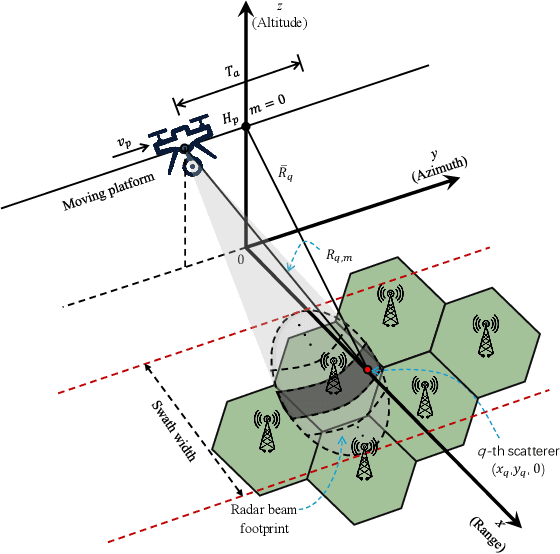
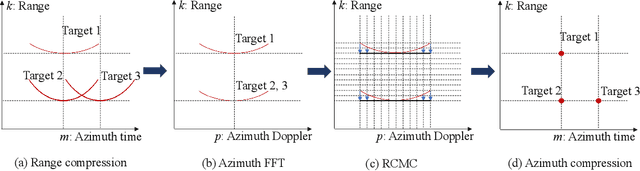
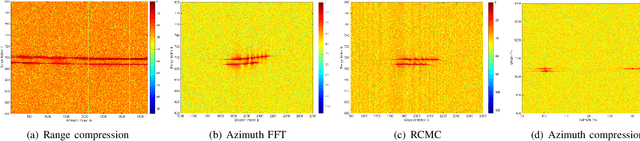
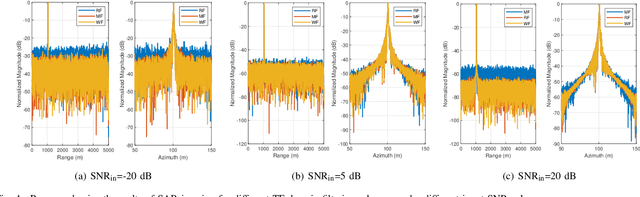
Synthetic aperture radar (SAR) deployed on unmanned aerial vehicles (UAVs) is expected to provide burgeoning imaging services for low-altitude wireless networks (LAWNs), thereby enabling large-scale environmental sensing and timely situational awareness. Conventional SAR systems typically leverages a deterministic radar waveform, while it conflicts with the integrated sensing and communications (ISAC) paradigm by discarding signaling randomness, in whole or in part. In fact, this approach reduces to the uplink pilot sensing in 5G New Radio (NR) with sounding reference signals (SRS), underutilizing data symbols. To explore the potential of data-aided imaging, we develop a low-altitude SAR imaging framework that sufficiently leverages data symbols carried by the native orthogonal frequency division multiplexing (OFDM) communication waveform. The randomness of modulated data in the temporal-frequency (TF) domain, introduced by non-constant modulus constellations such as quadrature amplitude modulation (QAM), may however severely degrade the imaging quality. To mitigate this effect, we incorporate several TF-domain filtering schemes within a rangeDoppler (RD) imaging framework and evaluate their impact. We further propose using the normalized mean square error (NMSE) of a reference point target's profile as an imaging performance metric. Simulation results with 5G NR parameters demonstrate that data-aided imaging substantially outperforms pilot-only counterpart, accordingly validating the effectiveness of the proposed OFDM-SAR imaging approach in LAWNs.
