 Add to Chrome
 Add to Firefox
 Add to Edge
TAU-R1: Visual Language Model for Traffic Anomaly Understanding
Mar 19, 2026
Traffic Anomaly Understanding (TAU) is important for traffic safety in Intelligent Transportation Systems. Recent vision-language models (VLMs) have shown strong capabilities in video understanding. However, progress on TAU remains limited due to the lack of benchmarks and task-specific methodologies. To address this limitation, we introduce Roundabout-TAU, a dataset constructed from real-world roundabout videos collected in collaboration with the City of Carmel, Indiana. The dataset contains 342 clips and is annotated with more than 2,000 question-answer pairs covering multiple aspects of traffic anomaly understanding. Building on this benchmark, we propose TAU-R1, a two-layer vision-language framework for TAU. The first layer is a lightweight anomaly classifier that performs coarse anomaly categorisation, while the second layer is a larger anomaly reasoner that generates detailed event summaries. To improve task-specific reasoning, we introduce a two-stage training strategy consisting of decomposed-QA-enhanced supervised fine-tuning followed by TAU-GRPO, a GRPO-based post-training method with TAU-specific reward functions. Experimental results show that TAU-R1 achieves strong performance on both anomaly classification and reasoning tasks while maintaining deployment efficiency. The dataset and code are available at: https://github.com/siri-rouser/TAU-R1

GameBench: Evaluating Strategic Reasoning Abilities of LLM Agents
Jun 07, 2024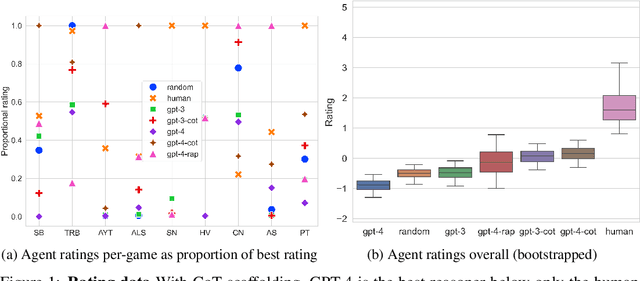
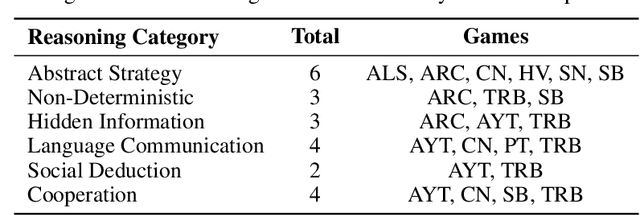

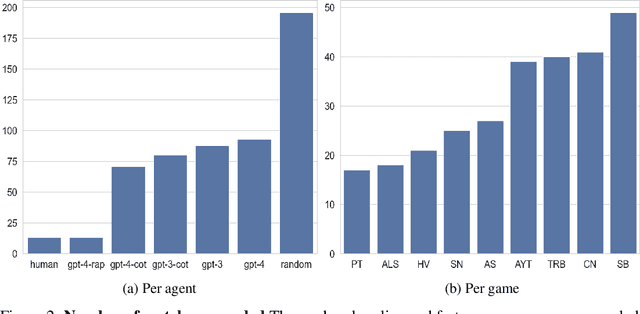
Large language models have demonstrated remarkable few-shot performance on many natural language understanding tasks. Despite several demonstrations of using large language models in complex, strategic scenarios, there lacks a comprehensive framework for evaluating agents' performance across various types of reasoning found in games. To address this gap, we introduce GameBench, a cross-domain benchmark for evaluating strategic reasoning abilities of LLM agents. We focus on 9 different game environments, where each covers at least one axis of key reasoning skill identified in strategy games, and select games for which strategy explanations are unlikely to form a significant portion of models' pretraining corpuses. Our evaluations use GPT-3 and GPT-4 in their base form along with two scaffolding frameworks designed to enhance strategic reasoning ability: Chain-of-Thought (CoT) prompting and Reasoning Via Planning (RAP). Our results show that none of the tested models match human performance, and at worse GPT-4 performs worse than random action. CoT and RAP both improve scores but not comparable to human levels.