 Add to Chrome
 Add to Firefox
 Add to Edge
The Implicit Bias of Adam on Separable Data
Jun 15, 2024
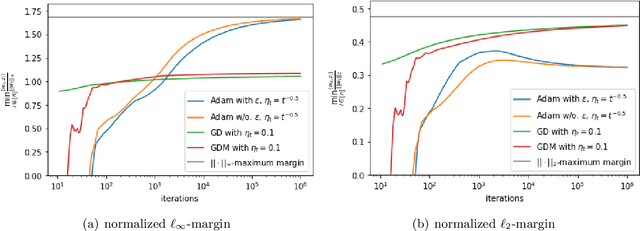
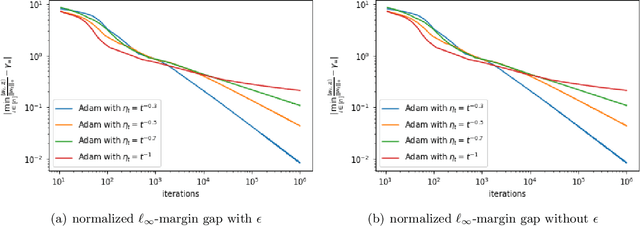
Adam has become one of the most favored optimizers in deep learning problems. Despite its success in practice, numerous mysteries persist regarding its theoretical understanding. In this paper, we study the implicit bias of Adam in linear logistic regression. Specifically, we show that when the training data are linearly separable, Adam converges towards a linear classifier that achieves the maximum $\ell_\infty$-margin. Notably, for a general class of diminishing learning rates, this convergence occurs within polynomial time. Our result shed light on the difference between Adam and (stochastic) gradient descent from a theoretical perspective.

Understanding the performance gap between online and offline alignment algorithms
May 14, 2024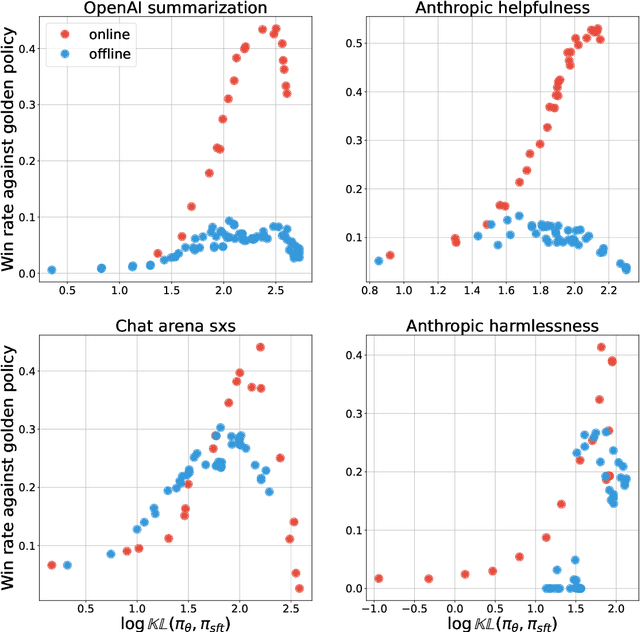
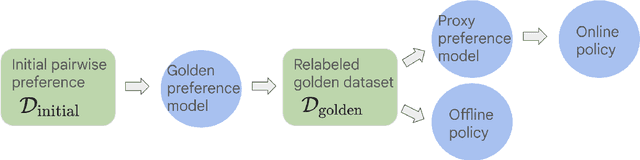
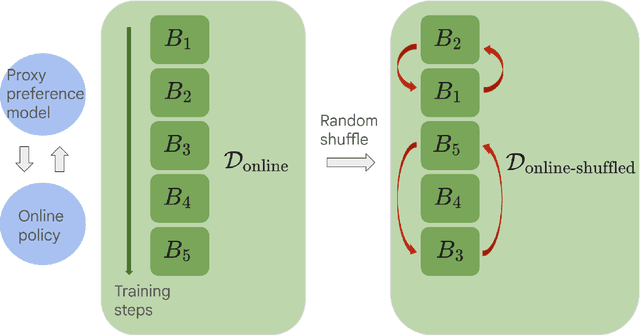
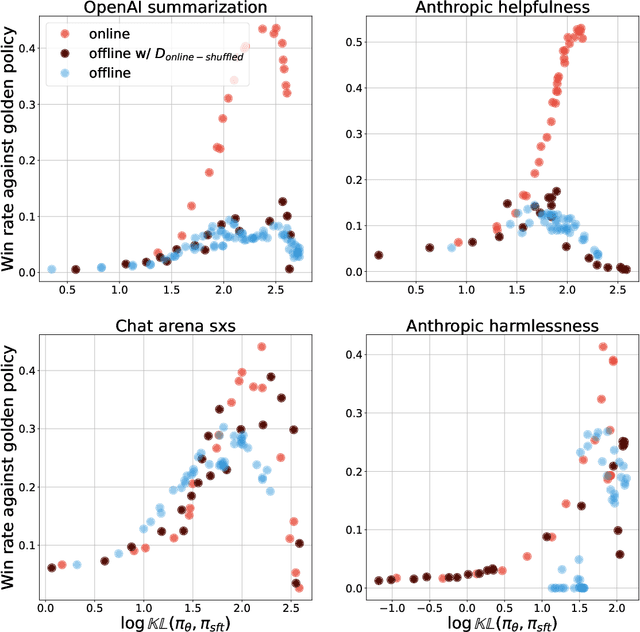
Reinforcement learning from human feedback (RLHF) is the canonical framework for large language model alignment. However, rising popularity in offline alignment algorithms challenge the need for on-policy sampling in RLHF. Within the context of reward over-optimization, we start with an opening set of experiments that demonstrate the clear advantage of online methods over offline methods. This prompts us to investigate the causes to the performance discrepancy through a series of carefully designed experimental ablations. We show empirically that hypotheses such as offline data coverage and data quality by itself cannot convincingly explain the performance difference. We also find that while offline algorithms train policy to become good at pairwise classification, it is worse at generations; in the meantime the policies trained by online algorithms are good at generations while worse at pairwise classification. This hints at a unique interplay between discriminative and generative capabilities, which is greatly impacted by the sampling process. Lastly, we observe that the performance discrepancy persists for both contrastive and non-contrastive loss functions, and appears not to be addressed by simply scaling up policy networks. Taken together, our study sheds light on the pivotal role of on-policy sampling in AI alignment, and hints at certain fundamental challenges of offline alignment algorithms.
Retrieval Augmented End-to-End Spoken Dialog Models
Feb 02, 2024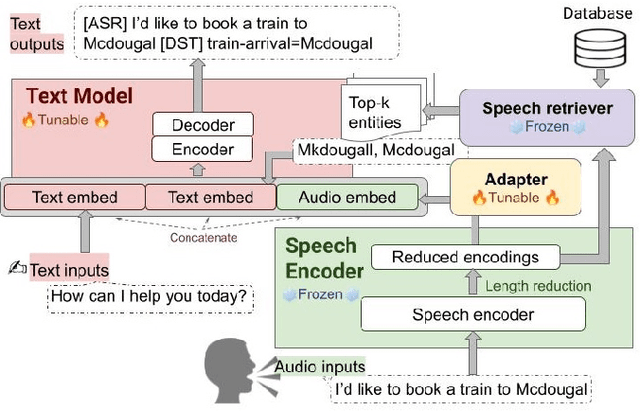


We recently developed SLM, a joint speech and language model, which fuses a pretrained foundational speech model and a large language model (LLM), while preserving the in-context learning capability intrinsic to the pretrained LLM. In this paper, we apply SLM to speech dialog applications where the dialog states are inferred directly from the audio signal. Task-oriented dialogs often contain domain-specific entities, i.e., restaurants, hotels, train stations, and city names, which are difficult to recognize, however, critical for the downstream applications. Inspired by the RAG (retrieval-augmented generation) paradigm, we propose a retrieval augmented SLM (ReSLM) that overcomes this weakness. We first train a speech retriever to retrieve text entities mentioned in the audio. The retrieved entities are then added as text inputs to the underlying SLM to bias model predictions. We evaluated ReSLM on speech MultiWoz task (DSTC-11 challenge), and found that this retrieval augmentation boosts model performance, achieving joint goal accuracy (38.6% vs 32.7%), slot error rate (20.6% vs 24.8%) and ASR word error rate (5.5% vs 6.7%). While demonstrated on dialog state tracking, our approach is broadly applicable to other speech tasks requiring contextual information or domain-specific entities, such as contextual ASR with biasing capability.
Can overfitted deep neural networks in adversarial training generalize? -- An approximation viewpoint
Jan 24, 2024Adversarial training is a widely used method to improve the robustness of deep neural networks (DNNs) over adversarial perturbations. However, it is empirically observed that adversarial training on over-parameterized networks often suffers from the \textit{robust overfitting}: it can achieve almost zero adversarial training error while the robust generalization performance is not promising. In this paper, we provide a theoretical understanding of the question of whether overfitted DNNs in adversarial training can generalize from an approximation viewpoint. Specifically, our main results are summarized into three folds: i) For classification, we prove by construction the existence of infinitely many adversarial training classifiers on over-parameterized DNNs that obtain arbitrarily small adversarial training error (overfitting), whereas achieving good robust generalization error under certain conditions concerning the data quality, well separated, and perturbation level. ii) Linear over-parameterization (meaning that the number of parameters is only slightly larger than the sample size) is enough to ensure such existence if the target function is smooth enough. iii) For regression, our results demonstrate that there also exist infinitely many overfitted DNNs with linear over-parameterization in adversarial training that can achieve almost optimal rates of convergence for the standard generalization error. Overall, our analysis points out that robust overfitting can be avoided but the required model capacity will depend on the smoothness of the target function, while a robust generalization gap is inevitable. We hope our analysis will give a better understanding of the mathematical foundations of robustness in DNNs from an approximation view.
Generative AI-enabled Quantum Computing Networks and Intelligent Resource Allocation
Jan 13, 2024Quantum computing networks enable scalable collaboration and secure information exchange among multiple classical and quantum computing nodes while executing large-scale generative AI computation tasks and advanced quantum algorithms. Quantum computing networks overcome limitations such as the number of qubits and coherence time of entangled pairs and offer advantages for generative AI infrastructure, including enhanced noise reduction through distributed processing and improved scalability by connecting multiple quantum devices. However, efficient resource allocation in quantum computing networks is a critical challenge due to factors including qubit variability and network complexity. In this article, we propose an intelligent resource allocation framework for quantum computing networks to improve network scalability with minimized resource costs. To achieve scalability in quantum computing networks, we formulate the resource allocation problem as stochastic programming, accounting for the uncertain fidelities of qubits and entangled pairs. Furthermore, we introduce state-of-the-art reinforcement learning (RL) algorithms, from generative learning to quantum machine learning for optimal quantum resource allocation to resolve the proposed stochastic resource allocation problem efficiently. Finally, we optimize the resource allocation in heterogeneous quantum computing networks supporting quantum generative learning applications and propose a multi-agent RL-based algorithm to learn the optimal resource allocation policies without prior knowledge.
Gemini: A Family of Highly Capable Multimodal Models
Dec 19, 2023This report introduces a new family of multimodal models, Gemini, that exhibit remarkable capabilities across image, audio, video, and text understanding. The Gemini family consists of Ultra, Pro, and Nano sizes, suitable for applications ranging from complex reasoning tasks to on-device memory-constrained use-cases. Evaluation on a broad range of benchmarks shows that our most-capable Gemini Ultra model advances the state of the art in 30 of 32 of these benchmarks - notably being the first model to achieve human-expert performance on the well-studied exam benchmark MMLU, and improving the state of the art in every one of the 20 multimodal benchmarks we examined. We believe that the new capabilities of Gemini models in cross-modal reasoning and language understanding will enable a wide variety of use cases and we discuss our approach toward deploying them responsibly to users.
IG Captioner: Information Gain Captioners are Strong Zero-shot Classifiers
Nov 27, 2023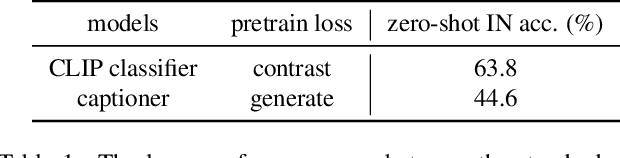
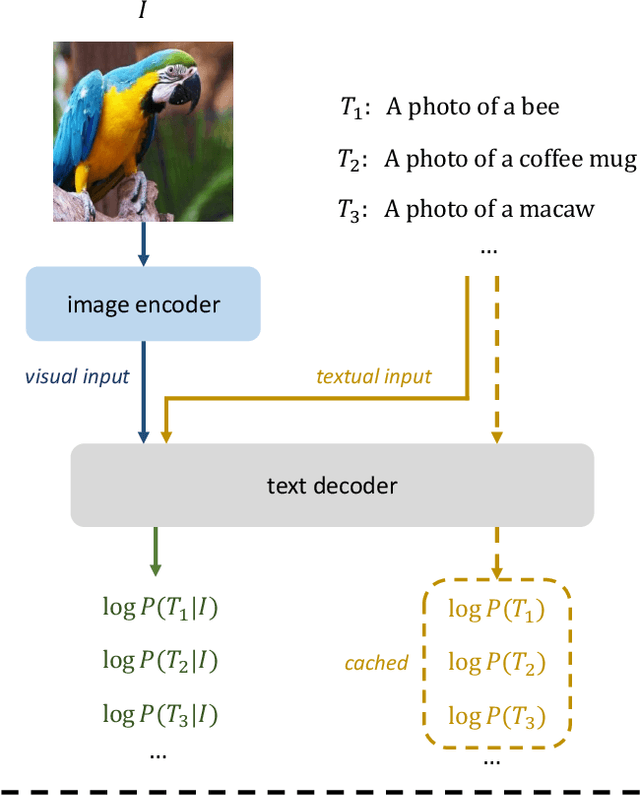

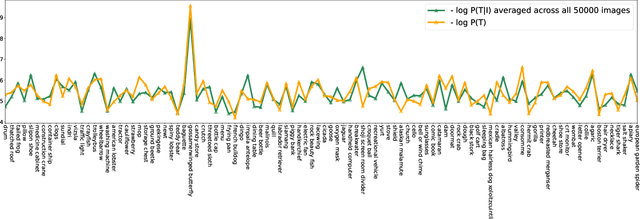
Generative training has been demonstrated to be powerful for building visual-language models. However, on zero-shot discriminative benchmarks, there is still a performance gap between models trained with generative and discriminative objectives. In this paper, we aim to narrow this gap by improving the efficacy of generative training on classification tasks, without any finetuning processes or additional modules. Specifically, we focus on narrowing the gap between the generative captioner and the CLIP classifier. We begin by analysing the predictions made by the captioner and classifier and observe that the caption generation inherits the distribution bias from the language model trained with pure text modality, making it less grounded on the visual signal. To tackle this problem, we redesign the scoring objective for the captioner to alleviate the distributional bias and focus on measuring the gain of information brought by the visual inputs. We further design a generative training objective to match the evaluation objective. We name our model trained and evaluated from the novel procedures as Information Gain (IG) captioner. We pretrain the models on the public Laion-5B dataset and perform a series of discriminative evaluations. For the zero-shot classification on ImageNet, IG captioner achieves $> 18\%$ improvements over the standard captioner, achieving comparable performances with the CLIP classifier. IG captioner also demonstrated strong performance on zero-shot image-text retrieval tasks on MSCOCO and Flickr30K. We hope this paper inspires further research towards unifying generative and discriminative training procedures for visual-language models.
ViP-Mixer: A Convolutional Mixer for Video Prediction
Nov 20, 2023
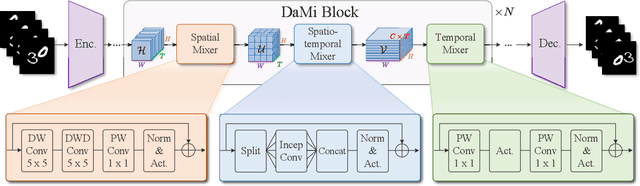
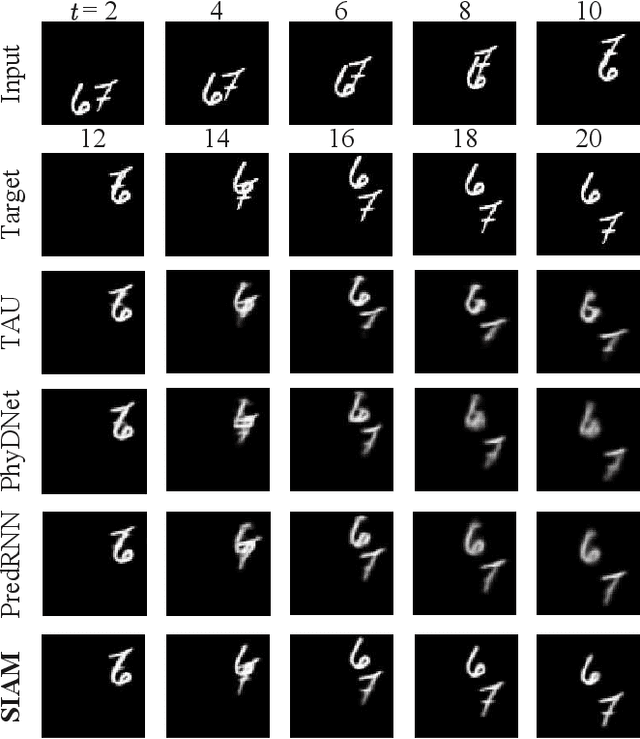
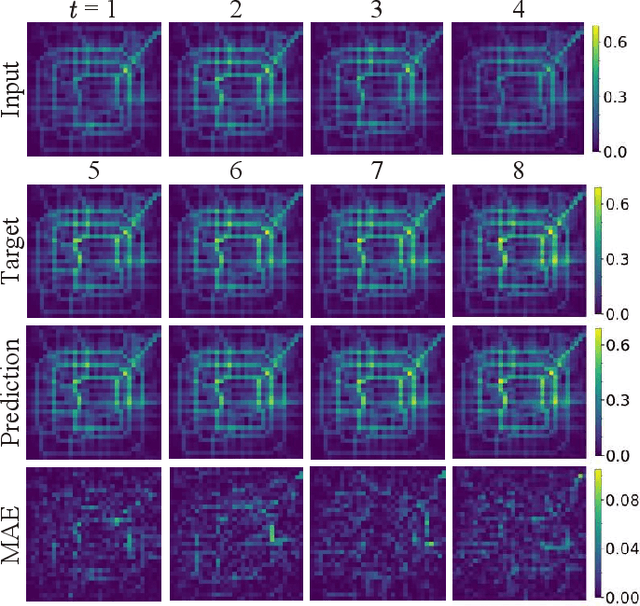
Video prediction aims to predict future frames from a video's previous content. Existing methods mainly process video data where the time dimension mingles with the space and channel dimensions from three distinct angles: as a sequence of individual frames, as a 3D volume in spatiotemporal coordinates, or as a stacked image where frames are treated as separate channels. Most of them generally focus on one of these perspectives and may fail to fully exploit the relationships across different dimensions. To address this issue, this paper introduces a convolutional mixer for video prediction, termed ViP-Mixer, to model the spatiotemporal evolution in the latent space of an autoencoder. The ViP-Mixers are stacked sequentially and interleave feature mixing at three levels: frames, channels, and locations. Extensive experiments demonstrate that our proposed method achieves new state-of-the-art prediction performance on three benchmark video datasets covering both synthetic and real-world scenarios.
RoboVQA: Multimodal Long-Horizon Reasoning for Robotics
Nov 01, 2023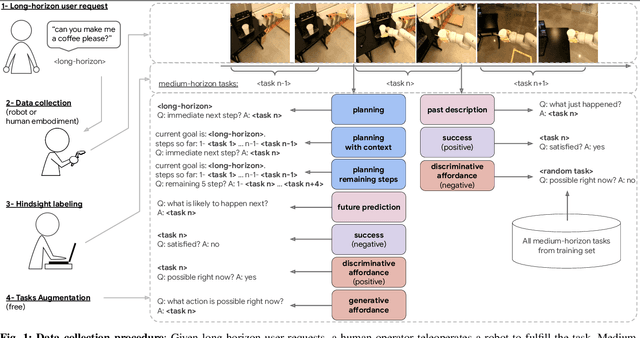
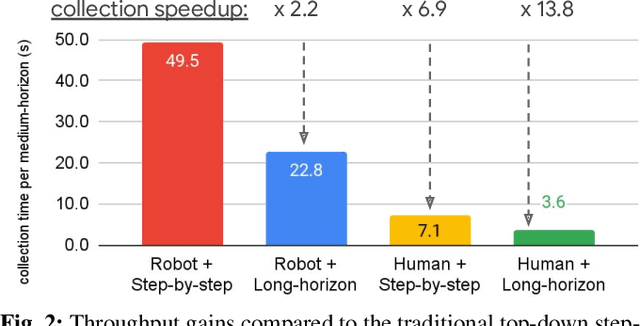
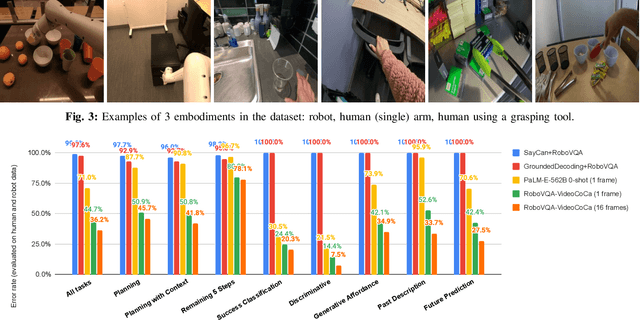
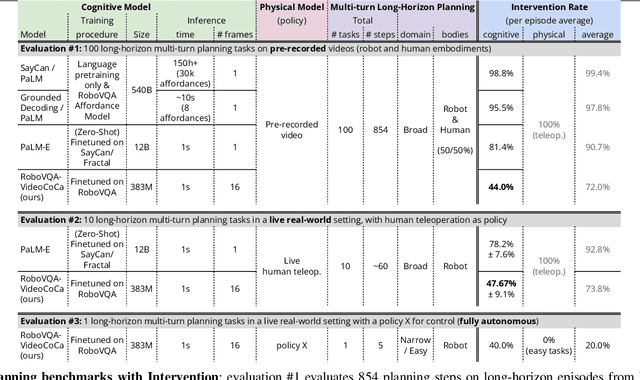
We present a scalable, bottom-up and intrinsically diverse data collection scheme that can be used for high-level reasoning with long and medium horizons and that has 2.2x higher throughput compared to traditional narrow top-down step-by-step collection. We collect realistic data by performing any user requests within the entirety of 3 office buildings and using multiple robot and human embodiments. With this data, we show that models trained on all embodiments perform better than ones trained on the robot data only, even when evaluated solely on robot episodes. We find that for a fixed collection budget it is beneficial to take advantage of cheaper human collection along with robot collection. We release a large and highly diverse (29,520 unique instructions) dataset dubbed RoboVQA containing 829,502 (video, text) pairs for robotics-focused visual question answering. We also demonstrate how evaluating real robot experiments with an intervention mechanism enables performing tasks to completion, making it deployable with human oversight even if imperfect while also providing a single performance metric. We demonstrate a single video-conditioned model named RoboVQA-VideoCoCa trained on our dataset that is capable of performing a variety of grounded high-level reasoning tasks in broad realistic settings with a cognitive intervention rate 46% lower than the zero-shot state of the art visual language model (VLM) baseline and is able to guide real robots through long-horizon tasks. The performance gap with zero-shot state-of-the-art models indicates that a lot of grounded data remains to be collected for real-world deployment, emphasizing the critical need for scalable data collection approaches. Finally, we show that video VLMs significantly outperform single-image VLMs with an average error rate reduction of 19% across all VQA tasks. Data and videos available at https://robovqa.github.io
Benign Overfitting in Two-Layer ReLU Convolutional Neural Networks for XOR Data
Oct 03, 2023Modern deep learning models are usually highly over-parameterized so that they can overfit the training data. Surprisingly, such overfitting neural networks can usually still achieve high prediction accuracy. To study this "benign overfitting" phenomenon, a line of recent works has theoretically studied the learning of linear models and two-layer neural networks. However, most of these analyses are still limited to the very simple learning problems where the Bayes-optimal classifier is linear. In this work, we investigate a class of XOR-type classification tasks with label-flipping noises. We show that, under a certain condition on the sample complexity and signal-to-noise ratio, an over-parameterized ReLU CNN trained by gradient descent can achieve near Bayes-optimal accuracy. Moreover, we also establish a matching lower bound result showing that when the previous condition is not satisfied, the prediction accuracy of the obtained CNN is an absolute constant away from the Bayes-optimal rate. Our result demonstrates that CNNs have a remarkable capacity to efficiently learn XOR problems, even in the presence of highly correlated features.