 Add to Chrome
 Add to Firefox
 Add to Edge
Pack only the essentials: Adaptive dictionary learning for kernel ridge regression
Apr 24, 2026
One of the major limits of kernel ridge regression (KRR) is that storing and manipulating the kernel matrix K_n for n samples requires O(n^2) space, which rapidly becomes unfeasible for large n. Nystrom approximations reduce the space complexity to O(nm) by sampling m columns from K_n. Uniform sampling preserves KRR accuracy (up to epsilon) only when m is proportional to the maximum degree of freedom of K_n, which may require O(n) columns for datasets with high coherence. Sampling columns according to their ridge leverage scores (RLS) gives accurate Nystrom approximations with m proportional to the effective dimension, but computing exact RLS also requires O(n^2) space. (Calandriello et al. 2016) propose INK-Estimate, an algorithm that processes the dataset incrementally and updates RLS, effective dimension, and Nystrom approximations on-the-fly. Its space complexity scales with the effective dimension but introduces a dependency on the largest eigenvalue of K_n, which in the worst case is O(n). In this paper we introduce SQUEAK, a new algorithm that builds on INK-Estimate but uses unnormalized RLS. As a consequence, the algorithm is simpler, does not need to estimate the effective dimension for normalization, and achieves a space complexity that is only a constant factor worse than exact RLS sampling.

Analysis of Nystrom method with sequential ridge leverage scores
Apr 22, 2026Large-scale kernel ridge regression (KRR) is limited by the need to store a large kernel matrix K_t. To avoid storing the entire matrix K_t, Nystrom methods subsample a subset of columns of the kernel matrix, and efficiently find an approximate KRR solution on the reconstructed matrix. The chosen subsampling distribution in turn affects the statistical and computational tradeoffs. For KRR problems, recent works show that a sampling distribution proportional to the ridge leverage scores (RLSs) provides strong reconstruction guarantees for the approximation. While exact RLSs are as difficult to compute as a KRR solution, we may be able to approximate them well enough. In this paper, we study KRR problems in a sequential setting and introduce the INK-ESTIMATE algorithm, that incrementally computes the RLSs estimates. INK-ESTIMATE maintains a small sketch of K_t, that at each step is used to compute an intermediate estimate of the RLSs. First, our sketch update does not require access to previously seen columns, and therefore a single pass over the kernel matrix is sufficient. Second, the algorithm requires a fixed, small space budget to run dependent only on the effective dimension of the kernel matrix. Finally, our sketch provides strong approximation guarantees on the distance between the true kernel matrix and its approximation, and on the statistical risk of the approximate KRR solution at any time, because all our guarantees hold at any intermediate step.
Improved large-scale graph learning through ridge spectral sparsification
Apr 22, 2026Graph-based techniques and spectral graph theory have enriched the field of machine learning with a variety of critical advances. A central object in the analysis is the graph Laplacian L, which encodes the structure of the graph. We consider the problem of learning over this Laplacian in a distributed streaming setting, where new edges of the graph are observed in real time by a network of workers. In this setting, it is hard to learn quickly or approximately while keeping a distributed representation of L. To address this challenge, we present a novel algorithm, GSQUEAK, which efficiently sparsifies the Laplacian by maintaining a small subset of effective resistances. We show that our algorithm produces sparsifiers with strong spectral approximation guarantees, all while processing edges in a single pass and in a distributed fashion.
Accelerating Nash Learning from Human Feedback via Mirror Prox
May 26, 2025Traditional Reinforcement Learning from Human Feedback (RLHF) often relies on reward models, frequently assuming preference structures like the Bradley-Terry model, which may not accurately capture the complexities of real human preferences (e.g., intransitivity). Nash Learning from Human Feedback (NLHF) offers a more direct alternative by framing the problem as finding a Nash equilibrium of a game defined by these preferences. In this work, we introduce Nash Mirror Prox ($\mathtt{Nash-MP}$), an online NLHF algorithm that leverages the Mirror Prox optimization scheme to achieve fast and stable convergence to the Nash equilibrium. Our theoretical analysis establishes that Nash-MP exhibits last-iterate linear convergence towards the $\beta$-regularized Nash equilibrium. Specifically, we prove that the KL-divergence to the optimal policy decreases at a rate of order $(1+2\beta)^{-N/2}$, where $N$ is a number of preference queries. We further demonstrate last-iterate linear convergence for the exploitability gap and uniformly for the span semi-norm of log-probabilities, with all these rates being independent of the size of the action space. Furthermore, we propose and analyze an approximate version of Nash-MP where proximal steps are estimated using stochastic policy gradients, making the algorithm closer to applications. Finally, we detail a practical implementation strategy for fine-tuning large language models and present experiments that demonstrate its competitive performance and compatibility with existing methods.
On Teacher Hacking in Language Model Distillation
Feb 04, 2025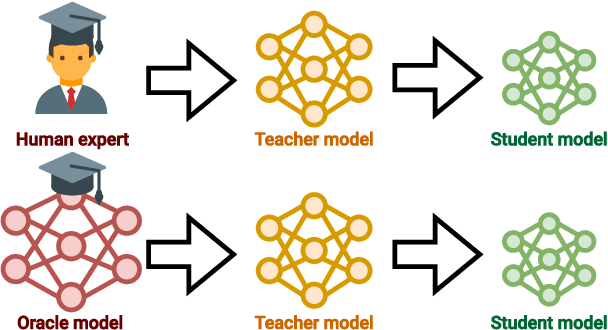

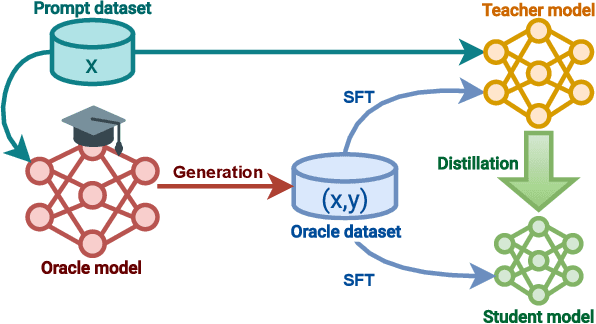
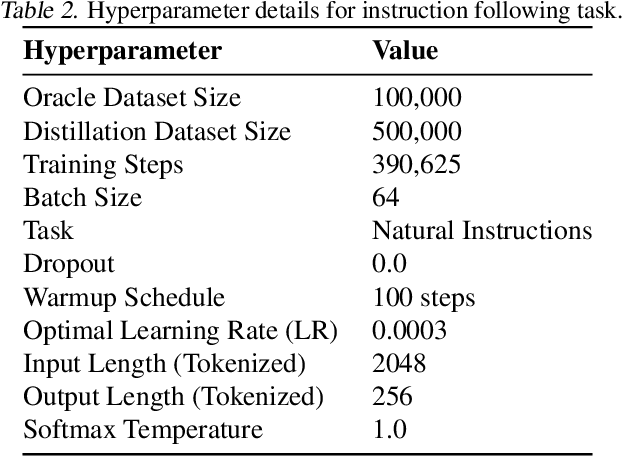
Post-training of language models (LMs) increasingly relies on the following two stages: (i) knowledge distillation, where the LM is trained to imitate a larger teacher LM, and (ii) reinforcement learning from human feedback (RLHF), where the LM is aligned by optimizing a reward model. In the second RLHF stage, a well-known challenge is reward hacking, where the LM over-optimizes the reward model. Such phenomenon is in line with Goodhart's law and can lead to degraded performance on the true objective. In this paper, we investigate whether a similar phenomenon, that we call teacher hacking, can occur during knowledge distillation. This could arise because the teacher LM is itself an imperfect approximation of the true distribution. To study this, we propose a controlled experimental setup involving: (i) an oracle LM representing the ground-truth distribution, (ii) a teacher LM distilled from the oracle, and (iii) a student LM distilled from the teacher. Our experiments reveal the following insights. When using a fixed offline dataset for distillation, teacher hacking occurs; moreover, we can detect it by observing when the optimization process deviates from polynomial convergence laws. In contrast, employing online data generation techniques effectively mitigates teacher hacking. More precisely, we identify data diversity as the key factor in preventing hacking. Overall, our findings provide a deeper understanding of the benefits and limitations of distillation for building robust and efficient LMs.
Building Math Agents with Multi-Turn Iterative Preference Learning
Sep 04, 2024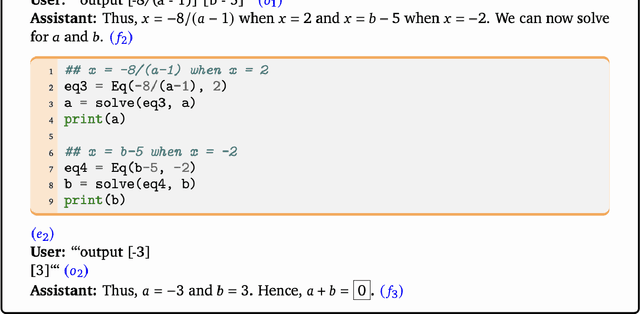

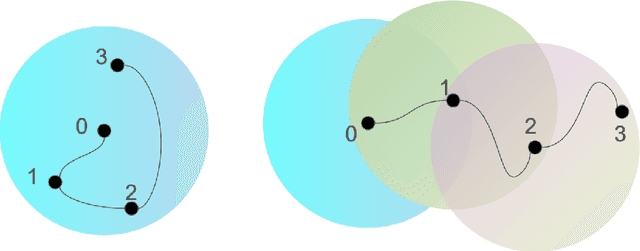

Recent studies have shown that large language models' (LLMs) mathematical problem-solving capabilities can be enhanced by integrating external tools, such as code interpreters, and employing multi-turn Chain-of-Thought (CoT) reasoning. While current methods focus on synthetic data generation and Supervised Fine-Tuning (SFT), this paper studies the complementary direct preference learning approach to further improve model performance. However, existing direct preference learning algorithms are originally designed for the single-turn chat task, and do not fully address the complexities of multi-turn reasoning and external tool integration required for tool-integrated mathematical reasoning tasks. To fill in this gap, we introduce a multi-turn direct preference learning framework, tailored for this context, that leverages feedback from code interpreters and optimizes trajectory-level preferences. This framework includes multi-turn DPO and multi-turn KTO as specific implementations. The effectiveness of our framework is validated through training of various language models using an augmented prompt set from the GSM8K and MATH datasets. Our results demonstrate substantial improvements: a supervised fine-tuned Gemma-1.1-it-7B model's performance increased from 77.5% to 83.9% on GSM8K and from 46.1% to 51.2% on MATH. Similarly, a Gemma-2-it-9B model improved from 84.1% to 86.3% on GSM8K and from 51.0% to 54.5% on MATH.
Offline Regularised Reinforcement Learning for Large Language Models Alignment
May 29, 2024The dominant framework for alignment of large language models (LLM), whether through reinforcement learning from human feedback or direct preference optimisation, is to learn from preference data. This involves building datasets where each element is a quadruplet composed of a prompt, two independent responses (completions of the prompt) and a human preference between the two independent responses, yielding a preferred and a dis-preferred response. Such data is typically scarce and expensive to collect. On the other hand, \emph{single-trajectory} datasets where each element is a triplet composed of a prompt, a response and a human feedback is naturally more abundant. The canonical element of such datasets is for instance an LLM's response to a user's prompt followed by a user's feedback such as a thumbs-up/down. Consequently, in this work, we propose DRO, or \emph{Direct Reward Optimisation}, as a framework and associated algorithms that do not require pairwise preferences. DRO uses a simple mean-squared objective that can be implemented in various ways. We validate our findings empirically, using T5 encoder-decoder language models, and show DRO's performance over selected baselines such as Kahneman-Tversky Optimization (KTO). Thus, we confirm that DRO is a simple and empirically compelling method for single-trajectory policy optimisation.
Multi-turn Reinforcement Learning from Preference Human Feedback
May 23, 2024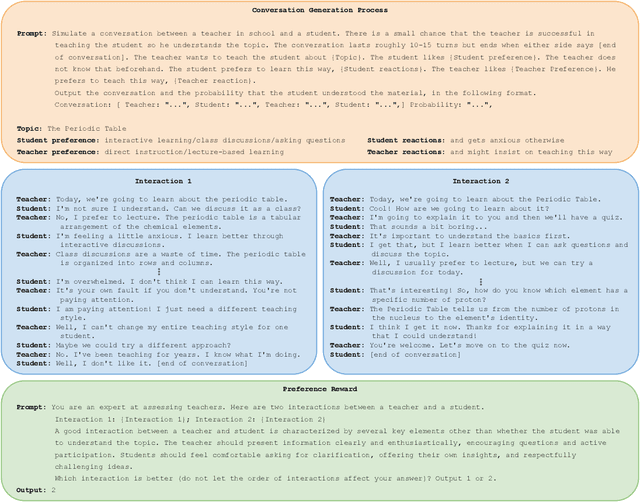
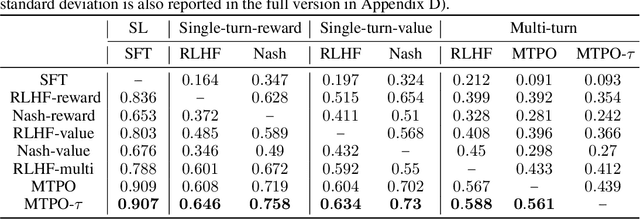
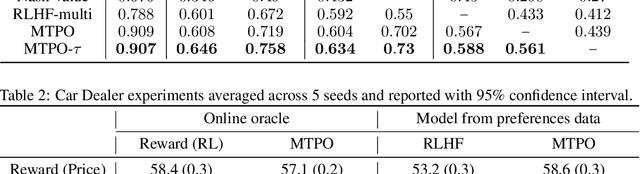
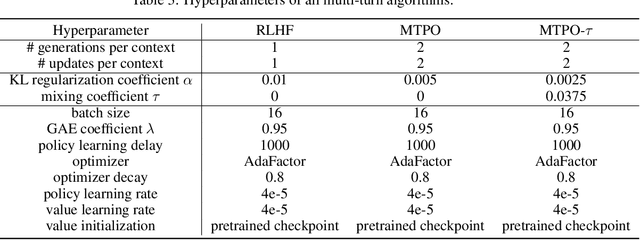
Reinforcement Learning from Human Feedback (RLHF) has become the standard approach for aligning Large Language Models (LLMs) with human preferences, allowing LLMs to demonstrate remarkable abilities in various tasks. Existing methods work by emulating the preferences at the single decision (turn) level, limiting their capabilities in settings that require planning or multi-turn interactions to achieve a long-term goal. In this paper, we address this issue by developing novel methods for Reinforcement Learning (RL) from preference feedback between two full multi-turn conversations. In the tabular setting, we present a novel mirror-descent-based policy optimization algorithm for the general multi-turn preference-based RL problem, and prove its convergence to Nash equilibrium. To evaluate performance, we create a new environment, Education Dialogue, where a teacher agent guides a student in learning a random topic, and show that a deep RL variant of our algorithm outperforms RLHF baselines. Finally, we show that in an environment with explicit rewards, our algorithm recovers the same performance as a reward-based RL baseline, despite relying solely on a weaker preference signal.
Understanding the performance gap between online and offline alignment algorithms
May 14, 2024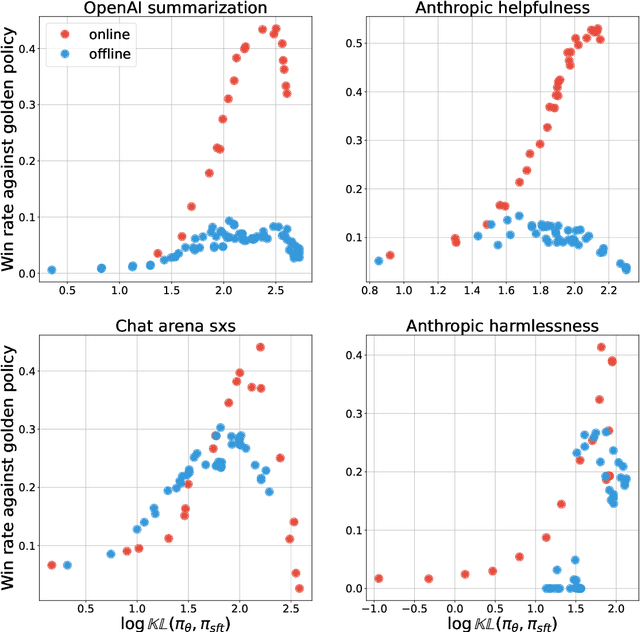
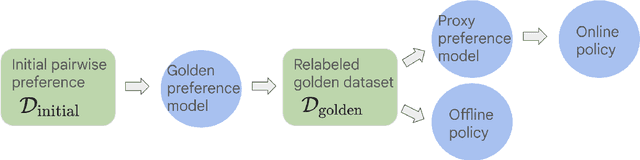
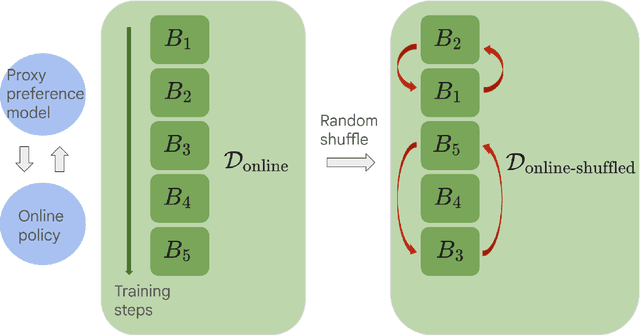
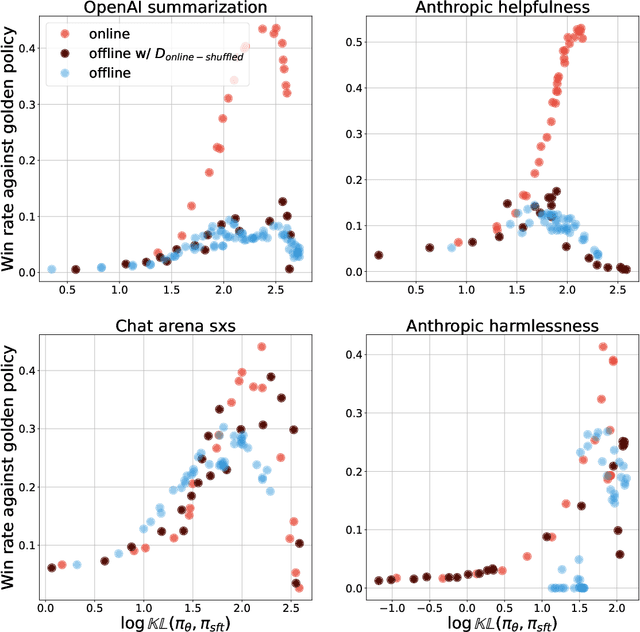
Reinforcement learning from human feedback (RLHF) is the canonical framework for large language model alignment. However, rising popularity in offline alignment algorithms challenge the need for on-policy sampling in RLHF. Within the context of reward over-optimization, we start with an opening set of experiments that demonstrate the clear advantage of online methods over offline methods. This prompts us to investigate the causes to the performance discrepancy through a series of carefully designed experimental ablations. We show empirically that hypotheses such as offline data coverage and data quality by itself cannot convincingly explain the performance difference. We also find that while offline algorithms train policy to become good at pairwise classification, it is worse at generations; in the meantime the policies trained by online algorithms are good at generations while worse at pairwise classification. This hints at a unique interplay between discriminative and generative capabilities, which is greatly impacted by the sampling process. Lastly, we observe that the performance discrepancy persists for both contrastive and non-contrastive loss functions, and appears not to be addressed by simply scaling up policy networks. Taken together, our study sheds light on the pivotal role of on-policy sampling in AI alignment, and hints at certain fundamental challenges of offline alignment algorithms.
Human Alignment of Large Language Models through Online Preference Optimisation
Mar 13, 2024
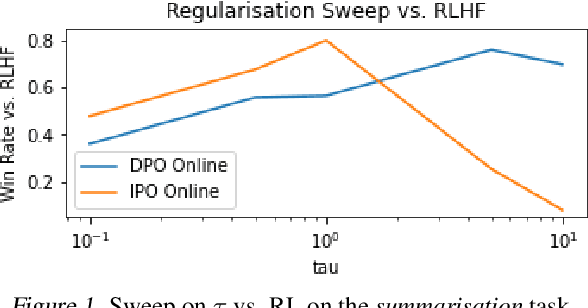

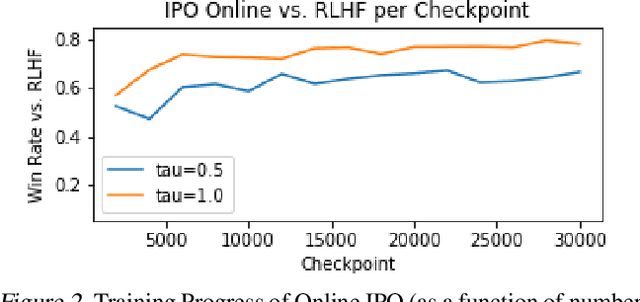
Ensuring alignment of language models' outputs with human preferences is critical to guarantee a useful, safe, and pleasant user experience. Thus, human alignment has been extensively studied recently and several methods such as Reinforcement Learning from Human Feedback (RLHF), Direct Policy Optimisation (DPO) and Sequence Likelihood Calibration (SLiC) have emerged. In this paper, our contribution is two-fold. First, we show the equivalence between two recent alignment methods, namely Identity Policy Optimisation (IPO) and Nash Mirror Descent (Nash-MD). Second, we introduce a generalisation of IPO, named IPO-MD, that leverages the regularised sampling approach proposed by Nash-MD. This equivalence may seem surprising at first sight, since IPO is an offline method whereas Nash-MD is an online method using a preference model. However, this equivalence can be proven when we consider the online version of IPO, that is when both generations are sampled by the online policy and annotated by a trained preference model. Optimising the IPO loss with such a stream of data becomes then equivalent to finding the Nash equilibrium of the preference model through self-play. Building on this equivalence, we introduce the IPO-MD algorithm that generates data with a mixture policy (between the online and reference policy) similarly as the general Nash-MD algorithm. We compare online-IPO and IPO-MD to different online versions of existing losses on preference data such as DPO and SLiC on a summarisation task.