 Add to Chrome
 Add to Firefox
 Add to Edge
Physics-Informed Implicit Neural Representations for Improved Myocardial Perfusion MRI Quantification
Aug 11, 2026
Quantifying myocardial perfusion from cardiac magnetic resonance (CMR) can be achieved by fitting tracer-kinetic models to the dynamic contrast-enhanced MR data. However, fitting the observed data with multi-compartment exchange models, which describe the evolution of the contrast agent in the tissue, to estimate perfusion parameters is a challenging inverse problem that is sensitive to noise and acquisition variability. Previously, physics-informed neural networks (PINNs) have been proposed as an alternative to conventional non-linear least squares fitting methods with promising results for quantitative perfusion CMR. In this work, we extend the previously proposed PINN framework with spatiotemporal implicit neural representations (INRs) to represent the MR signal as a continuous spatiotemporal function and to improve the accuracy, smoothness, and physical consistency of the PINN model. In realistic simulated CMR datasets, our proposed PINN with INRs demonstrates improved robustness and parameter estimation accuracy over the previously established methods. The code is available at https://github.com/q-cardIA/pinn-inr.

Perovskite-LLM: Knowledge-Enhanced Large Language Models for Perovskite Solar Cell Research
Feb 18, 2025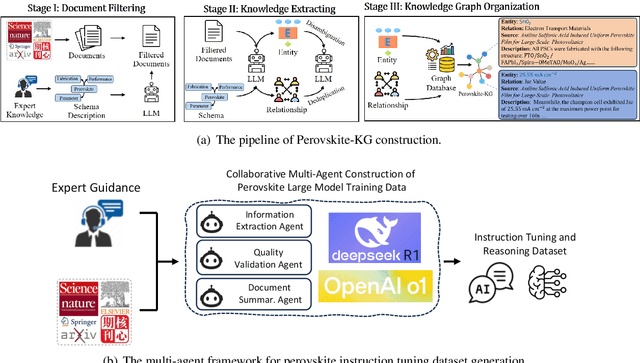
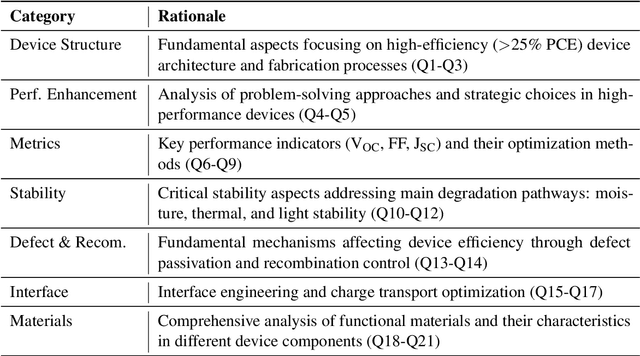

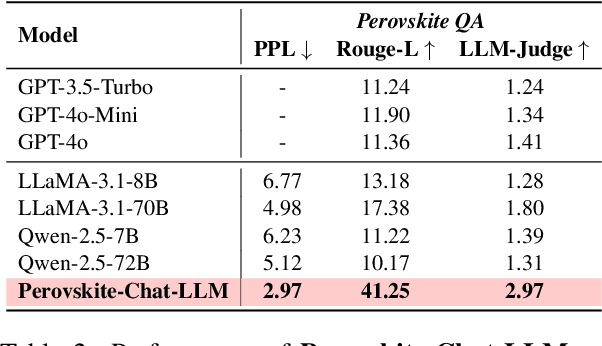
The rapid advancement of perovskite solar cells (PSCs) has led to an exponential growth in research publications, creating an urgent need for efficient knowledge management and reasoning systems in this domain. We present a comprehensive knowledge-enhanced system for PSCs that integrates three key components. First, we develop Perovskite-KG, a domain-specific knowledge graph constructed from 1,517 research papers, containing 23,789 entities and 22,272 relationships. Second, we create two complementary datasets: Perovskite-Chat, comprising 55,101 high-quality question-answer pairs generated through a novel multi-agent framework, and Perovskite-Reasoning, containing 2,217 carefully curated materials science problems. Third, we introduce two specialized large language models: Perovskite-Chat-LLM for domain-specific knowledge assistance and Perovskite-Reasoning-LLM for scientific reasoning tasks. Experimental results demonstrate that our system significantly outperforms existing models in both domain-specific knowledge retrieval and scientific reasoning tasks, providing researchers with effective tools for literature review, experimental design, and complex problem-solving in PSC research.
Label Propagation via Random Walk for Training Robust Thalamus Nuclei Parcellation Model from Noisy Annotations
Mar 30, 2023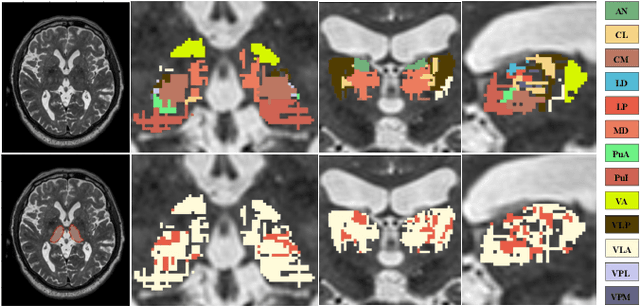
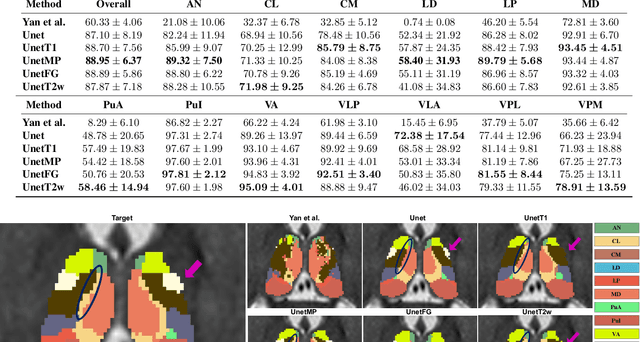
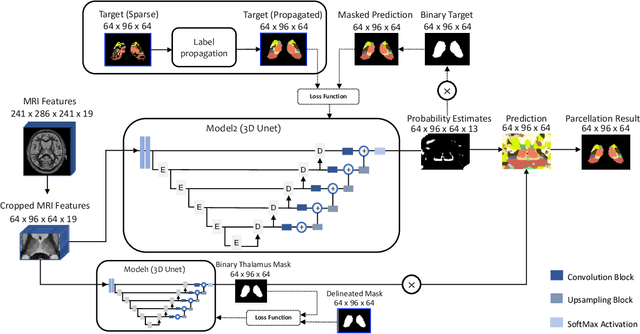
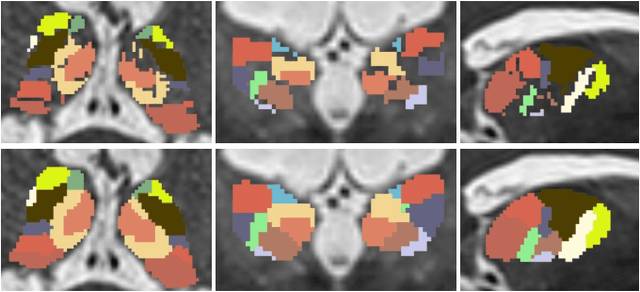
Data-driven thalamic nuclei parcellation depends on high-quality manual annotations. However, the small size and low contrast changes among thalamic nuclei, yield annotations that are often incomplete, noisy, or ambiguously labelled. To train a robust thalamic nuclei parcellation model with noisy annotations, we propose a label propagation algorithm based on random walker to refine the annotations before model training. A two-step model was trained to generate first the whole thalamus and then the nuclei masks. We conducted experiments on a mild traumatic brain injury~(mTBI) dataset with noisy thalamic nuclei annotations. Our model outperforms current state-of-the-art thalamic nuclei parcellations by a clear margin. We believe our method can also facilitate the training of other parcellation models with noisy labels.
Segmenting thalamic nuclei from manifold projections of multi-contrast MRI
Jan 15, 2023The thalamus is a subcortical gray matter structure that plays a key role in relaying sensory and motor signals within the brain. Its nuclei can atrophy or otherwise be affected by neurological disease and injuries including mild traumatic brain injury. Segmenting both the thalamus and its nuclei is challenging because of the relatively low contrast within and around the thalamus in conventional magnetic resonance (MR) images. This paper explores imaging features to determine key tissue signatures that naturally cluster, from which we can parcellate thalamic nuclei. Tissue contrasts include T1-weighted and T2-weighted images, MR diffusion measurements including FA, mean diffusivity, Knutsson coefficients that represent fiber orientation, and synthetic multi-TI images derived from FGATIR and T1-weighted images. After registration of these contrasts and isolation of the thalamus, we use the uniform manifold approximation and projection (UMAP) method for dimensionality reduction to produce a low-dimensional representation of the data within the thalamus. Manual labeling of the thalamus provides labels for our UMAP embedding from which k nearest neighbors can be used to label new unseen voxels in that same UMAP embedding. N -fold cross-validation of the method reveals comparable performance to state-of-the-art methods for thalamic parcellation.