 Add to Chrome
 Add to Firefox
 Add to Edge
LEDGERMIND: Provenance-Constrained Multimodal Agentic Reasoning with a Structured Evidence Ledger
Jul 30, 2026
Multimodal agents for visual question answering increasingly operate as multi-step trajectories that interleave perception, retrieval, and reasoning, yet evaluation still largely reduces to final-answer accuracy. This aggregate signal cannot tell whether a correct answer was reached through grounded evidence, language priors, or accidental error cancellation. We propose to treat a multimodal agent trajectory as a provenance-constrained state machine: tool outputs are normalized into a Structured Evidence Ledger that serves as the trajectory state, downstream reasoning and decision claims may cite only active ledger entries, grounding is checked at the entity and numeric level, and repair is realized as typed state transitions that cannot introduce content without tool-produced provenance. We instantiate this design as LedgerMind (Provenance-Constrained Multimodal Agentic Reasoning with a Structured Evidence Ledger), augmented by a Three-Layer Grounding Protocol, an Adaptive Dual-Path Dispatcher that matches reasoning depth to question complexity, and an Event-Triggered Verification-and-Repair engine with a formal provenance non-amplification guarantee. We use LedgerMind to target four recurring failure patterns that final-answer accuracy tends to obscure: unsupported intermediate reasoning, citation-backed entity hallucination (Phantom Grounding), over-reasoning on simple queries, and repair-time amplification. Experiments across multiple multimodal reasoning benchmarks and backbone MLLMs show that LedgerMind improves both answer accuracy and trajectory-level faithfulness.

CARA: Concept-Aware Risk Attention for Interpretable Collision Anticipation
Jul 24, 2026Collision anticipation in autonomous driving requires not only accurate early warnings but also interpretable reasoning about what risk factors are being tracked and how risk evolves over time. Existing methods fall short in this regard: feature-driven models are opaque, post-hoc explanations often lack fidelity, and concept-based methods are mostly designed for static recognition rather than dynamic driving scenes. We propose CARA (Concept-Aware Risk Attention), an intrinsically interpretable spatio-temporal framework for collision anticipation. CARA derives domain-grounded risk concepts from accident narratives, aligns them with video frames via vision-language similarity, and organizes them into evolving concept trajectories. These trajectories provide explicit risk evidence that guides spatial attention, temporal attention, and anticipation, allowing semantic concepts to directly influence both where the model attends and how it predicts risk over time. By treating semantic risk factors as dynamic intermediate evidence rather than auxiliary post-hoc explanations, CARA tightly couples interpretability with the predictive process. Extensive experiments on three benchmarks show that CARA consistently improves anticipation accuracy and warning earliness over strong baselines, while providing sparse and semantically grounded concept evidence.
Mixture of Length and Pruning Experts for Knowledge Graphs Reasoning
Jul 28, 2025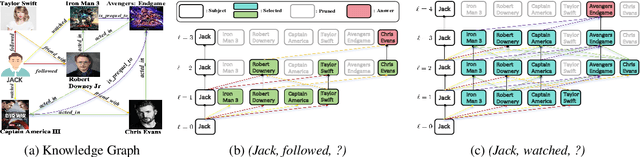
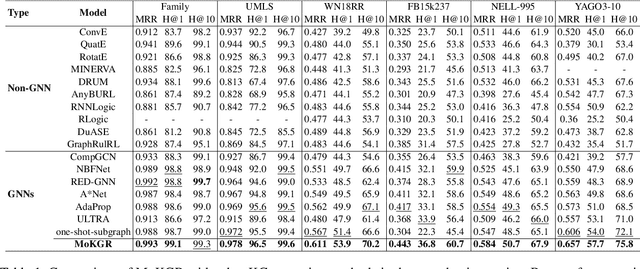
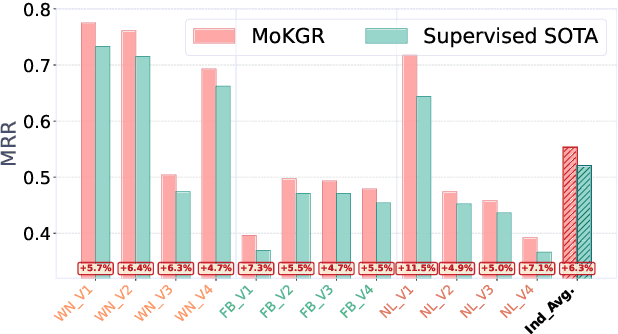
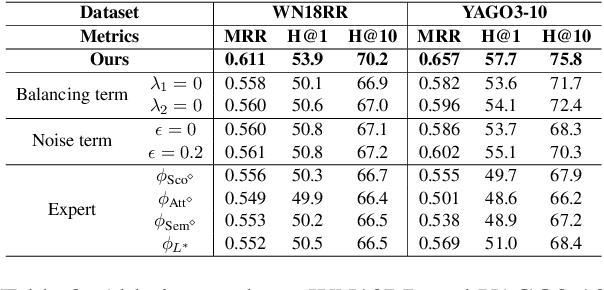
Knowledge Graph (KG) reasoning, which aims to infer new facts from structured knowledge repositories, plays a vital role in Natural Language Processing (NLP) systems. Its effectiveness critically depends on constructing informative and contextually relevant reasoning paths. However, existing graph neural networks (GNNs) often adopt rigid, query-agnostic path-exploration strategies, limiting their ability to adapt to diverse linguistic contexts and semantic nuances. To address these limitations, we propose \textbf{MoKGR}, a mixture-of-experts framework that personalizes path exploration through two complementary components: (1) a mixture of length experts that adaptively selects and weights candidate path lengths according to query complexity, providing query-specific reasoning depth; and (2) a mixture of pruning experts that evaluates candidate paths from a complementary perspective, retaining the most informative paths for each query. Through comprehensive experiments on diverse benchmark, MoKGR demonstrates superior performance in both transductive and inductive settings, validating the effectiveness of personalized path exploration in KGs reasoning.
GraphOracle: A Foundation Model for Knowledge Graph Reasoning
May 16, 2025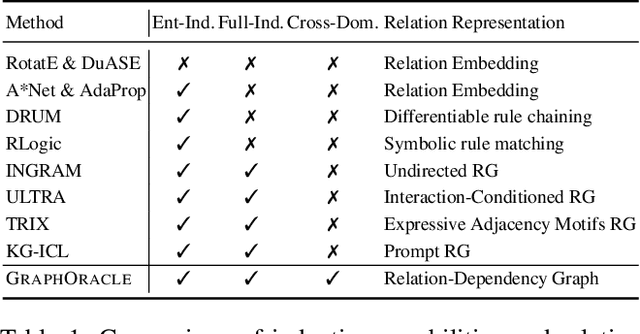
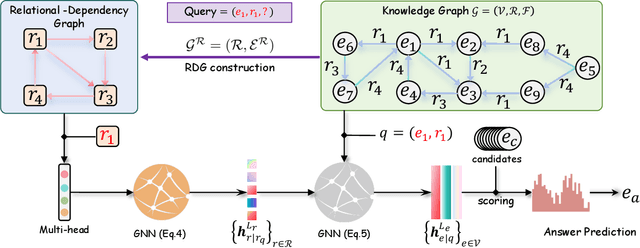


Foundation models have demonstrated remarkable capabilities across various domains, but developing analogous models for knowledge graphs presents unique challenges due to their dynamic nature and the need for cross-domain reasoning. To address these issues, we introduce \textbf{\textsc{GraphOracle}}, a relation-centric foundation model that unifies reasoning across knowledge graphs by converting them into Relation-Dependency Graphs (RDG), explicitly encoding compositional patterns with fewer edges than prior methods. A query-dependent attention mechanism is further developed to learn inductive representations for both relations and entities. Pre-training on diverse knowledge graphs, followed by minutes-level fine-tuning, enables effective generalization to unseen entities, relations, and entire graphs. Through comprehensive experiments on 31 diverse benchmarks spanning transductive, inductive, and cross-domain settings, we demonstrate consistent state-of-the-art performance with minimal adaptation, improving the prediction performance by up to 35\% compared to the strongest baselines.
GraphMaster: Automated Graph Synthesis via LLM Agents in Data-Limited Environments
Apr 01, 2025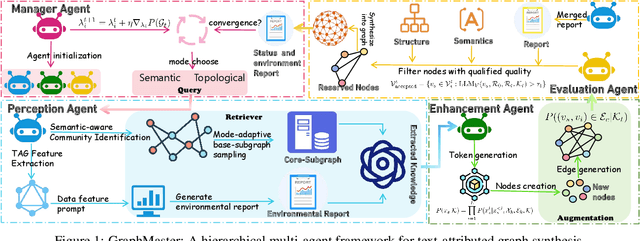
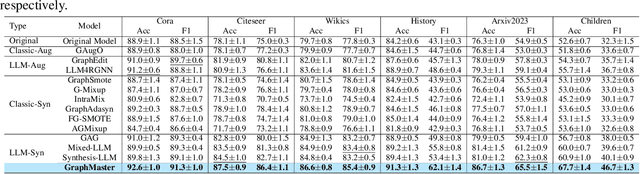
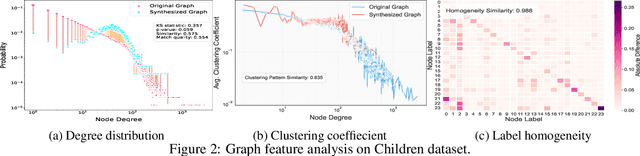
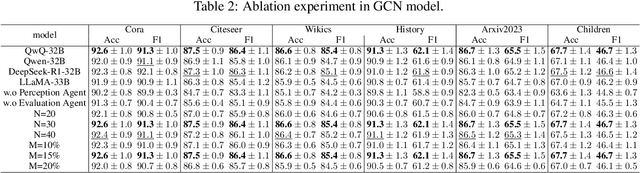
The era of foundation models has revolutionized AI research, yet Graph Foundation Models (GFMs) remain constrained by the scarcity of large-scale graph corpora. Traditional graph data synthesis techniques primarily focus on simplistic structural operations, lacking the capacity to generate semantically rich nodes with meaningful textual attributes: a critical limitation for real-world applications. While large language models (LLMs) demonstrate exceptional text generation capabilities, their direct application to graph synthesis is impeded by context window limitations, hallucination phenomena, and structural consistency challenges. To address these issues, we introduce GraphMaster, the first multi-agent framework specifically designed for graph data synthesis in data-limited environments. GraphMaster orchestrates four specialized LLM agents (Manager, Perception, Enhancement, and Evaluation) that collaboratively optimize the synthesis process through iterative refinement, ensuring both semantic coherence and structural integrity. To rigorously evaluate our approach, we create new data-limited "Sub" variants of six standard graph benchmarks, specifically designed to test synthesis capabilities under realistic constraints. Additionally, we develop a novel interpretability assessment framework that combines human evaluation with a principled Grassmannian manifold-based analysis, providing both qualitative and quantitative measures of semantic coherence. Experimental results demonstrate that GraphMaster significantly outperforms traditional synthesis methods across multiple datasets, establishing a strong foundation for advancing GFMs in data-scarce environments.
Unifying Structure and Activation: A Comprehensive Approach of Parameter and Memory Efficient Transfer Learning
Mar 11, 2025Parameter-efficient transfer learning (PETL) aims to reduce the scales of pre-trained models for multiple downstream tasks. However, as the models keep scaling up, the memory footprint of existing PETL methods is not significantly reduced compared to the reduction of learnable parameters. This limitation hinders the practical deployment of PETL methods on memory-constrained devices. To this end, we proposed a new PETL framework, called Structure to Activation (S2A), to reduce the memory footprint of activation during fine-tuning. Specifically, our framework consists of: 1)Activation modules design(i.e. bias, prompt and side modules) in the parametric model structure, which results in a significant reduction of adjustable parameters and activation memory 2) 4-bit quantisation of activations based on their derivatives for non-parametric structures (e.g., nonlinear functions), which maintains accuracy while significantly reducing memory usage. Our S2A method consequently offers a lightweight solution in terms of both parameter and memory footprint. We evaluate S2A with different backbones and conduct extensive experiments on various datasets to evaluate the effectiveness. The results show that our method not only outperforms existing PETL techniques, achieving a fourfold reduction in GPU memory footprint on average, but also shows competitive performance in accuracy with lower tunable parameters. These also demonstrate that our method is highly suitable for practical transfer learning on hardware-constrained devices.