 Add to Chrome
 Add to Firefox
 Add to Edge
DASH-OPD: Discrepancy-Aware Switching with Hysteresis for On-Policy Distillation
Jul 31, 2026
On-policy distillation (OPD) trains student models on their own rollouts to reduce exposure bias. However, in multi-turn agent scenarios, early student errors can lead a trajectory away from the teacher's familiar domain. Existing curriculum learning methods regulate how much teacher support is used according to training progress, but cannot determine when it is needed. In light of this, we propose DASH-OPD, Discrepancy-Aware Switching with Hysteresis for OPD, a new agentic OPD method that can switch executors adaptively and bidirectionally. On each turn, DASH-OPD calculates a mean log-probability ratio between the two executors over action tokens as their discrepancy. Student-to-teacher ratios on student turns form drift signals, while teacher-to-student ratios on teacher turns form recovery signals. These signals are normalized and accumulated over multiple turns into drift and recovery evidence. DASH-OPD switches executors when the evidence exceeds its corresponding switching threshold. This multi turn accumulation makes the switching hysteretic, preventing high-frequency switches caused by transient fluctuations. On ALFWorld, DASH-OPD outperforms all the baselines and demonstrates superior training and deployment efficiency. This paper is a work in progress. Code, training logs, and model checkpoints will be released later.

Demystifying Reinforcement Learning for Long-Horizon Tool-Using Agents: A Comprehensive Recipe
Mar 23, 2026Reinforcement Learning (RL) is essential for evolving Large Language Models (LLMs) into autonomous agents capable of long-horizon planning, yet a practical recipe for scaling RL in complex, multi-turn environments remains elusive. This paper presents a systematic empirical study using TravelPlanner, a challenging testbed requiring tool orchestration to satisfy multifaceted constraints. We decompose the agentic RL design space along 5 axes: reward shaping, model scaling, data composition, algorithm selection, and environmental stability. Our controlled experiments yield 7 key takeaways, e.g., (1) reward and algorithm choices are scale-dependent as smaller models benefit from staged rewards and enhanced exploration, whereas larger models converge efficiently with simpler dense rewards, (2) ~ 1K training samples with a balanced difficulty mixture mark a sweet spot for both in-domain and out-of-domain performance, and (3) environmental stability is critical to prevent policy degradation. Based on our distilled recipe, our RL-trained models achieve state-of-the-art performance on TravelPlanner, significantly outperforming leading LLMs.
VSearcher: Long-Horizon Multimodal Search Agent via Reinforcement Learning
Mar 03, 2026Large models are increasingly becoming autonomous agents that interact with real-world environments and use external tools to augment their static capabilities. However, most recent progress has focused on text-only large language models, which are limited to a single modality and therefore have narrower application scenarios. On the other hand, multimodal large models, while offering stronger perceptual capabilities, remain limited to static knowledge and lack the ability to access and leverage up-to-date web information. In this paper, we propose VSearcher, turning static multimodal model into multimodal search agent capable of long-horizon, multi-turn tool use in real-world web environments, including text search, image search, and web browsing, via reinforcement learning. Specifically, we introduce Iterative Injection Data Synthesis pipeline to generate large-scale, complex multimodal QA questions, which are further filtered with comprehensive metrics to ensure high quality and sufficient difficulty. We then adopt an SFT-then-RL training pipeline to turn base multimodal models to agent capable of multi-turn tool calling in real-world web environments. Besides, we propose a multimodal search benchmark MM-SearchExam dedicated to evaluating search capabilities of multimodal search agents, which proves highly challenging for recent proprietary models. Extensive evaluations across multiple multimodal search benchmarks reveal effectiveness of our method. VSearcher achieves superior performance compared to recent multimodal search agents and even surpasses several proprietary models on multimodal web search tasks.
Linear Preference Optimization: Decoupled Gradient Control via Absolute Regularization
Aug 20, 2025DPO (Direct Preference Optimization) has become a widely used offline preference optimization algorithm due to its simplicity and training stability. However, DPO is prone to overfitting and collapse. To address these challenges, we propose Linear Preference Optimization (LPO), a novel alignment framework featuring three key innovations. First, we introduce gradient decoupling by replacing the log-sigmoid function with an absolute difference loss, thereby isolating the optimization dynamics. Second, we improve stability through an offset constraint combined with a positive regularization term to preserve the chosen response quality. Third, we implement controllable rejection suppression using gradient separation with straightforward estimation and a tunable coefficient that linearly regulates the descent of the rejection probability. Through extensive experiments, we demonstrate that LPO consistently improves performance on various tasks, including general text tasks, math tasks, and text-to-speech (TTS) tasks. These results establish LPO as a robust and tunable paradigm for preference alignment, and we release the source code, models, and training data publicly.
UniTTS: An end-to-end TTS system without decoupling of acoustic and semantic information
May 23, 2025The emergence of multi-codebook neutral audio codecs such as Residual Vector Quantization (RVQ) and Group Vector Quantization (GVQ) has significantly advanced Large-Language-Model (LLM) based Text-to-Speech (TTS) systems. These codecs are crucial in separating semantic and acoustic information while efficiently harnessing semantic priors. However, since semantic and acoustic information cannot be fully aligned, a significant drawback of these methods when applied to LLM-based TTS is that large language models may have limited access to comprehensive audio information. To address this limitation, we propose DistilCodec and UniTTS, which collectively offer the following advantages: 1) This method can distill a multi-codebook audio codec into a single-codebook audio codec with 32,768 codes while achieving a near 100\% utilization. 2) As DistilCodec does not employ a semantic alignment scheme, a large amount of high-quality unlabeled audio (such as audiobooks with sound effects, songs, etc.) can be incorporated during training, further expanding data diversity and broadening its applicability. 3) Leveraging the comprehensive audio information modeling of DistilCodec, we integrated three key tasks into UniTTS's pre-training framework: audio modality autoregression, text modality autoregression, and speech-text cross-modal autoregression. This allows UniTTS to accept interleaved text and speech/audio prompts while substantially preserving LLM's text capabilities. 4) UniTTS employs a three-stage training process: Pre-Training, Supervised Fine-Tuning (SFT), and Alignment. Source code and model checkpoints are publicly available at https://github.com/IDEA-Emdoor-Lab/UniTTS and https://github.com/IDEA-Emdoor-Lab/DistilCodec.
Never Lost in the Middle: Improving Large Language Models via Attention Strengthening Question Answering
Nov 15, 2023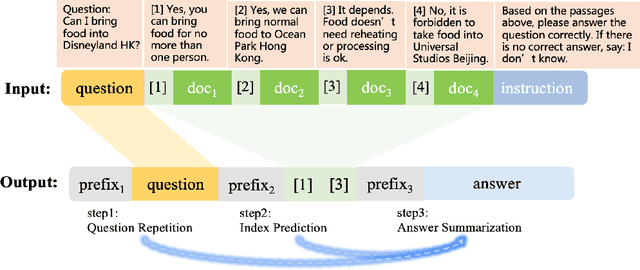
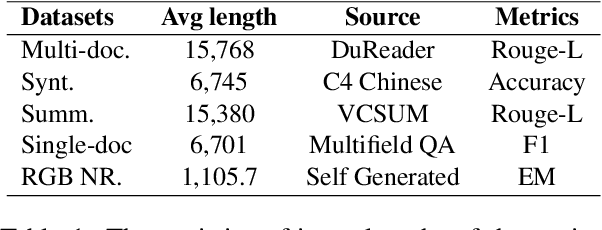
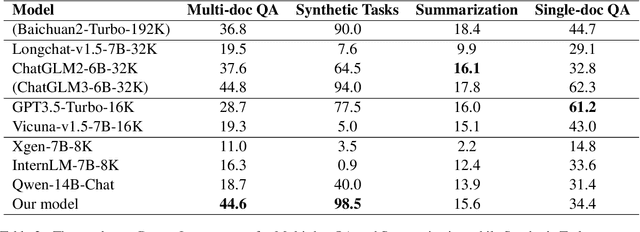
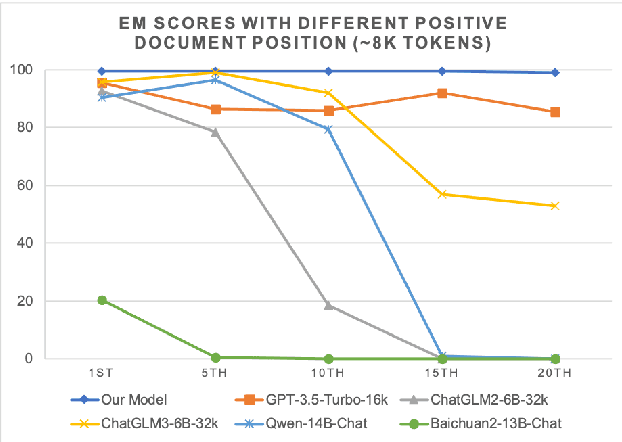
While large language models (LLMs) are equipped with longer text input capabilities than before, they are struggling to seek correct information in long contexts. The "lost in the middle" problem challenges most LLMs, referring to the dramatic decline in accuracy when correct information is located in the middle. To overcome this crucial issue, this paper proposes to enhance the information searching and reflection ability of LLMs in long contexts via specially designed tasks called Attention Strengthening Multi-doc QA (ASM QA). Following these tasks, our model excels in focusing more precisely on the desired information. Experimental results show substantial improvement in Multi-doc QA and other benchmarks, superior to state-of-the-art models by 13.7% absolute gain in shuffled settings, by 21.5% in passage retrieval task. We release our model, Ziya-Reader to promote related research in the community.