 Add to Chrome
 Add to Firefox
 Add to Edge
Learning to Route Queries to Heads for Attention-based Re-ranking with Large Language Models
Apr 27, 2026
Large Language Models (LLMs) have recently been explored as fine-grained zero-shot re-rankers by leveraging attention signals to estimate document relevance. However, existing methods either aggregate attention signals across all heads or rely on a statically selected subset identified by heuristic rules. This solution can be suboptimal because the informative heads can vary across queries or domains. Moreover, naively combining multiple heads can degrade performance due to redundancy or conflicting ranking signals. In this paper, we propose a query-dependent head selection method, RouteHead, for attention-based re-ranking with LLMs. Specifically, we learn a lightweight router that can map each query to an optimal head set, and relevance scores are computed by aggregating attention signals only from these heads. Since query-to-head optimal labels are unavailable, we first construct pseudo labels via an offline search. The router represents each head with a learnable embedding and represents each query using an embedding extracted from the hidden states of the frozen LLM. Then it is trained on the pseudo labels with a sparsity regularizer. Experiments on diverse benchmarks and multiple LLM backbones show that the proposed method consistently outperforms strong baselines.

Context-Fidelity Boosting: Enhancing Faithful Generation through Watermark-Inspired Decoding
Apr 24, 2026Large language models (LLMs) often produce content that contradicts or overlooks information provided in the input context, a phenomenon known as faithfulness hallucination. In this paper, we propose Context-Fidelity Boosting (CFB), a lightweight and general decoding-time framework that reduces such hallucinations by increasing the generation probability of source-supported tokens. Motivated by logit-shaping principles from watermarking techniques, CFB applies additive token-level logit adjustments based on a token's degree of support from the input context. Specifically, we develop three boosting strategies: static boosting, which applies a fixed bias to source-supported tokens; context-aware boosting, which scales this bias using the divergence between next-token distributions with and without context; and token-aware boosting, which further redistributes the adaptive bias according to local relevance estimated from source-position attention and source-scoped semantic similarity. CFB requires no retraining or architectural changes, making it compatible with a wide range of LLMs. Experiments on summarization and question answering tasks across multiple open-source LLMs show that CFB consistently improves faithfulness metrics with minimal generation overhead. Our implementation is fully open-sourced.
Preference Heads in Large Language Models: A Mechanistic Framework for Interpretable Personalization
Apr 24, 2026Large Language Models (LLMs) exhibit strong implicit personalization ability, yet most existing approaches treat this behavior as a black box, relying on prompt engineering or fine tuning on user data. In this work, we adopt a mechanistic interpretability perspective and hypothesize the existence of a sparse set of Preference Heads, attention heads that encode user specific stylistic and topical preferences and exert a causal influence on generation. We introduce Differential Preference Steering (DPS), a training free framework that (1) identifies Preference Heads through causal masking analysis and (2) leverages them for controllable and interpretable personalization at inference time. DPS computes a Preference Contribution Score (PCS) for each attention head, directly measuring its causal impact on user aligned outputs. During decoding, we contrast model predictions with and without Preference Heads, amplifying the difference between personalized and generic logits to selectively strengthen preference aligned continuations. Experiments on widely used personalization benchmarks across multiple LLMs demonstrate consistent gains in personalization fidelity while preserving content coherence and low computational overhead. Beyond empirical improvements, DPS provides a mechanistic explanation of where and how personalization emerges within transformer architectures. Our implementation is publicly available.
ReAttn: Improving Attention-based Re-ranking via Attention Re-weighting
Feb 23, 2026The strong capabilities of recent Large Language Models (LLMs) have made them highly effective for zero-shot re-ranking task. Attention-based re-ranking methods, which derive relevance scores directly from attention weights, offer an efficient and interpretable alternative to generation-based re-ranking methods. However, they still face two major limitations. First, attention signals are highly concentrated a small subset of tokens within a few documents, making others indistinguishable. Second, attention often overemphasizes phrases lexically similar to the query, yielding biased rankings that irrelevant documents with mere lexical resemblance are regarded as relevant. In this paper, we propose \textbf{ReAttn}, a post-hoc re-weighting strategy for attention-based re-ranking methods. It first compute the cross-document IDF weighting to down-weight attention on query-overlapping tokens that frequently appear across the candidate documents, reducing lexical bias and emphasizing distinctive terms. It then employs entropy-based regularization to mitigate over-concentrated attention, encouraging a more balanced distribution across informative tokens. Both adjustments operate directly on existing attention weights without additional training or supervision. Extensive experiments demonstrate the effectiveness of our method.
Learning Discriminative and Generalizable Anomaly Detector for Dynamic Graph with Limited Supervision
Feb 23, 2026Dynamic graph anomaly detection (DGAD) is critical for many real-world applications but remains challenging due to the scarcity of labeled anomalies. Existing methods are either unsupervised or semi-supervised: unsupervised methods avoid the need for labeled anomalies but often produce ambiguous boundary, whereas semi-supervised methods can overfit to the limited labeled anomalies and generalize poorly to unseen anomalies. To address this gap, we consider a largely underexplored problem in DGAD: learning a discriminative boundary from normal/unlabeled data, while leveraging limited labeled anomalies \textbf{when available} without sacrificing generalization to unseen anomalies. To this end, we propose an effective, generalizable, and model-agnostic framework with three main components: (i) residual representation encoding that capture deviations between current interactions and their historical context, providing anomaly-relevant signals; (ii) a restriction loss that constrain the normal representations within an interval bounded by two co-centered hyperspheres, ensuring consistent scales while keeping anomalies separable; (iii) a bi-boundary optimization strategy that learns a discriminative and robust boundary using the normal log-likelihood distribution modeled by a normalizing flow. Extensive experiments demonstrate the superiority of our framework across diverse evaluation settings.
Adaptive Personalized Conversational Information Retrieval
Aug 12, 2025Personalized conversational information retrieval (CIR) systems aim to satisfy users' complex information needs through multi-turn interactions by considering user profiles. However, not all search queries require personalization. The challenge lies in appropriately incorporating personalization elements into search when needed. Most existing studies implicitly incorporate users' personal information and conversational context using large language models without distinguishing the specific requirements for each query turn. Such a ``one-size-fits-all'' personalization strategy might lead to sub-optimal results. In this paper, we propose an adaptive personalization method, in which we first identify the required personalization level for a query and integrate personalized queries with other query reformulations to produce various enhanced queries. Then, we design a personalization-aware ranking fusion approach to assign fusion weights dynamically to different reformulated queries, depending on the required personalization level. The proposed adaptive personalized conversational information retrieval framework APCIR is evaluated on two TREC iKAT datasets. The results confirm the effectiveness of adaptive personalization of APCIR by outperforming state-of-the-art methods.
Latent Conditional Diffusion-based Data Augmentation for Continuous-Time Dynamic Graph Mode
Jul 11, 2024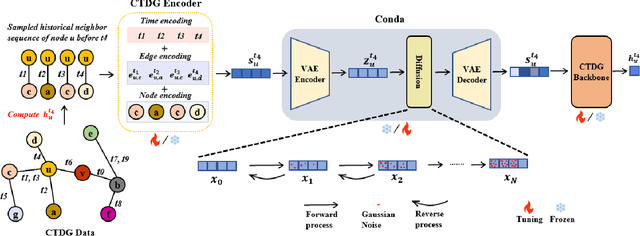
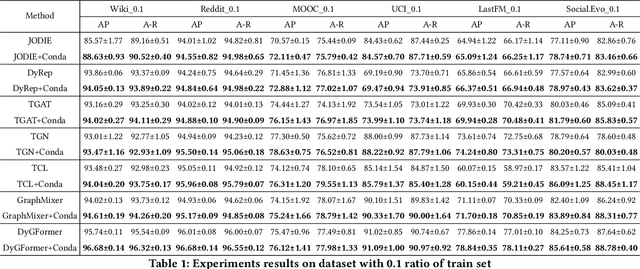
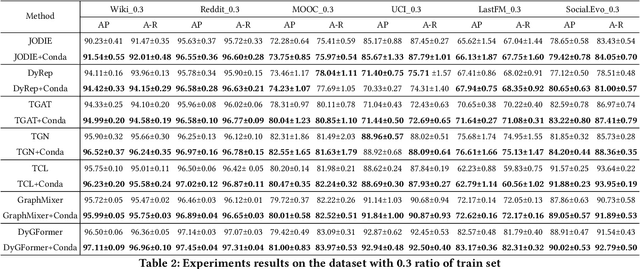
Continuous-Time Dynamic Graph (CTDG) precisely models evolving real-world relationships, drawing heightened interest in dynamic graph learning across academia and industry. However, existing CTDG models encounter challenges stemming from noise and limited historical data. Graph Data Augmentation (GDA) emerges as a critical solution, yet current approaches primarily focus on static graphs and struggle to effectively address the dynamics inherent in CTDGs. Moreover, these methods often demand substantial domain expertise for parameter tuning and lack theoretical guarantees for augmentation efficacy. To address these issues, we propose Conda, a novel latent diffusion-based GDA method tailored for CTDGs. Conda features a sandwich-like architecture, incorporating a Variational Auto-Encoder (VAE) and a conditional diffusion model, aimed at generating enhanced historical neighbor embeddings for target nodes. Unlike conventional diffusion models trained on entire graphs via pre-training, Conda requires historical neighbor sequence embeddings of target nodes for training, thus facilitating more targeted augmentation. We integrate Conda into the CTDG model and adopt an alternating training strategy to optimize performance. Extensive experimentation across six widely used real-world datasets showcases the consistent performance improvement of our approach, particularly in scenarios with limited historical data.
A Survey on Large Language Model Hallucination via a Creativity Perspective
Feb 02, 2024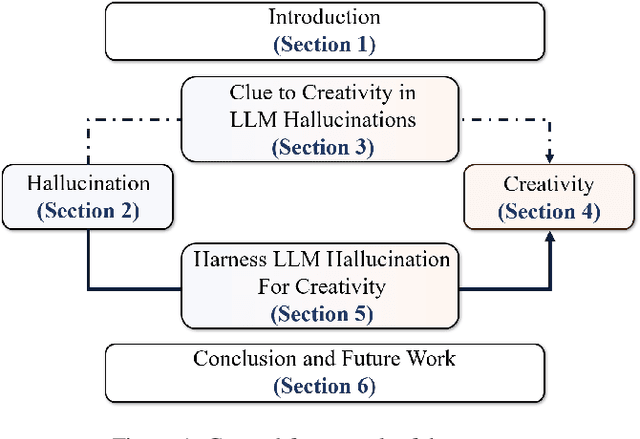
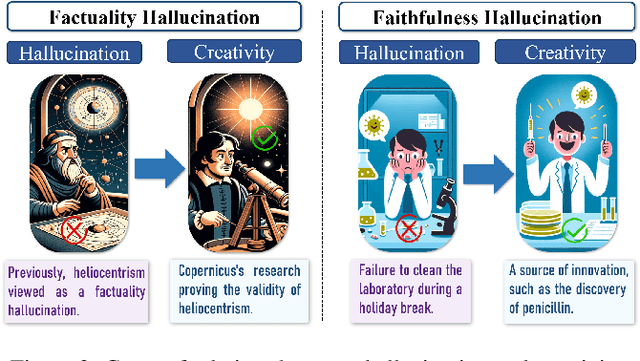
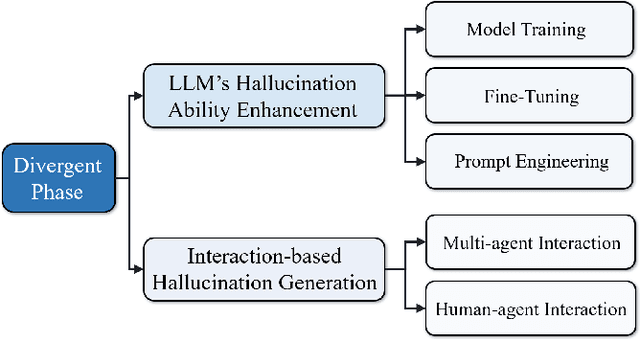
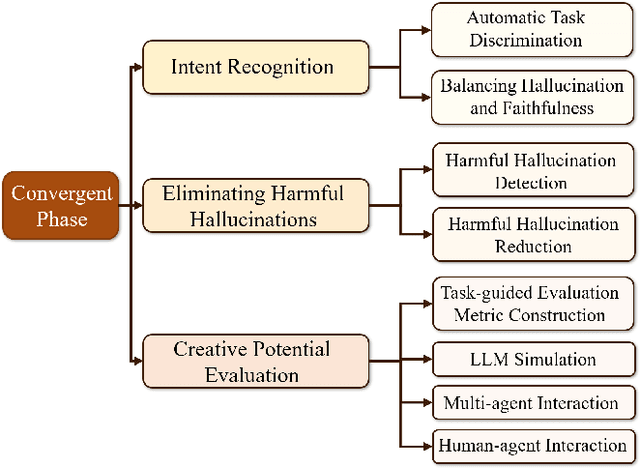
Hallucinations in large language models (LLMs) are always seen as limitations. However, could they also be a source of creativity? This survey explores this possibility, suggesting that hallucinations may contribute to LLM application by fostering creativity. This survey begins with a review of the taxonomy of hallucinations and their negative impact on LLM reliability in critical applications. Then, through historical examples and recent relevant theories, the survey explores the potential creative benefits of hallucinations in LLMs. To elucidate the value and evaluation criteria of this connection, we delve into the definitions and assessment methods of creativity. Following the framework of divergent and convergent thinking phases, the survey systematically reviews the literature on transforming and harnessing hallucinations for creativity in LLMs. Finally, the survey discusses future research directions, emphasizing the need to further explore and refine the application of hallucinations in creative processes within LLMs.
Natural Language Interfaces for Tabular Data Querying and Visualization: A Survey
Oct 27, 2023


The emergence of natural language processing has revolutionized the way users interact with tabular data, enabling a shift from traditional query languages and manual plotting to more intuitive, language-based interfaces. The rise of large language models (LLMs) such as ChatGPT and its successors has further advanced this field, opening new avenues for natural language processing techniques. This survey presents a comprehensive overview of natural language interfaces for tabular data querying and visualization, which allow users to interact with data using natural language queries. We introduce the fundamental concepts and techniques underlying these interfaces with a particular emphasis on semantic parsing, the key technology facilitating the translation from natural language to SQL queries or data visualization commands. We then delve into the recent advancements in Text-to-SQL and Text-to-Vis problems from the perspectives of datasets, methodologies, metrics, and system designs. This includes a deep dive into the influence of LLMs, highlighting their strengths, limitations, and potential for future improvements. Through this survey, we aim to provide a roadmap for researchers and practitioners interested in developing and applying natural language interfaces for data interaction in the era of large language models.
Boosting long-term forecasting performance for continuous-time dynamic graph networks via data augmentation
Apr 12, 2023
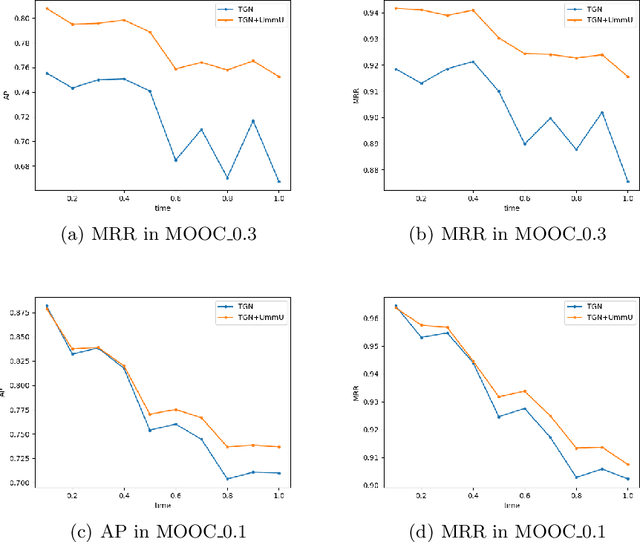

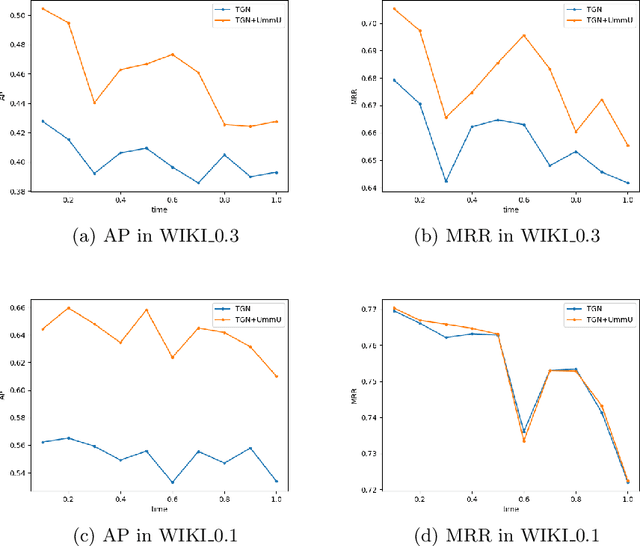
This study focuses on long-term forecasting (LTF) on continuous-time dynamic graph networks (CTDGNs), which is important for real-world modeling. Existing CTDGNs are effective for modeling temporal graph data due to their ability to capture complex temporal dependencies but perform poorly on LTF due to the substantial requirement for historical data, which is not practical in most cases. To relieve this problem, a most intuitive way is data augmentation. In this study, we propose \textbf{\underline{U}ncertainty \underline{M}asked \underline{M}ix\underline{U}p (UmmU)}: a plug-and-play module that conducts uncertainty estimation to introduce uncertainty into the embedding of intermediate layer of CTDGNs, and perform masked mixup to further enhance the uncertainty of the embedding to make it generalize to more situations. UmmU can be easily inserted into arbitrary CTDGNs without increasing the number of parameters. We conduct comprehensive experiments on three real-world dynamic graph datasets, the results demonstrate that UmmU can effectively improve the long-term forecasting performance for CTDGNs.