 Add to Chrome
 Add to Firefox
 Add to Edge
OmniRoam: World Wandering via Long-Horizon Panoramic Video Generation
Mar 31, 2026
Modeling scenes using video generation models has garnered growing research interest in recent years. However, most existing approaches rely on perspective video models that synthesize only limited observations of a scene, leading to issues of completeness and global consistency. We propose OmniRoam, a controllable panoramic video generation framework that exploits the rich per-frame scene coverage and inherent long-term spatial and temporal consistency of panoramic representation, enabling long-horizon scene wandering. Our framework begins with a preview stage, where a trajectory-controlled video generation model creates a quick overview of the scene from a given input image or video. Then, in the refine stage, this video is temporally extended and spatially upsampled to produce long-range, high-resolution videos, thus enabling high-fidelity world wandering. To train our model, we introduce two panoramic video datasets that incorporate both synthetic and real-world captured videos. Experiments show that our framework consistently outperforms state-of-the-art methods in terms of visual quality, controllability, and long-term scene consistency, both qualitatively and quantitatively. We further showcase several extensions of this framework, including real-time video generation and 3D reconstruction. Code is available at https://github.com/yuhengliu02/OmniRoam.

SDD-YOLO: A Small-Target Detection Framework for Ground-to-Air Anti-UAV Surveillance with Edge-Efficient Deployment
Mar 26, 2026Detecting small unmanned aerial vehicles (UAVs) from a ground-to-air (G2A) perspective presents significant challenges, including extremely low pixel occupancy, cluttered aerial backgrounds, and strict real-time constraints. Existing YOLO-based detectors are primarily optimized for general object detection and often lack adequate feature resolution for sub-pixel targets, while introducing complexities during deployment. In this paper, we propose SDD-YOLO, a small-target detection framework tailored for G2A anti-UAV surveillance. To capture fine-grained spatial details critical for micro-targets, SDD-YOLO introduces a P2 high-resolution detection head operating at 4 times downsampling. Furthermore, we integrate the recent architectural advancements from YOLO26, including a DFL-free, NMS-free architecture for streamlined inference, and the MuSGD hybrid training strategy with ProgLoss and STAL, which substantially mitigates gradient oscillation on sparse small-target signals. To support our evaluation, we construct DroneSOD-30K, a large-scale G2A dataset comprising approximately 30,000 annotated images covering diverse meteorological conditions. Experiments demonstrate that SDD-YOLO-n achieves a mAP@0.5 of 86.0% on DroneSOD-30K, surpassing the YOLOv5n baseline by 7.8 percentage points. Extensive inference analysis shows our model attains 226 FPS on an NVIDIA RTX 5090 and 35 FPS on an Intel Xeon CPU, demonstrating exceptional efficiency for future edge deployment.
tttLRM: Test-Time Training for Long Context and Autoregressive 3D Reconstruction
Feb 23, 2026We propose tttLRM, a novel large 3D reconstruction model that leverages a Test-Time Training (TTT) layer to enable long-context, autoregressive 3D reconstruction with linear computational complexity, further scaling the model's capability. Our framework efficiently compresses multiple image observations into the fast weights of the TTT layer, forming an implicit 3D representation in the latent space that can be decoded into various explicit formats, such as Gaussian Splats (GS) for downstream applications. The online learning variant of our model supports progressive 3D reconstruction and refinement from streaming observations. We demonstrate that pretraining on novel view synthesis tasks effectively transfers to explicit 3D modeling, resulting in improved reconstruction quality and faster convergence. Extensive experiments show that our method achieves superior performance in feedforward 3D Gaussian reconstruction compared to state-of-the-art approaches on both objects and scenes.
V-RGBX: Video Editing with Accurate Controls over Intrinsic Properties
Dec 12, 2025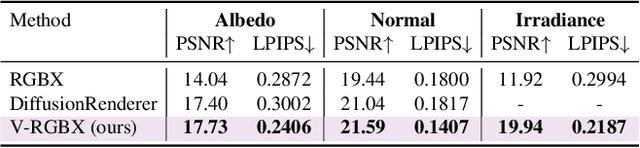
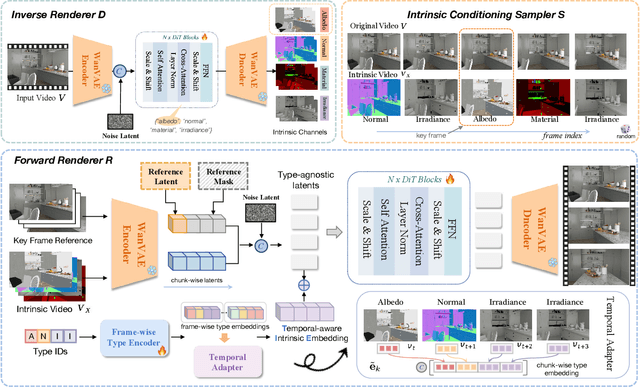
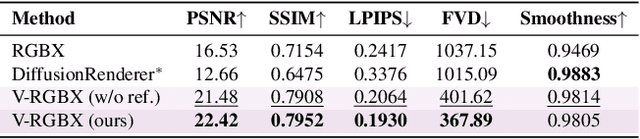
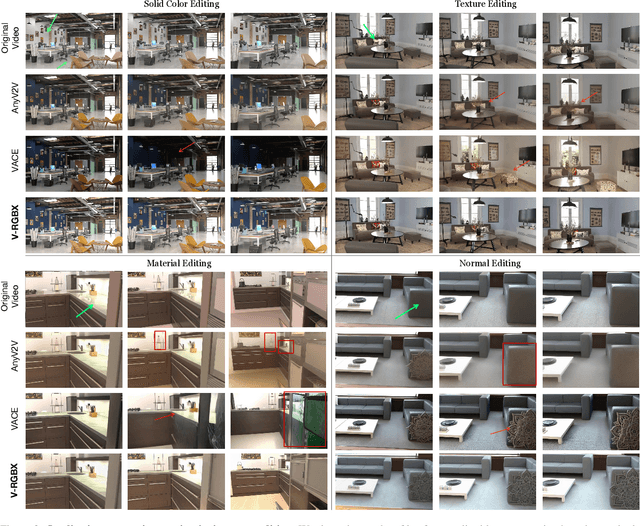
Large-scale video generation models have shown remarkable potential in modeling photorealistic appearance and lighting interactions in real-world scenes. However, a closed-loop framework that jointly understands intrinsic scene properties (e.g., albedo, normal, material, and irradiance), leverages them for video synthesis, and supports editable intrinsic representations remains unexplored. We present V-RGBX, the first end-to-end framework for intrinsic-aware video editing. V-RGBX unifies three key capabilities: (1) video inverse rendering into intrinsic channels, (2) photorealistic video synthesis from these intrinsic representations, and (3) keyframe-based video editing conditioned on intrinsic channels. At the core of V-RGBX is an interleaved conditioning mechanism that enables intuitive, physically grounded video editing through user-selected keyframes, supporting flexible manipulation of any intrinsic modality. Extensive qualitative and quantitative results show that V-RGBX produces temporally consistent, photorealistic videos while propagating keyframe edits across sequences in a physically plausible manner. We demonstrate its effectiveness in diverse applications, including object appearance editing and scene-level relighting, surpassing the performance of prior methods.
HiMat: DiT-based Ultra-High Resolution SVBRDF Generation
Aug 12, 2025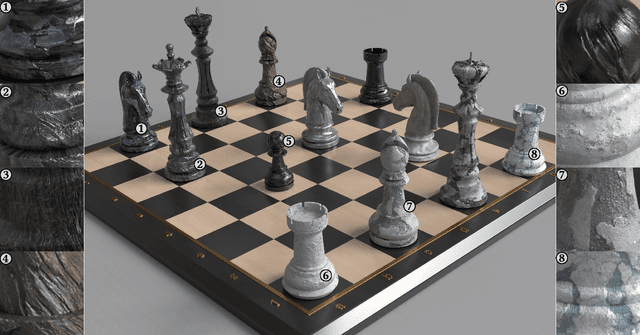
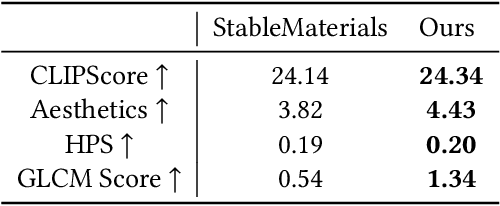
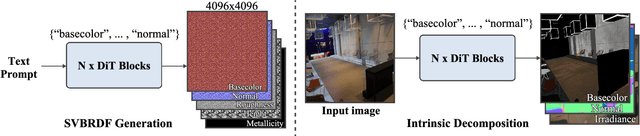
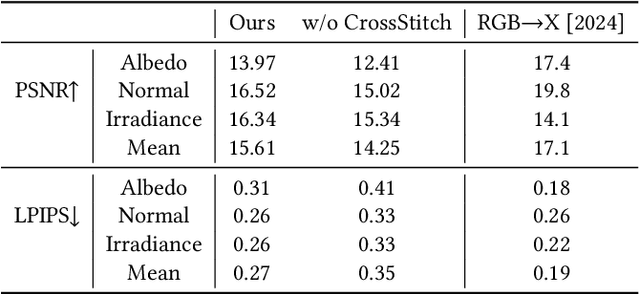
Creating highly detailed SVBRDFs is essential for 3D content creation. The rise of high-resolution text-to-image generative models, based on diffusion transformers (DiT), suggests an opportunity to finetune them for this task. However, retargeting the models to produce multiple aligned SVBRDF maps instead of just RGB images, while achieving high efficiency and ensuring consistency across different maps, remains a challenge. In this paper, we introduce HiMat: a memory- and computation-efficient diffusion-based framework capable of generating native 4K-resolution SVBRDFs. A key challenge we address is maintaining consistency across different maps in a lightweight manner, without relying on training new VAEs or significantly altering the DiT backbone (which would damage its prior capabilities). To tackle this, we introduce the CrossStitch module, a lightweight convolutional module that captures inter-map dependencies through localized operations. Its weights are initialized such that the DiT backbone operation is unchanged before finetuning starts. HiMat enables generation with strong structural coherence and high-frequency details. Results with a large set of text prompts demonstrate the effectiveness of our approach for 4K SVBRDF generation. Further experiments suggest generalization to tasks such as intrinsic decomposition.
WorldPrompter: Traversable Text-to-Scene Generation
Apr 02, 2025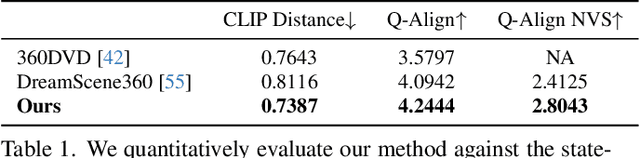
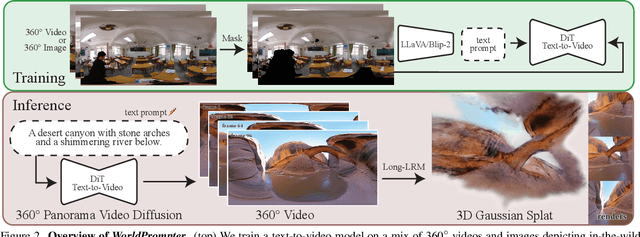
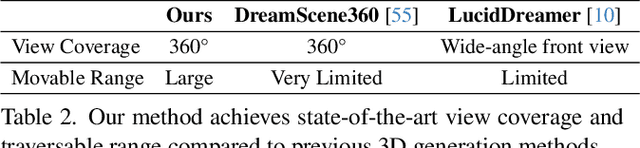
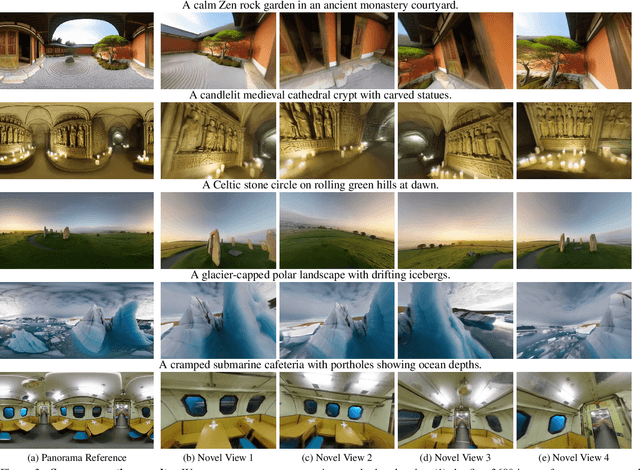
Scene-level 3D generation is a challenging research topic, with most existing methods generating only partial scenes and offering limited navigational freedom. We introduce WorldPrompter, a novel generative pipeline for synthesizing traversable 3D scenes from text prompts. We leverage panoramic videos as an intermediate representation to model the 360{\deg} details of a scene. WorldPrompter incorporates a conditional 360{\deg} panoramic video generator, capable of producing a 128-frame video that simulates a person walking through and capturing a virtual environment. The resulting video is then reconstructed as Gaussian splats by a fast feedforward 3D reconstructor, enabling a true walkable experience within the 3D scene. Experiments demonstrate that our panoramic video generation model achieves convincing view consistency across frames, enabling high-quality panoramic Gaussian splat reconstruction and facilitating traversal over an area of the scene. Qualitative and quantitative results also show it outperforms the state-of-the-art 360{\deg} video generators and 3D scene generation models.
Turbo3D: Ultra-fast Text-to-3D Generation
Dec 05, 2024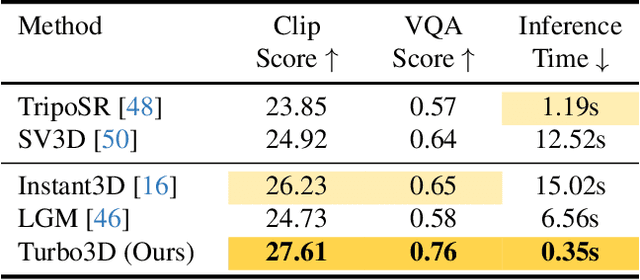


We present Turbo3D, an ultra-fast text-to-3D system capable of generating high-quality Gaussian splatting assets in under one second. Turbo3D employs a rapid 4-step, 4-view diffusion generator and an efficient feed-forward Gaussian reconstructor, both operating in latent space. The 4-step, 4-view generator is a student model distilled through a novel Dual-Teacher approach, which encourages the student to learn view consistency from a multi-view teacher and photo-realism from a single-view teacher. By shifting the Gaussian reconstructor's inputs from pixel space to latent space, we eliminate the extra image decoding time and halve the transformer sequence length for maximum efficiency. Our method demonstrates superior 3D generation results compared to previous baselines, while operating in a fraction of their runtime.
MaterialPicker: Multi-Modal Material Generation with Diffusion Transformers
Dec 04, 2024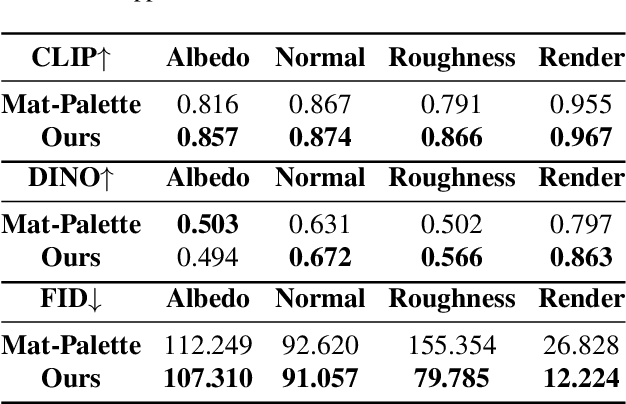

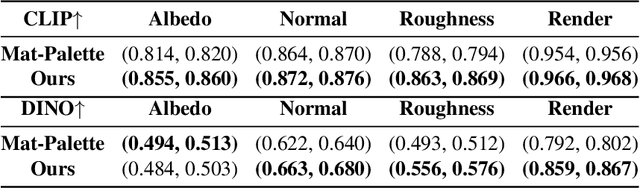
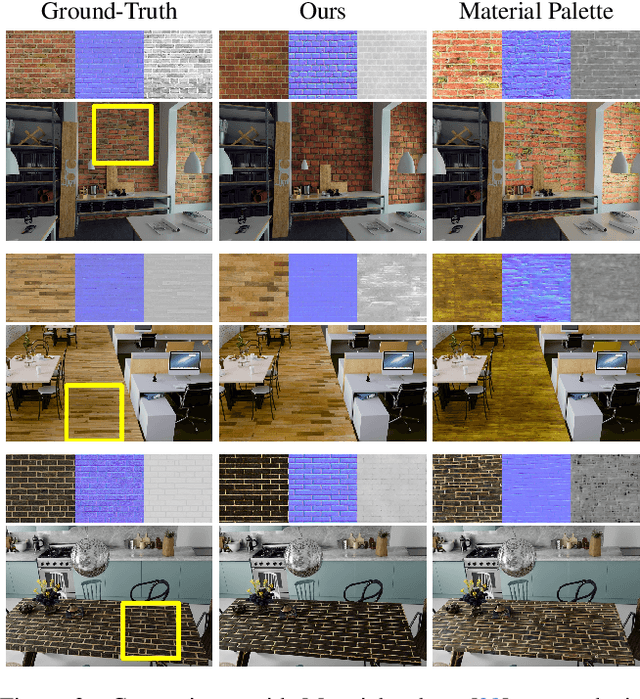
High-quality material generation is key for virtual environment authoring and inverse rendering. We propose MaterialPicker, a multi-modal material generator leveraging a Diffusion Transformer (DiT) architecture, improving and simplifying the creation of high-quality materials from text prompts and/or photographs. Our method can generate a material based on an image crop of a material sample, even if the captured surface is distorted, viewed at an angle or partially occluded, as is often the case in photographs of natural scenes. We further allow the user to specify a text prompt to provide additional guidance for the generation. We finetune a pre-trained DiT-based video generator into a material generator, where each material map is treated as a frame in a video sequence. We evaluate our approach both quantitatively and qualitatively and show that it enables more diverse material generation and better distortion correction than previous work.
Buffer Anytime: Zero-Shot Video Depth and Normal from Image Priors
Nov 26, 2024We present Buffer Anytime, a framework for estimation of depth and normal maps (which we call geometric buffers) from video that eliminates the need for paired video--depth and video--normal training data. Instead of relying on large-scale annotated video datasets, we demonstrate high-quality video buffer estimation by leveraging single-image priors with temporal consistency constraints. Our zero-shot training strategy combines state-of-the-art image estimation models based on optical flow smoothness through a hybrid loss function, implemented via a lightweight temporal attention architecture. Applied to leading image models like Depth Anything V2 and Marigold-E2E-FT, our approach significantly improves temporal consistency while maintaining accuracy. Experiments show that our method not only outperforms image-based approaches but also achieves results comparable to state-of-the-art video models trained on large-scale paired video datasets, despite using no such paired video data.
RelitLRM: Generative Relightable Radiance for Large Reconstruction Models
Oct 10, 2024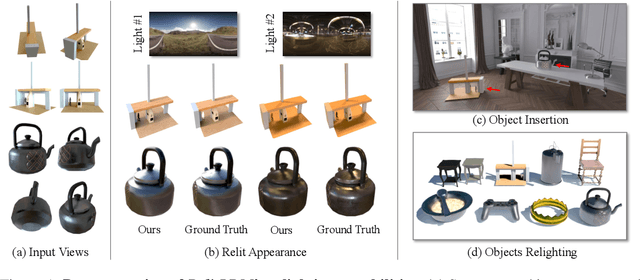
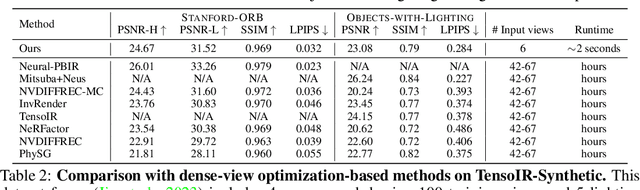
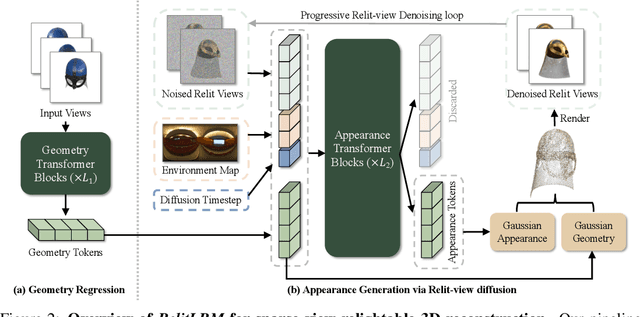

We propose RelitLRM, a Large Reconstruction Model (LRM) for generating high-quality Gaussian splatting representations of 3D objects under novel illuminations from sparse (4-8) posed images captured under unknown static lighting. Unlike prior inverse rendering methods requiring dense captures and slow optimization, often causing artifacts like incorrect highlights or shadow baking, RelitLRM adopts a feed-forward transformer-based model with a novel combination of a geometry reconstructor and a relightable appearance generator based on diffusion. The model is trained end-to-end on synthetic multi-view renderings of objects under varying known illuminations. This architecture design enables to effectively decompose geometry and appearance, resolve the ambiguity between material and lighting, and capture the multi-modal distribution of shadows and specularity in the relit appearance. We show our sparse-view feed-forward RelitLRM offers competitive relighting results to state-of-the-art dense-view optimization-based baselines while being significantly faster. Our project page is available at: https://relit-lrm.github.io/.