 Add to Chrome
 Add to Firefox
 Add to Edge
PureLight: Learning Complex Luminaires with Light Tracing
Jun 03, 2026
We propose a neural formulation for estimating the appearance of complex luminaires. We focus on challenging luminaires with complex light transport (e.g., small emitters enclosed by multiple specular layers) that are difficult for (bidirectional) path tracing. To this end, we use light tracing to construct paths from emitters to the exit surfaces and formulate appearance estimation as a distribution learning problem. Specifically, we model the probability density function (pdf) of outgoing radiance on the exit surfaces using a large normalizing flow network, and recover the outgoing radiance as the product of the estimated pdf and flux. To enable efficient inference, we distill the learned appearance into a lightweight MLP that directly estimates radiance on the exit surfaces. We additionally train a sampling network for effective direct illumination computation from the luminaire, and a blending network to composite the luminaire into the scene. Our formulation makes it feasible to render challenging luminaires using low sample counts in arbitrary scenes.

AlbedoEdit: Unified Instance-Level Video Editing with Albedo Guidance
May 31, 2026Video generative models have achieved remarkable progress in synthesizing photorealistic video sequences. However, enabling broader and more creative downstream applications requires fine-grained instance-level video editing, including object insertion, object removal, and texture editing, which has emerged as a prominent yet challenging problem. Existing approaches either propose unified generative frameworks with only coarse semantic control, or design task-specific frameworks for individual editing tasks, limiting their flexibility and applicability across diverse real-world scenarios. To address these limitations, we propose AlbedoEdit, a unified generative video editing framework that jointly supports object insertion, object removal, and texture editing. Our key insight is that the intrinsic albedo map, which is invariant to lighting and contains no specularity, shadowing and inter-reflection effects, provides an effective and user-friendly mechanism for specifying fine-grained appearance edits. Built upon video foundation models, AlbedoEdit is fine-tuned to translate source RGB videos into edited RGB videos, conditioned on a user-edited first-frame albedo. Trained on a new paired synthetic dataset covering all three editing tasks, AlbedoEdit implicitly learns to harmonize edited contents and simulate complex real-world visual effects triggered by editing operations, including specular highlights, soft shadows, and mirror reflections. AlbedoEdit demonstrates superior performance over state-of-the-art video editing approaches, both qualitatively and quantitatively. Project webpage is https://vcai.mpi-inf.mpg.de/projects/AlbedoEdit/.
F-RNG: Feed-Forward Relightable Neural Gaussians
May 28, 2026Capturing relightable 3D assets from real-world objects is a widely researched problem. Several per-scene optimization-based methods, based on 3D Gaussian splatting (3DGS), support relighting; however, they usually require dense input views, and their overfitting nature makes it difficult to generalize across scenes. Unlike per-scene optimization methods, generalized feed-forward models can directly reconstruct Gaussians from sparse input views. However, the resulting assets have baked-in illumination and cannot be easily used for relighting. In this paper, we present F-RNG, a feed-forward framework that directly generates relightable 3DGS assets from sparse-view inputs. Training such a model from scratch can require massive data and computing resources, and it is especially challenging to generate relightable assets in a feed-forward manner with acceptable cost. We develop F-RNG upon an existing large reconstruction model (LRM) to extract relightable representations, while also utilizing priors from an intrinsic decomposition model (IDM). Specifically, we first introduce a latent-interpolated fine-grained geometry synthesis to enhance the LRM's geometry representation. Second, we propose a prior-guided relightable appearance distillation to extract relightable neural representations by incorporating IDM priors. Finally, a universal neural renderer enables flexible and high-fidelity relighting. F-RNG requires neither re-training nor fine-tuning of the underlying LRMs, thus can automatically benefit from better LRMs and IDMs in the future. With only small networks that can be trained with affordable data and computational resources, F-RNG avoids the repetitive inference of large models under different light conditions. By comparison to the state-of-the-art LRM-based relighting method, F-RNG achieves ~25x faster relighting, as well as superior quality (~+2.0 dB).
8DNA: 8D Neural Asset Light Transport by Distribution Learning
Apr 28, 2026High-fidelity 3D assets exhibit intriguing global illumination effects like subsurface scattering, glossy interreflections, and fine-scale fiber scatterings, which often involve long scattering paths that are expensive to simulate. We introduce 8D neural assets (8DNA) to pre-bake these light transport effects into neural representations. Unlike prior methods that assume far-field lighting and precompute light transport into 6D functions, 8DNA learns the full 8D light transport, enabling accurate rendering under near-field illumination. Our training leverages a distribution-learning formulation that learns light transport from forward path-traced samples, which produces less optimization variance with lower training budget than the prior regression-based approaches. Experiments show our 8DNA rendering closely matches path-traced results under various scene configurations, yet it achieves improved variance reduction and fast inference speeds on challenging assets.
WeatherDiffusion: Weather-Guided Diffusion Model for Forward and Inverse Rendering
Aug 09, 2025Forward and inverse rendering have emerged as key techniques for enabling understanding and reconstruction in the context of autonomous driving (AD). However, complex weather and illumination pose great challenges to this task. The emergence of large diffusion models has shown promise in achieving reasonable results through learning from 2D priors, but these models are difficult to control and lack robustness. In this paper, we introduce WeatherDiffusion, a diffusion-based framework for forward and inverse rendering on AD scenes with various weather and lighting conditions. Our method enables authentic estimation of material properties, scene geometry, and lighting, and further supports controllable weather and illumination editing through the use of predicted intrinsic maps guided by text descriptions. We observe that different intrinsic maps should correspond to different regions of the original image. Based on this observation, we propose Intrinsic map-aware attention (MAA) to enable high-quality inverse rendering. Additionally, we introduce a synthetic dataset (\ie WeatherSynthetic) and a real-world dataset (\ie WeatherReal) for forward and inverse rendering on AD scenes with diverse weather and lighting. Extensive experiments show that our WeatherDiffusion outperforms state-of-the-art methods on several benchmarks. Moreover, our method demonstrates significant value in downstream tasks for AD, enhancing the robustness of object detection and image segmentation in challenging weather scenarios.
IntrinsicEdit: Precise generative image manipulation in intrinsic space
May 15, 2025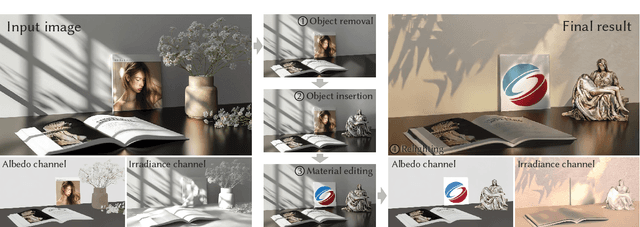
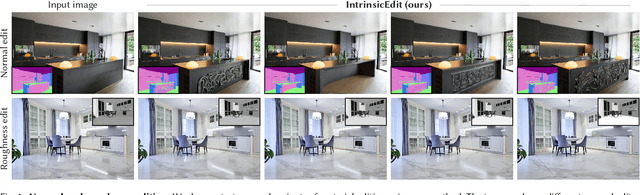
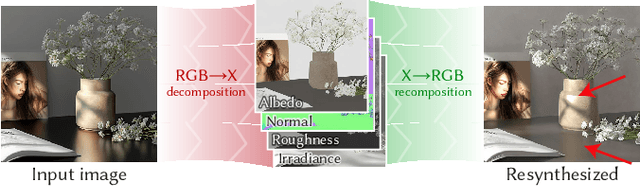
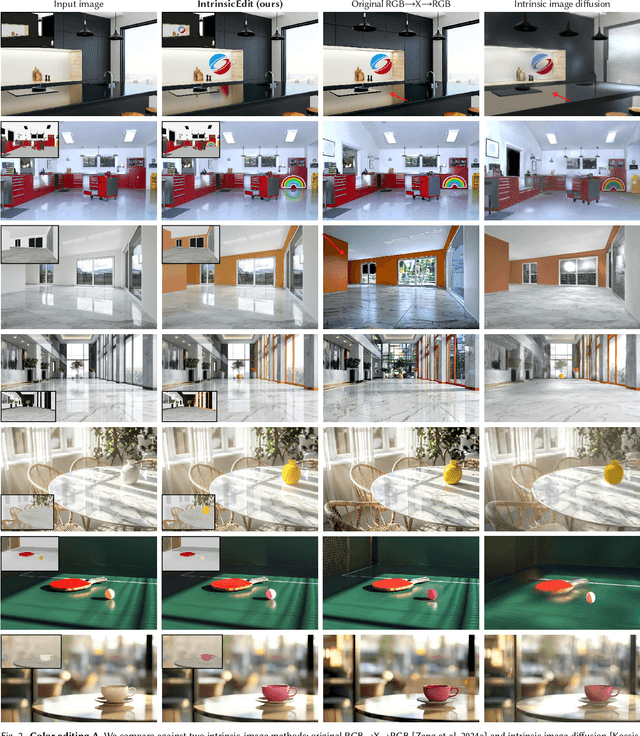
Generative diffusion models have advanced image editing with high-quality results and intuitive interfaces such as prompts and semantic drawing. However, these interfaces lack precise control, and the associated methods typically specialize on a single editing task. We introduce a versatile, generative workflow that operates in an intrinsic-image latent space, enabling semantic, local manipulation with pixel precision for a range of editing operations. Building atop the RGB-X diffusion framework, we address key challenges of identity preservation and intrinsic-channel entanglement. By incorporating exact diffusion inversion and disentangled channel manipulation, we enable precise, efficient editing with automatic resolution of global illumination effects -- all without additional data collection or model fine-tuning. We demonstrate state-of-the-art performance across a variety of tasks on complex images, including color and texture adjustments, object insertion and removal, global relighting, and their combinations.
WorldPrompter: Traversable Text-to-Scene Generation
Apr 02, 2025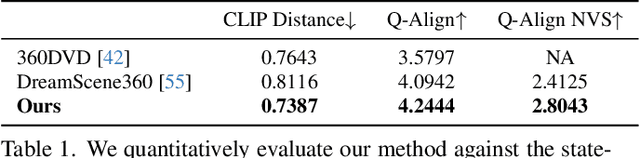
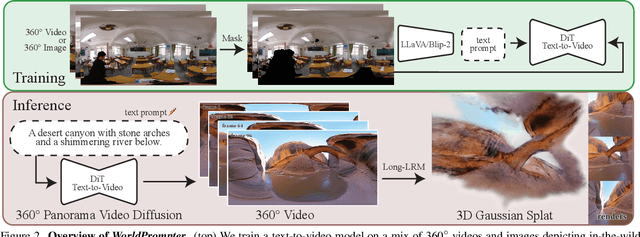
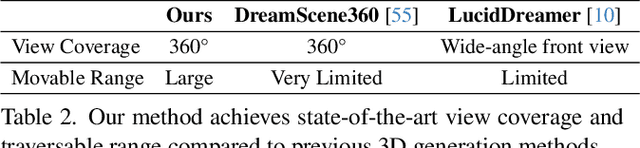
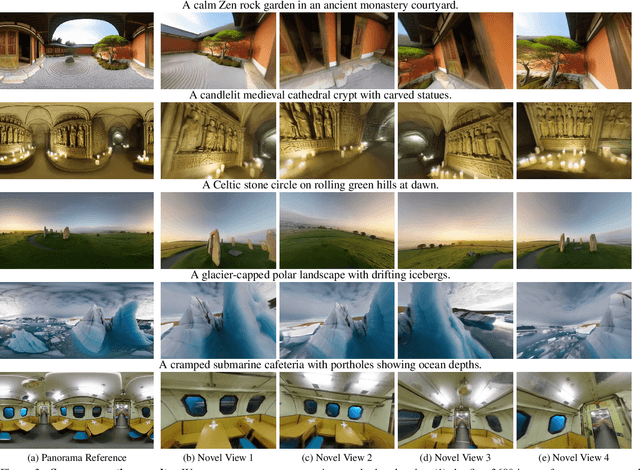
Scene-level 3D generation is a challenging research topic, with most existing methods generating only partial scenes and offering limited navigational freedom. We introduce WorldPrompter, a novel generative pipeline for synthesizing traversable 3D scenes from text prompts. We leverage panoramic videos as an intermediate representation to model the 360{\deg} details of a scene. WorldPrompter incorporates a conditional 360{\deg} panoramic video generator, capable of producing a 128-frame video that simulates a person walking through and capturing a virtual environment. The resulting video is then reconstructed as Gaussian splats by a fast feedforward 3D reconstructor, enabling a true walkable experience within the 3D scene. Experiments demonstrate that our panoramic video generation model achieves convincing view consistency across frames, enabling high-quality panoramic Gaussian splat reconstruction and facilitating traversal over an area of the scene. Qualitative and quantitative results also show it outperforms the state-of-the-art 360{\deg} video generators and 3D scene generation models.
MaterialPicker: Multi-Modal Material Generation with Diffusion Transformers
Dec 04, 2024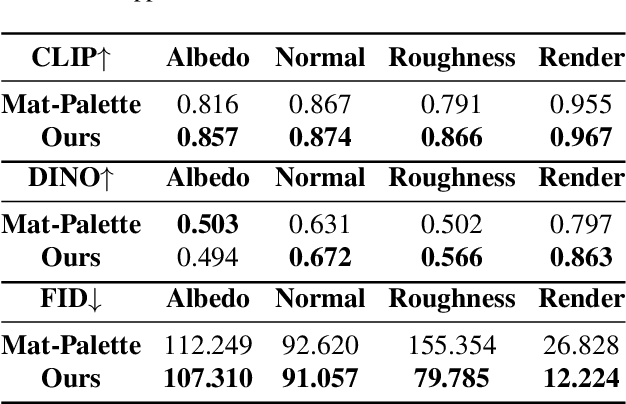

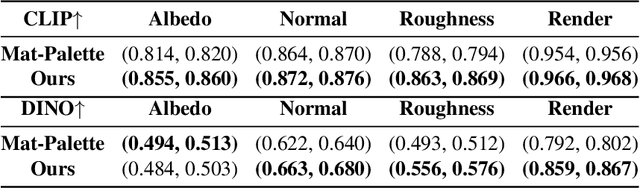
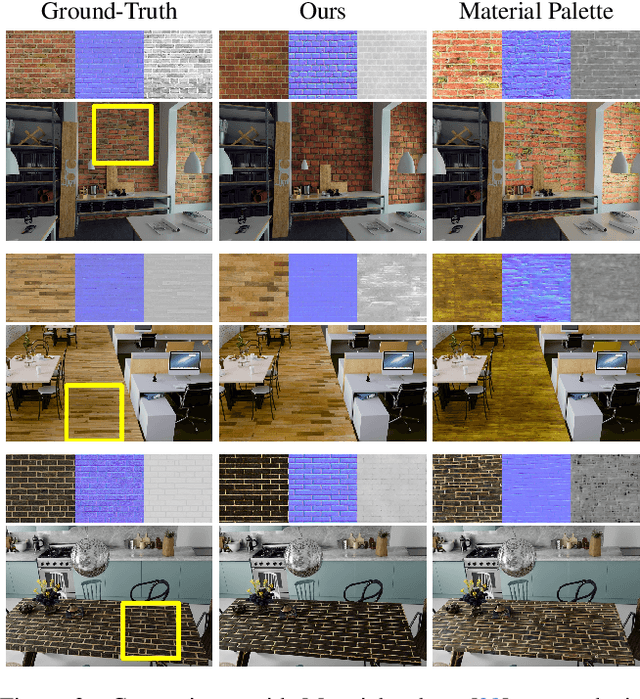
High-quality material generation is key for virtual environment authoring and inverse rendering. We propose MaterialPicker, a multi-modal material generator leveraging a Diffusion Transformer (DiT) architecture, improving and simplifying the creation of high-quality materials from text prompts and/or photographs. Our method can generate a material based on an image crop of a material sample, even if the captured surface is distorted, viewed at an angle or partially occluded, as is often the case in photographs of natural scenes. We further allow the user to specify a text prompt to provide additional guidance for the generation. We finetune a pre-trained DiT-based video generator into a material generator, where each material map is treated as a frame in a video sequence. We evaluate our approach both quantitatively and qualitatively and show that it enables more diverse material generation and better distortion correction than previous work.
RNG: Relightable Neural Gaussians
Sep 29, 2024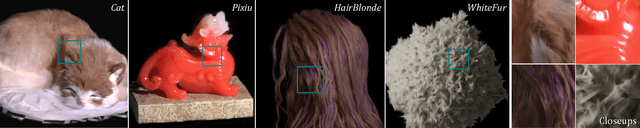
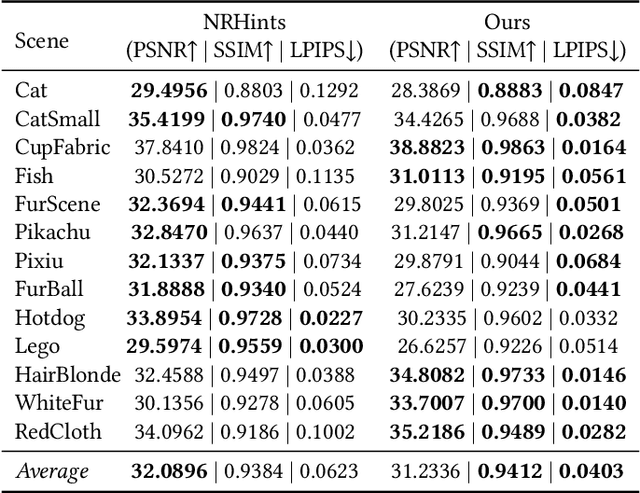
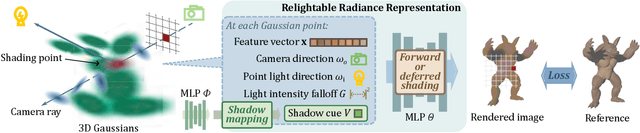
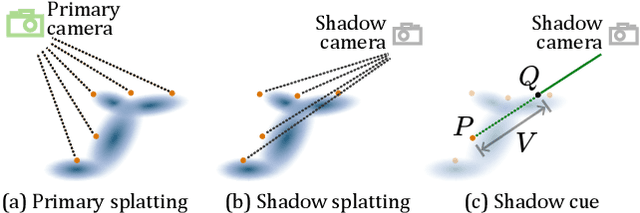
3D Gaussian Splatting (3DGS) has shown its impressive power in novel view synthesis. However, creating relightable 3D assets, especially for objects with ill-defined shapes (e.g., fur), is still a challenging task. For these scenes, the decomposition between the light, geometry, and material is more ambiguous, as neither the surface constraints nor the analytical shading model hold. To address this issue, we propose RNG, a novel representation of relightable neural Gaussians, enabling the relighting of objects with both hard surfaces or fluffy boundaries. We avoid any assumptions in the shading model but maintain feature vectors, which can be further decoded by an MLP into colors, in each Gaussian point. Following prior work, we utilize a point light to reduce the ambiguity and introduce a shadow-aware condition to the network. We additionally propose a depth refinement network to help the shadow computation under the 3DGS framework, leading to better shadow effects under point lights. Furthermore, to avoid the blurriness brought by the alpha-blending in 3DGS, we design a hybrid forward-deferred optimization strategy. As a result, we achieve about $20\times$ faster in training and about $600\times$ faster in rendering than prior work based on neural radiance fields, with $60$ frames per second on an RTX4090.
PBIR-NIE: Glossy Object Capture under Non-Distant Lighting
Aug 13, 2024
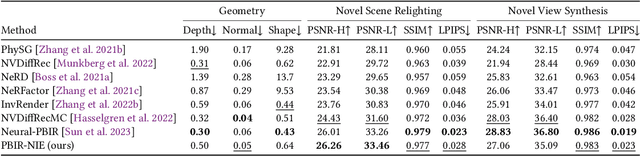


Glossy objects present a significant challenge for 3D reconstruction from multi-view input images under natural lighting. In this paper, we introduce PBIR-NIE, an inverse rendering framework designed to holistically capture the geometry, material attributes, and surrounding illumination of such objects. We propose a novel parallax-aware non-distant environment map as a lightweight and efficient lighting representation, accurately modeling the near-field background of the scene, which is commonly encountered in real-world capture setups. This feature allows our framework to accommodate complex parallax effects beyond the capabilities of standard infinite-distance environment maps. Our method optimizes an underlying signed distance field (SDF) through physics-based differentiable rendering, seamlessly connecting surface gradients between a triangle mesh and the SDF via neural implicit evolution (NIE). To address the intricacies of highly glossy BRDFs in differentiable rendering, we integrate the antithetic sampling algorithm to mitigate variance in the Monte Carlo gradient estimator. Consequently, our framework exhibits robust capabilities in handling glossy object reconstruction, showcasing superior quality in geometry, relighting, and material estimation.