 Add to Chrome
 Add to Firefox
 Add to Edge
GaussianSelector: Lightweight Human-Guided Object Selection in 3D Gaussian Splatting with Graph Optimization
Aug 02, 2026
Selecting a complete 3D object from a reconstructed scene with minimal user effort is essential for practical scene editing and embodied interaction. Existing 3DGS-based methods either retrain the Gaussian representation to embed per-object labels, or build dense multi-view SAM observations, both requiring heavy computation and dense viewpoint coverage that is rarely available in practice. We present GaussianSelector, a training-free framework for interactive 3D object selection from sparse views and sparse scribble guidance. Operating directly on native Gaussian primitives, we coarsen dense Gaussians into geometrically coherent superpoints and construct a continuity-weighted graph using appearance and spatial cues. Sparse user scribbles are lifted into 3D via visibility-aware transmittance coverage, and selection is solved as a global graph-cut energy minimization that propagates sparse evidence to a complete 3D object. This design naturally supports multi-round refinement, where users iteratively correct the selection from additional viewpoints to progressively improve the result. Experiments demonstrate that GaussianSelector achieves competitive selection quality against state-of-the-art multi-view SAM-based methods, while requiring significantly fewer interaction views and substantially lower computational overhead. These properties make it well suited for human-in-the-loop 3D scene editing and 3D asset extraction in real-world deployment scenarios.

PanoWorld: Towards Spatial Supersensing in 360$^\circ$ Panorama World
May 13, 2026Multimodal large laboratory models (MLLMs) still struggle with spatial understanding under the dominant perspective-image paradigm, which inherits the narrow field of view of human-like perception. For navigation, robotic search, and 3D scene understanding, 360-degree panoramic sensing offers a form of supersensing by capturing the entire surrounding environment at once. However, existing MLLM pipelines typically decompose panoramas into multiple perspective views, leaving the spherical structure of equirectangular projection (ERP) largely implicit. In this paper, we study pano-native understanding, which requires an MLLM to reason over an ERP panorama as a continuous, observer-centered space. To this end, we first define the key abilities for pano-native understanding, including semantic anchoring, spherical localization, reference-frame transformation, and depth-aware 3D spatial reasoning. We then build a large-scale metadata construction pipeline that converts mixed-source ERP panoramas into geometry-aware, language-grounded, and depth-aware supervision, and instantiate these signals as capability-aligned instruction tuning data. On the model side, we introduce PanoWorld with Spherical Spatial Cross-Attention, which injects spherical geometry into the visual stream. We further construct PanoSpace-Bench, a diagnostic benchmark for evaluating ERP-native spatial reasoning. Experiments show that PanoWorld substantially outperforms both proprietary and open-source baselines on PanoSpace-Bench, H* Bench, and R2R-CE Val-Unseen benchmarks. These results demonstrate that robust panoramic reasoning requires dedicated pano-native supervision and geometry-aware model adaptation. All source code and proposed data will be publicly released.
UniRecGen: Unifying Multi-View 3D Reconstruction and Generation
Apr 01, 2026Sparse-view 3D modeling represents a fundamental tension between reconstruction fidelity and generative plausibility. While feed-forward reconstruction excels in efficiency and input alignment, it often lacks the global priors needed for structural completeness. Conversely, diffusion-based generation provides rich geometric details but struggles with multi-view consistency. We present UniRecGen, a unified framework that integrates these two paradigms into a single cooperative system. To overcome inherent conflicts in coordinate spaces, 3D representations, and training objectives, we align both models within a shared canonical space. We employ disentangled cooperative learning, which maintains stable training while enabling seamless collaboration during inference. Specifically, the reconstruction module is adapted to provide canonical geometric anchors, while the diffusion generator leverages latent-augmented conditioning to refine and complete the geometric structure. Experimental results demonstrate that UniRecGen achieves superior fidelity and robustness, outperforming existing methods in creating complete and consistent 3D models from sparse observations.
OmniRoam: World Wandering via Long-Horizon Panoramic Video Generation
Mar 31, 2026Modeling scenes using video generation models has garnered growing research interest in recent years. However, most existing approaches rely on perspective video models that synthesize only limited observations of a scene, leading to issues of completeness and global consistency. We propose OmniRoam, a controllable panoramic video generation framework that exploits the rich per-frame scene coverage and inherent long-term spatial and temporal consistency of panoramic representation, enabling long-horizon scene wandering. Our framework begins with a preview stage, where a trajectory-controlled video generation model creates a quick overview of the scene from a given input image or video. Then, in the refine stage, this video is temporally extended and spatially upsampled to produce long-range, high-resolution videos, thus enabling high-fidelity world wandering. To train our model, we introduce two panoramic video datasets that incorporate both synthetic and real-world captured videos. Experiments show that our framework consistently outperforms state-of-the-art methods in terms of visual quality, controllability, and long-term scene consistency, both qualitatively and quantitatively. We further showcase several extensions of this framework, including real-time video generation and 3D reconstruction. Code is available at https://github.com/yuhengliu02/OmniRoam.
tttLRM: Test-Time Training for Long Context and Autoregressive 3D Reconstruction
Feb 23, 2026We propose tttLRM, a novel large 3D reconstruction model that leverages a Test-Time Training (TTT) layer to enable long-context, autoregressive 3D reconstruction with linear computational complexity, further scaling the model's capability. Our framework efficiently compresses multiple image observations into the fast weights of the TTT layer, forming an implicit 3D representation in the latent space that can be decoded into various explicit formats, such as Gaussian Splats (GS) for downstream applications. The online learning variant of our model supports progressive 3D reconstruction and refinement from streaming observations. We demonstrate that pretraining on novel view synthesis tasks effectively transfers to explicit 3D modeling, resulting in improved reconstruction quality and faster convergence. Extensive experiments show that our method achieves superior performance in feedforward 3D Gaussian reconstruction compared to state-of-the-art approaches on both objects and scenes.
Comparison of Single Carrier FTN-QAM and PCS-QAM for Amplifier-less Coherent Communication Systems
Jan 25, 2026A performance comparison of FTN-QAM and PCS-QAM for amplifier-less short-reach coherent communication systems is provided. With the applications of phase tracking partial response DFE and turbo equalization strategy, FTN-16QAM exhibits about 0.9dB power margin advantage over PCS-64QAM.
Data-Chain Backdoor: Do You Trust Diffusion Models as Generative Data Supplier?
Dec 12, 2025The increasing use of generative models such as diffusion models for synthetic data augmentation has greatly reduced the cost of data collection and labeling in downstream perception tasks. However, this new data source paradigm may introduce important security concerns. This work investigates backdoor propagation in such emerging generative data supply chains, namely Data-Chain Backdoor (DCB). Specifically, we find that open-source diffusion models can become hidden carriers of backdoors. Their strong distribution-fitting ability causes them to memorize and reproduce backdoor triggers during generation, which are subsequently inherited by downstream models, resulting in severe security risks. This threat is particularly concerning under clean-label attack scenarios, as it remains effective while having negligible impact on the utility of the synthetic data. Furthermore, we discover an Early-Stage Trigger Manifestation (ESTM) phenomenon: backdoor trigger patterns tend to surface more explicitly in the early, high-noise stages of the diffusion model's reverse generation process before being subtly integrated into the final samples. Overall, this work reveals a previously underexplored threat in generative data pipelines and provides initial insights toward mitigating backdoor risks in synthetic data generation.
Controllable 3D Outdoor Scene Generation via Scene Graphs
Mar 10, 2025Three-dimensional scene generation is crucial in computer vision, with applications spanning autonomous driving, gaming and the metaverse. Current methods either lack user control or rely on imprecise, non-intuitive conditions. In this work, we propose a method that uses, scene graphs, an accessible, user friendly control format to generate outdoor 3D scenes. We develop an interactive system that transforms a sparse scene graph into a dense BEV (Bird's Eye View) Embedding Map, which guides a conditional diffusion model to generate 3D scenes that match the scene graph description. During inference, users can easily create or modify scene graphs to generate large-scale outdoor scenes. We create a large-scale dataset with paired scene graphs and 3D semantic scenes to train the BEV embedding and diffusion models. Experimental results show that our approach consistently produces high-quality 3D urban scenes closely aligned with the input scene graphs. To the best of our knowledge, this is the first approach to generate 3D outdoor scenes conditioned on scene graphs.
Pyramid Diffusion for Fine 3D Large Scene Generation
Nov 20, 2023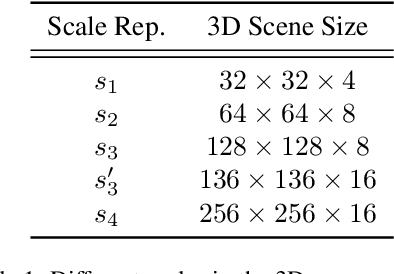
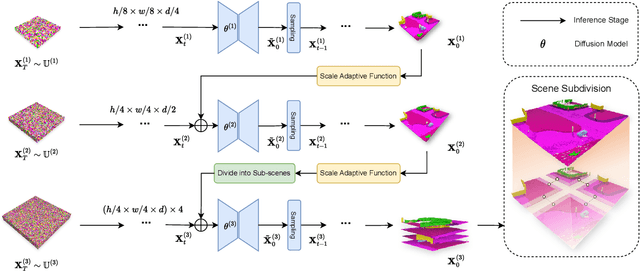
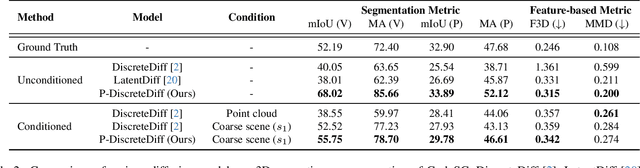
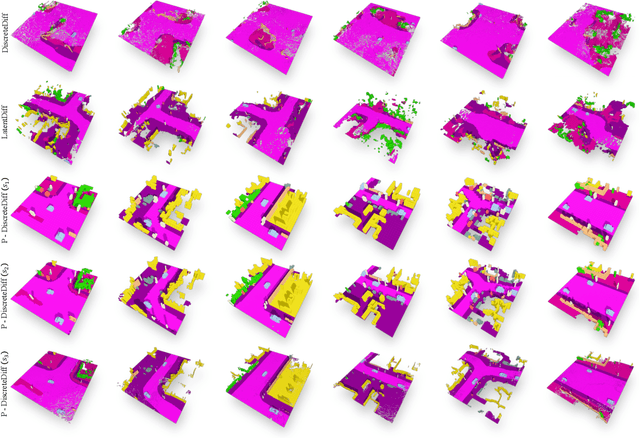
Directly transferring the 2D techniques to 3D scene generation is challenging due to significant resolution reduction and the scarcity of comprehensive real-world 3D scene datasets. To address these issues, our work introduces the Pyramid Discrete Diffusion model (PDD) for 3D scene generation. This novel approach employs a multi-scale model capable of progressively generating high-quality 3D scenes from coarse to fine. In this way, the PDD can generate high-quality scenes within limited resource constraints and does not require additional data sources. To the best of our knowledge, we are the first to adopt the simple but effective coarse-to-fine strategy for 3D large scene generation. Our experiments, covering both unconditional and conditional generation, have yielded impressive results, showcasing the model's effectiveness and robustness in generating realistic and detailed 3D scenes. Our code will be available to the public.