 Add to Chrome
 Add to Firefox
 Add to Edge
SDD-YOLO: A Small-Target Detection Framework for Ground-to-Air Anti-UAV Surveillance with Edge-Efficient Deployment
Mar 26, 2026
Detecting small unmanned aerial vehicles (UAVs) from a ground-to-air (G2A) perspective presents significant challenges, including extremely low pixel occupancy, cluttered aerial backgrounds, and strict real-time constraints. Existing YOLO-based detectors are primarily optimized for general object detection and often lack adequate feature resolution for sub-pixel targets, while introducing complexities during deployment. In this paper, we propose SDD-YOLO, a small-target detection framework tailored for G2A anti-UAV surveillance. To capture fine-grained spatial details critical for micro-targets, SDD-YOLO introduces a P2 high-resolution detection head operating at 4 times downsampling. Furthermore, we integrate the recent architectural advancements from YOLO26, including a DFL-free, NMS-free architecture for streamlined inference, and the MuSGD hybrid training strategy with ProgLoss and STAL, which substantially mitigates gradient oscillation on sparse small-target signals. To support our evaluation, we construct DroneSOD-30K, a large-scale G2A dataset comprising approximately 30,000 annotated images covering diverse meteorological conditions. Experiments demonstrate that SDD-YOLO-n achieves a mAP@0.5 of 86.0% on DroneSOD-30K, surpassing the YOLOv5n baseline by 7.8 percentage points. Extensive inference analysis shows our model attains 226 FPS on an NVIDIA RTX 5090 and 35 FPS on an Intel Xeon CPU, demonstrating exceptional efficiency for future edge deployment.

Skilled AI Agents for Embedded and IoT Systems Development
Mar 20, 2026Large language models (LLMs) and agentic systems have shown promise for automated software development, but applying them to hardware-in-the-loop (HIL) embedded and Internet-of-Things (IoT) systems remains challenging due to the tight coupling between software logic and physical hardware behavior. Code that compiles successfully may still fail when deployed on real devices because of timing constraints, peripheral initialization requirements, or hardware-specific behaviors. To address this challenge, we introduce a skills-based agentic framework for HIL embedded development together with IoT-SkillsBench, a benchmark designed to systematically evaluate AI agents in real embedded programming environments. IoT-SkillsBench spans three representative embedded platforms, 23 peripherals, and 42 tasks across three difficulty levels, where each task is evaluated under three agent configurations (no-skills, LLM-generated skills, and human-expert skills) and validated through real hardware execution. Across 378 hardware validated experiments, we show that concise human-expert skills with structured expert knowledge enable near-perfect success rates across platforms.
PrivAct: Internalizing Contextual Privacy Preservation via Multi-Agent Preference Training
Feb 14, 2026Large language model (LLM) agents are increasingly deployed in personalized tasks involving sensitive, context-dependent information, where privacy violations may arise in agents' action due to the implicitness of contextual privacy. Existing approaches rely on external, inference-time interventions which are brittle, scenario-specific, and may expand the privacy attack surface. We propose PrivAct, a contextual privacy-aware multi-agent learning framework that internalizes contextual privacy preservation directly into models' generation behavior for privacy-compliant agentic actions. By embedding privacy preferences into each agent, PrivAct enhances system-wide contextual integrity while achieving a more favorable privacy-helpfulness tradeoff. Experiments across multiple LLM backbones and benchmarks demonstrate consistent improvements in contextual privacy preservation, reducing leakage rates by up to 12.32% while maintaining comparable helpfulness, as well as zero-shot generalization and robustness across diverse multi-agent topologies. Code is available at https://github.com/chengyh23/PrivAct.
SniffySquad: Patchiness-Aware Gas Source Localization with Multi-Robot Collaboration
Nov 09, 2024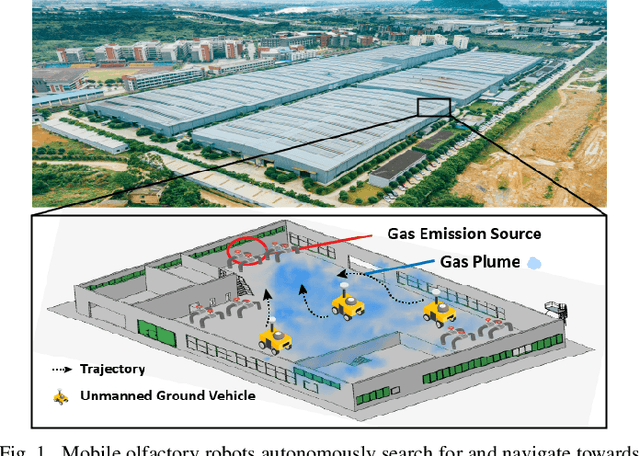
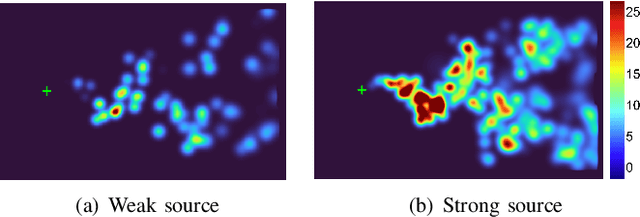
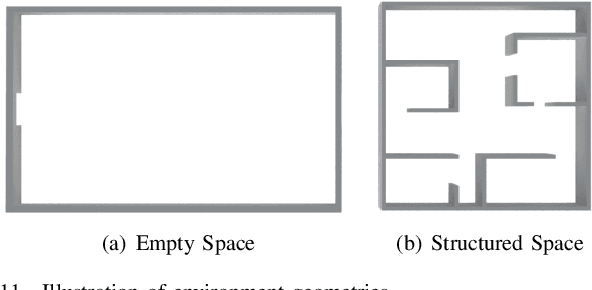
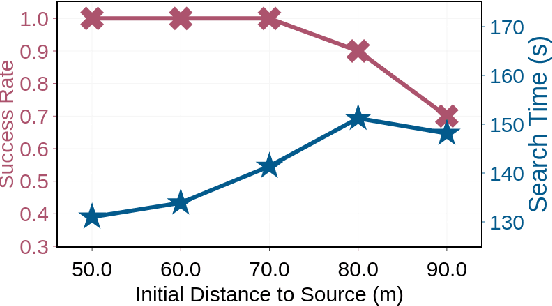
Gas source localization is pivotal for the rapid mitigation of gas leakage disasters, where mobile robots emerge as a promising solution. However, existing methods predominantly schedule robots' movements based on reactive stimuli or simplified gas plume models. These approaches typically excel in idealized, simulated environments but fall short in real-world gas environments characterized by their patchy distribution. In this work, we introduce SniffySquad, a multi-robot olfaction-based system designed to address the inherent patchiness in gas source localization. SniffySquad incorporates a patchiness-aware active sensing approach that enhances the quality of data collection and estimation. Moreover, it features an innovative collaborative role adaptation strategy to boost the efficiency of source-seeking endeavors. Extensive evaluations demonstrate that our system achieves an increase in the success rate by $20\%+$ and an improvement in path efficiency by $30\%+$, outperforming state-of-the-art gas source localization solutions.
Simulating Financial Market via Large Language Model based Agents
Jun 28, 2024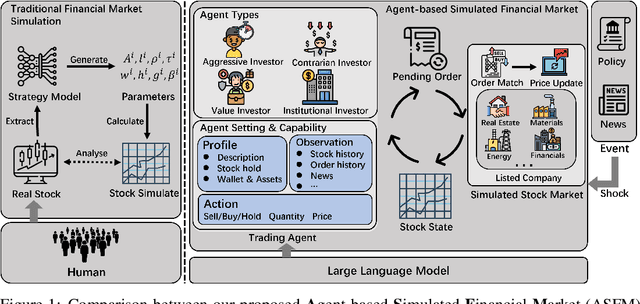


Most economic theories typically assume that financial market participants are fully rational individuals and use mathematical models to simulate human behavior in financial markets. However, human behavior is often not entirely rational and is challenging to predict accurately with mathematical models. In this paper, we propose \textbf{A}gent-based \textbf{S}imulated \textbf{F}inancial \textbf{M}arket (ASFM), which first constructs a simulated stock market with a real order matching system. Then, we propose a large language model based agent as the stock trader, which contains the profile, observation, and tool-learning based action module. The trading agent can comprehensively understand current market dynamics and financial policy information, and make decisions that align with their trading strategy. In the experiments, we first verify that the reactions of our ASFM are consistent with the real stock market in two controllable scenarios. In addition, we also conduct experiments in two popular economics research directions, and we find that conclusions drawn in our \model align with the preliminary findings in economics research. Based on these observations, we believe our proposed ASFM provides a new paradigm for economic research.
Towards Generalizable Diabetic Retinopathy Grading in Unseen Domains
Jul 21, 2023Diabetic Retinopathy (DR) is a common complication of diabetes and a leading cause of blindness worldwide. Early and accurate grading of its severity is crucial for disease management. Although deep learning has shown great potential for automated DR grading, its real-world deployment is still challenging due to distribution shifts among source and target domains, known as the domain generalization problem. Existing works have mainly attributed the performance degradation to limited domain shifts caused by simple visual discrepancies, which cannot handle complex real-world scenarios. Instead, we present preliminary evidence suggesting the existence of three-fold generalization issues: visual and degradation style shifts, diagnostic pattern diversity, and data imbalance. To tackle these issues, we propose a novel unified framework named Generalizable Diabetic Retinopathy Grading Network (GDRNet). GDRNet consists of three vital components: fundus visual-artifact augmentation (FundusAug), dynamic hybrid-supervised loss (DahLoss), and domain-class-aware re-balancing (DCR). FundusAug generates realistic augmented images via visual transformation and image degradation, while DahLoss jointly leverages pixel-level consistency and image-level semantics to capture the diverse diagnostic patterns and build generalizable feature representations. Moreover, DCR mitigates the data imbalance from a domain-class view and avoids undesired over-emphasis on rare domain-class pairs. Finally, we design a publicly available benchmark for fair evaluations. Extensive comparison experiments against advanced methods and exhaustive ablation studies demonstrate the effectiveness and generalization ability of GDRNet.