 Add to Chrome
 Add to Firefox
 Add to Edge
ResEdit: Residual embeddings for precise generative image editing
Jun 15, 2026
Conditional diffusion image generators can be repurposed for editing through inversion, without the need for large-scale paired fine-tuning data. However, producing high-quality, targeted edits while maintaining image identity and global consistency remains challenging, as weakly conditioned inversion often embeds conflicting image features into the noise. We demonstrate that incorporating a residual image encoding as additional conditioning enables both improved identity preservation and better editability. We optimize this residual encoding to provide a strong conditioning signal for reconstruction, thereby reducing the reliance on inversion and susceptibility to its aforementioned pitfalls. To ensure this residual does not interfere with desired edits, we incorporate a gradient reversal-based optimization strategy that disentangles the residual from the edited condition. We illustrate our method's ability to produce high-fidelity results across precise intrinsic-based editing and relighting, and show proof-of-concept text-guided manipulation.

MAOAM: Unified Object and Material Selection with Vision-Language Models
Jun 02, 2026Selection is a core operation in interactive image editing. To be practical, a user should be able to specify and disambiguate the desired selection region through either text or click-based interactions, and the system should support selecting not only objects but also other criteria, such as materials. Material-based selection is valuable for tasks like re-texturing surfaces or editing instances of a specific material. However, existing vision-language-model (VLM) based selection methods are object-centric and typically support a single interaction modality, limiting their applicability. In this work, we thus present Mask Any Object And Material (MAOAM), a unified selection framework that enables precise object and material-level selection across both text- and click-based interactions. MAOAM leverages a VLM with a segmentation head to produce pixel-accurate masks from user prompts: the VLM interprets the user's selection intent (object or material-level) and encodes visual entities, attributes, and spatial relations, while the segmentation head decodes the output token into a mask. A key challenge is the lack of material selection datasets with text annotations. We propose a scalable data generation pipeline: we collect real and synthetic images with material masks, and leverage VLMs to generate material descriptions with rich visual-semantics. We train MAOAM with a multi-task objective over click and text-based selection, along with an auxiliary VQA task derived from the material descriptions to facilitate deeper material understanding. Despite being trained with uni-modal prompts, our model exhibits an emergent improvement in selection when combining text and clicks at inference, enabling flexible image editing workflows. Experiments demonstrate accurate and coherent selections across diverse objects, materials, and interaction scenarios, highlighting robustness in practice.
Stochastic Ray Tracing for the Reconstruction of 3D Gaussian Splatting
Mar 24, 2026Ray-tracing-based 3D Gaussian splatting (3DGS) methods overcome the limitations of rasterization -- rigid pinhole camera assumptions, inaccurate shadows, and lack of native reflection or refraction -- but remain slower due to the cost of sorting all intersecting Gaussians along every ray. Moreover, existing ray-tracing methods still rely on rasterization-style approximations such as shadow mapping for relightable scenes, undermining the generality that ray tracing promises. We present a differentiable, sorting-free stochastic formulation for ray-traced 3DGS -- the first framework that uses stochastic ray tracing to both reconstruct and render standard and relightable 3DGS scenes. At its core is an unbiased Monte Carlo estimator for pixel-color gradients that evaluates only a small sampled subset of Gaussians per ray, bypassing the need for sorting. For standard 3DGS, our method matches the reconstruction quality and speed of rasterization-based 3DGS while substantially outperforming sorting-based ray tracing. For relightable 3DGS, the same stochastic estimator drives per-Gaussian shading with fully ray-traced shadow rays, delivering notably higher reconstruction fidelity than prior work.
V-RGBX: Video Editing with Accurate Controls over Intrinsic Properties
Dec 12, 2025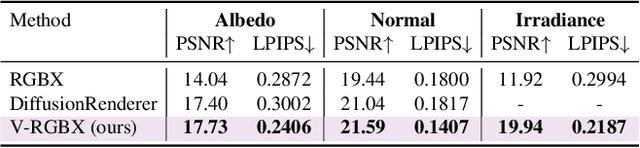
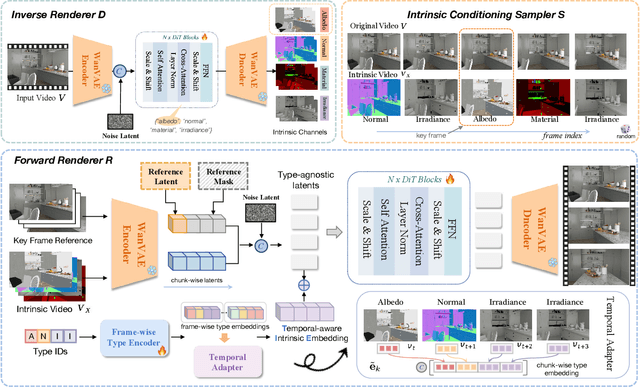
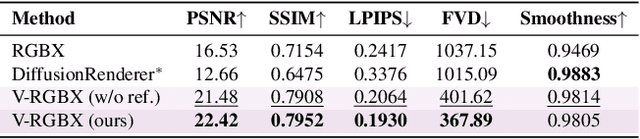
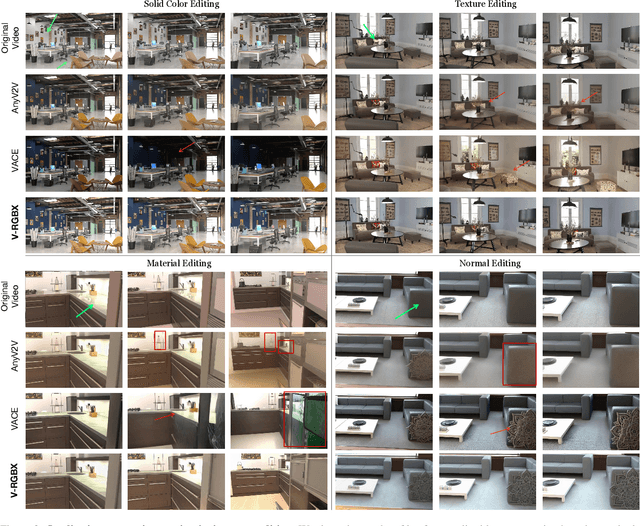
Large-scale video generation models have shown remarkable potential in modeling photorealistic appearance and lighting interactions in real-world scenes. However, a closed-loop framework that jointly understands intrinsic scene properties (e.g., albedo, normal, material, and irradiance), leverages them for video synthesis, and supports editable intrinsic representations remains unexplored. We present V-RGBX, the first end-to-end framework for intrinsic-aware video editing. V-RGBX unifies three key capabilities: (1) video inverse rendering into intrinsic channels, (2) photorealistic video synthesis from these intrinsic representations, and (3) keyframe-based video editing conditioned on intrinsic channels. At the core of V-RGBX is an interleaved conditioning mechanism that enables intuitive, physically grounded video editing through user-selected keyframes, supporting flexible manipulation of any intrinsic modality. Extensive qualitative and quantitative results show that V-RGBX produces temporally consistent, photorealistic videos while propagating keyframe edits across sequences in a physically plausible manner. We demonstrate its effectiveness in diverse applications, including object appearance editing and scene-level relighting, surpassing the performance of prior methods.
Fine-Grained Spatially Varying Material Selection in Images
Jun 11, 2025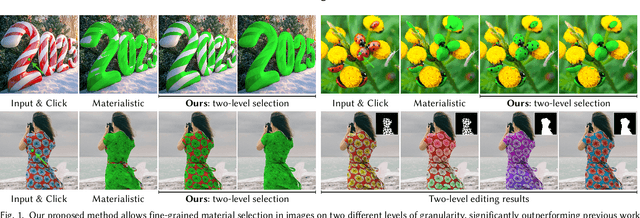
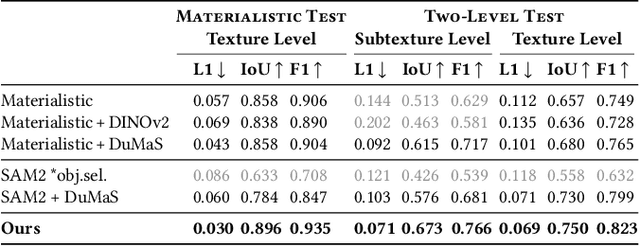
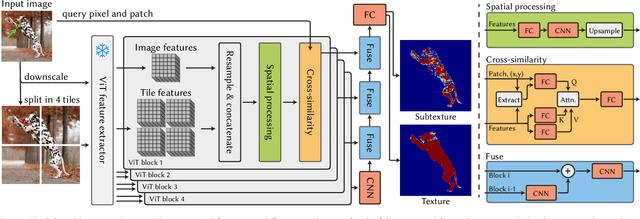
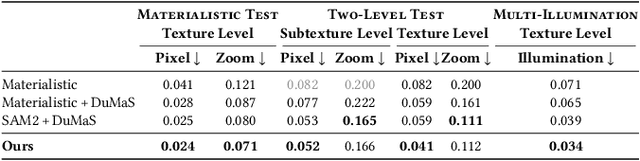
Selection is the first step in many image editing processes, enabling faster and simpler modifications of all pixels sharing a common modality. In this work, we present a method for material selection in images, robust to lighting and reflectance variations, which can be used for downstream editing tasks. We rely on vision transformer (ViT) models and leverage their features for selection, proposing a multi-resolution processing strategy that yields finer and more stable selection results than prior methods. Furthermore, we enable selection at two levels: texture and subtexture, leveraging a new two-level material selection (DuMaS) dataset which includes dense annotations for over 800,000 synthetic images, both on the texture and subtexture levels.
IntrinsicEdit: Precise generative image manipulation in intrinsic space
May 15, 2025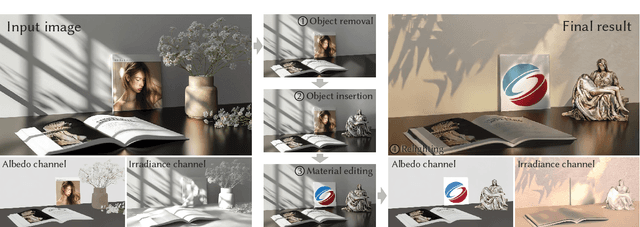
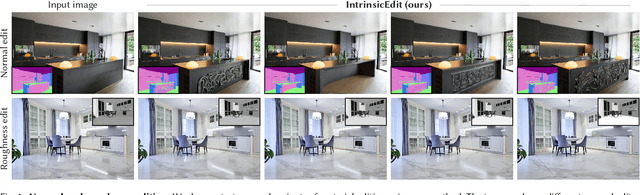
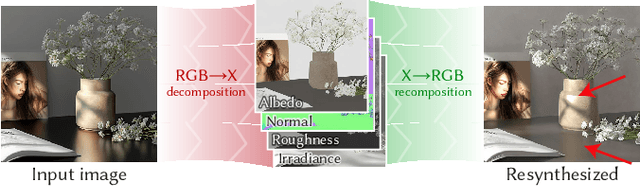
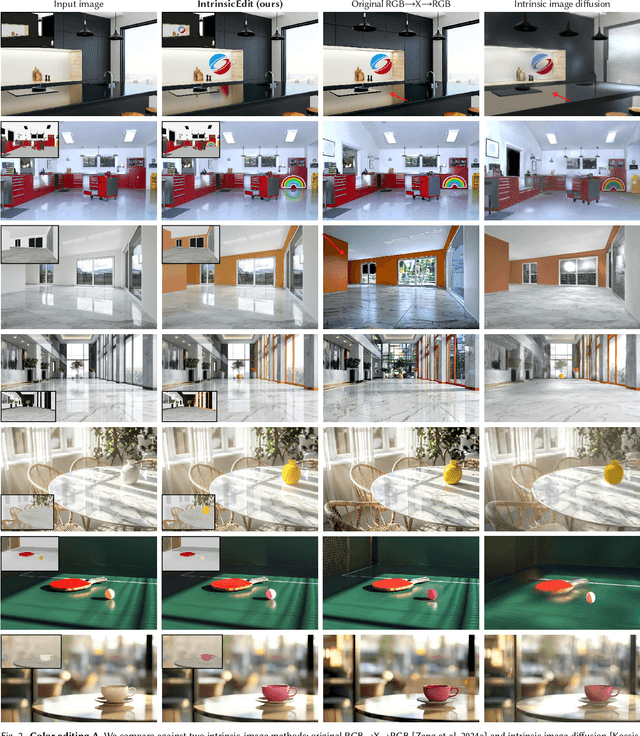
Generative diffusion models have advanced image editing with high-quality results and intuitive interfaces such as prompts and semantic drawing. However, these interfaces lack precise control, and the associated methods typically specialize on a single editing task. We introduce a versatile, generative workflow that operates in an intrinsic-image latent space, enabling semantic, local manipulation with pixel precision for a range of editing operations. Building atop the RGB-X diffusion framework, we address key challenges of identity preservation and intrinsic-channel entanglement. By incorporating exact diffusion inversion and disentangled channel manipulation, we enable precise, efficient editing with automatic resolution of global illumination effects -- all without additional data collection or model fine-tuning. We demonstrate state-of-the-art performance across a variety of tasks on complex images, including color and texture adjustments, object insertion and removal, global relighting, and their combinations.
Mean-Shift Distillation for Diffusion Mode Seeking
Feb 21, 2025We present mean-shift distillation, a novel diffusion distillation technique that provides a provably good proxy for the gradient of the diffusion output distribution. This is derived directly from mean-shift mode seeking on the distribution, and we show that its extrema are aligned with the modes. We further derive an efficient product distribution sampling procedure to evaluate the gradient. Our method is formulated as a drop-in replacement for score distillation sampling (SDS), requiring neither model retraining nor extensive modification of the sampling procedure. We show that it exhibits superior mode alignment as well as improved convergence in both synthetic and practical setups, yielding higher-fidelity results when applied to both text-to-image and text-to-3D applications with Stable Diffusion.
SAMa: Material-aware 3D Selection and Segmentation
Nov 28, 2024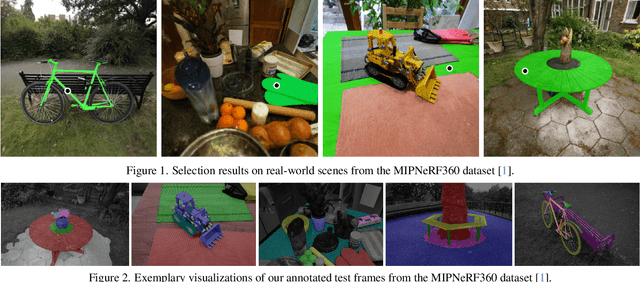
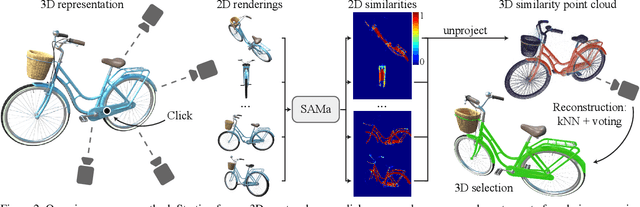
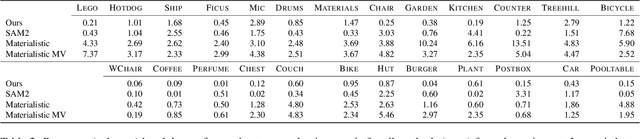
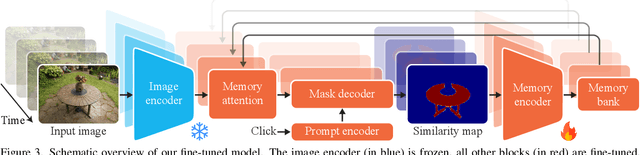
Decomposing 3D assets into material parts is a common task for artists and creators, yet remains a highly manual process. In this work, we introduce Select Any Material (SAMa), a material selection approach for various 3D representations. Building on the recently introduced SAM2 video selection model, we extend its capabilities to the material domain. We leverage the model's cross-view consistency to create a 3D-consistent intermediate material-similarity representation in the form of a point cloud from a sparse set of views. Nearest-neighbour lookups in this similarity cloud allow us to efficiently reconstruct accurate continuous selection masks over objects' surfaces that can be inspected from any view. Our method is multiview-consistent by design, alleviating the need for contrastive learning or feature-field pre-processing, and performs optimization-free selection in seconds. Our approach works on arbitrary 3D representations and outperforms several strong baselines in terms of selection accuracy and multiview consistency. It enables several compelling applications, such as replacing the diffuse-textured materials on a text-to-3D output, or selecting and editing materials on NeRFs and 3D-Gaussians.
PBIR-NIE: Glossy Object Capture under Non-Distant Lighting
Aug 13, 2024
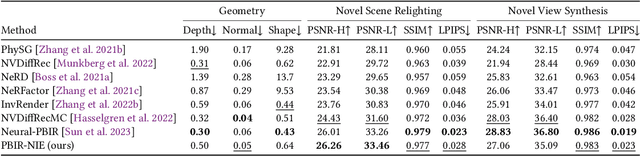


Glossy objects present a significant challenge for 3D reconstruction from multi-view input images under natural lighting. In this paper, we introduce PBIR-NIE, an inverse rendering framework designed to holistically capture the geometry, material attributes, and surrounding illumination of such objects. We propose a novel parallax-aware non-distant environment map as a lightweight and efficient lighting representation, accurately modeling the near-field background of the scene, which is commonly encountered in real-world capture setups. This feature allows our framework to accommodate complex parallax effects beyond the capabilities of standard infinite-distance environment maps. Our method optimizes an underlying signed distance field (SDF) through physics-based differentiable rendering, seamlessly connecting surface gradients between a triangle mesh and the SDF via neural implicit evolution (NIE). To address the intricacies of highly glossy BRDFs in differentiable rendering, we integrate the antithetic sampling algorithm to mitigate variance in the Monte Carlo gradient estimator. Consequently, our framework exhibits robust capabilities in handling glossy object reconstruction, showcasing superior quality in geometry, relighting, and material estimation.
Multiple importance sampling for stochastic gradient estimation
Jul 22, 2024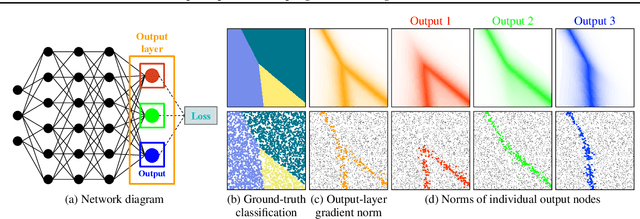


We introduce a theoretical and practical framework for efficient importance sampling of mini-batch samples for gradient estimation from single and multiple probability distributions. To handle noisy gradients, our framework dynamically evolves the importance distribution during training by utilizing a self-adaptive metric. Our framework combines multiple, diverse sampling distributions, each tailored to specific parameter gradients. This approach facilitates the importance sampling of vector-valued gradient estimation. Rather than naively combining multiple distributions, our framework involves optimally weighting data contribution across multiple distributions. This adapted combination of multiple importance yields superior gradient estimates, leading to faster training convergence. We demonstrate the effectiveness of our approach through empirical evaluations across a range of optimization tasks like classification and regression on both image and point cloud datasets.